Can authors make a living?

A lot of folks hear I’m going to be published and automatically classify me with J.K. Rowling, James Patterson, or Dan Brown. Heck, I at least ought to be categorized with Joe Schmo who was featured on Oprah.

And why shouldn’t they think that? Those are the authors they see. That’s what it means to them to be published.

For those of us who have actually gotten a peek behind the curtain, we realize it just ain’t so. Those are best-selling authors. See my post on best sellers to understand the quantities that have to move to make a best seller. Those are huge numbers, but very few authors sell that many books.

So what do you need to sell to make a living?  Let’s do some math.

Let’s say you want to make $50,000, the median household income in the US at this time. I know, I know, that’s nothing in some places, but if you’re a writer you don’t have to live in San Francisco. So you want to take home $50k after taxes. That means you’ll probably need to make $62,000 before taxes. That’s our goal.  

So here are some numbers with conservative royalties.

What authors make on a paperback
8% royalty (authors usually make 8 – 12 % on paperbacks)
15% agent fee
6.8% net royalty rate

To net $50k with only PAPERBACK sales would you need:
$911,765 in sales required in the year
$7.99 per book
114,113 books sold

What authors make on a hardback
10% royalty (it’s common to make 10-15%)
15% agent fee
8.5% net royalty rate

To net $50k with only HARDBACK sales would you need:
$729,412 in sales in the year
$25.00 per book
29,176 books sold

If you have previous books that are still selling, they all count. Make foreign sales, they count. Can produce two books per year, maybe one in a different genre, they count. Of course, this doesn’t factor in discounts and the corresponding reduced royalty rates. Nor does it factor in costs of being in business for yourself, including taxes, insurance, etc. But this is enough to get a rough idea of numbers.

100,000 paperbacks is a BIG number. However, you usually mix and match.

Let’s say you sell 5,000 hardbacks. 5,000 x $25.00 = $125,000. $125,000 x .085 net royalty = $10,625. $62,000 – $10,625 = $51,375 to be made by the paperbacks when they come out the next year. At a 6.8% net royalty rate you have to make $755,515 or sell about 94,558 paperback copies.

Here it is in an easy to read list. Given the hardback sales shown below, you’d have to make up the rest of the $62,000 with the paperback sales on the right.

5,000 HB: 94,558 PB
10,000 HB: 75,002 PB
15,000 HB: 55,446 PB
20,000 HB: 35,890 PB

I know those seem like small numbers compared to the Publisher’s Weekly 2007 numbers I link to above. But most authors don’t sell that many books. Most authors are happy to sell 5,000 hardbacks.

But it’s not all bad news. I looked at a few authors on the PW list comparing hardback and paperback numbers. It seems any given author will sell twice the number of paperbacks that they do hardbacks.  So perhaps selling somewhere between 15,000 to 20,000 hardbacks is the magic number.

20,000 hardbacks is a lot. But it seems doable for a writer who has been publishing for a few years. It’s not the 700,000 of  a James Patterson. But it just might be enough to make, hold your breath, what the average household in America makes in a year.

Share

Similar Posts

  • How to get and develop killer story ideas – recording

    The recording of the session with Larry Correia at LTUE is up on YouTube. I really enjoyed this session, and it’s always fun to work with Larry. A few additonal points.

    First, you might think, well, heck, they didn’t finish a story idea. No, we didn’t. The purpose wasn’t to wow the audience. It was to show them the process of generating ideas. But . . . that doesn’t mean we weren’t close.

    The big thing we’re missing from the story at the end is the situation, the problem. So if you want to extend this, ask yourself a question to help you identify that story core. For example, you might say, let’s narrow this down by genre. What genres could we use? Romance, political thriller, crime, horror, humor, scifi, western, paranormal, etc. If we select paranormal thriller, we limit our options (a good thing), and can start to generate ideas around a question like, what’s going on, what’s the problem? Potential answers:

    • There’s some gateway to the spirit world in Wyoming
    • Maybe there’s an oilrigger roughneck involved
    • Maybe something with the drilling disturbed something
    • Maybe a crime has been committed (I know, I know, but what did I say in the video about crap, cliche?)
    • Maybe that Japanese tourist has a way to capture the spirits and use them in some magic. Is he a wizard? Is he there to trap the spirits of the dead to fuel his magic? Did he get a nagging ghost that drives him nuts?
    • Did someone call him in?
    • Or is he possessed? An innocent bystander?
    • Is there some ghost there that knows something about a political figure, some information?  
    • Maybe someone who can project her spirit, has some power, has been kidnapped and is being held in Wyoming. Or tries to make her escape when her kidnappers stop in Rock Springs. And the guy to help her is the Japanese Tourist.
    • Maybe these aren’t ghosts, but some kind of alien symbiote? There was a crash somewhere and the locals were infected?
    • Or should I ask: what could go wrong with ghosts? Or what is the nature of ghost magic?  

    Do you see? If we had more time, we’d have delved more into the situation with creative Q&A. Sooner or later as we generated ideas around character, setting, and problem a story idea would have come to life.

    And (thank you, Mike Barker) here’s a transcript.

    Share
  • How much does author Jim C. Hines make?

    Dear But-All-Writers-Are-Rich,

    Jim C. Hines is a hard working midlist author with a couple of fun series out. Hines reveals what he makes in his post 2011 Writing Income. More importantly he reveals what he’s been making for a few years. For more information on advances etc., please peruse my page on Writing Business Facts & Figures.

    Sincerely,

    The Man

    Share
  • Revised version of “Key Conditions for Reader Suspense”

    Last year I published four very long essays on my site in a series called “The Key Conditions for Reader Suspense.”  The folks at SFWA (Science Fiction and Fantasy Writers of America) liked them and wanted to reprint them on their site. Of course, as I went through those essays I found things to revise and add. We published the revised essays in a twenty-seven part series. Read those more recent versions here.

    Share
  • |

    Killer Story Workshop to be held at CONduit

    I will conduct The 3 Things You Must Learn to Write Killer Stories workshop at CONduit this year. It’s being held at the downtown Raddison hotel. Here’s my schedule.

    Friday, May 22nd

    • Culture-Building in F&SF:  3:00  PM  (with Lee Modesitt, Roger White, Dave Wolverton, Elisabeth Waters, & Brandon Sanderson)
    • The 3 Things You Must Learn to Write Killer Stories Workshop: 8:00 pm – 10:00 pm

    Saturday, May 23rd

    • Mike Oberg asks questions from the audience: 4:00 PM (with Dave Wolverton, James Dashner, & Larry Correia)
    • Reading of Servant of a Dark God: 6:00 PM
    Share
  • |

    The Little Secret that Propels So Many Blockbuster Plots

    I was invited to present a master class at the 2022 StoryMakers conference in Provo, Utah.

    We all want to develop plots that delight readers. Maybe we have ideas for the characters. Maybe we have ideas for the setting. Maybe we even have a couple of scenes.

    But a novel needs 40, 50, 60 or more scenes.

    How do you figure out what happens next, and do it in a way readers love?

    There’s one tool that can help.

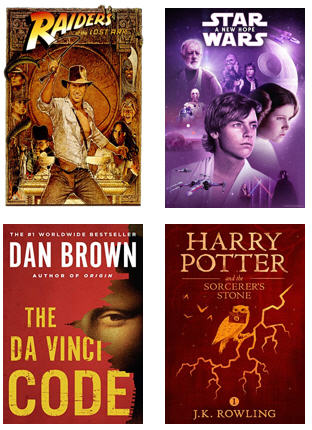
    Harry Potter, Lord of the Rings, and The Da Vinci Code all had it. So did Star Wars, Raider of the Lost Ark (1, 2, and 3), Taken, James Bond, The Wheel of Time, and thousands of other stories, TV episodes, and films.

    It’s what I call the wanted object, sometimes known as the MacGuffin.

    A good MacGuffin will not only make your plotting easier, it can also inject a wow factor into your story that readers love.

    In this session, the writers learned what a MacGuffin really is and how you can use it to propel the plot and keep readers turning the page.

    Here’s a PDF of the presentation.

    2022 john brown – the secret that propels so many blockbuster plots2

    And here’s the PDF of the handout.

    2022 john brown – the secret that propels so many blockbuster plots handout

    Enjoy!

    Share
  • |

    Story insights from the director of Pixar’s Up

    How would you like to listen to a master story teller for almost an hour? You can. Radio West recently interviewed Pete Docter who directed Pixar’s recent motion picture Up.

    Docter has been with Pixar since the beginning and he shares a number of insights into story telling. He talks about the importance of emotional hooks, getting ideas and developing them via the creative Q&A process, and editing a story from schlock to greatness, and much more. What a wonderful interview.

    Click here to listen.

    Share