1
The Three Things You Must Learn to Write Killer Stories
I LIVE UP in the hinterlands of Utah. And I mean hinterlands. The closest town has a whopping 248 residents, and I think the number’s that high only because they counted a few of the cows.
I’m surrounded by mountains, wide open vistas, and a number of ranches run by men and women who can often be seen riding horses as part of their jobs. Not long ago, after a fine church meeting, I was chatting with one of the ranchers that live here. He asked about my novels and what my latest project was. I described it to him, and then he looked at me, and with a little bit of wonder, said, “I don’t know how you do it. Coming up with all those ideas. I could no more do that than fly to the moon.”
I smiled and told him that was not true. I said people think writing is mystery. That it’s some special gift. But it’s not. It’s just like any other skill. The problem is that it’s not obvious what you need to learn to be successful at it.
“Oh, now,” he said, and I could tell he didn’t quite believe me.
And so I tried to relate it to his world. I told him I could no more fly to the moon than run a ranching operation like he did. There’s a massive amount of knowledge and skill that’s required to raise cattle and hay and run and maintain all the equipment. In their arena, these ranchers have more knowledge than any number of PhDs. But was it impossible to learn? Even if I couldn’t do it now, was it was possible for someone like me to learn it?
He agreed it was.
I said writing novels is no different. There are certain things you need to learn, and as you learn them you get better and better at it. The key is knowing what you need to learn and whether you are willing to put in the work to learn it.
But what are those things? Well, there are three of them. Three things you must learn to write killer stories:
- What a story is supposed to do.
- How the elements of story work together to do that.
- How to generate options for those elements until you find one that achieves your purpose.
I didn’t know any of this when I was first starting out. And that gap in my knowledge was one of the things that held me back for years. In fact, I almost gave up my dream of writing stories because of it. And that was even after I’d had some success.
After years of stumbling around, I wrote a story that won an award and $2,000. I was flown out to Cocoa Beach, Florida for a week-long writing workshop with amazing pros. And then I went home, finished another story, and proceeded not be able to finish another thing for five years.
Five years.
FIVE. FREAKING. YEARS!
And I tried.
After five years of failure you begin to wonder if maybe you were just gaslighting yourself. Your family begins to wonder that as well. You realize life is short and there are a lot of other things you could be spending your time on. You begin to think that only an idiot would spend more time on this. And you’d probably be right.
Unless, of course, you realize that what’s keeping you back isn’t a manifestation of cosmic will. Rather, it’s just a lack of understanding.
Except for some reason we don’t think of that. We don’t treat writing like we do ranching, or even math. Instead, we treat it as some kind of mysterious gift handed out to rare individuals at birth. But it’s not. It’s a skill that can be learned just like anything else. And to drive the point home I’m going to call out some of the myths we have about creativity so you can avoid them.
The Myths
Myth #1: To be Creative You Must Smolder
Some people imagine that you can only succeed at writing if you are the type that looks at life with a gaze of brooding and smoldering intensity. Such types wear brushed velvet jackets. They usually have rakish, devil-may-care hair. And if they’re male, they definitely have a beard.
When you look at such people, you feel the passion radiating off them in waves. Surely, their inner worlds are vast tempestuous seas of passion that send passionate ideas crashing in great surges onto the rocky beaches of their passionate souls. And those passionate forces cannot be contained. No, the artist must write them, write them, write them. They must channel those forces onto the written page because if they didn’t, they would surely drown.
Passionate intensity is the key to creativity.
Except, it isn’t.
Sure, you need to be excited about what you write (most of the time), but you don’t need to be Mr. or Ms. Smolder. You don’t need to wear brushed velvet jackets. I don’t know any that do. And you don’t need to walk around with an intense, brooding gaze. And while sometimes a gigawatt idea will come to you, I don’t know any authors that claim that channeling passion is the secret. What they report, and what I’ve found, is that it requires work.
Myth #2: If You Don’t Smolder, You Must, at the Very Least, be Eccentric
Fine, some say. Maybe passion isn’t necessary, but surely eccentricity is. You need to wear crazy beardage or sit in a big Alice-in-Wonderland chair with funky upholstery when you write. Or maybe, this theory of writing tells us, you can only succeed at writing if you are the type that wears purple pants. Or fancy hats. Or tattoos. Or rides a bike with a pet parrot clinging to the handlebars. Or whatever it is that you might think is eccentric.
But this too is false. Some of the best writers I know are accountants who wear accountant clothes. Others are frazzled moms. Others work in the military and wouldn’t be caught dead in purple pants (although many are okay with green).
Okay, fine, you say. But, surely, if nothing else, the hair can help.
Except there are too many New York Times bestselling authors who have no eccentric hair whatsoever. There are too many successes that wear regular pants and shirts, sometimes purchased from Walmart.
Myth #3: Fine, Then You Must Have a Certain Personality Type
I remember the day of woe when I took the Meyers-Briggs personality test and learned that I was an ENFJ, and then learned that the “natural” writers were supposedly all ISFPs.

The Meyers-Briggs Personality Grid of Doom
No wonder I couldn’t write! Me being a blockhead was all scientific.
Except this is bogus too.
How can I make such a claim? Because I know writers of all personality types who tell stories that readers love. They’re extroverts, introverts, detail-oriented, big-picture-oriented, eccentrics, regular Janes and Joes—you name it.
Writing success doesn’t have anything to do with personality type. Don’t forget: John Brown was the wrong personality type and yet still managed to figured it out. Hmm.
Myth #4: Okay, then You Need Certain DNA
This is the three-footed cousin to myths #1, #2, and #3. Sure, you need to have an IQ above that of a rutabaga. But if you meet that bar, you can learn to tell stories.
Another outrageous claim. How can I continue to make such statements?
This one is easy. My assertion rests on the fact that our brains are story-making machines. This is what cognitive science teaches us. Story making is part of what your brain does, every day. It’s how we survive. You are constantly making up stories about cause and effect. You are constantly putting yourselves in the other people’s shoes, which is why you can feel moments of sympathy, suspense, and joy while watching TV or the neighborhood kid down the street. It’s why you learn from the successes and failures of others. Furthermore, you regularly solve problems. Like getting child-proof lids off the tops of bottles. All of this is part of storytelling.
So if you’re a human, you’ve got the DNA. Not only that, it’s already turned on and working upstairs.
Myth #5: Then It’s Booze (or Weed or Vitamin Supplements)
Some people look at authors like Ernest Hemmingway, who liked his booze, or Lee Child, who it appears smokes whole bushes of marijuana when writing his books, and conclude that normal people can’t come up with ideas. They need chemicals to facilitate it.
Except chemical supplementation has nothing to do with it. How do I know? Because I know droves of successful writers who don’t use any.
Myths #6, #7, and #8
There are more of these ideas.
There’s the one that says in order to be creative you need to be mentally unstable like Vincent Van Gogh.
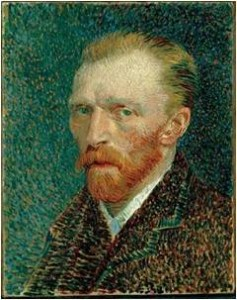
Van Gogh with stylish beard contemplating comments from his editor
Except, how many one-eared authors do you know?
There’s another that says creativity is obtained only as a gift from God.
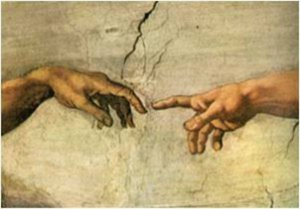
Adam languorously reaching out to touch the Almighty
Well, I guess in a sense this is right because God gave it to all of us—it’s in our DNA, remember? So you’re blessed too.
Or there’s the idea that to be creative you need to be born to it and manifest it at an early age. Like when you were six. And that if you’re over forty, fifty, or sixty, it’s impossible to learn.
But how does that theory square with the fact that all of these bestselling authors published their first books after they were fifty: Laura Ingalls Wilder, Raymond Chandler, Richard Adams, Frank McCourt, and John Flanagan (who was sixty when his first book was published). Truly, age doesn’t matter.
The bottom line is that all of the ideas above about creativity and writing ability are rubbish. Creativity has nothing to do eccentricity, gifts from Odin, or whether you wear Argyle socks.
What Creativity is Really About
Let me show you the face of creativity.

Warren, Creative Master
That is Warren Ellis. One day our fridge started to drip. The freezer would cycle through its normal thawing, and all the water would drip down into the fridge and soak up our egg cartons and pool in the vegetable crispers. It was a mess.
We defrosted the freezer we weren’t supposed to ever have to defrost, but the problem persisted. So we called Warren because he fixes things.
Warren came to our house, looked the fridge over. He declared that the freezer’s drain tube was plugged. We thought up a few ideas for cleaning it out, none of which were any good, then Warren asked if we had an air compressor. We did and hauled it in.
Warren plugged it in, let it build up the pressure, and then held the compressor nozzle to the bottom end of the tube. The compressed air went in. The obstruction flew up and out and landed on the counter. The obstruction was a fat fly that had crawled in there, gotten stuck, and died.
We poured a quart of water into that freezer, and it all flowed down into the catch pan at the bottom. Warren fixed our freezer with an air compressor.
What did Warren have? He didn’t have passionate hair. No. He had an objective. He knew basically how fridges worked. And he had some methods that helped him come up with a couple of options until he found one that fixed the issue. He knew the three things required for killer fridge fixes.
Let’s look at another example. Here’s Ed Smylie.

Ed, Creative Master
Ed was like Warren. He ran into some problems. Actually, the astronauts in Apollo 13 ran into some problems. They were running out of air.
The spacecraft had three modules—a lunar module for landing on the moon, a service module, and a command module which was also the capsule they used to re-enter Earth’s atmosphere and splash into the ocean. The problem was that the oxygen tank in the service module failed two days into the mission. With the oxygen in the service module gone, the only way to get the astronauts back was to move them to the lunar module. But it couldn’t filter the carbon dioxide that would build up in the air. To do that they had to move the square carbon dioxide filter cartridges from the command module to the lunar module and get them to work in a totally different system.
Ed and the others designed the solution in two days. The ground crew relayed the instructions to the flight crew. The lunar module’s CO2 scrubbers started working again, saving the lives of the three astronauts on board. Of the experience, Ed said that he knew the problem was solvable when it was confirmed that duct tape was on the spacecraft. “I felt like we were home free”, he said. “One thing a Southern boy will never say is: I don’t think duct tape will fix it.”
Ed and his crew saved the day. The made a round peg fit into a square hole. How did he come up with such a creative solution?
Ed had an objective. He knew how the CO2 scrubbers and the shuttle worked. He knew about duct tape. And he had some methods to come up with options until he found one that worked. He knew the three things for coming up with killer fixes to space capsule problems.
Creativity is built into our brains. Some solutions are brilliant. Others make you smile. Like the woman who fixed the broken sideview mirror on her minivan by attaching a large, purple-framed hand mirror to it with hair elastics.
Or the man whose toilet paper holder broke, and so he decided to do this.

A portable roll holder
Or the family who needed a latrine when they went out camping in the wilderness, but didn’t want to dig. And so they came up with a hitch-mountable, portable, redneck crapper dubbed the Bumper Dumper.

For those who want to tan while they toilet
What did all of these fine folks have? They had a goal. They knew the basics of how things worked. And they had some method that helped them come up with some solutions until they found one that did the job.
That’s all there is to creativity. Three things. Not so mystical, is it?
But I can hear some of you complaining. Writing is different. It’s a whole other world. It’s Fiction, which is so significant we must capitalize it. It’s passion. It’s mystical. It’s a matter of the dark recesses of the mind. It’s not a fridge or space ship or some dumb hotdog roast. You cannot compare these things.
Except I can because the process is the same. It doesn’t matter if you’re trying to adapt a recipe, decorate your house, come up with a way to keep the squirrels out of your bird feeders, or make people weep while watching a movie. You need to know three things:
- You need to have an idea of what you’re trying to accomplish.
- You need to have a basic knowledge of how things work in that arena.
- And you need to have methods that help you come up with potential solutions until you find one that does the job.
The problem is that new writers don’t know what they’re trying to accomplish, they don’t know how the parts of story work to accomplish those things, and they don’t have effective methods for coming up with potential solutions.
No wonder we conclude it’s a mystery.
But it just ain’t so. You’re a human. You have a brain. The type of brain that can come up with a redneck crapper. And that means you can write a story.
Now, it’s true that a lot of people feel their way through this. They don’t know what they’re doing and kind of woo-woo themselves into it. I did that, remember? I won an award. But then I couldn’t repeat it. Couldn’t find that groove I’d stumbled into.
However, if you’re like me, you don’t want to stumble around hoping to get lucky. You don’t want to write stories on accident. The good news is that you don’t have to. You can create terrific stories on purpose because there are principles to invention. When we learn them, our productivity shoots through the roof.
Finding a solution to Apollo 13’s issues might seem impossible to us. But it wasn’t impossible to Ed because Ed had an objective; he knew how things worked up there; and knew how to come up with potential solutions.
So let’s get you those same things for story. The first thing on the agenda is to learn is what it is you’re trying to accomplish. And it might not be what you think.