And Bad Penny is now available in audio
Here’s the link to Audible, and as soon as I get the link to iTunes, I’ll post it here. I think Naramore’s performance is going to please a lot of listeners.
Here’s the link to Audible, and as soon as I get the link to iTunes, I’ll post it here. I think Naramore’s performance is going to please a lot of listeners.
 LTUE has posted its schedule for the upcoming conference Thursday – Saturady, Feb 12-14. I’m, of course, stoked to present and participate on the panels. But I’m also looking forward to attending some of the sessions.
Look at this one: How a Military Unit Works in Real Life: Zachary Hill, Brook West, Robert J Defendi, C. R. Asay, Mike Kupari (m)
Or this one: All about armor: Zachary Hill, J. D. Raisor, Kay Mildenhall, Charles B. Stanford (m)
Or what about this one: Law Enforcement: James Ganiere, Zach Hill, Robin Ambrose (m), which conflicts with one of mine, dang it!
Or this: Making Creatures Realistic to their Environment: Keliana Tayler, Brian Hailes, Jessica Douglas, Bryan Beus (m)
This: Applied Biotechnology: Derrick William Dalton, Mikki Kells, Charlie Pulsipher, Chersti Nieveen, Ali Cross (m)
This: How to Create a Language: Maxwell Alexander Drake, Dirk Elzinga, Valerie Mechling, Samuel Stubbs, Bryce Moore (m)
And tons of others.
Oh, and what about the keynote address on Saturday by Toni Weisskopf?
It’s going to be a great conference. I’ll be giving these presentations.
I’ll also be moderating or participating on these panels:
Hope to see you there!
 A number of weeks ago life happened at my day job. I had just started a rewrite of the final battle of CURSE, but life put that on hold. Life got back to normal a few days ago. And a few days ago I began to work on that final battle sequence again. So you’ll notice that delivery targets have changed on the books page. I’m moving under a good head of steam now, and unless life happens again, we should meet those dates 🙂 More than anyone else, I want to get this book into your hands.
Holy schmoly, has this been a ride. I projected the CURSE OF A DARK GOD to be 140,000 words. When I blew by that, I projected it would be 170,000. Today I just typed the last word of the first draft. It’s 230,000 words. For reference SERVANT OF A DARK GOD is 170,000 words.
The bad news is that while I’m really happy with this draft, it IS a first draft and needs some editing. I’m also behind schedule. I hit 140k words just a few weeks after my original deadline (in March), so I pride myself on knowing how fast I can write, but at that point I had, unknowingly, about a normal novel’s worth of material left to write. Obviously, I haven’t quite figured out yet how to estimate the size of these bigger works. The problem is that instead of getting a month or even two to revise, I’ve got two days. Then I have to turn it in to my editors.
The good news is that my editors haven’t canned me, yet. 🙂 And that they have great insight into story. And that I should have plenty of time to fix and polish this thing to make it shine. I just don’t like turning in first drafts. My goal with book three is to get back on schedule.
Having told you my scheduling woes, I am very excited about the characters and storylines and expect readers to enjoy this as much or more than the first in the series. However, I do wish I could get this process down so that I was 99% of the way there in one draft. There are some authors who can do that. Perhaps that will come with more experience. Until then, I get to enjoy revision.
Here are my stats:
For those who don’t know, an average young adult book as from 40,000 to 80,000 words. An average adult novel is from 70,000 – 120,000 words. I’m very pleased I was able to finish this monster. I might not be the fastest writer, but what this tells me is that I should be able to finish two big novels a year if I should ever be so lucky as to go full time.
There are a thousand things to “remember” when writing story. New writers who make lists of these things soon begin to drown in them. But I’ve come to realize that many of these “rules” don’t matter.
They don’t matter because many ignore the function of story. And so you can’t know how and when to apply them, or if they’re even something you should apply in the first place. Furthermore, a good number that do tie back to function often have little impact.
The more I develop and write, the more I begin to see that the key is to focus on a liminted number of fundamentals. To focus on the things that matter most.
So what really matters when you’re writing a story?
I’m going to be speaking for an hour at the Book Academy tomorrow. It’s at Utah Valley University. The week after I’ll be presenting all day at the American Fork Arts Council’s autumn writer’s conference. I will probably write up all my thoughts and post them to my site at some time. But for right now this is where you can hear them.
I truly believe the Pareto Principle applies to writing. But you can’t go searching for those vital few factors until you know the effects they’re supposed to produce. Form follows function. And the function is something that happens in the reader.
Here’s a nibble. This quote from David Howard is an example of what I’m talking about.
“As we’ve seen, what the audience hopes for and what the characters hope for need not be the same thing. The same is true of our fears versus their fears. But how do hope and fear fit into the scheme of storytelling? Hope and fear are about the future. They derive from uncertaintly about future events in the story, future decisions the characters might make, future discoveries or revelations that might be unearthed, future outside forces and how they will influence the journey of the characters. When we discuss hope verusus fear in dramaturgical terms, this uncertainty is a function solely of the audience and its experience [my emphasis]. This is dramatic tension. We hope the man with the cobra in the shoe box won’t open the box; we fear he might and get himself or someone else bitten. We don’t know what will happen, but we know what might happen and therefore feel tension about those possibilities” (How to Build a Great Screenplay, 52).
Readers buy novels because novels provide a service. They provide something to the reader. They DO something to the reader. That’s why readers pay good money for them, and stay up late at night (well past smart bedtimes) with them, and spend hours of their lives reading them.
What do stories do? What are the key factors that have to be present in the stories for them to be able to do these things? How do you help readers hope and fear for what might happen?
I’m no story guru, but I do hope to share some of the vital few factors I see in the presentations I’ll be giving this week and next.
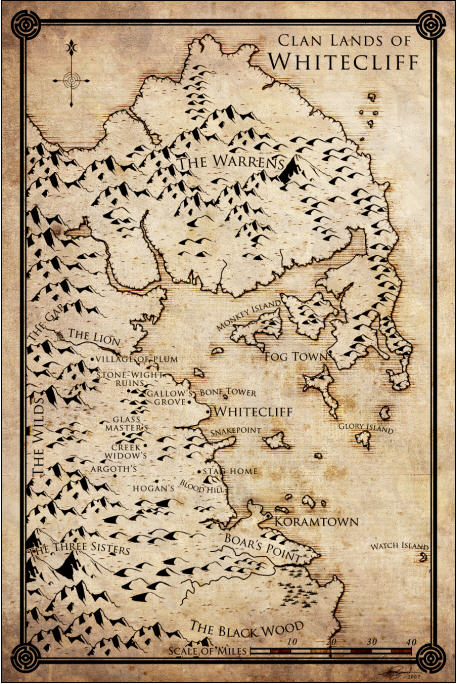
Check it out. “The Clan Lands of Whitecliff” by Isaac Stewart. I think he’s done a great job. Here’s the full PDF. BTW, this is not the map that will appear in the book. That one’s being done by another artist selected by Tor. This is one I commissioned when I got my book contract.
Gun Runner, the action-packed sci-fi novel I wrote with Larry Correia, comes out in February. But we already have copies.
And I’m happy to announce that this week you have a chance to WIN A STACK OF FIVE SIGNED SCI-FI AND FANTASY NOVELS that includes Gun Runner.
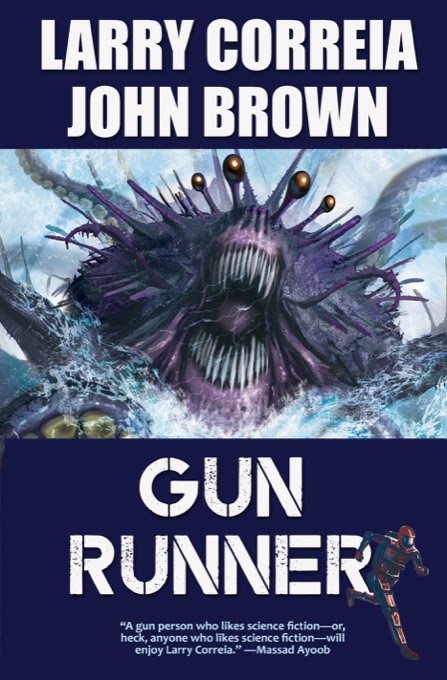
Even if you don’t win, you can still get copies at Uncle Hugo’s that were signed by both Larry and I! You can pre-order one now, and get it shipped to you as soon as they’re available in February.
Uncle Hugo’s is one of those rare indie bookshops that specializes and knows their customers. They’re the oldest independent science fiction bookstore in America.
Comments are closed.

🙁 no whisper sync
Yoo Hoo! Checked the sample @ audible -you are spot on: Mr. Naramore has a great reading style and voice; very engaging. I was sold. So i immediately got the book.
** The terrific reviews didn’t hurt any 🙂
As i’ve not read Bad Penny yet, I am looking forward to a great story -read to me- during breaks, lunch, at night, etc.
Thanks for continuing to keep us up-to-date re progress during this journey, John. Regards.
Awesome.
Hum. I’ll look into that.
Here’s Amazon’s statement on it.