book business

  • Is book marketing bad?

    At CONduit I spoke with an author friend who thought that marketing was indeed a bad thing, especially marketing for YA, because said author felt it didn’t build an audience based on the merits of the book. It built one based on hype and buzz.  Instead of buying a book because it delivered a wonderful experience, readers would be buying only because it was what everyone else was doing. Furthermore, publishers only have so much money, and by choosing to put the dollars behind some books, they choose to let other books, which might deliver a better experience, languish.

    I understand wanting to build a readership that’s based on love, not hype. But what I think my friend is overlooking is that you can’t love something if you don’t try it. And you won’t try it if you don’t know it’s there. Marketing and PR help make sure people know the book is there.

    Yes, some readers might try it the first time because it’s what everyone is doing. But if the book is really that good, i.e. it actually delivers a wonderful experience for the target audience, then those readers will come back for another serving. They might look initially because everyone else is, but they’ll stay for love.

    One of my editors just forwarded a link to “Not Quite a PR Campaign” by Sherry Thomas. Lots of interesting details there about what she does for PR, but probably one of the most important ideas she shares is the fact that marketing & PR don’t build an audience. A great story experience does that. However, marketing & PR can get the book in the audience’s hands.

    What we all want to happen is word-of-mouth. PR doesn’t really create word-of-mouth, love does. But readers won’t read a book until they know it exists. So then the point of a PR campaign, if a PR campaign has any point at all, is to create awareness and hope that awareness will translate into love, once a critical mass of readers have read and enjoyed your book.

    Readers may miss many high quality (i.e. they deliver a great experience to the intended audience) books because the lion’s share of the publisher’s marketing budget is being spent on a small group of books, and the author who gets the leftovers just doesn’t have the cash or know-how to do it themselves. But that doesn’t mean marketing is bad. It means that getting a big marketing push is like any other lucky break or opportunity.

    I just started reading Guide to Writing Fiction by Phillys A. Whitney (a huge seller in the 1970’s and 1980’s). It’s a wonderful, slim, down-to-earth volume. She opens the book with a chapter called “Opportunity is Like a Train.” She maintains that her success did not come from starting with loads of talent. In fact, she says her ability was “modest.” She certainly wasn’t as gifted as many other authors she’d worked with in the writing groups of her youth. Nor did it come from immediate initial success. It came from being ready when opportunity knocked. 

    Of course, I have been lucky. I’ve had extraordinary breaks come my way–along with some pretty bad blows and disappointments. There’s been bad luck too, but that doesn’t always show. Good fortune and unexpected opportunities are always coming along. Perhaps opportunity is like a train on an endless track. Now and then it makes a stop at your station, often without fanfare, and without warning.

    …What is important is not the lucky break, the stopping of the train–that’s only part of it. Life is full of trains that stop. What counts is what we are doing with our lives when there is no opportunity and not a train in sight.

    James Dashner is someone who is getting a big promo budget from Random House this year for Maze Runner. A very big one. But if you read his story about how he got published (links to all nine parts of the story are in his sidebar) and what got him to this point, you’ll see this promo train was a long time coming. 

    Meanwhile, if the big promo budget ever stops at my station, I’m going to hop on. Until then, I will keep writing the best stories I can and make my current marketing budget (part publisher, part mine) go as far as possible. I’ll do the one for the love, the other because I can’t share the love if nobody even knows it’s out there.
  • How readers select books

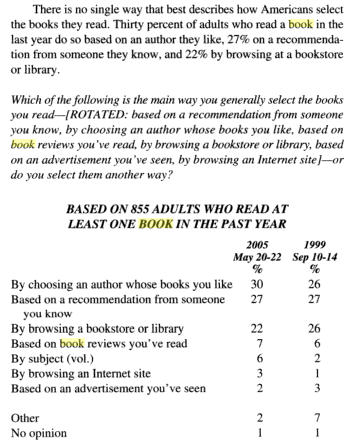
    Gallup did a poll in 2005 asking readers how they selected the books they read. Here are the results.

    gallup-poll-how-readers-select-books

    What this says to me as an author is that the most important thing I can do to help my career is write the best dang story I can, seeing that almost 60% of what readers select is driven by the experience they or someone else had with the book.

    The next most important factor has to do with helping my book stand out for browsers. This would include the cover, store placement, blurbs, flap text, and the opening pages. The only part of this an author can really focus on is the opening pages–again, writing the best dang story I can.

    So it seems authors, especially debut authors, can’t do much to affect sales. But not being able to do much doesn’t mean they can’t do anything. Somewhere, somehow the first readers have to be enticed to give the book a go. Robert Sawyer talks about some of the methods to do that here.

    EDIT: 4/8/2011

    Kris Rusch adds more information that confirms the findings of the poll above in “The Business Rusch: Promotion”. READ HER WHOLE ARTICLE. Notice she does concede that publishers can get some notice for a book. So there ARE things that can be done to make the offer. But I agree with her advice that the best thing to do is get more product out the door. The studies she cites are:

    2010 Survey of Book-buying Behavior by VERSO Advertising. The key conclusion on book-buying is that “Multiple factors impact consumer awareness of a particular title, but final purchase decision (online and offline) driven by author reputation, personal recommendations, and price.” If I were you, I’d read the whole presentation.

    # Reason % Respondents
    1 Author reputation 52%
    2 Personal recommendation 49%
    3 Price 45%
    4 Book reviews 37%
    5 Cover artwork/blurbs 22%
    6 Advertising (including on-line) 14%

    2007 Survey on what motivates readers to by a book by Spier Advertising, reported in Publishers Weekly

    # Reason % of Respondents
    1 Friend’s Recommendation 49%
    2 Familiarity with Author 45%
    3 Description on Jacket 32%
    4 Reviews 22%
    5 Advertisement 21%
    6 Place on bestsellers list 17%
    7 Reading group pick 16%
    8 Cover design 12%
  • Can you write for love AND money?

    Many artists think you can’t. And not simply because they envy those who are selling hundreds of thousands of copies.

    The reason they think this is for the simple fact that the creative process is fueled by following the zing. It’s ruled by passion. You have to care about AND believe in what you’re writing. You have to because if you think it’s boring or unbelivable, then it’s likely everyone else will as well. 

    For example, let’s say you are deeply bored by vampires, but see that vampire love stories are making piles of cash and decide to write about one with smoldering eyes and a bad habit of chewing tobacco even though it leads to dental problems with the fangs (hey, why would her man-toy care?), then you’re substituting passion (that which springs up from within) for graphs and plots about marektability (stuff that’s imposed from without).

    And so many folks think that there’s a continuum. On one end is writing for passion. On the other is writing for money. And the two don’t cross. But this is a false dichotomy. The truth is that money and passion are independent factors.

    Lon Prater, a writer friend, recently expressed it this way.

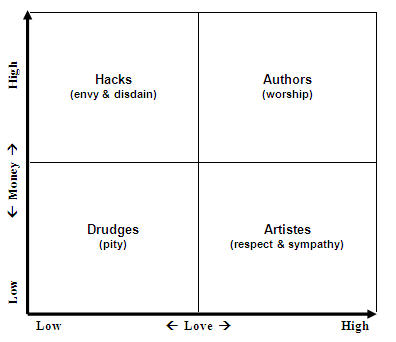
    Not a dichotomy, but rather an X and Y axis, the way I see it.

    There’s:

    low love, low money (SEO writing?)

    low love, high money (For me, this would be tech writing, or media tie-in to a universe I didn’t care about)

    high love, low money (unfortunately too much of my writing!)

    high love, high money. (Loftiest of goals) 🙂

    You can find datapoints for every quadrant, and of course “love” is highly subjective and individualized, as are what counts as low and high for each writer.

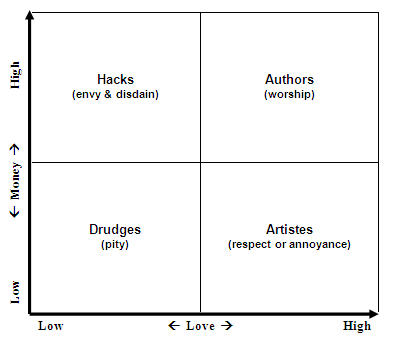
    If we put labels to the quadrants, we get something like this, along with common emotions they tend to evoke in other writers. (Although I will say that envy seems to want to run amok in the author quadrant as well.) 

    writer-love-and-money-quadrants2

  • Can authors make a living?

    A lot of folks hear I’m going to be published and automatically classify me with J.K. Rowling, James Patterson, or Dan Brown. Heck, I at least ought to be categorized with Joe Schmo who was featured on Oprah.

    And why shouldn’t they think that? Those are the authors they see. That’s what it means to them to be published.

    For those of us who have actually gotten a peek behind the curtain, we realize it just ain’t so. Those are best-selling authors. See my post on best sellers to understand the quantities that have to move to make a best seller. Those are huge numbers, but very few authors sell that many books.

    So what do you need to sell to make a living?  Let’s do some math.

    Let’s say you want to make $50,000, the median household income in the US at this time. I know, I know, that’s nothing in some places, but if you’re a writer you don’t have to live in San Francisco. So you want to take home $50k after taxes. That means you’ll probably need to make $62,000 before taxes. That’s our goal.  

    So here are some numbers with conservative royalties.

    What authors make on a paperback
    8% royalty (authors usually make 8 – 12 % on paperbacks)
    15% agent fee
    6.8% net royalty rate

    To net $50k with only PAPERBACK sales would you need:
    $911,765 in sales required in the year
    $7.99 per book
    114,113 books sold

    What authors make on a hardback
    10% royalty (it’s common to make 10-15%)
    15% agent fee
    8.5% net royalty rate

    To net $50k with only HARDBACK sales would you need:
    $729,412 in sales in the year
    $25.00 per book
    29,176 books sold

    If you have previous books that are still selling, they all count. Make foreign sales, they count. Can produce two books per year, maybe one in a different genre, they count. Of course, this doesn’t factor in discounts and the corresponding reduced royalty rates. Nor does it factor in costs of being in business for yourself, including taxes, insurance, etc. But this is enough to get a rough idea of numbers.

    100,000 paperbacks is a BIG number. However, you usually mix and match.

    Let’s say you sell 5,000 hardbacks. 5,000 x $25.00 = $125,000. $125,000 x .085 net royalty = $10,625. $62,000 – $10,625 = $51,375 to be made by the paperbacks when they come out the next year. At a 6.8% net royalty rate you have to make $755,515 or sell about 94,558 paperback copies.

    Here it is in an easy to read list. Given the hardback sales shown below, you’d have to make up the rest of the $62,000 with the paperback sales on the right.

    5,000 HB: 94,558 PB
    10,000 HB: 75,002 PB
    15,000 HB: 55,446 PB
    20,000 HB: 35,890 PB

    I know those seem like small numbers compared to the Publisher’s Weekly 2007 numbers I link to above. But most authors don’t sell that many books. Most authors are happy to sell 5,000 hardbacks.

    But it’s not all bad news. I looked at a few authors on the PW list comparing hardback and paperback numbers. It seems any given author will sell twice the number of paperbacks that they do hardbacks.  So perhaps selling somewhere between 15,000 to 20,000 hardbacks is the magic number.

    20,000 hardbacks is a lot. But it seems doable for a writer who has been publishing for a few years. It’s not the 700,000 of  a James Patterson. But it just might be enough to make, hold your breath, what the average household in America makes in a year.