Some lessons from Tom Clancy’s first novel

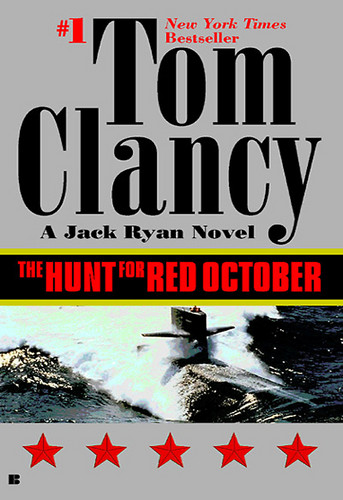
tom-clancy-the-hunt-for-red-octoberTom Clancy is one of the biggest authors of our time. How did he break in? It’s an interesting story that Deborah Grosvenor, the editor who acquired The Hunt for Red October (Clancy’s first book), tells here.

And this early interview provides more insights.

So what conclusions can you draw from this? Here’s what I picked up.

1. Writing a good book is one thing. That book finding success is quite another.

2. Endorsements from the right people make a huge difference. More here in my blog Is Product Popularity Random?

3. Know what you write. And if you don’t know it, do the research. And then invent what you have to.

4. It’s not always a bad thing to start with a small press, especially if they’re going to put as much $$ into marketing and PR as this one did.

5. To finish your novel, you’re going to have to set aside time and get it done.

6. Finally, follow the zing. Clancy loved this stuff. Notice how his book was fed by the stories he heard and read.

Share

Similar Posts

  • Indie Thoughts: Resources for Indie Writers

    About this time last year I got the last of my rights back to the Dark God properties. I thought it would take twenty or thirty hours to figure out the whole indie publishing thing. And then the awesome John Brown story machine would kick in gear.

    Reality promptly woke me up and slapped me around a bit. This last year has been quite the learning curve. Here’s what I’ve had to pick up:

    • Designing book covers
    • Finding artists
    • Working with artists in a way that actually works
    • Copy editing
    • Formatting book interiors
    • Fonts, fonts, fonts
    • Using ISBNs
    • Using InDesign to create files for both POD books and epubs
    • eBook structure
    • Editing ebooks (okay, just get Calibre ebook editor right now. We luvs it, Precious)
    • Validating ebooks (http://validator.idpf.org/)
    • Converting epubs to Amazon’s mobi format
    • Uploading ebooks to the various ebook retailers: Amazon, NookPress, Kobo, iTunes (I upload via Draft2Digital), Smashwords
    • The pros and cons of CreateSpace vs Lightning Source
    • Using CreateSpace to publish POD books
    • Registering books with the US Copyright Office
    • Writing better book descriptions
    • Using keywords and categories on Amazon
    • Setting prices in the indie market
    • Creating an email list (I love MailChimp. They make me happy every time I go to their site)
    • Advertising and promoting as an indie

    One of the things I love about this business is that there is always more to learn. But I’m happy to be over that curve. For folks just starting out, let me share some of the resources I found super helpful with a number of the things listed above.

    Posts by a mega indie-seller Russell Blake to give you the right perspective about indie publishing. I’ve read a lot of posts the last few years about being an indie author. These are the best I’ve come across.

    Online courses to help you on the publishing side.

    • Designing Book Covers and Designing Book Interiors with Dean Wesley Smith (look for “Online Workshops”). I don’t agree with Dean on all his ideas about pricing and promotion, but these two courses helped a great deal.
    • InDesign CS6 to EPUB, Kindle, and iPad with Anne-Marie Concepción at Lynda.com. Awesome.

    The most practical and clear-headed books about indie promotion I’ve read. For other clear-headed advice, see the Russell Blake posts above.

    The most helpful book on copyright.

    The most helpful book on copy editing as well as info to put into front and back matter.

    Helpful threads on Kindle boards

    Other great resources

    Good luck!

    Share
  • Generating Story 9: Creative Q&A with Author Ian Creasey

    So how do writers use questions in their story development? Let’s hear first from Ian Creasey, whose short fiction has appeared in magazines such as Asimov’s, Realms of Fantasy and Weird Tales, and has been reprinted in several Year’s Best SF anthologies.  His excellent collection Maps of the Edge was published last year. 

    Stories Are Made Of Scenes

     by Ian Creasey

    I’d like to begin by thanking John for the opportunity to write a guest post about the technique of using questions to help create stories.  This is not a “where do you get your ideas?” post.  Rather, it assumes that you already have a basic idea, which you want to develop into a complete story.

    I’ll use one of my own stories to illustrate how the question technique works in practice.  The questions themselves are sufficiently general that they can be applied across a whole range of stories.  What tends to change is the order in which they are asked.  I find that stories sometimes start from an idea for a specific detail, in which case the process involves working backwards to develop the appropriate context.  In other cases, the initial idea is rather abstract, and the task is to flesh out the premise with sufficient detail.

    My example story is “The Report of a Doubtful Creature”, which was published in Orson Scott Card’s InterGalactic Medicine Show (November 2009).  I mention the publication date, because this was actually the seed for the story.  The year 2009 marked the bicentenary of Charles Darwin’s birth, and also the 150th anniversary of the publication of Origin of Species.  I live near the Yorkshire town of Ilkley, which Charles Darwin visited just before the first edition of Origin was published.  I therefore decided to write a story about Darwin’s visit to Ilkley, with the aim of getting it published in November 2009, exactly 150 years after the first edition of Origin of Species in November 1859. 

    So I had a story I wanted to write, without any notion of what its plot might be.  The technique of asking questions helped me to shape the story, and I’ll list some of those questions here. 

    Who is the story about?

    For my particular story, the answer is already in the premise: it’s about Charles Darwin.  But other times, it’s not immediately obvious who a story might be about — for instance, if the initial idea is to explore a technological or social development, then there is a wide range of people who might be affected.  In this case the standard advice is to ask, “Who is the most hurt by this development?  Who has the most to lose?”  That person is often a suitable protagonist (or antagonist) for the story.

    What is the story about?

    In this example, it’s fairly obvious that the story has to be about evolution.  There’s not much point in writing a story targeted for the anniversary of the Origin of Species, if it’s not about evolution!

    What is the conflict?

    The Origin of Species is a famously controversial book, symbolising a clear conflict between science and faith.

    Wow… so far it looks easy, doesn’t it?  It may appear that I’ve cheated by starting with several questions to which I already know the answer.  But in fact I’m illustrating the point that if you have the germ of an idea for a story, then there are already some questions and answers implicit in your premise, no matter how vague it may initially seem to be.  It can be useful to state these answers explicitly, to help crystallise the starting position.

    What is the specific example?

    This is what John calls a “power question”, a key question that can be widely applied, and which cuts right through to the essentials.  The question “what is the specific example?” can be asked in many contexts (e.g. in considering how to show characterisation), but I find it particularly useful when framed as, “How does the conflict manifest itself?”

    This isn’t mathematics: there’s no right or wrong answer.  But you need some kind of answer.  It’s a classic beginner’s mistake to write a story entirely in abstract terms: telling the reader about the conflict, without showing it.  Stories are made of scenes.  There should be at least one scene which dramatises the overarching conflict by putting a specific example onstage.

    A short story will typically hinge upon a single scene that illustrates the core of the conflict.  A novella or novel may require more instances, e.g. a small-scale scene near the beginning, and a large-scale scene toward the end.  But the principle of needing specific examples still applies.

    If I say that I’m going to write a story about evolution, and the conflict between science and faith, I’m speaking in general terms.  I need a specific example.  The device I chose was to have Darwin encounter a strange creature, which might possibly be a fairy.

    What are the stakes?

    This is another “power question”.  It’s a way of saying, “Why does this story matter?  Why should the reader care?”

    There are different ways of addressing the question, depending on whether you develop the story on a top-down or bottom-up basis.  If you start from specific details, then you may need to establish that those details represent important issues.  Conversely, if you start from the big issues, then you need to establish that your illustrative details are sufficiently representative.

    For my story, the question of evolution (i.e. science vs. faith) is already a high-stakes issue.  So the crucial task was to establish that my specific example adequately represented the issue.  Basically, if fairies exist — so what?  Why would that affect evolution?

    Here is the answer from the story, in Darwin’s words:

    “My theory of natural selection requires that life proceeds by common descent.  All creatures are related, however distantly.  So any particular creature must possess living relatives, of some kind; and ancestral forms should be preserved as fossils.  Any beast, however unprecedented to man’s eyes, must fit somewhere within the Linnaean taxonomy.

    “If fairies exist as material creatures, what genus do they occupy?  Where are their fossils?  (The fossiliferous strata contain an imperfect sample of past organisms, yet surely we could hope for one example to be retained from the entire fairy lineage.)  If the traditional description be correct — like a small man with wings — it is clear that fairies cannot fit anywhere within the existing genera of Mammalia.  We could only accommodate them within Animalia by supposing an entirely separate line of descent, one which has left no close relatives, no intermediate forms, and no fossils.  The evidence does not support it.

    “It would be simpler, therefore, to suppose that fairies were a separate creation.  After all, why should we require all creatures to be related?

    “We indeed require it, for if we allow that any creature may be a separate creation, then we must allow the possibility to all creatures.  How could I argue that a wolf must have descended from canid predecessors, if I cannot argue likewise for a fairy?  Any opponent could simply say, ‘The wolf was independently created in its current form, just like a fairy.’  I would have no refutation for such a critique.  Even those who accepted the Wolf might balk at the descent of Man from simpler progenitors, if given the excuse of the Fairy.

    “My hypothesis must explain all creatures, or it explains none.  Everything, or nothing.  The thought burned in my mind: If this fairy truly exists, it will destroy my whole Theory.”

    What choice does the protagonist face?

    This is another “power question”.  A story tends to feel more meaningful if the protagonist faces a genuine choice — a difficult decision.  The nature of the choice obviously depends upon the overall conflict, but its onstage manifestation is determined by the specific example that illustrates the conflict.  So when deciding upon an example, it’s helpful to bear in mind the choice that the example implies.

    In my story, what choice did Darwin face when he encountered the fairy?

    “A thought struck me that it would be simple to let the creature escape, thus avoiding the revelation of what it might be, and what it might imply.  The temptation seemed to hang in the air before me, needing but a single step to reach out and grasp.”

    Where does the encounter happen?

    Once the specific example has been selected, and its importance has been established, our questions move to the realm of practicalities.  We must decide how the example is “staged”.

    Stories are made of scenes.  The scene begins when the protagonist encounters the situation, whatever the situation is.  So the author’s task is to decide where and when that encounter takes place.

    For my story, I needed Darwin to see a fairy.  How could that happen?  Maybe he goes out for a walk, and simply happens to see one.  But that feels rather coincidental: too obviously contrived by the author.  Also, at the time the story takes place, Darwin is ill: he’s in Ilkley to take the “water cure”.  So he’s not likely to be wandering very far.

    I decided to introduce a secondary character: a woman who had captured the fairy.  She knew that Darwin was a famous naturalist, so she asked him to come and see it.

    It’s important for a short story to remain focused, and not become cluttered with too many characters.  It’s dangerous to answer every question by introducing a new character.  But in this particular case, it was a useful solution.  I started off with only a protagonist, Darwin.  He didn’t have anyone to interact with.  By introducing a secondary character, I allowed myself scope for dialogue, interaction, and contrast.

    Conclusion

    I’ve deliberately ended this post on an anti-climactic note, because although stories conclude with a climax, this doesn’t mean that the climax is the last thing you work out when writing it.  Personally I find it easier to begin by shaping the overall structure of a story, including the ending, before I work out all the nitty-gritty staging details.

    The questions that I’ve listed here are, obviously, not exhaustive.  But I hope they give an indication of how an abstract idea can be turned into a detailed narrative.  In my opinion the most important thing to remember is this: Stories are made of scenes.  The most useful questions are those which help you envisage a particular scene.  Once you can imagine the scene in your head, half the task of writing it is already done.

    John sez . . .

    So are you curious about his story yet?  If so, “The Report of a Doubtful Creature” is available to IGMS subscribers at http://www.intergalacticmedicineshow.com/cgi-bin/mag.cgi?do=issue&vol=i15&article=_003 . You can also learn more about Ian and his work at www.iancreasey.com.

    I’d like to thank Ian for taking the time to write up his process on this story. I though he made a number of interesing points. Did you notice what he said about envisioning scenes? Did you see that at least one of his questions is particular to this story and might not be used on any other?

    Understand the core principles. Get a list of core questions. But then realize you’ll need to use creative Q&A as you go with all sorts of questions, large and small.

    For more in this series, see How to Get and Develop Story Ideas
    Share
  • | |

    Teachers (and writers)! Free Class Next Monday on How to Teach Narrative for the Common Core

    If you feel a bit lost or anxious about how to teach narrative for the new core, especially stories, I think I can help.

    I’m an educator in the private sector and an award-winning novelist and short story writer. I’ve been teaching authors in various venues how to write for the last five years. I’ve been on writing podcasts with thousands of listeners, taught at a number of writers conventions, and had a series of articles published by the national Science Fiction and Fantasy Writers of America organization, an organization for professional authors. I’ve also been helping Nellie, my wonderful wife, teach her 7th and 8th grade language arts students the unit on short stories during that same period. We’ve taught it to twenty different classes and picked up a number of important insights along the way.

    This last year I couldn’t help but examine all the materials Nellie brought home during the district’s writing program adoption investigations. Some programs looked very promising; others not so much. Some got some things about writing flat out wrong. Most of the programs had gaps.

    Furthermore, because I work with so many people wanting to write, I know that it’s difficult to teach if you really don’t understand what stories really are and how they work. For lots of people, the subject matter can seem impenetrable. And yet writing stories is such a wonderful way to teach writing, especially because so many kids love it. You won’t find a kid who will spend extra hours writing a business letter or poem analysis, but you will find quite a few who will go crazy writing stories. And the whole time they’re practicing their writing skills.

    The question is how DO you write a story?

    What is a story?

    How can you tell if it’s good?

    How do you come up with ideas?

    Where do you start?

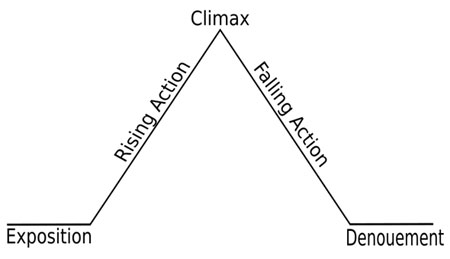
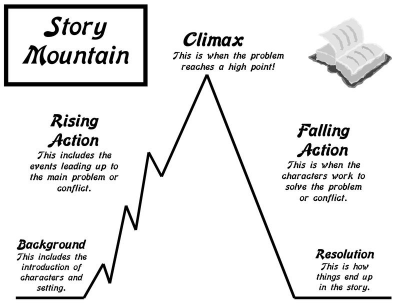
    And what the heck is this chart? Do writers really use this? (Not many that I know.)

    Story Diagram plot-mountain-pic

    And does anyone think changing the diagram to look like Aspen, Colorado actually helps?

    Story Diagram Aspen 

    Hey, students—please make your story look like Aspen, Colorado!  (Yeah, that’s going to be effective.)

    And yet it’s not as difficult as it appears. Nellie and I have seen a lot of kids really get into writing stories. We’ve seen kids WILLINGLY going way beyond the assignment to write stories that are eight, twelve, twenty-five plus pages. And as they’re writing, they’re practicing grammar, spelling, structure, vocabulary, etc. without knowing it and having a great time. I know that if you enable your students, many of them will write, write, write. Especially in grade school. But also in the higher grades.

    Stories can be a blast. The assignments can connect to many students. And the results can be wonderful. I’ve laughed out loud at some of the stories coming out of Nellie’s class. Others have been enjoyable on other levels.

    But for this to work in your class, you need to know some key things. You need to understand the core of story and the story development process. You need a lesson plan that details everything step-by-step so your students don’t flounder. And you need to know some fundamental tips (secrets?) about teaching this content.

    So I’m going to hold this day-long class for you. A full eight hours. And share everything Nellie and I have learned. This class will be for teachers at ALL levels (I’ll show you some ways to scale the complexity of what you’re doing). There will be NO cost. The only thing you have to bring is a pencil, paper, whatever program materials you have, and a willingness to have a good time.

    When we finish, you will know how to write a simple story like the ones your students will write because, ta-dum, you will write one! AND you’ll have a step-by-step lesson plan that builds on whatever materials you have—an official program or one of your own. AND you’ll understand story better than 99% of the population. AND you’ll have a bundle of techniques to help your students. AND you’ll solve both world peace and maybe the lost sock conundrum.

    Truly, I think that instead of feeling stress, you’ll actually be looking forward to teaching and writing stories with your students. If not, you may bring tomatoes and huck them at me, but please be aware that I will not stand still; to find satisfaction, you will have to be able to hit a moving target.

    If you’re interested, just click the Contact John link under my photo in the left sidebar and send me an email letting me know.

    Hope to see you in class!

    GET READY FOR A FUN DAY OF LEARNING!

    Topic: Teaching writing (narrative & the common core)

    Who: Teachers (and writers at least 18 years old), seats are limited

    When: Monday, July 29th, 8:15 AM – 5:00 PM

    Where: Rich Middle School, 54 E 100 S  Laketown, UT 84038

    Materials you need to bring:

    • Pencil
    • Paper
    • The writing program you’ll be using this year
    • Kooky socks, for those who cannot resist the urge
    • A lunch or a way to get one

    AGENDA

    8:15 AM Arrive

    8:30 AM – 9:20 AM

    • Can you create a redneck crapper?
    • The 1st secret to teaching writing: Attributes & techniques
    • The 5 parts of story
    • Thieves prosper – using existing patterns
    • A car, a beggar, and an idiot — basic pattern 1

    9:30 AM – 10:20 AM

    • The 2nd secret to teaching writing: Do it with them
    • Technique: Sketch then draft
    • Workshop 1: Zombies and kisses
    • Technique: Zing hunting
    • Workshop 2: Hunt zing

    10:30 – 11:20

    • What makes a story big or small
    • Workshop 3: Select a right-sized THOM and character
    • Workshop 4: Select a Goal
    • Workshop 5: Make character sympathetic
    • Workshop 6: 3 tries
    • Workshop 7: Resolution

    LUNCH

    12:00 – 12:50

    • The 3rd secret to teaching writing: Cognitive modeling and the 6-step process
    • The 4th secret to teaching writing: Our tiny brains
    • Writing is telling: Narrative & description
    • Technique: Yes, SiR
    • Technique: Broad-brush + 1
    • Technique: The Pause

    1:00 – 1:50

    • The 5th secret to teaching writing: Have fun
    • Workshop 8: Write your story

    2:00  – 2:50

    • How the pros revise—concept, line, & copy
    • Workshop 9: Content edit
    • The 6th secret to teaching writing: Our brains are still tiny
    • Workshop 10: Line edit

    3:00 – 3:50

    • The 7th secret to teaching writing: The 3 grunts (responding to a story and grading)
    • Share stories
    • What the heck did we just do?

    4:00 – 4:50

    • How to adjust for grade level
    • Common core
    • Your program and lesson plan
    • Identify black holes
    • Wrap up & next steps
    Share
  • |

    The average American reads 17 books per year

    Americans and Reading

    The Pew Research Center has just published their findings on reading in America. It’s called “The Rise of E-reading“. There’s a LOT of fascinating information in the report. Here’s a taste:

    1. Americans 18 and older read on average 17 books each year. 19% say they don’t read any books at all. Only 5% say they read more than 50.
    2. Fewer Americans are reading books now than in 1978.
    3. 64% of respondents said they find the books they read from recommendations from family members, friends, or co-workers.
    4. The average reader of e-books read 24 books (the mean number) in the past 12 months; the average non-e-book consumer read an average of 15.

    Building an Audience

    I also want to recommend this week’s post by Kris Rusch on Audience. She has a number of interesting things to say about the dream of being a best seller and building an audience. The money quote comes as she refers to a post by Tracy Hickman:

    “The point here is that you do not have to feel as though you are in competition with the entire world. You don’t NEED the entire world to be a successful writer. What you need is an audience—just enough of an audience, mind you—who reads your words, is changed by them and wants to come back for more.”

    An audience. More importantly, an audience that reads and “is changed by” your words. Not an audience who loves them, not even an audience who likes them. An audience who is changed by them, and because of that experience, “wants to come back for more.”

    Simple. Important. Usually forgotten.

    She talks about lots more. Read the whole thing.

    My thoughts?

    First, there’s no need for authors or readers to worry about wading through “crap.”

    According to Pew, readers only read 15 or 24 books a year on average.  That’s not a lot of books.

    More importantly, it takes about 3 seconds to get a lead for a good book.  You hear something from a friend or family member, you look at the USA Today best sellers list, you browse a few books at a store or online, you read a blog and suddenly you’ve found a book. 

    Readers fill up their book reading slots much more quickly than they can ever empty them.  That’s why we all have years of reading in our queues.

    It doesn’t matter that there are millions of other books out there, a good majority of which might have been written by monkeys. There’s no need for authors to worry that readers will have to wade through a mountain of crap to find a good book. They don’t need to because they have leads for good books coming out their ears.

    Second, people purchase books that friends, family, and co-workers love.

    Which means that when you deliver a great experience to one person, it’s going to ripple out. It’s probably not going to be linear. It’s probably going to ripple out like viruses do into different population pockets. Or seeds do into different environments. It will run through one pocket, make a jump to one or more others, or it may not jump at all. Some pockets are big, some are small.

    The way to keep a virus going is to release it in a lot of places where it’s likely to thrive or in places that a lot of people travel through. And as Kris points out, writing is all about repeat business–making sure you have a stream of good product (something I hope to rectify with my own writing this year).

    Bottom line: the best way to build your writing business is to simply write the best book you can, and keep them coming.

    Third, the market is BIG. 

    If you read Rusch’s and Hickman’s articles, you’ll see that even the mega sellers only reach a fraction of those who read. This is reinforced by the statement made by Thomas McCormack, former CEO of St. Martin’s that you can read here. So just because 100,000 people read one book doesn’t mean 100,000 others won’t read mine.  

    Moreover, e-books and online shopping are broadening distribution. Brick and mortar stores only have so many slots for books. Every 8-12 weeks they rotate the old books out (like 12 weeks is old) and replace them with the new ones, unless, of course, your book is selling very well and gets “modeled” at the store.  The point is: when you only display a few books at a time, those books will get bigger sales numbers. This happens because there isn’t anything else to purchase.

    But you don’t have that limitation with e-books and online shopping. Nothing rotates out of the store. Sure, things rotate on and off the best seller lists. But the books are always there. With an ever growing selection, there won’t be as many mega sellers.  Publishers Weekly discusses this trend in their 2011 Facts & Figures articles, which list best-seller numbers (make sure you click through to the Trade Paperback article as well). The same thing has happened with TV station viewership with the explosion of channels, DVDs, and online streaming. Same thing happened with music.

    What this means is each author has a better chance of getting his or her books to those who will love them. We’ll still have best-sellers. But we’ll also have a lot more medium sellers as well. And that’s great for authors everywhere.

    Share
  • Trusting the writing process

    I’ve experienced yet again the miracle of manure, of starting from scratch, and following the zing.

    This last week I’ve been rewriting a beginning to a novel. It’s a bit tricky because I can’t just rewrite it without constraint. Such a rewrite would cause massive changes to everything else in the book. In fact, a complete, unfettered rewrite of a beginning might end up requiring a totally different book. But Tor bought the book in hand. Besides, I don’t have time for a total rewrite even if they did want one. So the new beginning had to fit into the rest of the current story.

    At three different spots where this beginning needed significant changes I have had to write a pile of cow crap because it’s all I had in me at the time. I knew I couldn’t use those plops when I finished them. But there they were.

    The problem was compounded by my reading the recent Time article about Stephenie Meyer and starting to listen to Empire by Card. I have a weakness for comparing myself to others, and this time the comparison yeilded some depressing results.

    Then I asked myself what wasn’t working and how I might meet the goals of those scenes a bit better. I followed my heart. But in all three cases I had to stop trying to use the brilliant words I had written originally. Not the cow crap revision, but the original stuff.

    I’m not talking about the general prescription that we writers need to “murder our darlings” because the darlings are usually bad writing. I find general prescriptions to be wrong much of the time and that one in particular to make no sense at all.

    In this case one of the things I had to jettison was a beginning segment that had compelled 90% of the readers who glanced at it to read more. A beginning page that snagged agents and editors. A beginning page I still loved, even after reading it as many times as I had.

    But it just wouldn’t fit, couldn’t fit with the new structure. When I tried to hang onto it, I wrote crap. Which was fine. There was some good stuff in the crap. But I eventually had to trust myself and come up with something else completely.

    And while I don’t know if it’s going to suck readers in like the original, I think it’s pretty dang good. Back before Card’s boot camp I would have never made it to this point. I would have given up. But this is just the process for me now. It took some time to learn and trust it. But now I know that while sometimes I can write hot. There’s no reason to despair if I don’t. Sometimes it takes a few tries before I get to the good stuff.

    As for Meyer and Card, well, it’s not my goal to be a one-trick pony, now, is it. 🙂

    Share