Can authors make a living?

A lot of folks hear I’m going to be published and automatically classify me with J.K. Rowling, James Patterson, or Dan Brown. Heck, I at least ought to be categorized with Joe Schmo who was featured on Oprah.

And why shouldn’t they think that? Those are the authors they see. That’s what it means to them to be published.

For those of us who have actually gotten a peek behind the curtain, we realize it just ain’t so. Those are best-selling authors. See my post on best sellers to understand the quantities that have to move to make a best seller. Those are huge numbers, but very few authors sell that many books.

So what do you need to sell to make a living?  Let’s do some math.

Let’s say you want to make $50,000, the median household income in the US at this time. I know, I know, that’s nothing in some places, but if you’re a writer you don’t have to live in San Francisco. So you want to take home $50k after taxes. That means you’ll probably need to make $62,000 before taxes. That’s our goal.  

So here are some numbers with conservative royalties.

What authors make on a paperback
8% royalty (authors usually make 8 – 12 % on paperbacks)
15% agent fee
6.8% net royalty rate

To net $50k with only PAPERBACK sales would you need:
$911,765 in sales required in the year
$7.99 per book
114,113 books sold

What authors make on a hardback
10% royalty (it’s common to make 10-15%)
15% agent fee
8.5% net royalty rate

To net $50k with only HARDBACK sales would you need:
$729,412 in sales in the year
$25.00 per book
29,176 books sold

If you have previous books that are still selling, they all count. Make foreign sales, they count. Can produce two books per year, maybe one in a different genre, they count. Of course, this doesn’t factor in discounts and the corresponding reduced royalty rates. Nor does it factor in costs of being in business for yourself, including taxes, insurance, etc. But this is enough to get a rough idea of numbers.

100,000 paperbacks is a BIG number. However, you usually mix and match.

Let’s say you sell 5,000 hardbacks. 5,000 x $25.00 = $125,000. $125,000 x .085 net royalty = $10,625. $62,000 – $10,625 = $51,375 to be made by the paperbacks when they come out the next year. At a 6.8% net royalty rate you have to make $755,515 or sell about 94,558 paperback copies.

Here it is in an easy to read list. Given the hardback sales shown below, you’d have to make up the rest of the $62,000 with the paperback sales on the right.

5,000 HB: 94,558 PB
10,000 HB: 75,002 PB
15,000 HB: 55,446 PB
20,000 HB: 35,890 PB

I know those seem like small numbers compared to the Publisher’s Weekly 2007 numbers I link to above. But most authors don’t sell that many books. Most authors are happy to sell 5,000 hardbacks.

But it’s not all bad news. I looked at a few authors on the PW list comparing hardback and paperback numbers. It seems any given author will sell twice the number of paperbacks that they do hardbacks.  So perhaps selling somewhere between 15,000 to 20,000 hardbacks is the magic number.

20,000 hardbacks is a lot. But it seems doable for a writer who has been publishing for a few years. It’s not the 700,000 of  a James Patterson. But it just might be enough to make, hold your breath, what the average household in America makes in a year.

Share

Similar Posts

  • “Vivid and Clear” video, bootleg style

    Michael Barker generously offered his time to mash up the audio and PowerPoint for my LTUE presentation “Vivid and Clear.” He didn’t have tons of tools so ended up playing the audio on his computer, clicking through the presentation as it played, and recording the event with his iPad as a movie. So the result isn’t Hollywood. But it’s not bad for a bootleg (grin).

    You can find it in seven-part Vivid and Clear (almost…) series on YouTube. Enjoy! And here’s the Vivid and Clear v2.

    He’s now working on Story Turns. Stay tuned for more.

    BTW, a big thanks goes to Aaron Allred who recorded the audio.

    Share
  • Is Amazon’s game totalitarianism?

    nazi_flagAmazatzi?

    Franklin Foer and Scott Turow recently made comments which suggest Amazon is in the process of ushering in a totalitarian book economy.

    Is Bezos, as Hitler was in the 1930s, biding his time, playing a long game, one that will lull the masses into a false sense of bookish security? Are we appeasing him, letting him take over the continent bit by bit? Is the blitzkrieg less than a decade away?

    If you listened to a recent Intelligence2 debate, you would have heard Foer-Turow claim that, yes, that’s exactly where we are headed. On the other side of the debate were Joe Konrath and Matthew Yglesais, arguing that Amazon is the reader’s friend.

    Konrath and Yglesais made some good points. But they left the central Foer-Turow argument standing like a citadel. It was left standing because much of what they had to say, as good as it was, frittered around the edges or went off into beer land.

    But the Foer-Turow argument is not a citadel. It’s a house of crackers.

    Here’s why: publishers, authors, readers, and entrepreneurs all have brains. And somehow, in their threat assessment, Foer-Turow forgot that.

    How could they forget something so fundamental?

    Well, their argument went like this.

    1. Amazon right now provides an amazing service that’s far and above anything any other bookseller currently provides. They have made more books more accessible to more readers than anyone else ever in history. Readers, of course, love this. But this is a bad thing.
    2. It’s bad because Amazon is becoming a monopoly–it already has 41% of all new book and 67% of all e-book sales, and in many divisions of those markets it has even more.
    3. If Amazon were an enlightened ruler like Aslan, okay. But Amazon is a business, and as a business it only cares about its profits. And the way to make profits is buy low and sell high. So when Amazon finishes consolidating its hold on the market, it will force publishers and authors to take less of the pie.
    4. In fact, Foer-Turow claim Amazon wants to not just reduce the share of the pie publishers get, it wants to kill off the publishers and take their share of the book pie completely. In addition to being very poor manners, this is bad for three other reasons.
    5. First, authors of non-fiction books that take a long time to research will never be able to get the money they need to do that research. Publishers are the only ones who can give them that money, which they do in the form of an advance.
    6. Second, few authors of fiction will be able to afford good editing, marketing, and book design, and so the many voices that could have been heard will be stifled, or never rise out of the crap to their true potential.
    7. Third, and this is the nefarious Nazi part, if Amazon is the only place you see books, they can control which books you see, which means they will exert enormous control over our culture because they will be able to suppress some books, and therefore the ideas in those books, and promote others. Foer-Turow claim Amazon has already done this.
    8. Finally, because it’s a business and has a goal of profit, when Amazon covers the land, it will probably eventually charge readers more. In fact, it may charge them a lot more. It can’t avoid it; it’s a business.

    So Amazon is taking over more and more book territory. When it’s taken over enough territory to be unassailable, it will then proceed to ruin our culture because its model of book selling will suppress quality non-fiction and fiction alike. And then it will gouge readers.

    Sounds depressing.

    Sounds like Orwell’s 1984 or global warming.

    The only problem is that there is a big honking flaw in all of that.

    Like BIG and HONKING.

    And I’m not talking about the issues like the idea that publisher advances are the only way non-fiction writers can be funded, or that publishers are the only way the vast majority of fiction writers can obtain quality book covers, marketing, and editing. Or that one internet site has the power to put a choke hold on ideas.

    No, it’s about something else.

    You need to know I’m not an Amazon groupie. Nor am I a hater of publishers. I am a businessman. I’m looking for good partners. And I recently wrote a post pointing out that it’s delusional for authors to think Amazon is their BFF with pinky rings. They are just, at the moment, a great indie partner. But their interests and mine are not perfectly aligned. Our love is definitely not written in the stars.

    So I’m not here to stand up for Amazon. I’m here to say that the scenario Foer-Turow paint is fantasy.

    Why?

    Because they’ve set up a chess board and assumed that Amazon is the only player.

    Monopoly

    How does a monopoly stay a monopoly?

    The government either legislates it. Or the company maintains their position by force. Or they own something that nobody else can get. Or the barriers to entering that market are so high nobody can get in to play. In all these scenarios, if people want the goods, they are forced to interact with the monopolies.

    But has the government given Amazon a legal monopoly?

    Um, nope. No charters here to be the only fur trappers in the West.

    Does Amazon have an army of thugs who are going to beat people up and make them join Amazon Prime?

    No. Well, maybe that’s what the drones are for, but they haven’t rolled them out yet.

    Do they own something nobody else can get, like a piece of land? Are they sitting on the world’s largest reserves of cheap book oil?

    Nope. They’ve got a great website and excellent logistics. But websites really aren’t that hard. And if we’re talking ebooks, you don’t need logistics.

    What about the barriers to entry?

    The big advantage Amazon has is that they usually have the lowest book prices around, the biggest selection (you can find almost any book you want there in any format it’s available in), and are incredibly convenient, providing samples, reviews, recommendations, and easy checkout. And they have the crowds.

    It’s hard to get crowds. It’s hard to get all that content. It’s hard to beat their prices. Those are some dang good barriers that keep new guys out.

    And Foer-Turow figured that’s all set. In stone.

    Human Beings

    But what happens if publishers have brains and are actually headed up by, like, real humans who aren’t just going to roll over and play dead? What would such folks do should Amazon keep killing off more and more of them and stealing their pie?

    Amazon doesn’t own the rights to their books. As soon as any contract ends, publishers could simply say, we’re done. Our books will no longer appear in your store. If you’re faced with extinction or something else, what do humans normally do?

    Amazon’s advantage is being the everything store. You can find every book imaginable there. So what happens when shoppers go there and can’t find the most popular books of our time? How long do they stick with Amazon when the shelves are empty? Anyone think about why Amazon kept selling Hachette books even when they were having contract disputes?

    What happens if indie authors have brains and are real humans who aren’t going to roll over and play dead either? What would such folks do should Amazon keep squeezing more and more profits out of them? Could such folks pull their books (like many bestselling indies have from Kindle Unlimited), form a co-op, and create their own site?

    What if everyone was talking about this awesome book that was all the rage, but it wasn’t stocked by Amazon? It was stocked on the indie site, and Apple, and all the others. How would that affect shoppers?

    What happens if there are real human entrepreneurs out there or real humans leading other businesses, and they were all wanting to make a buck, and they see Amazon charging readers a ton and swimming in easy dollars? What happens when they see those tempting profits?

    Do you think they might offer disgruntled publishers and authors better terms? Do you think they might give better deals to price-gouged readers?

    So is Amazon going to kill publishers? Only if the humans have left the building.

    Will they kill authors? Only if authors let them.

    Will they gouge readers? Not when other folks see there’s money to be made by undercutting them.

    Amazon is playing in a global market with the likes of Alibaba, Google, Apple, Walmart, etc. Amazon is playing in an internet economy where college students can come up with an idea and become billionaires. Equally important, Amazon owns nothing that somebody else can’t recreate. They have no legal monopoly. They have no army of thugs. What they have is a lot of content, a well-known URL, logistics for the hard copies, and good prices.

    But what they do not have is a marketplace where everyone else involved is absent a brain.

    Share
  • | |

    Speculative Fiction, Gateway Drugs, and Literacy

    You can read the transcript of my remarks at the American Librarian Association (ALA) conference in Chicago on July 11 below as well as the supporting information.

    IS SF/Fantasy Key to Teen Literacy?

    Intro

    I am so happy to be here. And I’m happy share some good news. David McCollough, the Pulitzer prize winning historian shared this fact in his commencement speech at the University of Utah this spring. “There are yet “more public libraries in America than there are McDonalds.” [Cheering]

    We have not yet been assimilated!

    Of course, this is due in a large part to you, the librarians who care for the collections and take care of the patrons. Which is why I think you deserve a big round of applause. Give yourselves a hand. [Applause]

    Fiction is a literal drug

    I want to start my remarks with two quotes.

    Ray Bradbury was recently interviewed in a NY Times article  He said, “I don’t believe in colleges and universities.” This is what he said, “I don’t believe in colleges and universities. I believe in libraries.” He said this because when he graduated from High School he didn’t have enough money to go to college. So he went to the library three days a week for ten years.

    The next quote is from the great poet Dylan Thomas–“Do not go gentle into that good night, rage, rage against the dying of the light”–that guy. He said,  “My education was the liberty I had to read indiscriminately and all the time, with my eyes hanging out.”

    If you look at Bradbury and Thomas, they read, not because there was some grade involved, not because someone went after them with a stick—they read from hunger. From thirst. They read with wild abandon because they found in reading something they couldn’t find elsewhere.

    I want to suggest one thing they found was a drug. [Laughter] I’m not speaking in metaphor. I’m talking about real physical response. As real and physical as the response you get when you or I take aspirin, brandy, or crack. Well, I hope we’re not taking crack. [Laughter] 

    When we think about drugs we think about pills, smoke, injections. But those are simply one set of delivery mechanisms for chemicals that trigger a physical response. There are other delivery mechanisms. Other triggers. One of them is fiction.

    Now I don’t have time today to detail how this works. But I will write it up on my website for those who are interested. The key thing to remember is that fiction, the kind of fiction we love, the kind that keeps us up at night sitting on the edge of the tub or locked in a closet with a light, the kind of fiction goes beyond cognition, beyond data and facts. We find it so pleasurable precisely because it triggers and guides a physical response.

    So how does all of this apply to science fiction and fantasy? Here’s the deal. And here’s where we come to our topic. Science fiction and fantasy is, for our youth, one of the most powerful gateways drugs into the fictive experience. Of course, there are ideas in science fiction and fantasy that ripple out to the society. But even if there weren’t, the happy side-effect of an addiction to this drug is improved literacy. And we all know how much that impacts.

    Numbas

    Now I know those of you who work with young adult circulation have seen this. But I thought it might be interesting to get some actual numbers so we can start to gauge the scope of the science fiction and  fantasy effect.

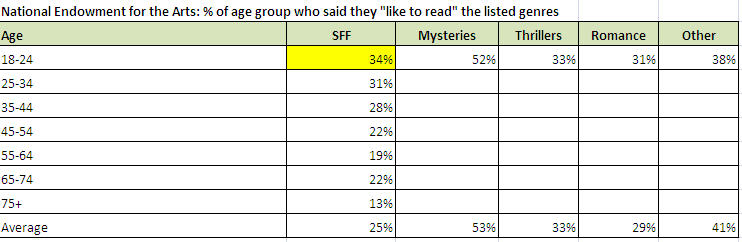
    My interest in this began when I saw the results of the latest NEA survey. They have this graph showing reading rates in all age groups dropping horribly since 1982. By 2002 the graph is taking a nose dive.  Then in 2008 everything turns around. And among the young adults (18-24), we see the biggest increase—9%.

    I saw they had a genre preference question in this survey. Of course, I wondered about science fiction and fantasy. So I contacted the NEA and dug into the details. It appears that 34% of the 18-24 group say they like to read science fiction and fantasy. That’s a big number. That’s 1 in 3.

    Of course, I wanted another data pont, so I went to BookScan and asked for data on book sales. Because the wonderful people there love librarians and Tor Books, they said of course. We looked at juvenile fiction sales from 2004-2008. What we saw was that science fiction and fantasy grew 144% during that period. All the other genres only grew 23%. We also saw that science fiction and fantasy currently make up almost 30% of the juvenile fiction market. So about 1/3.

    Now there are some problems with the BookScan data. Yes, it only cover 60-70% of the market. It’s not in Wal-mart, grocery stories, and a few other places. But what’s more problematic for this issue is that they don’t break up the juvenile sales by age. It includes everything for folks one month old to age eighteen. So I’ve got books like Go Dog, Go in the dataset along with Twilight and Go Dog, Go isn’t categorized as fantasy. [Laughter] My suspicion is that if we narrow it down to the middle grade and YA group, we’ll see more science fiction and fantasy.

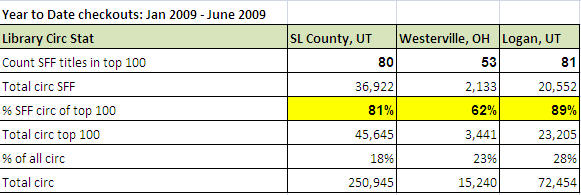
    So I needed someone who did break it up by age. Well, who does that? You do. Libraries do. Besides, a lot of youth don’t have the $ to buy lots of books. So I went to some libraries in Utah and Ohio and got their YA fiction circulation stats. Here’s what I found: 60-80% of the YA fiction circulation is science fiction and fantasy. This does not include graphic novels or magna. It’s text fiction.

    Folks, this is a big drug. I don’t know what part science fiction and fantasy played in the rise in reading rates, that would require a larger and more rigorous study. But I can tell you this: We want to see the impact of science fiction and fantasy on our society? We’re seeing it right now.

    My Story

    This large effect makes sense because science fiction and fantasy deliver experiences that are intersting to and matter to youth. It’s chock full of and encounter with the strange, weird, and wonderful; adventure and danger; doing something meaningful; being someone special, someone desireable, someone wanted in the group. All that coming of age stuff. So no wonder it’s a huge gateway drug.

    I know that it was in my case. I wasn’t a reader. I don’t think I read more than twenty or twenty-four book from kindergater to sixth grade. I look at the little fellows in my local school today and they read that many titles in the first six months of the first grade. But I didn’t. I wasn’t a reader. I do remember loving the look and feel of these small chubby books. [Laughter]

    I would take them them up to the librarian to check them out. She’d look down at me. “Are you going to read all that?” she’d ask. “Yes,” I’d say. Of course, it was lie. [Laughter] It was a huge lie because I would take them home and put them up on my dresser and just look at them.  Just loving the look and feel. And then when it was time to check them in, I’d take them back and give them to the librarian. “Did you read all that?”

    “Yes,” I’d say. And that’s how I became an author–lying to librarians. [Laughter] 

    Now in sixth grade my sister, we were in the car, I had four sisters and we had one TV, and so you had to reserve the time for your programs. So my sister says, “I have to watch The Hobbit for school.” Now I don’t know anything about The Hobbit. It sounded like a romance. [Laughter] I protested. No, way–we’re not going to watch some dumb kissing thing.

    “No,” she said. “It’s got dragons.”

    “You’re lying,” I said.

    I was convinced I was doomed. But it didn’t matter. We watched it. It had dragons. And I loved the experience so much I wanted another hit. Shortly thereafter my mother and father went on a business trip. I went over to my buddy’s house. So the first day we come up out of the basement to go to school and I said, “Oh, I’m feeling sick.” So my buddy went off to school and I went back down into the basement and played hookie for two days and read The Hobbit.

    It was amazing. More amazing than the movie. I had to have that experience again. And so I read Ursula LeGuin, Patricia McKillip, Donaldson, Terry Brooks. I kept reading because it delivered a cognitive-physical experience I loved. Of course, I didn’t put it that way back then. It was more along the lines of, duuuude. [Laughter]

    Now I got a BA in English and a Masters in Accounting. Those degress required a lot of reading. But I didn’t develop the requisite literacy skills in school. I developed them in science fiction and fantasy.

    And so when I started to write I was naturally drawn to fantasy. Having experienced this wonderful thing, I wanted to produce that and share it with others. So this novel that’s coming out has the gosh-wow I still love. It’s set in a world were humans are ranched by beings of immense power. There’s a young man and young woman in terrible trouble. So it has monsters, magic, and mayhem. But I also found fantasy big enough to let me explore other things that have become more important to me as I’ve aged. Like family, sacrifice, and redemption. And I hope people enjoy all that. But ultimately, I hope this book does for someone else what The Hobbit did for me and opens a door to a wonderful addiction. And, of course, as a powerful side-effect, improves the literacy of some rascal or rascaless. [Laughter]

    Conclusion

    I want to end where we began with that Thomas quote.

    “My education was the liberty I had to read indiscriminately and all the time, with my eyes hanging out.”

    That kind of wild abandon will happen when the drug takes effect. And for many of our youth, probably at least one in three, that’s going to be when they ingest a few ounces of SF & Fantasy.

    Thank you.

    [Applause]

    Supporting Numbers

    How fiction is a drug

    Emotion is not a cognition, although cognition plays a part. It’s not just in your brain. It involves a physical response, which means it involves chemicals. 

    We sometimes forget that our bodies produce a staggering number of chemicals. Sometimes they produce in response to external stimuli—the sun triggers the creation of vitamin D, ingested sugar triggers the production of insulin, the sight of a ravening lion standing not five feet away with nothing between him and me produces, among other things, adrenaline.

    Lots of these reactions, we don’t notice. But there’s a whole group of these physical responses that we do. We lump them together and call them emotions.

    Jenefer Robinson in her wonderful book Deeper Than Reason, explains, “Emotions are our way of responding to events in the environment (either external or internal)” that matter to us. They are “physiological changes that register the event in a bodily way and get us ready to respond appropriately.” Fight, flight, pursue, woo, investigate. They focus our attention, get us ready to take action, and communicate all this to others.

    So while I might not feel the production of vitamin D, I do feel the fear of the lion. Fear is a wonderful thing—it keeps us alive. It raises our heart rate, pumps us full of drugs that prepare us to flee or fight. The emotion writes itself on our faces in order to, among other things, communicate the situation to those around us, warning others and calling for help. It is a physical response. Yes, there are cognitions involved, but there are also chemicals.

    The latest research on emotion shows that emotion is a process that involves three things. (1) An affective appraisal of our environment that signals something important to us—a threat or opportunity. (2) This triggers an immediate physical response (chemicals, galvanic skin response, accelerated heart rates, facial expressions, etc.). (3) At this point cognitive (conscious thought) appraisals kick in and help us monitor the situation and moderate the physical response.

    For example, I go out to the yard and step on this thing that slithers through the grass. The sensory signals immediately trigger a physical response to get me ready to flee or fight–heart rate, adrenaline, etc. Then I notice the snake is far too long. I look closer. It’s the garden hose. My physical response changes. I laugh, feel relief. Research has shown that when we read text, the same process occurs. We do indeed have the same types of physical responses. In some cases they’re more intense.

    Now here’s the thing. This physical response is triggered not just by threats and opportunities we perceive with our senses, things out there. It is also triggered by thought. Thoughts deliver a physical response just as surely as crack does. We have the research to prove it. In fact, sometimes thought delivers a more powerful physical response. Here’s but one example. Did you know that people with a phobia of snakes have a stronger reaction to reading a passage about snakes than they do to the actual critter?

    This is where fiction comes in. As I stated in my speech, fiction, the kind of fiction we love, the kind that keeps us up at night sitting on the edge of the tub or locked in a closet with a light, the kind that lingers in the fabric of our clothes and our hair long after we close the book, that kind of fiction goes beyond cognition, beyond data and facts. That kind of fiction triggers a physical response.

    It does this, and this is one difference from emotion triggered by our own thoughts or the sensory data we pick up from the world, because fiction, by its very nature, its very structure, is actually guiding our emotional response. Our physical response. This management of the response is in fact one of the things that we find so pleasurable about it.

    To find out more, please read:

    • The Science of Emotion by Randolph R. Cornelius
    • Deeper Than Reason: Emotion and its Role in Literature, Music, and Art by Jenefer Robinson

    You may then want to search out texts by Dolf Zillmann, Jennings Bryant, and Peter Vorderer.

    Share
  • Generating Story 8: Creative Q&A part 2

    I realized I needed to blather a bit more on this topic to warn you against something before I bring the other authors on.

    You’re going to be tempted.  You’re going to be tempted to seek for some Holy Grail list of magic development questions.  Some of you are going to be tempted to compile some big old honking list of “the questions that will produce a killer story every time and all I have to do is ask them.”

    That list doesn’t exist. If you seek for it, you’re going to waste a lot of time and end up having to fight killer rabbits and fetch shrubberies for weird knights.

    Don’t fall for it.

    But, John, didn’t you say there were core questions?

    I did.  You need answers for those.  But you need to also understand that a writer will ask a great number of development questions when writing a specific novel, some of which he might only ask once.

    Last year I was out on the forum at CodexWriters.com and one writer asked the rest of us how we approached developing our stories.  He was looking for some kind of development map, e.g. I have this piece of the story, now I need to develop the rest–how does one go about that? 

    That discussion led directly to this series on getting and developing story ideas. My thoughts then were that you need to define and understand the basic elements of story.  Knowing the key story principles behind each element leads us to a handful of core development objectives and questions.  But–

    I DO NOT think there’s a comprehensive must-do list. 

    Why?

    Because it’s been my experience that no two stories are exactly the same, and so no two stories require the exact same questions. And even if stories are similar, questions and techniques don’t always produce the same results each time. One question or technique might prove fruitful one time, but it might be unfruitful the next, or even unnecessary.  So the point of this is NOT to get a checklist of a hundred questions that will lead you to generate the whole story in your mind before you write.

    The goal is to develop the six parts. Use the questions you need to develop those parts.

    Look at the many setting and character profile question lists that float around. As I’ve used those, I always run out of steam because while some of those questions are interesting and helpful, quite a few of them just don’t apply to the project at hand. They bore me. Maybe I felt a spark of life with one question, but instead of following it as the way into the story, the whole checklist format suggests I need to move on to the next one and fill in the blanks.

    But my goal isn’t to fill in blanks. My goal is to make the story come alive in my mind, to make the character come alive, to develop someone sympathetic, deserving, and interesting (if he’s the hero).

    So while I think looking for productive questions is important, and I DO think there are some core questions that need to be answered every time, I think a person will be more productive if they step back and identify the key things they want in the story, the scene, the particular character.  This means we’ll have some standard questions and techniques based on how stories work, but it also means we’ll learn how to do the creative Q&A process on the fly, following the zing for the current project, coming up with questions that we could never predict we’d use. 

    And we’ll use the objectives for the six core parts as the guide then build upon them.

    For example, when finishing up my last draft of Curse of a Dark God, I wrote the opening to a big battle chapter. I know that for things to be clear to the reader, I need to set the stage, have a hook, give the what, why, where, etc. I need to transport them as best I can. Those are my objectives. The questions, while not formally stated, flowed from them–what are some options for a good hook, how do I want to set the scene, etc.

    These are fairly standard objectives/questions. They’re story fundamentals. And there weren’t a lot of them. You can get overwhelmed with too many niggling objectives and criteria. I’ve found it’s best to focus on KEY things. To ask myself–what are the Pareto factors, the handful of things that really have the biggest effect in story with character, plot, scene? Once I identify those factors I can easily turn them into questions.

    So I had those handful of objectives. But I had some others that were very specific to that scene that I probably won’t use in any other scene ever.  And I couldn’t have really even known about them until I got to the point where I was writing the scene.

    For example, one was how to introduce the Dogman of Toth and his pack of maulers in a way that makes the reader say “ho-lee crap those guys are screwed!” Another one was how to introduce the kitemen in a cool way. Another was based on a feeling I was getting from my Spidey-sense that the scene I was writing was going to undercut a later one if I made the hero’s objective to kill one certain character. So I had to ask, what is the right progression of these scenes? Who should the hero attack here so it feels right, like a progression?  Another objective was to make this whole battle scene awesome, thrilling. That’s certainly something I’ll want to do with other battle scenes. But not on all scenes.

    With the very next scene I was asking–how can I make this scene tender and heart-breaking? These ad hoc questions about the Dogman and kitemen and the story progression are all great questions flowing from objectives, but they were for that one particular scene.

    So I think there are some core objectives or principles of how character, setting, problem, plot, and text work. These are based on key story factors. I listed those out in the last post and in my series on suspense. You can make a “standard” list of objectives and questions out of these. For example, one of those key objectives is for the reader to care about the hero. Another is to find him interesting. I can indeed translate these core objectives into some standard POWER QUESTIONS that might be put on a list.  Along with some core questions, there are favorite techniques (tools) we each use to help us work up what we need and get into a story, scene, character, problem, etc.

    But I think a lot of writing is using the creative Q&A on the fly because it’s just impossible to think up all the objectives and questions you’ll encounter before you get into it. 

    Have I said that about twenty times now in this post?

    Let me suggest you not try to develop everything up front before you begin to draft.  Some development questions occur when you’re sketching or outlining. Others when you’re in details of draft mode. It’s a mistake to try to get it all up front in some list.

    The key, I think, is to have our handful of CORE development objectives/questions and ALSO expect to use the QA process along the way. This allows us to move forward in the creation without needing to develop everything up front, which is impossible (no, it really is impossible), and then step back and formulate questions when the need arises, based on our objectives of the moment, and use any number of methods to generate the answers until we have something that rocks.

    But John, how do you know when you’re ready to move forward?

    For me I need to have generated the story concept–the basics of the character, setting, and problem.  When I have that, I’m usually beginning to “see” things, although certainly not everything.  Often I’ve envisioned a couple of moments or scenes.  Maybe some dialogue, etc.  When I get to this point, I’m able to write a Story Setup statement.  And then I generate a sketch of the plot with a working outline.  I DON’T have all the details, but the story’s alive enough in my mind to proceed. 

    Sometimes I begin to draft what I sketched and find out it doesn’t work.  And sometimes I have to draft to get my story concept. Eloise McGraw (I love her book The Moorchild) usually found she had to draft seven chapters before she really knew what the story was about. That’s fine. The key isn’t to use a certain set of tools in a specific sequence. The key is to get to the point where you understand the story you’re telling. If I can do that with a bit of sketching and a little drafting, great.  If I need to do a bit more exploratory drafting to have the story come to life in my mind, that’s fine too.  The key is to know what I need to know about the story and work until I know it. This is writing that’s based on objectives, on principles, not on procedures.

    So there ARE core questions you’ll need to answer for every story.  But it’s also true that you will be hunting mythical rabbits if you look for a secret magic question procedure that lists all the questions you need to ask, EVAR!  Having said that, I’ll now let these other authors finally get a few words in edgewise.

    For more in this series, see How to Get and Develop Story Ideas

    Share
  • The eBook Tsunami of Crap is Crap

    Some folks say ebooks will foist a terrible problem upon readers–they’ll soon have to wade through mountains of crap to find a book to read. It will be a terrible chore. J.A. Konrath gives his answer to this lament. Kris Rusch gives hers.

    Here’s mine: there will NEVER be a tsunami of crap facing a reader looking to buy ebooks or any other kind of book. Ever.

    Why?

    REASON 1

    Buyers REFUSE to look at seas of choices–crap or otherwise. Shoppers always seek to limit choices (too costly to look at everything) and use a number of methods to immediately narrow those choices down: recommendations, reviews, what’s on the shelf, etc. (For a fascinating look into a few facets of how we make choices, listen to this Radio Lab espisode.)

    For example, when shopping for vanilla you don’t go searching through the 500 brands available online and in various stores–Mexican, Vodka, American, Rum, organic, generic, brand, etc. It’s just not worth the time. Something on the shelf is usually GOOD ENOUGH.

    Likewise, nobody cares to look at 150,000 titles to find the best. They don’t have the time. In fact, they don’t need to. They can usually find a number of books that are intriguing enough in the “smaller” selection any given vendor sets before them.

    In the case of Amazon ebooks, that selection is the best-sellers, the ads, and the this person bought that.

    Nobody ever sees the 4 gazillion books. Ever. They don’t want to.

    REASON 2

    Vendors can’t display a gazillion choices, even if they wanted to, which they don’t (studies have actually shown that providing shoppers too big a selection leads to FEWER sales).

    And no, just because Amazon says it have 2 quintillion titles for sale that does not mean they’ve been displayed. You only see a handful of titles at a time.

    Even if you scroll through the various lists, you are rarely looking at more than a dozen choices at a time. You’ll probably see less than 200 titles total any given time you go shopping.

    Vendors NEVER display a tsunami. EVER.

    REASON 3

    Readers have MORE THAN ENOUGH leads to fill their capacity for reading.  Even if they wanted a sea of options, they wouldn’t wade through them because they don’t have to–it’s too easy to find something to read.

    Leads are everywhere. There are recommendations from friends, family, reviewers, celebrites, and Amazon’s this person bought that.  There are leads from best-seller lists (another type of tacit recommendation). Leads from browsing.

    Readers have leads coming out their ears.

    This is important because the number of leads any given reader has far excees that reader’s capacity for reading.

    How long does it take you to find one book that looks interesting? From browsing or recommendations or whatever?

    Minutes.

    Maybe if you’re having a really bad day, it takes an hour. But it takes so much longer to read one story than it does to find one you want to read.  That’s why we all have two year’s worth of books to read in our queues.

    So. There is no sea of crap. There NEVER was or ever will be one for any given reader.

    Buyers avoid selection seas like the plague. Vendors don’t provide such seas anyway. And readers don’t need them–they have more than enough leads which turn out to be exciting enough to fill up all their reading slots and more.

    Share
  • Read and report for effect, not rule compliance

    At a recent writer’s conference I was on a panel and someone asked what the pros and cons of writing groups were.  Writing groups can save AND kill your writing. So beware.

    Workshop Benefits

    Writing groups are great for:

    • Encouragement
    • Deadline motivation
    • Having fun with other authors
    • Getting a chance to think about and discuss craft
    • Testing your work

    The benefits listed above can all be huge helps to a writer. However, there are two traps that many individuals fall into. You want to avoid both of these because they are plagues that can not only infect, but kill your writing.

    Workshop Plague 1: submitting for fixes instead of effect

    The first problem occurs when a writer forgets that the purpose of sharing your work with the group is NOT to have them tell you what to do. It’s to test your product on readers who are likely to be in the audience for that particular type of story (please note the last part of that sentence as well).

    But in many groups this isn’t what happens. The writer submits his work and then hopes it does well. If it does, he purrs and goes his way rejoicing. If it doesn’t, he figures the group will tell him what to do to fix it. In such groups the readers often arrive with a list of “you shoulds” or “I woulds.”

    • The dialogue here is clunky, you should…
    • These characters are stereotypes, I would…
    • You have infodumps here, here, and here: you should…

    This all sounds great, right?

    Wrong.

    This tells a writer very little that’s worthwhile. What was the problem all these shoulds and woulds are trying to fix? You can’t tell. And not knowing the problem, you don’t know if the fix is really going to work. In fact, the suggested fix might be completely wrong for the story. You are the story designer. YOU have to figure out what’s really wrong and then select the right fix.

    Case in point: at this conference another author told of a time her editors came back and said the novel needed to be shorter. It was too slow. In reality, the novel was too short. The real fix was to make it longer. She was skimming the surface of the story in summary and needed to go deeper. She made it longer, and the story worked. But if she had been looking for fixes instead of symptoms she would have done the exact wrong thing for her story.

    The most productive thing a writer can hear is what effect the text was having on the reader. Was the reader bored, lost, or feeling it was made up? Or was the reader surprised, intrigued, fascinated, freaked out? In short, did it do what the story was supposed to do to the reader?  An accurate report of the reader experience is invaluable. But a list of shoulds and woulds by the Fixits is not. You want symptoms, not diagnoses and presecriptions.

    Of course, when you understand the symptoms, you can very easily open it up to the group for suggestions on ways to fix it. Sometimes brilliant solutions arise from such discussions. Sometimes they don’t. Othertimes, they simply provide a way for the writer to work it out in his own mind. But in the end, YOU as writer have to do what’s right for the story you feel in your gut.

    One time to be especially careful of this is when you submit revisions of a story to the same group. Here’s why: when someone says a revision lacks blood and vitamins, it may be this is actually the case. But it also might simply be a case of diminishing returns, e.g. the first ice cream cone you eat is great, the second okay, the fourth begins to make you sick. Would the movie you just saw on Friday night be just as powerful if you saw it again on Saturday? And then again on Monday? I know it’s not exactly what’s happening, but it’s similar. After reading a manuscript multiple times, a reader sometimes can see nothing but the stitching.

    Furthermore, a reader will often get revision ideas that jazz them about the story only to find the author was jazzed about some other revision idea. And that can often disappoint. And if this multiple revision reading goes through multiple cycles, I’ve found it becomes harder and harder for the reader to avoid becoming a director of sorts, the author trying to perform to their taste. I done this far too often to people feeding me multiple revisions. 

    There’s an easy way around this one: simply avoid submitting any individual story to the same set of readers more than once.  However, I don’t want to suggest you should NEVER submit revisions to the same set of readers. Orson Card submits all his work, originals and revisions, to his wife Kristine. I submit mine to my wife and editors. Many writers have trusted readers. Just be aware that submitting multiple revisions can very easily lead to our chasing someone else’s opinion instead of writing the story we feel in our guts.  Tread with caution.

    Workshop Plague 2: reading for rule compliance instead of effect

     The second problem occurs when you have readers who have forgotten that the ONLY thing that matters is effect. Many times writers will build a list of writing rules as they learn the craft. And they will forget that the rules are, by themselves, meaningless. Please see my post on Rules vs. Objectives. These well-meaning folks come, not with an accurate report of their reading experience, but with a list of your rule violations.

    So instead of hearing that the story immediately pulled the reader in but that by page four the reader’s mind was wandering, the reader points out that you started the story with dialogue and you shouldn’t do that. Or that you used said-bookisms, which was a very flabby and naughty thing to do. Or that you had more than one point-of-view in the chapter. Or that you chapters were too short or too long. Or whatever it is that that particular reader has in their rule book.

    This kind of feedback is worthless. I don’t care if my story started with dialogue. What I want to know is if it pulled the reader in. And when I say “reader” I mean  one who is looking for a story, not for rule infractions. What you want is an accurate report of the reading experience. That’s it. Both the good and the bad.

    Here’s an example of what I try to do when I read and report. It’s not the only way, but it illustrates what I’m talking about.

    1. I read the story as a normal reader. No pencil or pen in hand. I’m just thinking: okay, I hope this is good.
    2. I read until I’m bored, lost, or (hopefully) turn the last page in delight. Some folks may wonder why I wouldn’t read to the end of everything I’d agreed to report on. Simple. If I’m bored or lost I’m OUT of the story and cannot judge the effect of what follows as a reader. Maybe I’m bored because of the craft. Maybe I’m bored because I’m not in the audience for that kind of story. If this is the case, my experience doesn’t matter. You wouldn’t give a romance to a thriller reader and then expect them to love it, would you? Well, authors are no different. Just because we write doesn’t mean we automatically love everything (please see my blog Is 90% of Everything Crap). 
    3. I write up my experience, making sure I accurately report who and what I was interested in, what delighted me, what bored me, where I was lost, or didn’t believe etc. I’m also very particular to clearly separate  the things that had a big effect on my experience versus those that had a small one. For example, some confusion in an exchange of dialogue might be a small thing. Confusion in a whole chapter is a big thing. As a writer I don’t want a laundry list. I want to get a sense of proportion. And I want to know if the reader generally enjoyed the story or not. It’s one thing to know the story is busted. It’s another to know that it works, but has a few paint spots.  
    4. If I did not read through to the end, I do so now. Or maybe I skim. Just to get an idea of the whole story.
    5. Then I ask myself what I think this story was trying to do. What kind of an experience, what kind of delights was it offering up to the reader? Suspense, delightful characters, romance, wonder, cool textual pyrotechnics, etc.
    6. Having an idea of what the story was trying to do, I see if I can’t diagnose the problems and think of some ways to fix them.
    7. Finally, I give my report to the writer. I include #3. Then I add #5 and #6, stating that here’s “what I think the root of my issues were and some ideas that might help.”

    You might do it differently. Just make sure you focus on accurately reporting your experience reading for effect, not rule compliance. Once you have a number of reports you can see what’s working and what isn’t. If one out of ten people has an issue with a certain part, I may or may not ignore it, depending on my own judgment. However, if four to seven of them have an issue, I’m probably going to fix it.

    So writing groups can be wonderful. Just be careful to avoid these two plauges as if they were, well, plagues.

    Share