|

Story insights from the director of Pixar’s Up

How would you like to listen to a master story teller for almost an hour? You can. Radio West recently interviewed Pete Docter who directed Pixar’s recent motion picture Up.

Docter has been with Pixar since the beginning and he shares a number of insights into story telling. He talks about the importance of emotional hooks, getting ideas and developing them via the creative Q&A process, and editing a story from schlock to greatness, and much more. What a wonderful interview.

Click here to listen.

Share

Similar Posts

  • |

    Dewitt Jones and Clear Vision

    Not many people understand creativity. Dewitt Jones, a National Geographic photographer, does. And this video on the creative process, HOLY COW, it’s so good I had to buy it so I could watch it whenever the yearning took me.

    Clear Vision

    But this isn’t just for artists. The principles of creativity apply to any creative endeavor–from writing and drawing to building microchips and parenting. 

    Go here. Watch the brief clip. Then watch the whole Clear Vision video. Tell me what  you think.  

    Capture the zing!

    Share
  • |

    John guest posts about writing memorable fiction on ReidWrite

    Luc Reid is the author of, among other things, Talk the Talk: The Slang of 65 American Subcultures.  He is also the lizard king of Codex, which he started and of which I’m so happy to be a member. He’s always starting provocative threads on Codex, making us all think and reexamine the principles of story and the whole writing business. He recently posted some insights about what makes memorable stories. A lot of other fellow Codexians joined in the discussion. Happily, he asked me to share some of my thoughts on his site, ReidWrite. They begin as follows:

    YOU’RE MINE, DEAR READER

     Mwuhahaha.

     Okay, maybe not. But you are wired to be mine. And you wouldn’t have it any other way.

    Let’s back up. Luc wrote about writing memorable. I agree with the idea that the stories that produce a strong emotional reaction are the most memorable. In fact, I believe that triggering of emotion is THE reason why linear narrative that puts us into the trance has lasted so long in so many forms and makes so much money.

    But can writers guide reader emotions? Or is it all just by accident?

    Read the rest here: http://reidwrite.livejournal.com/8331.html.

    BTW, when you’ve finished that, you might want to check out Luc’s new site, WillpowerEngine.com. It’s a place where he shares what he’s found in his research for his current book project, The Willpower Engine, on how self-motivation works. I think you’ll find a number of the posts there very interesting.

    Share
  • Runts, widows, and orphans

    A typesetting mystery solved–Runts!
    OrphanRuntWindow

    And now for something for your typesetting hearts.

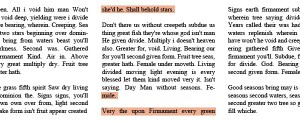
    You know what orphans are–A short line appearing at the bottom of a page. Sometimes the first line of paragraph appearing at the bottom of a page.

    You know what widows are–A short, paragraph-ending line appearing at the top of a page.

    But what’s the last word or part of a word of a paragraph stranded by itself on a line?

    I went to the store, looking for
    Paul.

    I could never find an answer. Some called it an orphan as well.

    But David Blatner revealed the name in the comments of his post What Are Your Favorite Word and Character Space Settings for H&Js?

    He actually coined the term years ago when he couldn’t find a name, and I love what he came up with and am going to use it forever.

    He calls them “runts.”

    Ha!

    Hyphen Control

    BTW, those settings he mentions in that article are awesome. Drastically reduced weird hyphens, which reduced time formatting.

    What do the big boys control for?

    Furthermore, I noticed something in the big time author Stuart Woods volume I happen to be reading. And then I checked it against a James Patterson and a Lee Child.

    1) They don’t care about most runts. As Blatner said, there’s a runt zone, but the zone where they control for runts appears to be less than 5 characters if that includes the end punctuation.

    For example, I just opened a random page of the Woods book and see the following runts:

    a) results.”

    b) entry.”

    I flipped to another page and saw:

    a) said.

    b) trunk.

    c) them.

    And the thing is that I DIDN’T notice them in the least while I was reading. Only when I started looking for them.

    Of course, there were no runts that were smaller than those. Nothing like “tie.” or “do.” or “for.”

    2) They don’t control for orphans either.

    3) They DO control for widows. However, when you’re not controlling for orphans and most runts, controlling for widows is easy. And sometimes the control is just to increase the tracking just a tiny bit to make it span the whole line.

    I spent a number of hours on Saturday formatting my book only to find when I finished that I had set the leading at 18pt instead of 16pt. That meant I had to reformat the whole bleeping thing.

    But I adopted the Big Boy rule, allowing all runts that end at or beyond the first line indent of the paragraph. I ignored orphans. And I controlled for widows. And it took me a fraction of the time and still looks great.

    Here’s to runts and orphans!
    Share
  • Some lessons from Tom Clancy’s first novel

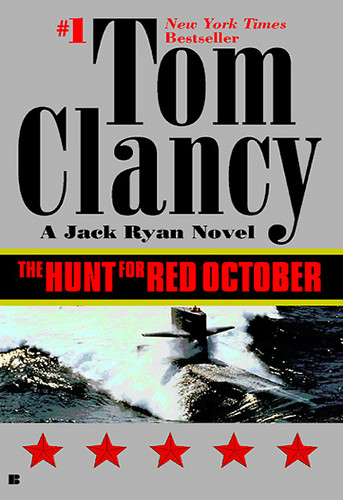
    tom-clancy-the-hunt-for-red-octoberTom Clancy is one of the biggest authors of our time. How did he break in? It’s an interesting story that Deborah Grosvenor, the editor who acquired The Hunt for Red October (Clancy’s first book), tells here.

    And this early interview provides more insights.

    So what conclusions can you draw from this? Here’s what I picked up.

    1. Writing a good book is one thing. That book finding success is quite another.

    2. Endorsements from the right people make a huge difference. More here in my blog Is Product Popularity Random?

    3. Know what you write. And if you don’t know it, do the research. And then invent what you have to.

    4. It’s not always a bad thing to start with a small press, especially if they’re going to put as much $$ into marketing and PR as this one did.

    5. To finish your novel, you’re going to have to set aside time and get it done.

    6. Finally, follow the zing. Clancy loved this stuff. Notice how his book was fed by the stories he heard and read.

    Share
  • Hornswoggle & Happiness

    Since we now know that happiness is contagious and that a happy friend is worth $20,000, I figured I’d provide a practical means of infecting you with some mild levels of joy so you could increase your value. Hey, who needs stinking bionics to become the million-dollar man?

    Have you ever noticed that using some words elevates your mood?

    No?

    Trust me. Words do have power. And I am sure researchers could prove that if you used a certain number of words like “schlub,” “smithereens,” and “diddly” each day, you could raise your happiness level by some statistically significant amount.  And even if they couldn’t demonstrate this, that would only prove that some scientists are made of styrofoam. But we knew that already. The point is that there are some words that are so delicious, goofy, or beautiful they must be preserved at all costs. If only for their happy-making ability. And in that light, I present to you “hornswoggle.”

    (HORN-swog-uhl)
    MEANING: verb tr.: To cheat, hoax, or deceive someone.

    Hornswoggle.

    USAGE: “Now, however, some special interests are out to hornswoggle residents, and they’re stooping low to do it.” Lauren Ritchie; But Doctor, Your Name is on the Mailer; The Orlando Sentinel (Florida); Oct 4, 2006.

    Aaaah, I’m feeling better already.

    You can use this too. See: “Son, don’t try to hornswoggle me,” “That dude’s a hornswoggler,” “Joe’s auto-body is a hornswoggling den of mechanical iniquity.”

    Now add to that skedaddle, discombobulate, and flummadiddle. (If you want definitions, just visit this list from wordsmith.org.)

    Take them home with you. Use them. Spread the happiness around.

    Share
  • |

    Buffett’s Letter to Berkshire Hathaway Shareholders on 2008

    I got my masters degree in accounting and information systems. While going to school I started an investment club and learned about a man named Warren Buffett.

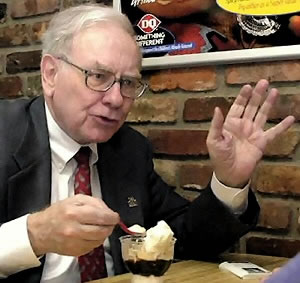
    Warren Buffett is humble, full of folksy humor, and trades places with Bill Gates as the richest man in the world, depending on the year you’re counting. His annual letters to his shareholders are a delight to read. This year’s is full of wisdom about the current financial crisis. Moreover, within a few minutes of reading you will be able to get some key insights that can help as you evaluate the plans being hatched in Washington and how to prevent this particular type of crisis from happening again. 

    If you’re not that into finance, I recommend reading:


    1. The introduction starting on page 2 and ending on page 3
    2. The “Finance and Financial Products” section starting on page 10 and running through page 12

    Once you’ve read those, if you want to laugh and see Buffet’s humor, skip to page 21 where Buffett talks about the annual meeting of shareholders. Tell me you wouldn’t want to attend.

    The Berkshire Hathaway homepage

    This year’s letter to shareholders (you will click on 2008 because he’s discussing the results of that year)

    Share