My editor just emailed me another endorsement from one of the folks we sent the manuscript to. I’m so excited! This one’s from Kage Baker.
I’m a total stranger to three of the four that have responded so far. It continually amazes me how generous the pros in this genre are with both their time and praise.
Here’s the last one.
“A classic heroic saga, dealing with the bedrock issues of good and evil and identity. These are classic themes because they matter; and Brown makes them matter both to his young protagonist and the reader. It promises to continue for quite a distance, and I hope it does.”
—Kage Baker, author of House of the Stag and The Company series.
Here are the previous ones.
“Thoroughly engrossing from the first page to the last! John Brown shows himself to be a writer with remarkable depth and power. I haven’t seen a debut novel this good in years!”
—David Farland, New York Times best-selling author of Runelords and Ravenspell series
“In Servant of a Dark God, John Brown has created a complex and intricate world, filled with all the permutations of human good and evil, as well as evil that goes beyond the human, where neither heroes nor villains are quite what they seem at first, and where the cost of virtue is high indeed, yet where, in the end, the tenacity of such virtue is what is required to triumph.”
“A complex, powerful story of a youth trying to learn who he is and what he is, with no allies he can trust in a world stalked by a monster. A book that copies nothing I have read before and which goes its own way brilliantly.”
—David Drake, author of the popular Hammer’s Slammers and Lord of Isles series
I’ve finished chapter 17 of CURSE. I’m up to 50,000 words and have moved from the presentation phase into the struggle. And I’m stopping at this point to review the what I’ve got. I’ve learned that if the foundations of the story–the presentation phase–has fundamental flaws in it, you’re only going to create a HUGE rewrite mess if you push on.
I know this from experience. When writing the first draft of CURSE back in 2009 (oh my heck, it feels like forever ago), I ignored my Spideysenses and told myself I could fix anything that was wrong in post production. And it IS possible to fix many things afterwards–you can change scenes, improve clarity and transport, remove continuity errors, layer in character tags and things like that.
And it IS true that sometimes you do just have to write to the end to figure out the story. Sometimes you have to just write to the end, and do it in a substandard way, because if you don’t you’ll never finish anything. Sort of like sketching first and then painting. But if there’s something wrong with the basic premise of a story line, and you keep writing, then that story line affects everything it touches. The fractures ripple out all the way to the end of the book. And you might end up, like I did, having to toss a huge amount of what you’d written.
Which is not all bad. I learned a lot and invented a lot of cool stuff while writing that. But when you’re on a deadline, it can be a killer. And I’m not doing that this time. I worked out the big issues in my chapter outline.
So I’m pulling back and reviewing. I’m delighted with everything but the villain. He’s still not right. I love his chapters, the scenes. I love the name I’ve given him–Endless. But the structure isn’t right. I’ve inadvertantly created two main villains. And that’s not useful. Having two “main” villains doesn’t double the power of the opposition. It splits it. The villain/henchman model works well. But I don’t have that either. Over the next few days I’ll be rectifying the setup. Then moving forward.
For those of you who are writers, I thought you’d be interested to know that there were a few times these last two weeks when I dreaded the writing. I had a large problem before me or had to invent a new chapter (as opposed to using something from the previous draft), and a dread filled me. But I sketch/drafted my way to the end, and soon found the writing a joy again.
I can’t say enough about the sketch/draft method. I’ve found it works in creative activities OUTSIDE writing as well. When working up a lesson plan for my day job, designing landscaping for our house, developing a talking script for a sales call, writing a technical manual, or a hundred other things I’ve had to do–it’s always easier to work from something than create everything all from scratch.
Sketching allows me to create that first draft. And it allows me to do this without having to worry about quality. Sketches can be silly. Weird. Full of crap. They can be all this because I can throw them away. They’re not meant to be permanent. And so there’s no pressure to perform. There’s no staring at a blank screen or page. Sketching is a free-wheeling joy. It fills me up with ideas. And then, when I’ve got the general idea of what I want to do, I can start in on the “real” draft knowing WHAT I want to accomplish which leaves me free to think about the HOW. And if I run into problems and realize the draft isn’t going to work, or I run into something better, I just call the current draft a sketch (or “take” as used in the movie business) and move on to the real one.
Sometimes a chapter or section requires 1 sketch or take, sometimes I’ve run up into the 20’s. Sometimes I haven’t needed any at all. It’s not the number that’s important, it’s the process that has really freed me.
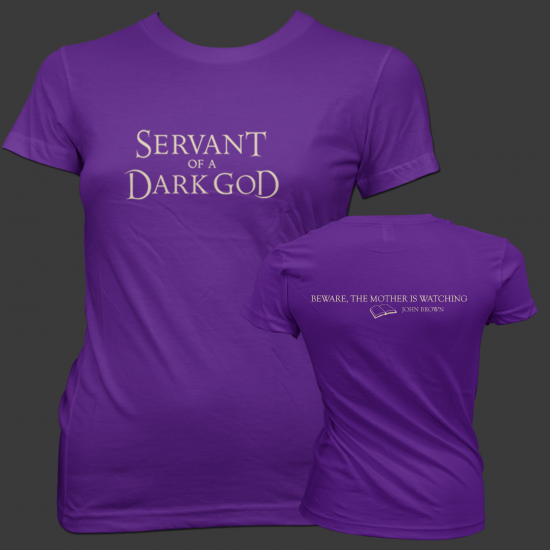
Yeah, Baby! We’ve got Dark God Tees! And all thanks to Fiction Addictions. You get to choose from two designs which you can see below. Please note: The Dark God got his fans some SPECIAL HOLIDAY PRICING!Through December 2010: $13.99 for standard style, $15.99 for the ladies fit.
P.S. If you desire, you can post pictures of yourself displaying your great sense of fashion (or the burnt crisp of your thunderstruck remains) on http://www.facebook.com/authorjohnbrown
Servant of a Dark God – In Yo Face
Boldly proclaim your allegiance with a simple front that states who you serve. NOTE: May attract lightning.
In Yo Face - Standard T Style
In Yo Face - Ladies T Style
Servant of a Dark God – Book Fan
For those who aren’t quite ready to commit to the dark side, we provide a more conservative front that will still raise eyebrows, but all in the good cause of literacy.
Book Fan – Standard T Style
Book Fan - Ladies T Style
Colors & Styles
Standard tee shirt style: for men or women, comes in dark brown, black, or navy with crème lettering.
The ladies tee shirt style (fitted cut and thinner fabric): comes in purple, black, or dark brown with crème lettering.
Other colors: If you simply must have the shirt in a different color, be happy, because you can, although it may take longer to process your order. Be sure to choose a color that goes well with the crème lettering.
Extra Large Sizes: If you want to get a shirt in a size not shown, you can. Just contact Fiction Addictions and let them know. It just may take a bit longer to ship your order.
I just turned in a 35 page chapter outline of Curse of a Dark God to my editor. This is the third iteration of the outline since December. Hopefully, at last, we have a story we can all agree on. Keep your fingers crossed.
Of course, since this back and forth has been a process of write like mad then wait a few weeks then write like mad and wait again, I’ve been working on another project during the waits. It’s a straight-up thriller.
Leon is ex-Special Forces (or an Army Ranger, but I’m leaning SF). He left the service when a colonel decided it was his job to make Leon’s life hell. He did security and a number of other things. Tried to be a plumber, but fell into bad company and then crime. And then was send to the big house and learned about a whole new theater of war. During his stay, he saw the light. Changed. He shaped up, and despite the swastika tatoos on his feet, flew straight when he got out. He had his odd jobs, but figured it was easiest to avoid all the questions and fuss that arise when you tell a prospective employer that you’re a felon. So he got himself a laundromat. Then another. Then he invested in a car wash. There’s good money in cleaning. And with the proceeds he bought himself a little ranch.
Leon’s a big man. Knows a lot about guns (although he can’t possess one), security, and crime. He lives in Rock Springs, Wyoming. On occassion, the sheriff is known to ask for his services. On more frequent occassions, the sheriff’s wife keeps trying to set him up with an unending line of women. But he doesn’t know if he’s ready for women. He doesn’t know if he’s ready for his nephew that his sister wants him to reform.
Then two old buddies from prison show up one night. They’ve got a girl with them. They need a place to stay. But it’s clear the girl isn’t there of her own accord. He figures they’re either holding her for ransom or blackmail. He’s not sure which. He knows these boys are connected to some bad men. Then his nephew breaks her free. The excons get in their car and chase after her. Leon gets in his car and chases after them. And soon he finds himself in the middle of something bigger than he could imagine.
Or something like that. I should have the chapter outline ready to go as soon as I finish Curse. I can’t wait to write it.
I finished the 10% edit, going from 205,000 words to 185,000, this morning and emailed the finished manuscript to Super Agent Caitlin who will perform various incantations before sending it off to ye Editors for review.
While that’s happening, I will be switching gears and starting the thriller. I’m looking forward to this. Not only am I having fun developing the ideas, but unlike these epic fantasies I’m writing with a gajillion story lines, this is going to have one story line (okay, with maybe, maybe two subplots), one point of view (instead of three or four), and a limited cast of characters like six (as opposed to close to twenty). I’m preparing to reach escape velocity. I’ll tell you what jupiter looks like when I get back.
Had a delightful time delivering “Story Lessons from the Hunger Games” at the annual conference for the Utah chapter of RWA up in Park City. Especially enjoyed delivering a sweet dream telegram involving waxed chests 🙂 Here’s the PDF as promised: Story Lessons from the Hunger Games RWA 2011
Folks, a huge thanks goes to Stephen Nelson for putting all this together. You may kiss his hand when you see him.
This is a recording of “How to Write a Story that Rocks,” a two-hour seminar Larry Correia and I just put on at the annual BYU’s Life, The Universe, & Everything symposium. I think we had 130-140 people attend. This symposium is focused on writing fiction. And while the panels and presentations do include things specific to the science fiction, horror, and fantasy genres (both adult and young adult), a lot of time is also spent on story writing fundamentals that apply to ALL genres. So when I developed this workshop, I made sure I took the fundamental approach.
The two-hour seminar has been broken down into 12 segments. To switch between the segments:
Hover your mouse pointer over the YouTube below
Click the forward and back arrows that appear on the right and left sides to move to the next or previous segment, OR
Scroll through all 12 segments and select the one you want using the playlist control at the bottom
I’ve found whenever I develop any presentation or training that it takes a few iterations and revisions before it’s the best it can be. This is the first iteration of this seminar. And so below this video I’ve provided additional comments on each segment explaining key concepts, principles, and techniques that we might have failed to discuss or convey as clearly as we’d hoped. Enjoy!
It’s documented–right-wing gun nut Larry Correia sang “Kumbaya.” What’s next? The hugging of small trees? Oh, Larry, the disilluion. The disillusion.
The reason why I had Larry sing was not for his mellifluous performance, but to demonstrate the difference in reactions between him and our happy volunteer (“Country Road” by John Denver–this really was a love fest). The volunteer balked because he hadn’t taken any thought to know what to sing before he was commanded to do so. On the other hand, Larry and I had spoken before the seminar. So Larry had something to sing BEFORE he sang it. It’s a simple demonstration, but it illustrates a principle a lot of new writers forget. Writing is a performance. It helps to know what it is you’re going to perform before you perform it.
It’s one thing for you to tell yourself to write. It’s much easier to tell yourself to write the scene where the rancher finds out one of his illegal ranch hands has been kidnapped.
Now this doesn’t mean that you have to know everything. Or that you can’t write exploratory drafts to figure out what it is you want to write. But it does illustrate that whatever techniques you use, you’ll be a lot more effective in your writing when you have something to say first.
But what do you develop? What are the things that bring the story to life? How do you go about getting those things to say? That’s precisely what I wanted to address in the seminar. In the segments that follow, I try to:
Explain what I’ve found are the most important things to develop, the things that define the essence of story, that make the story come alive in the writer’s mind–the things that really matter
Demonstrate techniques to develop those things so you have something to say
Segment 2
I think this segment went fairly well. What rocks will different from person to person, even though there will often be a huge overlap between people. So it’s important for authors to seek to develop the kinds of stories that rouse their passion. Watch this interview with best seller Debbie Macomber to see what I mean. So I can’t tell you what to write about. Or if whath you think rocks will resonate with a large number of people. However, what I can do is share the techniques I use that have been most productive in helping me develop initial ideas into something that has much more power.
You can use the techniques to juice up any of the four parts of story. However, I will say that I find that the most productive, the most important parts, are character and problem. Plot and setting are important. I love them and work to juice them up. But when I get a good character and problem, that’s when the writing seems to flow the easiest.
And no, I don’t list theme as a part of story. Everyone talks about theme, but when I read what they have to say or press them for examples, it seems that it always either boils down to (1) a story element or topic that’s repeated, (2) a story problem/issue stated in an abstract manner, or (3) some moral situation. Les Miserables is about the “theme” of mercy versus justice. But saying justice versus mercy is just an abstraction of the story problem and dilemmas the story deals with. So, no theme.
I’ll be adding my comments to the rest of these segments over the next few days.
Segment 5
Segment 6
Segment 7
Segment 8
Segment 9
Segment 10
Segment 11
Segment 12
Dan Wells on Story Structure
Check it out: Dan Wells on How to Build a Story (story structure). I find Dan’s “start with the ending” technique helpful as well as thinking about a worst fears realized moment. Watch the videos and see if there isn’t something there that can help you develop your story idea.