Villainous Heroes

If we root against villains based on moral judgments, then how is it possible to root for heroes who are not just bad boys but down right criminal, e.g. hitmen, mobsters, thieves?

It’s a wonderful question that has a simple and revealing explanation.  We root for these bad guys because they’re really good.

What?!

When talking about bad heroes, what we often do is:

1. Take them out of their context.
2. Focus on one or two negative traits, not the person as a whole.
3. Abstract them and miss what’s happening in real time as we process the story. We only have so much working memory and usually can only think about what’s being presented versus what we think about when we’re out of the story. What’s being presented in the story is mostly the threats to these heroes, not the consequences of their evil deeds. And if the consequences are show, it’s always modified by context (#1 and #2 above).
4. Confuse fascination with rooting.

When we actually look at what’s happening with the hero in the context of the story, what we find is that rooting is still based on moral judgments of who is good/right and who is not. We root for people we think are in the right (given their context) or are getting, undeservedly, the short end of the stick; we root against people who we think are in the wrong.

Here are some examples.

DISNEY’S ALADDIN

Thief. This one’s easy, I grant it. But it’s illustrative. I never once didn’t root for the boy. But I also never saw him as a true bad boy. He was nice. He shared the bread he stole with kids less fortunate. The guards were mean brutes. Jaffar was wicked and threatened the sultan and Jasmine who were good and innocent. was in a situation that provided some leeway for his behavior (alone, penniless).

1. Context. He’s fighting a much greater evil, someone we are rooting against.
2. Whole Person. He is a thief, but he’s also kind. Given his whole person, he falls on the side of good.
3. Processing. As we process the story we’re never shown awful consequnces of his theiving. Mostly just the good and courageous things he does. And the threats to his welfare.

THE ITALIAN JOB

Thieves.

1. Context. The movie starts with a heist and then a betrayal and murders by a traitor. Yes they’re theives, but we wittness a greater evil. The people they fight against are worse than they are.
2. Whole person. Except for the thieving, he’s a likeable guy.
3. Processing. We see few negative consequences of their actions to others, but we are constantly being presented with threats to them by guys who are committing greater crimes.
4. Fascination. I was incredibly interested in the scam–the plans, tech, everything.

THE PROFESSIONAL

Mob Hit Man

1. Context. He’s protecting a girl from other hit men. He’s fighting a bigger evil. He’s also taken advantage of by his boss.
2. Whole Person. He’s a hitman, but more time is spent on his kindness.
3. Processing. We see very little of the effect his hits have on others. Instead we are presented with threats to the girl and him.

DIRTY HARRY

Murdering vigilante

1. Context. He’s stopping guys who are doing terrible things.
3. Processing. We don’t focus on negative consequences of his vigilantism, but the threats from these really bad guys.

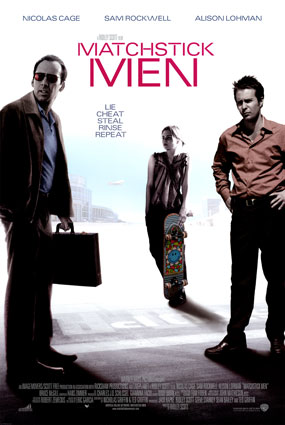
MATCHSTICK MEN

Scammers of the elderly

From IMDB “Roy’s private life, however, is not so successful. An obsessive-compulsive agoraphobe with no personal relationships to call his own, Roy is barely hanging on to his wits, and when his idiosyncrasies begin to threaten his criminal productivity he’s forced to seek the help of a psychoanalyst just to keep him in working order. While Roy is looking for a quick fix, his therapy begets more than he bargained for: the revelation that he has a teenage daughter–a child whose existence he suspected but never dared confirm. What’s more troubling, 14-year-old Angela wants to meet the father she never knew. At first, Angela’s appearance disrupts her neurotic father’s carefully ordered routine. Soon, however, with his own unique spin on parenthood, Roy begins to enjoy a relationship he never dreamed of having with his daughter.”

1. Context. Much of the time is spent his on his loneliness and issues with his estranged daughter.
2. Whole person. He steals, but we never see huge suffering from it. We see all the other issues he deals and have sympathy for him.
3. Processing. We’re focused on the threats to him, not the consequences of his one negative trait.
4. Fascination. I was fascinated by the scam and this pulled me along through the first.

CONCLUSION

What happened in all these stories as I experienced them was that the story carefully managed my view of the hero. He was always on the better side of the antagonists. He was always more good than bad, even if only by a little. And the story focused my attention most of the time on the bad/threats/consequences flowing from the antagonists, not the bad from the hero’s deeds.

What this shows is that you could write a story about a villain and make him the hero. In some instances it might be exceedingly difficult. For example, I think Hitler would be a hard sell as a hero, someone we’d root for. But the Neo-Nazis prove it’s not too hard a sell for some people. 

I don’t think recognizing the fact that we can make “bad” people sympathetic means authors are “simply being clever” or “pushing buttons.” After all, to write well you must believe and care about what you’re writing about. YOU have to believe it. Nor do I think it undercuts the notion that we root for people based on a moral stance. It just recognizes the fact that moral judgments, in fact, the vast majority of appraisals of situations, happen quickly with the facts at hand, which are the ones in our working memories. The ones the authors are controlling.

Share

Similar Posts

  • |

    John guests on Writing Excuses season 3 episode 16

    writing-excuses-the-guys2-300x139A while ago the Writing Excuses team asked me to record with them, and last Friday I got to do it and had a blast.

    We recorded three episodes. In the first podcast we talk about putting and not putting ourselves in our writing and making characters who don’t all sound like the author. As usual, the guys had some great insights. Check it out: The Anti-Mary Sue Episode.

    Share
  • |

    Is Product Popularity Random?

    In Why Publishing is Making You Crazy—and What You Can Do About It: The Tao of Publishing, Steven Axelrod and Julie Anne Long write an interesting post that takes some findings made by Duncan Watts and attempts to explain why writers should only focus on the quality of their work because they cannot reliably affect popularity in any other way.

    I agree with them that social-influence seems like a good explanation for the sometimes unexplicable successes we see in publishing and the difficulty publishers have in both predicting and producing a steady stream of hits. However, I do not find support for their main conclusion that writers can do nothing but write.  In fact, I suggest that Watts’ findings show quite the opposite.

    Axelrod and Long base much of their argument on an experiment conducted by Duncan Watts that tested the power of social-influence on music selection in some controlled music websites. Watts summarizes his findings in the excellent Is Justin Timberlake a Product of Cumulative Advantage?.

    In his part of the post, Axelrod points out that the Watts findings indicate “50% of the factors affecting your career could be totally outside of your control—totally random” and that “unless we can separate out those random factors which contributed to an author’s past success [and we can’t, Axelrod suggests], anything we can say or predict about why she succeeded will invariably be way off-the-mark.” And therefore “what’s interesting—and chilling, as well—is that there’s evidence that the harder a person works to make sense of a random event, the farther they’ll end up from the truth.”

    In other words, the only thing an author can reliably do to improve the popularity of his stories is focus on their instrinsic quality. And get more stories out so he has more shots in the fickle social-influence game.

    I agree that having more product in the market increases your odds. I also agree that focusing on the intrinsic quality of the writing can do the same. I even agree that this is where authors should spend most of their time. However, Watts’ studies do not indicate other efforts are wasted. In fact, they suggest the opposite.

    Watts does not controvert anything we now know about marketing. What he does is clarify the power of social-influence in our decision making and the dynamics of ONE type of endorsement system. What Watts shows is:

    1. A perceived non-bias endorsement of your product can have a huge effect in the product’s popularity.
    2. The intrinsic quality of the product has an effect on popularity, but social-influence plays as large or larger role.
    3. Popularity in the system set up in the test websites depended on the decisions of a few early-arriving potential endorsers, i.e. good early reviews (downloads in this case) are amplified and lead to an effect he calls “the richer getting richer.”
    4. In this one endorsement system, neither a future endorsement nor the identity of the early endorser can be predicted.

    These findings, however, need to be put in context. From cars, to camcorders, to recipes, the popularity of a product depends on three main factors. These aren’t new ideas and publishing is no different than any other industry. The factors come from long-standing marketing practice:

    1. Visibility (people know about it)
    2. Endorsement (recommendation from an attractive person, trusted authority or friend, or trusted system like the perceived unbiased reviews on Amazon or “most downloads” stats)
    3. Attractiveness (intrinsic to the product, the perceived value offered the target market, and the social effect as pointed out by Watts)

    Each of these three affects the other two. Visibility makes endorsements and initial attractiveness possible. Endorsements make a product more attractive and more likely to be visible. Attractiveness makes something more visible and more likely to be endorsed. And round and round we go.

    It’s true that Watts shows 50% of the effect is due to endorsement. But nowhere does Watts suggest an author cannot increase the probability of visibility and endorsement.

    In the study, the endorsement method used was a counter showing the number of times the song had been downloaded. It was random, anonymous, and perceived as unbiased. That was a controlled environment. However, what if a singer had been able to ask all those he knew who loved his song to download it from the site? Or what if someone organized such a campaign independent of the singer? Both actions would immediately affect the probability of the song increasing in visiblity and endorsement and, hence, popularity.

    It’s too bad Watts didn’t test this in one of his sites to see if he could make a winner. As it was, all Watts was doing was seeing if he could predict a success by quality alone. He was passively observing, not actively taking measures to increase visibility and endorsement.

    Furthermore, the counter is just one type of endorsement system. There are a number of others. We’ve all seen how an Oprah endorsement can move the market. The identity of that endorser is NOT random and has great predictive value. Her decision to endorse is still random. But what if you have a way to make your book visible to her? Would it be a waste of time to do so?

    Robert Sawyer loves to tell of one action he took with someone with much less endorsement power than Oprah and the effect it had on his sales. Was Sawyer guaranteed visibility and endorsement from that action? No. However, he DID increase the probability, and it resulted in sales. Here’s his account.

    Watts confirms that endorsements have a mighty effect on popularity. Even something as simple as a “most downloads” counter can easily overwhelm a listener’s own reactions. But the logical conclusion is not to do nothing. The logical conclusion is that if authors want to increase their popularity, they must not rely only on the intrinsic value of their product, but they must also search for ways to increase visibility and endorsement.

    Axelrod is correct that it’s sometimes difficult to see the effect of any given marketing campaign or tactic. This is because marketing efforts are probabilistic, not deterministic. However, probabilistic does not mean random. Furthermore, it does not indicate you cannot increase the probability of success. While publishers may not be able to produce best sellers every time, I’m confident if they decided to stop marketing altogether, sales would drop.

    Will all efforts succeed? No. Any marketing progam needs to consider the effect of diminishing returns. The effectiveness of some actions may be difficult to test. Furthermore, authors may not have the budget to run a campaign large enough to increase their probabilities, although there are strategies to become a big fish in a small pond (see Geoffery Moore’s Crossing the Chasm).

    Despite all these issues, we know, in general, getting endorsements helps. In general, the right placement in book stores increases visibility. Author visits to schools, if done right for middle age readers, can also increase visibility. Radio interviews, if done right, do the same. There are many things that DO improve an author’s odds. We can increase the probability of visibility and endorsement by taking intelligence, consistent action.

    And that’s good news. We might not be able to guarantee a hit, but one thing IS certain—we’ll have no direct influence on visibility and endorsement if we do nothing.

    (BTW, for those interested, here’s a great presentation on a related idea:Six Degrees: The Science of the Connected Age a presentation by Duncan J. Watts.)

    Share
  • Generating Story 9: Creative Q&A with Author Ian Creasey

    So how do writers use questions in their story development? Let’s hear first from Ian Creasey, whose short fiction has appeared in magazines such as Asimov’s, Realms of Fantasy and Weird Tales, and has been reprinted in several Year’s Best SF anthologies.  His excellent collection Maps of the Edge was published last year. 

    Stories Are Made Of Scenes

     by Ian Creasey

    I’d like to begin by thanking John for the opportunity to write a guest post about the technique of using questions to help create stories.  This is not a “where do you get your ideas?” post.  Rather, it assumes that you already have a basic idea, which you want to develop into a complete story.

    I’ll use one of my own stories to illustrate how the question technique works in practice.  The questions themselves are sufficiently general that they can be applied across a whole range of stories.  What tends to change is the order in which they are asked.  I find that stories sometimes start from an idea for a specific detail, in which case the process involves working backwards to develop the appropriate context.  In other cases, the initial idea is rather abstract, and the task is to flesh out the premise with sufficient detail.

    My example story is “The Report of a Doubtful Creature”, which was published in Orson Scott Card’s InterGalactic Medicine Show (November 2009).  I mention the publication date, because this was actually the seed for the story.  The year 2009 marked the bicentenary of Charles Darwin’s birth, and also the 150th anniversary of the publication of Origin of Species.  I live near the Yorkshire town of Ilkley, which Charles Darwin visited just before the first edition of Origin was published.  I therefore decided to write a story about Darwin’s visit to Ilkley, with the aim of getting it published in November 2009, exactly 150 years after the first edition of Origin of Species in November 1859. 

    So I had a story I wanted to write, without any notion of what its plot might be.  The technique of asking questions helped me to shape the story, and I’ll list some of those questions here. 

    Who is the story about?

    For my particular story, the answer is already in the premise: it’s about Charles Darwin.  But other times, it’s not immediately obvious who a story might be about — for instance, if the initial idea is to explore a technological or social development, then there is a wide range of people who might be affected.  In this case the standard advice is to ask, “Who is the most hurt by this development?  Who has the most to lose?”  That person is often a suitable protagonist (or antagonist) for the story.

    What is the story about?

    In this example, it’s fairly obvious that the story has to be about evolution.  There’s not much point in writing a story targeted for the anniversary of the Origin of Species, if it’s not about evolution!

    What is the conflict?

    The Origin of Species is a famously controversial book, symbolising a clear conflict between science and faith.

    Wow… so far it looks easy, doesn’t it?  It may appear that I’ve cheated by starting with several questions to which I already know the answer.  But in fact I’m illustrating the point that if you have the germ of an idea for a story, then there are already some questions and answers implicit in your premise, no matter how vague it may initially seem to be.  It can be useful to state these answers explicitly, to help crystallise the starting position.

    What is the specific example?

    This is what John calls a “power question”, a key question that can be widely applied, and which cuts right through to the essentials.  The question “what is the specific example?” can be asked in many contexts (e.g. in considering how to show characterisation), but I find it particularly useful when framed as, “How does the conflict manifest itself?”

    This isn’t mathematics: there’s no right or wrong answer.  But you need some kind of answer.  It’s a classic beginner’s mistake to write a story entirely in abstract terms: telling the reader about the conflict, without showing it.  Stories are made of scenes.  There should be at least one scene which dramatises the overarching conflict by putting a specific example onstage.

    A short story will typically hinge upon a single scene that illustrates the core of the conflict.  A novella or novel may require more instances, e.g. a small-scale scene near the beginning, and a large-scale scene toward the end.  But the principle of needing specific examples still applies.

    If I say that I’m going to write a story about evolution, and the conflict between science and faith, I’m speaking in general terms.  I need a specific example.  The device I chose was to have Darwin encounter a strange creature, which might possibly be a fairy.

    What are the stakes?

    This is another “power question”.  It’s a way of saying, “Why does this story matter?  Why should the reader care?”

    There are different ways of addressing the question, depending on whether you develop the story on a top-down or bottom-up basis.  If you start from specific details, then you may need to establish that those details represent important issues.  Conversely, if you start from the big issues, then you need to establish that your illustrative details are sufficiently representative.

    For my story, the question of evolution (i.e. science vs. faith) is already a high-stakes issue.  So the crucial task was to establish that my specific example adequately represented the issue.  Basically, if fairies exist — so what?  Why would that affect evolution?

    Here is the answer from the story, in Darwin’s words:

    “My theory of natural selection requires that life proceeds by common descent.  All creatures are related, however distantly.  So any particular creature must possess living relatives, of some kind; and ancestral forms should be preserved as fossils.  Any beast, however unprecedented to man’s eyes, must fit somewhere within the Linnaean taxonomy.

    “If fairies exist as material creatures, what genus do they occupy?  Where are their fossils?  (The fossiliferous strata contain an imperfect sample of past organisms, yet surely we could hope for one example to be retained from the entire fairy lineage.)  If the traditional description be correct — like a small man with wings — it is clear that fairies cannot fit anywhere within the existing genera of Mammalia.  We could only accommodate them within Animalia by supposing an entirely separate line of descent, one which has left no close relatives, no intermediate forms, and no fossils.  The evidence does not support it.

    “It would be simpler, therefore, to suppose that fairies were a separate creation.  After all, why should we require all creatures to be related?

    “We indeed require it, for if we allow that any creature may be a separate creation, then we must allow the possibility to all creatures.  How could I argue that a wolf must have descended from canid predecessors, if I cannot argue likewise for a fairy?  Any opponent could simply say, ‘The wolf was independently created in its current form, just like a fairy.’  I would have no refutation for such a critique.  Even those who accepted the Wolf might balk at the descent of Man from simpler progenitors, if given the excuse of the Fairy.

    “My hypothesis must explain all creatures, or it explains none.  Everything, or nothing.  The thought burned in my mind: If this fairy truly exists, it will destroy my whole Theory.”

    What choice does the protagonist face?

    This is another “power question”.  A story tends to feel more meaningful if the protagonist faces a genuine choice — a difficult decision.  The nature of the choice obviously depends upon the overall conflict, but its onstage manifestation is determined by the specific example that illustrates the conflict.  So when deciding upon an example, it’s helpful to bear in mind the choice that the example implies.

    In my story, what choice did Darwin face when he encountered the fairy?

    “A thought struck me that it would be simple to let the creature escape, thus avoiding the revelation of what it might be, and what it might imply.  The temptation seemed to hang in the air before me, needing but a single step to reach out and grasp.”

    Where does the encounter happen?

    Once the specific example has been selected, and its importance has been established, our questions move to the realm of practicalities.  We must decide how the example is “staged”.

    Stories are made of scenes.  The scene begins when the protagonist encounters the situation, whatever the situation is.  So the author’s task is to decide where and when that encounter takes place.

    For my story, I needed Darwin to see a fairy.  How could that happen?  Maybe he goes out for a walk, and simply happens to see one.  But that feels rather coincidental: too obviously contrived by the author.  Also, at the time the story takes place, Darwin is ill: he’s in Ilkley to take the “water cure”.  So he’s not likely to be wandering very far.

    I decided to introduce a secondary character: a woman who had captured the fairy.  She knew that Darwin was a famous naturalist, so she asked him to come and see it.

    It’s important for a short story to remain focused, and not become cluttered with too many characters.  It’s dangerous to answer every question by introducing a new character.  But in this particular case, it was a useful solution.  I started off with only a protagonist, Darwin.  He didn’t have anyone to interact with.  By introducing a secondary character, I allowed myself scope for dialogue, interaction, and contrast.

    Conclusion

    I’ve deliberately ended this post on an anti-climactic note, because although stories conclude with a climax, this doesn’t mean that the climax is the last thing you work out when writing it.  Personally I find it easier to begin by shaping the overall structure of a story, including the ending, before I work out all the nitty-gritty staging details.

    The questions that I’ve listed here are, obviously, not exhaustive.  But I hope they give an indication of how an abstract idea can be turned into a detailed narrative.  In my opinion the most important thing to remember is this: Stories are made of scenes.  The most useful questions are those which help you envisage a particular scene.  Once you can imagine the scene in your head, half the task of writing it is already done.

    John sez . . .

    So are you curious about his story yet?  If so, “The Report of a Doubtful Creature” is available to IGMS subscribers at http://www.intergalacticmedicineshow.com/cgi-bin/mag.cgi?do=issue&vol=i15&article=_003 . You can also learn more about Ian and his work at www.iancreasey.com.

    I’d like to thank Ian for taking the time to write up his process on this story. I though he made a number of interesing points. Did you notice what he said about envisioning scenes? Did you see that at least one of his questions is particular to this story and might not be used on any other?

    Understand the core principles. Get a list of core questions. But then realize you’ll need to use creative Q&A as you go with all sorts of questions, large and small.

    For more in this series, see How to Get and Develop Story Ideas

    Share
  • Advice to new writers

    Recently a fellow writer brought up this post by author Kameron Hurley. He has a lot of interesting things to say (and some cool covers in his sidebar). A Steve Martin quote features prominently: “Be so good they can’t ignore you.”

    That sounds like excellent advice, doesn’t it?

    Until you start to think about it.

    Are there authors out there who strive to be just okay? That set goals to be mediocre?

    “Marge, keep the kids away! Bring me no lunch. Because today, do or die, I am determined to write a middling tale about lukewarm characters with a so-so plot!”

    !?

    I believe our writer of measley aspirations just might just be a strawman.

    Be good enough they can’t ignore you, Martin says.

    Wow, sounds good. Except let’s test it out. Let’s take some of the least-ignored authors of our day.

    For millions of readers J. K. Rowling is NOT a great writer. And neither is Harper Lee. Or Steven King. Or Orson Card. Or Brandon Sanderson. Or Lee Child. Or Nora Roberts. Or whomever. Insert whom you will–the vast majority of the reading public ignores or eschews them.

    The vast majority of the reading public is not moved by them in the least.

    Stephenie Meyer is a great writer for some. She gave them such a moving experience they dress up and relive it all at balls. She’s a horrible writer for others. Most people haven’t read her or gone to see her movies.

    The Bible is THE most life-changing, most moving book that millions have read. For others it’s a piece of trash.

    It seems that following Martin’s advice is a really good way to lose a lot of time galavanting after shrubberies only to then have your throat ripped out by the Rabbit of Caerbannog.

    Woe is me, for I should have stayed home with my lovely wench and lovely children and eaten more peas and read about sparrows. Zounds, but the blood my mother gavest me, at nine-month cost, now flows silently onto the sterile rocks. . .

    You can create great product, stuff made with extraordinary skill, and still not be Great because you’re earth-shattering stuff speaks to and shatters only a small portion of readers.

    I say forget greatness!

    Just sing. And revel in the singing. And the new songs your voice can carry as your skill grows. And share that reveling with all who enjoy such singing.

    Because it’s not about greatness. It’s about the song.

    And then go home and enjoy the laughter and coversation of the woman/man at your hearth, the children/cats at your feet, and the lovely taste of the fresh green peas.

    (Dear me, I believe I just equated children with cats. And yet, does it not sound just right?)

    John, you ask, what about goals? What about being all you can be? Are you saying it’s okay to schlub your way through life and writing?

    You must choose your own path. But I would never say don’t have goals. Nor would I say don’t try to write the best book possible . . . for the particular type of story you’re trying to tell.

    I think we all benefit by singing our types of songs to the very best of our ability and then trying to enlarge that ability as much as we can.

    That generates more joy in the giver and the receiver.

    But the quest to be Great so some amorphous “they” (who is they?) can’t ignore you seems foolish. It disregards the idea that it’s impossible to write great books for all audiences. But that’s not its only problem. It also seems to be all about the writer, and not the sharing. Me-me-me is, ultimately, such a hollow prize.

    It seems to me that it’s so much better to quest after singing, not to be noticed, but to deliver a service that I and the reciever can both rejoice in together. And then to increase that joy.

    Share
  • Is trying to improve your style a bad thing?

    By Stan Eales
    Ink and Quill by Stan Eales

    Another great podcast by the Writing Excuses team, this time on style and voice: http://www.writingexcuses.com/2008/10/06/writing-excuses-episode-35-voice-tone-and-style/

    Quesion: is it dangerous as a writer to try to improve your style?

    A lot of respected authors say it’s foolishness to focus on style. Because story is what people want. Story is the thing. Put all the lipstick you want on a pig, it’s never going to be anything but a pig.

    I agree with them. Why fiddle with the words when the content oinks? If you have to focus on something, focus on delivering killer stories.

    However, story content is not everything. There is a feeling that comes with how the story is written. You can serve prime rib on fine china in a $100 / plate restaurant, or you can serve it in a cardboard box out on the back lawn by the shed. Same beef, but not quite the same experience.

    Orson Card is one of those who cautions against thinking about trying to improve your style. I want you to read this.  

    Question 5:

    I would like to use the discussion in Lesson One as a springboard to my own inquiry. I understand that obsessively analyzing the style in which one writes can lead to bigger problems. However, my problem is not with an overall stylistic deficiency, but a very specific one. Through dialogue, the voices of the characters speak with one another. Are there any techniques you can offer which make the process of composing dialogue any easier? (I don’t expect a wonder formula, just some methods which would help me organize my thoughts a little better.)

    — Submitted by Jennifer Dittrich

    OSC Replies:

    Composing Dialogue

    The secret is not to think about dialogue as a separate task. You aren’t writing dialogue, you’re writing an encounter between characters. Part of the encounter is what they say, but part of it is how they react to each other, what they want from each other, what has happened between them in the past, who else is watching and the impression they want to make, and so on. When the characters speak, therefore, they aren’t “speaking dialogue,” they’re using words to do something to the other person — sometimes to try to get the other person to understand some information, but more often to get the other person to do something or feel something or reveal something. That’s what you concentrate on, and then come up with words you might use to accomplish that character’s purpose. Sometimes you’ll try many different opening lines as a conversation begins, and see where they go; sometimes you’ll erase long passages because they don’t feel right to you. But the solution to dialogue problems is rarely to “write better dialogue.” It’s almost always to clarify or change what the character wants or feels or thinks.

    Most often, bad dialogue is bad because it’s “clunky.” The usual cause is that you’re trying to “write well,” and your idea of writing well comes from the horrible essays you were forced to write in high school and college. Forget all that! But don’t forget it just when you’re writing dialogue — that’s bad writing even in the essays and papers produced by those very same teachers! Good writing sounds like a person talking. Your narrative sections should be written in fluid language that can easily be read aloud. In other words, your narrative should sound like dialogue spoken by a good storyteller!

    So if you worry about your writing style, especially your dialogue writing, chances are that the problem you have is that you are worrying about your writing style instead of worrying about what happens and why in the story! Bad style is almost invariably the result of trying for “good style,” because “good style” is invariably defined by writing teachers and the students who believe them as “writing like someone else who writes better than you.” But you can’t write like them, because you’re not them and their voice isn’t your voice. You can only write well when you write the way you talk, only more clearly and precisely. If you are laboriously constructing your sentences, searching in the thesaurus for “just the right word,” you are almost certainly writing unreadably; and, while you might only notice it in your dialogue, chances are you are writing badly all the time.

    How do you cure this destructive habit? Let me give you a parallel example. When I was a child, I had a lyric boy-soprano voice, complete with vibrato. I sang high and sweetly, and that ability to sing was an important part of who I was. But when my voice changed, the “high” was gone and so was the sweet. Grimly determined to get my voice back, I forced a vibrato using very bad technique — a strained, rapid diaphragmatic vibrato rather than one that arises from a relaxed throat. It made my voice sound eccentric and unpleasant — and the tightness that resulted severely limited my range. I went through my college career with that voice, even though I knew it didn’t sound all that good, because I didn’t know how to do it better.

    Then I went to Brazil as a missionary. Nobody there knew me as a performer. No one cared how I sang. I stripped away the old pretense and sang “straight,” with clear tone, no vibrato at all. I learned to relax my throat. I sounded like nothing; and then, to my surprise, a genuine, relaxed vibrato began to enter my voice on sustained notes. And my singing range increased, both higher and lower. When I came home, my singing voice was a far more versatile and powerful instrument than it had ever been before. During my forced-vibrato years, I couldn’t “do voices” — I could only sing the one way. Now I could take my relaxed voice and shape it to sound like an old man singing, or a child, or an untrained singer, or an operatic buffoon. I could sing conversationally; I could sing formally. I had my voice at last.

    But I had to stop trying to force my voice and just relax, concentrating on the song and not the singer. Before I could sing well, I had to stop trying to sing well and concentrate on singing clearly, singing to the audience.

    And if you don’t understand how this applies to writing style, I’m not a good enough writer to explain it to you any better.

    You can read it on his site here: http://www.hatrack.com/writingclass/lessons/1998-08-14-5.shtml

    Lots of great insights there. How many ways can you say, “Please, focus on the content of the story!”

    But did you notice this line: ” Your narrative sections should be written in fluid language that can easily be read aloud. In other words, your narrative should sound like dialogue spoken by a good storyteller! ”

    And this one: “You can only write well when you write the way you talk, only more clearly and precisely.”

    Card is talking about improving your style to make it more clear and fluid and authentic to you. Even while warning this questioner as strongly as possible to avoid trying to improve your style, Card prescribes improving your style.

    So style matters, even to Card. It just doesn’t matter nearly as much, in most cases, as content does. And I agree with him on his priorities.

    However, I still think Card is throwing the baby out with the bath water. Maybe because he’s seen too many wretched stories that had great style. Nevertheless, there IS a way that each of us talks. We talk that way out of habit, but also because we like some of those turns of phrases. Because certain sounds, words, and rhythms appeal to us at some level. Because they feel right.

    So what if you’re reading TC Boyle and love the rhythm of his prose? What if you figure out some of what drives that rhythm? What if you begin to use it in your writing? Is that bad?

    Or what if you notice how David Farland always puts movement into descriptive passages? Or that you use “really” and “very” really a lot in very many places? What if you like how Dean Koontz stops to paint his characters? His use of metaphor to evoke an image of a person? What if you notice how some of Card’s prose works poetically?

    What if your editor notices something you do that jars him so much it sets his teeth to rattling, and when he points it out you agree?

    What if you pick up new stylistic elements and options and try them? Are you then going to write excrement?

    No. You’re not. Because it’s natural to pick up words, phrases, manners of speaking. It’s natural to try them on. In fact, trying to AVOID this is what’s unnatural.

    I used to work with a guy named Rick Jendro. He looks like a young Sylvester Stallone. One thing I loved about him was that he is a wonderful water cooler story teller. Rick used his hands and voice and face when telling his water cooler stories. He wasn’t Acting with a capital A, but he was acting. He was evoking the story. He reminded me of another friend, Jeff Cuthbert, who did the same thing.

    I loved listening to both of them. LOVED IT. Partly because of this acting they did.

    So I noticed what Rick was doing and Jeff had been doing. The next time I told a story I let myself be a bit more free with my hand motions and actions. I didn’t study movements or anything like that. Didn’t rehearse. I found they just came when I reminded myself to let them come. I tell a better story today than I did before because of this.

    Was I wrong to delight in what they did and try it? I don’t think so. There’s nothing wrong with imitation. Good gravy, that’s how we learned language in the first place.

    My advice, lowly writer that I am, is to read and imitate. Notice things. Notice every thing that sings. Every thing that clunks. From character to plot to punctuation to paragraphing to dialogue to whatever. Then try things on. Try on structures and plot twists and dilemmas. Try on paragraphing and poetical devices like simile and metaphor. Try on everything that strikes your fancy. Get a whole closet of outfits that feel wonderful on your bones.

    And when you write, just write. Don’t worry about the style because all these new outfits you’ve got: the ones that feel most natural for the task at hand will present themselves to you when the time is right. I promise.

    Share
  • Generating Story 8: Creative Q&A part 2

    I realized I needed to blather a bit more on this topic to warn you against something before I bring the other authors on.

    You’re going to be tempted.  You’re going to be tempted to seek for some Holy Grail list of magic development questions.  Some of you are going to be tempted to compile some big old honking list of “the questions that will produce a killer story every time and all I have to do is ask them.”

    That list doesn’t exist. If you seek for it, you’re going to waste a lot of time and end up having to fight killer rabbits and fetch shrubberies for weird knights.

    Don’t fall for it.

    But, John, didn’t you say there were core questions?

    I did.  You need answers for those.  But you need to also understand that a writer will ask a great number of development questions when writing a specific novel, some of which he might only ask once.

    Last year I was out on the forum at CodexWriters.com and one writer asked the rest of us how we approached developing our stories.  He was looking for some kind of development map, e.g. I have this piece of the story, now I need to develop the rest–how does one go about that? 

    That discussion led directly to this series on getting and developing story ideas. My thoughts then were that you need to define and understand the basic elements of story.  Knowing the key story principles behind each element leads us to a handful of core development objectives and questions.  But–

    I DO NOT think there’s a comprehensive must-do list. 

    Why?

    Because it’s been my experience that no two stories are exactly the same, and so no two stories require the exact same questions. And even if stories are similar, questions and techniques don’t always produce the same results each time. One question or technique might prove fruitful one time, but it might be unfruitful the next, or even unnecessary.  So the point of this is NOT to get a checklist of a hundred questions that will lead you to generate the whole story in your mind before you write.

    The goal is to develop the six parts. Use the questions you need to develop those parts.

    Look at the many setting and character profile question lists that float around. As I’ve used those, I always run out of steam because while some of those questions are interesting and helpful, quite a few of them just don’t apply to the project at hand. They bore me. Maybe I felt a spark of life with one question, but instead of following it as the way into the story, the whole checklist format suggests I need to move on to the next one and fill in the blanks.

    But my goal isn’t to fill in blanks. My goal is to make the story come alive in my mind, to make the character come alive, to develop someone sympathetic, deserving, and interesting (if he’s the hero).

    So while I think looking for productive questions is important, and I DO think there are some core questions that need to be answered every time, I think a person will be more productive if they step back and identify the key things they want in the story, the scene, the particular character.  This means we’ll have some standard questions and techniques based on how stories work, but it also means we’ll learn how to do the creative Q&A process on the fly, following the zing for the current project, coming up with questions that we could never predict we’d use. 

    And we’ll use the objectives for the six core parts as the guide then build upon them.

    For example, when finishing up my last draft of Curse of a Dark God, I wrote the opening to a big battle chapter. I know that for things to be clear to the reader, I need to set the stage, have a hook, give the what, why, where, etc. I need to transport them as best I can. Those are my objectives. The questions, while not formally stated, flowed from them–what are some options for a good hook, how do I want to set the scene, etc.

    These are fairly standard objectives/questions. They’re story fundamentals. And there weren’t a lot of them. You can get overwhelmed with too many niggling objectives and criteria. I’ve found it’s best to focus on KEY things. To ask myself–what are the Pareto factors, the handful of things that really have the biggest effect in story with character, plot, scene? Once I identify those factors I can easily turn them into questions.

    So I had those handful of objectives. But I had some others that were very specific to that scene that I probably won’t use in any other scene ever.  And I couldn’t have really even known about them until I got to the point where I was writing the scene.

    For example, one was how to introduce the Dogman of Toth and his pack of maulers in a way that makes the reader say “ho-lee crap those guys are screwed!” Another one was how to introduce the kitemen in a cool way. Another was based on a feeling I was getting from my Spidey-sense that the scene I was writing was going to undercut a later one if I made the hero’s objective to kill one certain character. So I had to ask, what is the right progression of these scenes? Who should the hero attack here so it feels right, like a progression?  Another objective was to make this whole battle scene awesome, thrilling. That’s certainly something I’ll want to do with other battle scenes. But not on all scenes.

    With the very next scene I was asking–how can I make this scene tender and heart-breaking? These ad hoc questions about the Dogman and kitemen and the story progression are all great questions flowing from objectives, but they were for that one particular scene.

    So I think there are some core objectives or principles of how character, setting, problem, plot, and text work. These are based on key story factors. I listed those out in the last post and in my series on suspense. You can make a “standard” list of objectives and questions out of these. For example, one of those key objectives is for the reader to care about the hero. Another is to find him interesting. I can indeed translate these core objectives into some standard POWER QUESTIONS that might be put on a list.  Along with some core questions, there are favorite techniques (tools) we each use to help us work up what we need and get into a story, scene, character, problem, etc.

    But I think a lot of writing is using the creative Q&A on the fly because it’s just impossible to think up all the objectives and questions you’ll encounter before you get into it. 

    Have I said that about twenty times now in this post?

    Let me suggest you not try to develop everything up front before you begin to draft.  Some development questions occur when you’re sketching or outlining. Others when you’re in details of draft mode. It’s a mistake to try to get it all up front in some list.

    The key, I think, is to have our handful of CORE development objectives/questions and ALSO expect to use the QA process along the way. This allows us to move forward in the creation without needing to develop everything up front, which is impossible (no, it really is impossible), and then step back and formulate questions when the need arises, based on our objectives of the moment, and use any number of methods to generate the answers until we have something that rocks.

    But John, how do you know when you’re ready to move forward?

    For me I need to have generated the story concept–the basics of the character, setting, and problem.  When I have that, I’m usually beginning to “see” things, although certainly not everything.  Often I’ve envisioned a couple of moments or scenes.  Maybe some dialogue, etc.  When I get to this point, I’m able to write a Story Setup statement.  And then I generate a sketch of the plot with a working outline.  I DON’T have all the details, but the story’s alive enough in my mind to proceed. 

    Sometimes I begin to draft what I sketched and find out it doesn’t work.  And sometimes I have to draft to get my story concept. Eloise McGraw (I love her book The Moorchild) usually found she had to draft seven chapters before she really knew what the story was about. That’s fine. The key isn’t to use a certain set of tools in a specific sequence. The key is to get to the point where you understand the story you’re telling. If I can do that with a bit of sketching and a little drafting, great.  If I need to do a bit more exploratory drafting to have the story come to life in my mind, that’s fine too.  The key is to know what I need to know about the story and work until I know it. This is writing that’s based on objectives, on principles, not on procedures.

    So there ARE core questions you’ll need to answer for every story.  But it’s also true that you will be hunting mythical rabbits if you look for a secret magic question procedure that lists all the questions you need to ask, EVAR!  Having said that, I’ll now let these other authors finally get a few words in edgewise.

    For more in this series, see How to Get and Develop Story Ideas

    Share