Sometimes, despite our best efforts, mistakes make their ways into the text. Omissions are common. For example, a missing “the” or “of” can be hard to see; your magical mind just fills these tiny words in.
Some omissions are hilarious. I was editing Raveler a few days ago and ran across a howler that made me laugh and laugh.
In one scene Shim is angry about the Bone Faces. When he sees their ships, I meant to have him exclaim with some indignation that they were “Coming to plunder under our noses while we’re tied up here.”
What I wrote was “Coming to plunder our noses while we’re tied up here,” which is a different type of threat altogether.
And then there are the aaarg! omissions. Like leaving the names of awesome folks who provided valuable input out of your acknowledgements. (Head smack!)
Yes, I’m guilty of such an idiocy.
I’m very recently guilty. Like, today guilty.
The good thing about indie publishing is that I can make changes and upload them immediately. I have already fixed the ebooks. The big paperbacks will be fixed on Monday. But these folks deserve better. To make amends, I’m going to spotlight them here, right now, for all posterity.
For excellent feedback on the full manuscript, I want to thank Stephen and Liesl Nelson.
A few years ago, I posted on this website, asking if anyone would be willing to read and report their response to a beginning I wanted to test. These folks stepped up and responded in grand fashion, helping me make the beginning better.
Adam Teachout Alexis Cooper Cameron Wilson David West Eric Allen Hyrum Grissom Justin Fisher Krista Hoeppner Leahy Laurel Amberdine Lindsey Tolis Mark Holt Martin Cahill Melanie Goldmund Merrill Nielson Nick Dianatkhah Ray Solomon Wes Amodt
All of you rock. And may the Bone Faces never come to plunder your noses.
I received the proof of SERVANT from CreateSpace today. Folks, it is georgeous. Inside and out. The cover, title page, Isaac Stewart’s map, headers, front and back matter, chapter titles, the poems. I’m so pleased.
Most readers will look at it and say, hey, looks like another book. But that’s the point. The interior is designed to give a great reading experience and fade into the background, letting the story come to the fore. The cover is meant to grab and give the feel. I think both do their job splendidly.
Of course, you know what this means, don’t you?
It means that next week we will have a new release day with the new release discount pricing. You may wonder why I don’t just do it now. The answer is that there are some copy edits that need to be made. Things you never catch until you see the story in book form. That’s why you always get a proof. As soon as we’ve made those updates, I’ll announce the sale.
Well, I’m less than 300 words from my original estimate of 140,000 words. The problem is that estimates are notoriously unreliable. Especially when most of the invention comes during the draft phase. It appears I have 20-30k more words. So I’m back down in the 80% finished range. But here’s my goal for completing. I hope to deliver it at somewhere around 170,000 words, maximum.
April 20 -24: finish pre-climax story lines
April 27 – 1: finish pre-climax story lines
May 4 – 8: climax, finish
May 11 – 15: revise
May 18 – 22: revise
May 25: deliver
BTW, let me tell you this story is exciting me–the giant dogmen of Toth that breed monstrous dogs called maulers, a tall insect like creature called ungar that are stealing souls for their magic, wurm fields, battles, mysteries, traitors, our first meeting of the woodikin and Harnock (the one bred by Lumen to be a superior warrior), a wonderful sleth called Eresh who was completely unplanned and completely delightful, plus some incredibly delicious character situations.
Oh, baby. This one is shaping up with all sorts of delights. Of course, if I don’t execute, readers will just see it as a mess. So it’s back to work.
Folks, were are so close to having the cover work done for SERVANT and BAD PENNY. But it’s not done yet. So we’re slipping the delivery into November. CURSE will move back to early December. We lost two months with the issues we encountered with our original art projects. This time, though, we’re going to make it. And you will be pleased with the results.
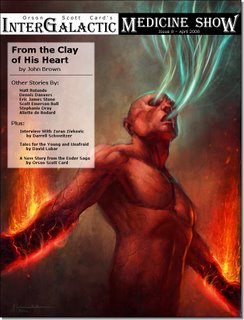
Locus Magazine, the trade publication for the science fiction and fantasy genre, has listed my novelette, “From the Clay of His Heart,” on their 2008 recommended reading list.
Folks, just wanted to update any who might be planning on attending my sessions at the American Fork Arts Council writing conference. I’ve had to cancel. There’s been a death in the family. My brother-in-law’s three week old son died yesterday. His name was Landry. I’ll be at the funeral up in Cokeville, Wyoming on Saturday. What a very, very hard thing for them. I was so looking forward to participating in the conference, but these folks need solace and support. I’m sure you understand. I hope to attend next year. And I will be presenting at CONduit in May, although the organizers haven’t gotten back yet with details. I’m sure you’ll still have a great time–there are so many other interesting presenters coming. Happiness.
Folks, a huge thanks goes to Stephen Nelson for putting all this together. You may kiss his hand when you see him.
This is a recording of “How to Write a Story that Rocks,” a two-hour seminar Larry Correia and I just put on at the annual BYU’s Life, The Universe, & Everything symposium. I think we had 130-140 people attend. This symposium is focused on writing fiction. And while the panels and presentations do include things specific to the science fiction, horror, and fantasy genres (both adult and young adult), a lot of time is also spent on story writing fundamentals that apply to ALL genres. So when I developed this workshop, I made sure I took the fundamental approach.
The two-hour seminar has been broken down into 12 segments. To switch between the segments:
Hover your mouse pointer over the YouTube below
Click the forward and back arrows that appear on the right and left sides to move to the next or previous segment, OR
Scroll through all 12 segments and select the one you want using the playlist control at the bottom
I’ve found whenever I develop any presentation or training that it takes a few iterations and revisions before it’s the best it can be. This is the first iteration of this seminar. And so below this video I’ve provided additional comments on each segment explaining key concepts, principles, and techniques that we might have failed to discuss or convey as clearly as we’d hoped. Enjoy!
It’s documented–right-wing gun nut Larry Correia sang “Kumbaya.” What’s next? The hugging of small trees? Oh, Larry, the disilluion. The disillusion.
The reason why I had Larry sing was not for his mellifluous performance, but to demonstrate the difference in reactions between him and our happy volunteer (“Country Road” by John Denver–this really was a love fest). The volunteer balked because he hadn’t taken any thought to know what to sing before he was commanded to do so. On the other hand, Larry and I had spoken before the seminar. So Larry had something to sing BEFORE he sang it. It’s a simple demonstration, but it illustrates a principle a lot of new writers forget. Writing is a performance. It helps to know what it is you’re going to perform before you perform it.
It’s one thing for you to tell yourself to write. It’s much easier to tell yourself to write the scene where the rancher finds out one of his illegal ranch hands has been kidnapped.
Now this doesn’t mean that you have to know everything. Or that you can’t write exploratory drafts to figure out what it is you want to write. But it does illustrate that whatever techniques you use, you’ll be a lot more effective in your writing when you have something to say first.
But what do you develop? What are the things that bring the story to life? How do you go about getting those things to say? That’s precisely what I wanted to address in the seminar. In the segments that follow, I try to:
Explain what I’ve found are the most important things to develop, the things that define the essence of story, that make the story come alive in the writer’s mind–the things that really matter
Demonstrate techniques to develop those things so you have something to say
Segment 2
I think this segment went fairly well. What rocks will different from person to person, even though there will often be a huge overlap between people. So it’s important for authors to seek to develop the kinds of stories that rouse their passion. Watch this interview with best seller Debbie Macomber to see what I mean. So I can’t tell you what to write about. Or if whath you think rocks will resonate with a large number of people. However, what I can do is share the techniques I use that have been most productive in helping me develop initial ideas into something that has much more power.
You can use the techniques to juice up any of the four parts of story. However, I will say that I find that the most productive, the most important parts, are character and problem. Plot and setting are important. I love them and work to juice them up. But when I get a good character and problem, that’s when the writing seems to flow the easiest.
And no, I don’t list theme as a part of story. Everyone talks about theme, but when I read what they have to say or press them for examples, it seems that it always either boils down to (1) a story element or topic that’s repeated, (2) a story problem/issue stated in an abstract manner, or (3) some moral situation. Les Miserables is about the “theme” of mercy versus justice. But saying justice versus mercy is just an abstraction of the story problem and dilemmas the story deals with. So, no theme.
I’ll be adding my comments to the rest of these segments over the next few days.
Segment 5
Segment 6
Segment 7
Segment 8
Segment 9
Segment 10
Segment 11
Segment 12
Dan Wells on Story Structure
Check it out: Dan Wells on How to Build a Story (story structure). I find Dan’s “start with the ending” technique helpful as well as thinking about a worst fears realized moment. Watch the videos and see if there isn’t something there that can help you develop your story idea.

Bought all 3 books today. Can’t wait to read ’em. 😉
-Matt
Lovely.