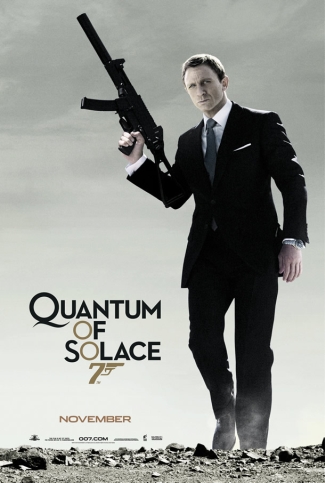
Last night I went out with my wife and some friends to watch QUANTUM OF SOLACE. I was so excited. But when the movie ended, I was totally unsatisfied. There was no release. Nothing. It just ended.
There was lots of great stuff in it. Love the character and style of this new bond. Loved CASINO ROYALE, but this just didn’t work for me. My diagnosis has two parts.
MINOR ISSUE: clarity in story. The chase scenes were so choppy I couldn’t get a feel for what was going on so I could worry for Bond. All I did was get sick to my stomach. Part of the way through I told my wife I was going to write death threats to the freaking director. Who in the world thought that was a good idea? It doesn’t mimic battle etc. In battle you are HYPER alert and focused. Your world doesn’t turn into chaos.
But it was more than the chase scenes. There were times when I did not know what was going on. Why was Bond going to his friend from movie 1, why was he watching that guy pick up a bag at the play, why was he going to the party, etc.?
If he’d shared any of his plans, I could have gotten worried when antagonistic forces thwarted him. As it was, I was just watching him do stuff and only realizing at the end what the goal was.
The basic principle of suspense is to let me know what they need to do and why they need to do it, then let me worry as I see the operation fall apart. Or let me know the danger and see them walking into it. But time and again they didn’t provider the viewer with the necessary information in this movie.
MAJOR ISSUE: ineffective story structure. I think for a film to build to a huge climax and release, the hero has to find himself in more and more desperate circumstances. His situation has to become darker and darker until we see no way out for him. By the end of act 2 his plans etc. should all be in shambles. He’s out of options.
In this Bond I rarely felt he was in danger. Yes, there were some fight sequences which were tense, but he never ended up in worse shape afterwards. We got messages that he was being framed for murders, but I never really felt the screws tightening on him. So it never got darker and darker for him.
His plans seemed to only be delayed, not destroyed. In Casino Royale, his car is wrecked and he’s taken captive and is going to die. He loses. In this one, nothing. Even when his plane is shot down going out to the desert, it’s just a delay. They walk to the bustop and are soon back on track.
There might be another point about something being at stake. The water grab is a great idea, but we’re talking a 50 year plot. It’s not THAT urgent.
A FIX?
I think they could have done more by playing up the revenge/mystery of the last one. Yes, have the water grab, but make this personal to him. He’s searching for the answers to who was behind his lover’s death. Why not?
Then get the villain, the US CIA, and the British hunting him down with real resources. He evaded everyone fairly easily in this one. He’s running FROM all these forces, barely one step ahead, until he gets caught by them. And it’s one of Green’s guys in the CIA or something like that who captures him. So he’s totally screwed. Then have the Black CIA officer do something to spring him. He’d probably have to die for it.
I’m sure there are more and better options. But do something so that Bond is running for his life, FAILS, then pulls it out. Not chasing down the bad guys one by one with relative ease.
At the UAA conference in Springville, Utah this Saturday, I’m going to be sharing two tools I use that help me figure out where to start my stories and what comes next.
The first is simply a quick and dirty method for figuring out a ballpark estimate of how long my story will be. But the length is not stated in words or pages for the simple reason that stories aren’t made up of words or pages.
Eric James Stone is a successful short story writer. You can read my review of his excellent “Like Diamond Tears From Emerald Eyes” here. Now, in Tips on Keeping Short Stories from Becoming Long Stories he shares excellent insights on how to keep those short stories from growing out of control. As someone whose stories always tend to go long, let me say that I know from experience that these tips work.
Luc Reid is the author of, among other things, Talk the Talk: The Slang of 65 American Subcultures. He is also the lizard king of Codex, which he started and of which I’m so happy to be a member. He’s always starting provocative threads on Codex, making us all think and reexamine the principles of story and the whole writing business. He recently posted some insights about what makes memorable stories. A lot of other fellow Codexians joined in the discussion. Happily, he asked me to share some of my thoughts on his site, ReidWrite. They begin as follows:
YOU’RE MINE, DEAR READER
Mwuhahaha.
Okay, maybe not. But you are wired to be mine. And you wouldn’t have it any other way.
Let’s back up. Luc wrote about writing memorable. I agree with the idea that the stories that produce a strong emotional reaction are the most memorable. In fact, I believe that triggering of emotion is THE reason why linear narrative that puts us into the trance has lasted so long in so many forms and makes so much money.
But can writers guide reader emotions? Or is it all just by accident?
BTW, when you’ve finished that, you might want to check out Luc’s new site, WillpowerEngine.com. It’s a place where he shares what he’s found in his research for his current book project, The Willpower Engine, on how self-motivation works. I think you’ll find a number of the posts there very interesting.
I arrived back at work, along with 2,000 e-mails and about that many incoming books, I got a report from Bowker, a global firm that tracks people’s book-buying habits. Here are some of the more interesting bits from 2009:More than 40 percent of Americans over the age of 13 purchased a book; the average age of the American book buyer is 42.
Women make 64 percent of all book purchases, even among detective stories and thrillers, where they buy more than 60 percent of that genre. [see, they act all touchy feeling, but most women like to see someone kick hiney. Except I suspect a lot of that 60% is driven by mysteries; or are there a lot of women that like, say, Lee Child?]
Thirty two percent of the books purchased in 2009 were from households earning less than $32,000 annually. A fifth of those sales were for children’s books.
The biggest nonfiction genre is biography and autobiography.
Surprise, surprise: the hardcore power users in the eBook world are the same demographics as the hardcore power users in the physical-book word, as a report called Consumer Attitudes Toward E-Book Reading from the Book Industry Study Group (BISG) indicates both hardcore groups are dominated by women buying fiction.
No surprise, really. The BISG says most eBook power buyers — that is, someone buying an eBook at least once a week — are by and large women (some 66 percent), who mostly buy fiction. Out of the entire eBook market, power buyers make just 18 percent of all buyers, but they buy 61 percent of the eBooks. [Holy crap! 18% are driving the sales–who are these people?! Of course, this is just the old 80/20 rule showing its face again.]
In terms of exactly what is selling: literary fiction, science fiction and romance lead the way, each with over 20 percent of the market. [Go SFF!! and those are not the normal breakdowns, SFF is usually under 10%] Overall, eBooks comprise 11 percent of the total book market, with 13 percent of print book buyers also downloading eBooks.
That evolution of the market isn’t surprising: early gadget adopters tend to be men, but as eReaders become more mainstreams, its userbase logically would look like the book market as a whole. And that’s exactly what happened: If women buy 64 percent of all books, it’s no surprise they’re buying 66 percent of all eBooks. [Except I think you got your math wrong; they’re 66% of power buyers. You didn’t say what report said of total sales]
A cracking good story idea requires five critical elements.
Until you have all five, you’ll struggle to plot. You’ll write a few scenes and run out of gas. You’ll feel like the story just isn’t going anywhere.
And that’s because it isn’t. It can’t. A story isn’t a story without all five elements.
However, once you develop these five things, your story will suddenly roar to life. There are a few other elements that are important as well, but these five things form the core of the story setup.
In this course you’re not going to merely learn about all of those story elements. You’re going to go deep and learn what can only be learned by actually doing the work and developing story idea after story idea with personal one-on-one feedback from someone who knows what they’re doing.
When you finish, you won’t just know story theory. You will be a story idea machine. And you will be that because you have put in the work. The right work.
Again, this is not a course full of lectures and videos. This is a course where you’re going to work. And develop the insights and skills that only come from doing the work.
You’re actually going to:
Come up with story setup after story setup after story setup
And improve them with one-on-one feedback.
It’s going to:
Eliminate years of you wandering about in the story wilderness trying to figure things out on your own.
Put you miles ahead of other writers who have no idea what’s really at the core of story.
You are going to learn how to develop killer story ideas on purpose instead of on accident. Which means you’ll be able to do again and again. Reliably. Like clockwork.
Course details
The focus of the class is not on learning about story, although you will do that. The majority of your time will be spent on developing stories.
You can’t become a carpenter by watching videos and reading books about it.
You have to get out on the work site, cut wood, and pound nails. You have to make the mistakes all beginning carpenters make, get feedback, and improve.
The same goes for writing.
And you’re going to work in this class. You develop 21 story setups. In fact, you develop more because the 21 are just the ones you turn into me. And with each one your skills, insights, and abilities grow.
In the beginning, your setups will be bare bones. By the end, they’ll be fully developed setups that beg to be written. Setups you can use to immediately write the first draft of your novel, whether that’s in outline or chapter form.
Here’s what you do each week.
Week 1.
Uncover the secrets of what’s really at the heart of story and how to generate ideas.
Define your genre requirements
Create story setups 1-3
Week 2.
Uncover the secrets to compelling characters
Create character sketches
Create story setups 4-7
Week 3.
Uncover the secrets to formidable obstacles
Create story setups 8-11
Week 4.
Uncover the secrets to interesting casts
Create story setups 12-15
Week 5.
Uncover the secrets to managing multiple storylines and series
Create story setups 16-19
Week 6.
Create story setups 20-21. These are your capstone projects where you apply everything you’ve learned and take it to the next level
In this class you develop story idea after story idea after story idea. You are going to be marinated in the work of developing characters, THOMs, goals, obstacles, settings, casts, and more. And because of that, each week will not only bring an explosion of insights, but new skills and abilities.
Every week you get two private, one-on-one, live sessions with me where you get encouragement and feedback on what you’ve developed. And you’ll have access to a private Facebook group where you can apply the principles to brainstorm even MORE ideas for each other’s stories.
At first you might feel a bit shy and worried about your ideas and abilities. But you’ll soon get over that. By the end of the course you’ll be one of those people that can generate terrific ideas easily. And you’ll be able to do that because you will have put in the work to become a different writer.
What’s the price?
Hours of one-on-one instruction from a professional editor or author costs thousands of dollars. An MFA program can cost $25,000 to $30,000 or more!
But this course won’t cost anywhere close to that.
Plus you’re going to learn things here you’ll never get in an MFA program (I know. I was accepted into a top-ranked program).
The cost of this course is $799. And I personally guarantee your results. You’ll be totally oh-my-gosh-I’m-so-happy-I-took-that-class satisfied, or I’ll give you your money back. No questions asked.
Now’s your chance to stop spinning your wheels. I can’t tell you how much I wish I’d had something like this when I’d started:
The secrets about the true core of story.
The secrets about how to come up with ideas.
Actual work with personal one-on-one feedback.
Laser focused on what actually matters, not a bunch of ridiculous writing rules.
When you finish, you will be a story idea machine.
You won’t know plotting. That’s a different course and set of skills. You won’t know how to write chapters. But you’ll know how to create the engine that powers all the rest of that. You’ll know how to create the core that makes awesome plots and chapters possible.
If you want to take this course, click the button below and contact me. I will tell you exactly how to apply.
I’m not going to be able to accept everyone who wants to take the class. I have a very strict limit on the number of students I can work with. So you need to get your application in before the deadline of midnight, December 11th.
Thank you so much for sharing these John. Your seminars were the most helpful at LtUE 2017! Now that it’s all over, I’ll do my homework you assigned and keep you posted.
Glad to hear you find it helpful!
Looking forward to receiving it 🙂
I loved your sessions at LTUE 2017, just like LTUE 2016 they were the highlight of LTUE for me! I am going to put THOM R into practice on the two current books I am working on as well as doing the list generation exercise.
Thank you so much for sharing!
Glad to hear it! Please let me know when you’ve done the exercise and report the results.
 Here are the materials for the presentations that I’m giving at LTUE this year. Enjoy!
Thanks for sharing! You always have great stuff!
Thank you so much for sharing these John. Your seminars were the most helpful at LtUE 2017! Now that it’s all over, I’ll do my homework you assigned and keep you posted.
Glad to hear you find it helpful!
Looking forward to receiving it 🙂
I loved your sessions at LTUE 2017, just like LTUE 2016 they were the highlight of LTUE for me! I am going to put THOM R into practice on the two current books I am working on as well as doing the list generation exercise.
Thank you so much for sharing!
Glad to hear it! Please let me know when you’ve done the exercise and report the results.
Thank you for the great sessions and handouts!