|

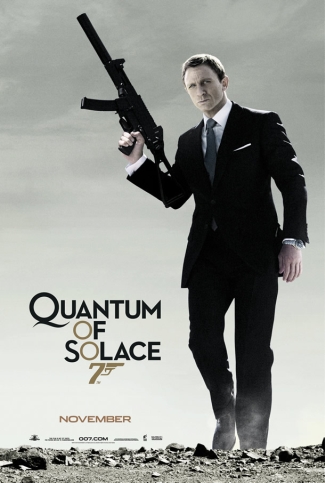
Diagnosing Quantum of Solace

***SPOILERS***

Last night I went out with my wife and some friends to watch QUANTUM OF SOLACE. I was so excited. But when the movie ended, I was totally unsatisfied. There was no release. Nothing. It just ended.

There was lots of great stuff in it. Love the character and style of this new bond. Loved CASINO ROYALE, but this just didn’t work for me. My diagnosis has two parts.

MINOR ISSUE: clarity in story. The chase scenes were so choppy I couldn’t get a feel for what was going on so I could worry for Bond. All I did was get sick to my stomach. Part of the way through I told my wife I was going to write death threats to the freaking director. Who in the world thought that was a good idea? It doesn’t mimic battle etc. In battle you are HYPER alert and focused. Your world doesn’t turn into chaos.

But it was more than the chase scenes. There were times when I did not know what was going on. Why was Bond going to his friend from movie 1, why was he watching that guy pick up a bag at the play, why was he going to the party, etc.?

If he’d shared any of his plans, I could have gotten worried when antagonistic forces thwarted him. As it was, I was just watching him do stuff and only realizing at the end what the goal was.

The basic principle of suspense is to let me know what they need to do and why they need to do it, then let me worry as I see the operation fall apart. Or let me know the danger and see them walking into it. But time and again they didn’t provider the viewer with the necessary information in this movie. 

MAJOR ISSUE: ineffective story structure. I think for a film to build to a huge climax and release, the hero has to find himself in more and more desperate circumstances. His situation has to become darker and darker until we see no way out for him. By the end of act 2 his plans etc. should all be in shambles. He’s out of options.

In this Bond I rarely felt he was in danger. Yes, there were some fight sequences which were tense, but he never ended up in worse shape afterwards. We got messages that he was being framed for murders, but I never really felt the screws tightening on him. So it never got darker and darker for him.

His plans seemed to only be delayed, not destroyed. In Casino Royale, his car is wrecked and he’s taken captive and is going to die. He loses. In this one, nothing. Even when his plane is shot down going out to the desert, it’s just a delay. They walk to the bustop and are soon back on track.

There might be another point about something being at stake. The water grab is a great idea, but we’re talking a 50 year plot. It’s not THAT urgent.

A FIX?

I think they could have done more by playing up the revenge/mystery of the last one. Yes, have the water grab, but make this personal to him. He’s searching for the answers to who was behind his lover’s death. Why not?

Then get the villain, the US CIA, and the British hunting him down with real resources. He evaded everyone fairly easily in this one. He’s running FROM all these forces, barely one step ahead, until he gets caught by them. And it’s one of Green’s guys in the CIA or something like that who captures him. So he’s totally screwed. Then have the Black CIA officer do something to spring him. He’d probably have to die for it.

I’m sure there are more and better options. But do something so that Bond is running for his life, FAILS, then pulls it out. Not chasing down the bad guys one by one with relative ease.

Just one option. Thoughts?

Share

Similar Posts

  • |

    Jon Ronson, mild-mannered pal of extremists

    Take a guy who does humorous journalism, but not in the sneering sort of way, and send him out to find out more about extremists (KKK, Islamicists, etc.) and conspiracy theories (he didn’t really believe in the Bildeburgers…until he was followed), and what do you get?

    Well, you get British journalist Jon Ronson.

    I just listened to a wonderful interview with him on Radio West.

    Don’t miss it.

    Share
  • New creatures & mystery in wonder fiction

    I love listening to writing excuses because I get to hear three smart and funny authors discuss interesting topics that get me thinking. This week’s writing excuse was on building non-humans in SF&F.

    Here’s my take.

    An alien race, if done right, can be a huge draw to a story. For example, Brandon Sanderson’s Kandra point of view in HERO OF AGES is one of the most enjoyable parts of that book.

    However, I want to suggest that aliens (in fantasy or sf) create that draw only IF they’re kept sufficiently strange or mysterious. The minute they become common or too human, they lose their power to enchant.

    That’s one thing I like about how Tolkien did the elves and orcs–we never got the National Geographic on them. They never became common. And so I always wanted to know more. Easterlings, ents, balrogs, the orders of wizards, dragons, etc. were the same. There were tons of tales Tolkien hinted at, curioisties raised, but those desires were never sated. This is part of what drove me to other fantasy books.

    It’s the same thing that made me love mammoths and dinosaurs, bats and giant squid, and far-off places. However, once these things became common and explained, their magic departed. The curiosity generated by the wonder of things new is one of the key things science fiction and fantasy offer its readers. But I think authors can only keep it alive if they approach it in the same way a fan dancer approaches her work.

    This leads me to another point. It’s true that focusing our world building on the conflicts and story touch points can keep us on track. And we do need to produce. However, I think if we strictly limit our alien development to the central story conflicts, we might miss many opportunities for that wonder. Some of what we develop might end up complicating the plot while other parts might only enrich the experience. And I don’t think that’s bad.

    For example, one of the most poignant parts of the LOTR, of which there were many, was the tale of the ents and the entwives and Treebeard’s poem. Tolkien could have eliminated that and the story never would have been affected. But, O, how much richer the story was for that little side trail that still beckons. Or you might think of the ring Bilbo found. When Tolkien first wrote THE HOBBIT, it wasn’t THE ring of power. It was merely a ring that Gollum used. Only later, when he began to work on LOTR and was trying to figure out the main problem of the story did he work that detail into it becoming THE ring of power.

    Share
  • Authors love women

    Two fascinating articles on who drives books sales. Would love to see original reports.

    September, 2010
    http://seattletimes.nwsource.com/html/books/2012801171_litlife06.html

    I arrived back at work, along with 2,000 e-mails and about that many incoming books, I got a report from Bowker, a global firm that tracks people’s book-buying habits. Here are some of the more interesting bits from 2009:More than 40 percent of Americans over the age of 13 purchased a book; the average age of the American book buyer is 42.

    Women make 64 percent of all book purchases, even among detective stories and thrillers, where they buy more than 60 percent of that genre. [see, they act all touchy feeling, but most women like to see someone kick hiney. Except I suspect a lot of that 60% is driven by mysteries; or are there a lot of women that like, say, Lee Child?]

    Thirty two percent of the books purchased in 2009 were from households earning less than $32,000 annually. A fifth of those sales were for children’s books.

    The biggest nonfiction genre is biography and autobiography.

    Whoa. Go gals.

    June, 2011
    http://tomorrowsbook.com/format-wars/features/who-is-buying-ebooks-women-reading-fiction.html

    Surprise, surprise: the hardcore power users in the eBook world are the same demographics as the hardcore power users in the physical-book word, as a report called Consumer Attitudes Toward E-Book Reading from the Book Industry Study Group (BISG) indicates both hardcore groups are dominated by women buying fiction.

    No surprise, really. The BISG says most eBook power buyers — that is, someone buying an eBook at least once a week — are by and large women (some 66 percent), who mostly buy fiction. Out of the entire eBook market, power buyers make just 18 percent of all buyers, but they buy 61 percent of the eBooks. [Holy crap! 18% are driving the sales–who are these people?! Of course, this is just the old 80/20 rule showing its face again.]

    In terms of exactly what is selling: literary fiction, science fiction and romance lead the way, each with over 20 percent of the market. [Go SFF!! and those are not the normal breakdowns, SFF is usually under 10%] Overall, eBooks comprise 11 percent of the total book market, with 13 percent of print book buyers also downloading eBooks.

    That evolution of the market isn’t surprising: early gadget adopters tend to be men, but as eReaders become more mainstreams, its userbase logically would look like the book market as a whole. And that’s exactly what happened: If women buy 64 percent of all books, it’s no surprise they’re buying 66 percent of all eBooks. [Except I think you got your math wrong; they’re 66% of power buyers. You didn’t say what report said of total sales]

    Whoa. GO LADIES!

    Seems women have been driving entertainment in a lot of ways for a long time. Watch a few minutes of this interview with Hitchcock back in 1964.

    Share
  • World-building the history of a place

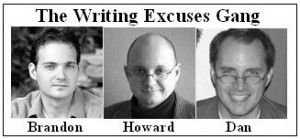
    writing-excuses-the-guys2-300x139The Writing Excuses guys have posted another good podcast: this one on world-building a history.

    I wanted to add a few comments. You’ll notice that a lot of the blurbs for my novel mention my world-building, so I guess it’s a strength in my writing. However, I don’t write huge world building documents in the pre-draft stage. I do write some history, of course. But I don’t think it would take up more than a few pages. A lot of world-building happens in draft.

    It seems to me there are two levels of “history” and a lot of it can be done on-the-fly.

    1. There are small hints of CHANGE in places and people.

    Dave Wolverton taught me this one. You come upon an orchard in the woods that’s gone wild and is overgrown. It takes two lines to describe it and it gives a strong feel of past. The reader wonders who was there, what happened. Maybe you tell them. Maybe you don’t. You mention that the village Knight used to be fat but is wasting or vice versa. I find I can do these types of things usually on-the-fly as I’m writing. And I don’t need to know much about them. I just ask myself if anything has changed with the location or characters in the current scene.

    A few touches of CHANGE throughout the novel give a strong sense of history.

    2. There are events, groups, and individuals who impact or impacted your characters and their community in large ways.

    There was a war with a neighboring country not five years ago. Your characters have to travel through that land, or maybe half the male population went to war and never came back. Or perhaps your character lost his sister in a drowning he could have prevented. Or he lost her to slavers. Or perhaps there is a secret police (like the Roman couriers) who arrived two years ago.

    Again, many of these things can be thought up on the fly as you look for conflict and the stories of a place and community. However, I’ve found that it helps to ask a few key questions in the pre-draft stage to lay some (NEVER ALL) the groundwork.

    — What kind of conflicts do these nations and groups have?
    — What events have had a large impact on my character and his community? They can be terrible or wonderful events.
    — Who in the community are my characters friends and enemies? What’s the history?
    — What are the local and regional stories of events (or people) that were eccentric, odd, mysterious, dangerous, or revolutionary?

    I never get all my answers up front. But I will get some. And then as I write I just keep in mind that it’s neat to indicate change every once in a while and to briefly bring up stories from the past that relate to the current matter at hand in the present story.

    Finally, I really like the idea the Writing Excuses guys brought up of sharing multiple explanations for an event (multiple histories) when it fits and to include more than one cause, although I’m pretty sure the 80/20 rule applies to causation.

    Share
  • How to get and develop killer story ideas – recording

    The recording of the session with Larry Correia at LTUE is up on YouTube. I really enjoyed this session, and it’s always fun to work with Larry. A few additonal points.

    First, you might think, well, heck, they didn’t finish a story idea. No, we didn’t. The purpose wasn’t to wow the audience. It was to show them the process of generating ideas. But . . . that doesn’t mean we weren’t close.

    The big thing we’re missing from the story at the end is the situation, the problem. So if you want to extend this, ask yourself a question to help you identify that story core. For example, you might say, let’s narrow this down by genre. What genres could we use? Romance, political thriller, crime, horror, humor, scifi, western, paranormal, etc. If we select paranormal thriller, we limit our options (a good thing), and can start to generate ideas around a question like, what’s going on, what’s the problem? Potential answers:

    • There’s some gateway to the spirit world in Wyoming
    • Maybe there’s an oilrigger roughneck involved
    • Maybe something with the drilling disturbed something
    • Maybe a crime has been committed (I know, I know, but what did I say in the video about crap, cliche?)
    • Maybe that Japanese tourist has a way to capture the spirits and use them in some magic. Is he a wizard? Is he there to trap the spirits of the dead to fuel his magic? Did he get a nagging ghost that drives him nuts?
    • Did someone call him in?
    • Or is he possessed? An innocent bystander?
    • Is there some ghost there that knows something about a political figure, some information?  
    • Maybe someone who can project her spirit, has some power, has been kidnapped and is being held in Wyoming. Or tries to make her escape when her kidnappers stop in Rock Springs. And the guy to help her is the Japanese Tourist.
    • Maybe these aren’t ghosts, but some kind of alien symbiote? There was a crash somewhere and the locals were infected?
    • Or should I ask: what could go wrong with ghosts? Or what is the nature of ghost magic?  

    Do you see? If we had more time, we’d have delved more into the situation with creative Q&A. Sooner or later as we generated ideas around character, setting, and problem a story idea would have come to life.

    And (thank you, Mike Barker) here’s a transcript.

    Share
  • Why I’m gonna purchase Correia’s MONSTER HUNTER ALPHA on Monday

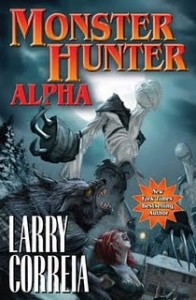
    I’m going to be purchasing MONSTER HUNTER ALPHA by Larry Correia on Monday.  Here’s why.

    Reason #1: Correia delivers the goods

    I read MONSTER HUNTER INTERNATIONAL.  I ended my review of MHI saying Correia was going to be a writer to watch.  Well, for those of you who haven’t been watching, not only did Correia  sell tons of copies of MHI, he also made the New York Times best seller list with his second book AND sold TV rights to the MHI series to a major TV producer.

    Why would his books generate such a response? Because they’re so dang fun. That’s why. And Correia isn’t just a flash in the pan one-trick pony. Far from it, as demonstrated by Reason #2 below.

    I told you in my review of INTERNATIONAL that I don’t read books that don’t suck me in. I don’t give them 70 pages to warm up and get going.  I don’t care who wrote the book. I don’t care if the author is a big lug with guns. I don’t care if he has status and money or friends who can put the hurt on me. I don’t care if the author is my girl’s godmother and brings me Walker Shortbread Rounds (which are evil cookies that exert mind control). If the book bores me, I put it down. That doesn’t mean that books which bore me aren’t wonderful. Sales and numerous reader exclamations of delight and satisfaction attest to the the fact that many are. It’s just that I’m a reader of little patience. I love it when a book starts with a bang and keeps me hooked. And Correia’s books do exactly that.   

    Reason #2: Correia’s getting better

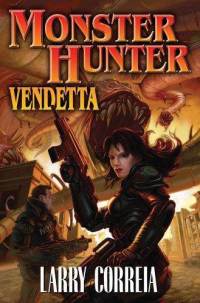
    I read MONSTER HUNTER VENDETTA recently.  I should have reviewed it, but I’ve been so freaking busy I barely have time to shave or appear in public because I’ve begun to look like the Unabomber. But here’s the deal with VENDETTA–it’s better than INTERNATIONAL.  

    Yes. Better.
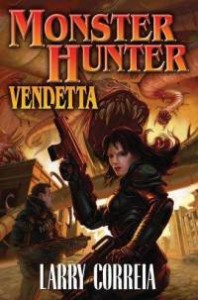
    Well, expect for maybe the opening paragraphs. The quote and first few paragraps that opened INTERNATIONAL are hard to beat. This doesn’t mean the opening of VENDETTA is weak. Heck, no. VENDETTA trounces the openings of most novels and steals their lunch. And then it continues to delight all the rest of the way through. It’s just that it didn’t quite deliver the same jolt as MHI. But 500 or 503 watts, what’s the difference?

    So with VENDETTA, are there guns? Yes.

    Monsters? Check.

    Action? There’s action galore.

    It appeals to my testosterone right off the bat (even though Larry reports that a good number of his readers are women). But there are guns, monsters, and action in a lot of stories that stink. What Correia does is not only give us great action, but he also gives us wonderful new situations.  For example, you will never see the scene set in the ghetto of Birmingham, Alabama that appears here in any other book. Never. It’s a Correia original. But even more important than great new situations, is that he gives us a first-person narrator who is delightful to be around. I’m talking about Owen Zavasta Pitt, the accountant monster hunter. His responses to the situations he gets in just make me laugh, as do a number of the responses of the other characters. My only wish is that Correia would tone down some of his language just a bit.  It is possible even when writing about military characters.  But you can’t have everything, and Owen’s such a loveable lug, I overlook it.  Hey, maybe Milo will help him out on that as the series progresses.

    Furthermore, Pitt isn’t the only character who I find delightful or interesting.  In VENDETTA there is also Holly, Agent Franks, and G-Nome, one of Correia’s best yet. Of course, there’s also the Doctors Nelson, the former hunter Carlos, Melvin the troll, and Earl Harbinger who have their own moments to shine. As do Owen’s dad and brother. And Dorcas, MHI’s secretary with the plastic leg. Heck, I even like Susan.

    So how many is that–eleven already? How many wonderful characters do most authors give you in one book? Two or three?

    And that’s one of the things that is is better with VENDETTA than INTERNATIONAL.  In INTERNATIONAL, as good as it was, some of the characters just didn’t get the stage time they needed to shine. But here Correia declutters his scenes so we’re not trying to focus on too many people. The result is that those we do focus on each have the their moments and lines. The other thing I noticed was that Correia deftly orients us to each new situation. For those of you who are writers, let me suggest you look at Correia’s technique in VENDETTA for introducing characters and settings. 

    Another good thing: he wipes out a Girls Gone Wild camera crew in the first chapter. Anyone who does that gets a few points in my book.

    VENDETTA doesn’t attempt to become bigger in scope than INTERNATIONAL (as if it could). Instead, it feels like another episode in a great tale. And I’m happy with that because it promises more to come. I’m back with characters I like and situations that make me laugh and magic crap that evokes some oohs and aahs and every now and again makes me wish I’d come up with it for my own use.

    Finally, VENDETTA leavens the humor and action with a couple of poignant moments. I’m thinking of a chapter with Carlos, another scene with Owen’s dad, and one with G-Nome.

    As you can see, VENDETTA’S packed with goodness.

    With ALPHA, I’m expecting to hook up with at least one of the gang for more exploits and laffs. Will Correia get even better? I have no doubt he will. But who cares–he’s already delivering great stuff.  

    Reason #3 Did I mention that Correia makes me laugh?

    Just didn’t want to forget that. Furthermore, I swear I read somewhere that laughter increases your health and makes you live longer. So not only am I getting a great read, I’m extending my days upon the land.

    Reason #4 Monday is a special day

    Not any old Monday. But the 25th of July.

    Why is this special?

    Because it’s the first day of the first week of the book’s release.

    Now I know I’m going to buy this book sometime. But buying it in the first week lets me do something I might not be able to do at some other time.

    Because Correia has given me hours of pleasure, I figure I can tip him for his good service by helping him make the best seller list again.  And a book has the best chance of making that list in the first week of release. (For those of you interested in how that works, Larry gives a good explaination here.) Making a best seller list does all sorts of good things for an author, and, as a result, that author’s readers.

    So Monday’s my day to leave the tip on the table and tell the owner to keep up the good work.

    The New York Times list is a good one. But I’d like to see him on the USA Today list, which measures sales so much better than any other list out there. My fingers are crossed.

    For those of you who are Correia fans or who have been putting off giving his stuff a go, now’s the time to either get MHI and begin the series or ALPHA and continue the delight.

    EDIT: After I posted, I couldn’t wait and just went ahead and processed my order. Pre-orders will count in that first week, and after writing this I couldn’t resist. Looking forward to more hours of laughter and some great characters.
    Share