An absolutely perfect and maddening turn in the story

You’ll note the word count on CODG is steadily rising. Today, I experienced a delightful AND maddening turn.

I find outlines to be immensely useful tools for story development. Of course, there are many more tools in the box–outlines can’t do everything. For example, there are times when you’re drafting a story that you write something and it suddenly generates new options for the story that you in no way could have imagined without getting to that point in the draft. You can get a lot of ideas with an outline, but drafts generate still more. Sometimes the options that present themselves while you’re drafting are so right they give you goosebumps. I got one of those today. Of course, part of why it was so good was not only that it put the character in a perfect dilemma and the reader in a perfect chapter cliffhanger, but also because it was completely unexpected yet logical. 

This all sounds so good, right? Well, the story turn was so unexpected, it startled me. It’s thrown my outline off. Which means I’m going to have to now revise the working outline. I was tempted to make the story fit. After all, I DO have a deadline. But this story turn is so freaking juicy that I cannot justify the hackery. Besides, working outlines are made for revision.

I’m riding by the seat of my pants today folks, and it’s exciting. I think readers are going to love this turn.

Share

Similar Posts

  • |

    Writing Update: 5/21/11 – visualize first, scene goals, the power of research

    I finished two chpaters this week. I’m quite a bit behind my stretch schedule which has me finishing the beginning of August although not too far behind my my conservative schedule which has me finishing the end of September.  A few more weeks and we’ll see if I’m giong to meet the stretch schedule.

    A lot of these first seven chapters are the same scenes as from before. Well, the same idea. But because enough has changed in the situations and because I’m writing some of the scenes from different points of view I have to rewrite them. So while I hope to catch up with some copy and paste from the last draft, I just am unable to do that here. 

    Visualize –> Report

    I thought I’d share one of my key methods for writing scenes. Here’s what I’ve found: when I can visualize the scene, it’s fairly easy to tell the reader what’s going on and to structure it in a way that achieves my purposes. When I can’t visualize it, I have nothing to tell. So for me the first thing I have to do is to see what’s going on. Then I can report as if I were there. Or if it’s from a more deep point of view penetration, I can report from my character’s eyes.

    So the sequence is to visualize (do the things that help me get that visual, feel, sound, etc.) then report in a way that will transport the reader and present the things I feel I need to present because they’re cool or because I want to generate a specific effect. 

    This is why I use the sketch/draft method. I sketch things out to get an idea of what’s going on first. Sure, I’ll discover details as I write. I’ll sometimes realize my first idea was off or wrong or won’t work. But if I don’t have an idea in the first place, I simply can’t write. It’s all a blank screen. One of the biggest causes of writer’s block is simply a lack of invention–of not having anything to write about because nothing’s in the mind of the writer.

    First have something to say. Then say it.

    Of course, you have to come up with the scenes in your mind before you have something to say. That takes some exploratory drafting, sketching, creative Q&A. You can see Orson Card doing some takes here in his writing lesson “Beginnings“, trying to help flesh it out in his mind. 

    The main tool I use to sketch is the summary–a bullet point or chapter outline like a posted about last week. However, sometimes it’s not enough. Sometimes I need an actual map to block out who does what and where. This week, for example, I was writing about Sugar coming into a village. She needed to enter then encounter some dead bodies.  I spent something like 45 minutes typing hardly anything and then realized-duh!-I don’t know what’s going on, where she’s going, why. I can’t see this place at all. I needed helping visualizing it first, not in super detail, but enough so I could report.

    So I took five minutes to sketch a simple map of the village, where she was when she entered, and where she was going, what was likely in the yards, the fences, etc. Once I saw it, I could then report, just tell what I saw as plainly as I could to the reader. I know these scenes fairly well, this being the FOURTH FREAKING DRAFT of this novel. And yet I’ve had to do some drawing for two scenes so far (the other drawing was for an ambush that wasn’t in the last draft). Because again, things had changed. And I had to see it before I could report it.

    Other tools that help me visualize and hear are actual photographs of things or people. Or audio of people’s voices. I was struggling getting a character in my mind for my short story LOOSE IN THE WIRES. I was listening at the time to Susan Grafton’s O IS FOR OUTLAW and when the actor performed this one character, suddenly I HEARD it. Boom, the guy came alive in my mind. Once alive there it was relatively easy to put him down on paper. Again, I was just relaying it to the reader.

    So I believe that what a writer must do is bring the situation to life in his or her mind first. It won’t be everything in exact detail. There’s a lot to be discovered in the writing. But it will be enough that it will feel like you’re simply telling something you saw or experienced.

    Scene Goals

    While writing, of course, I have objectives for my scenes. Sometimes I’ll do exploratory drafts, not having any goal except to see what happens and invent something cool. But that’s usually in my pre-draft stage. At this point I have a rough idea of where the story is going to go. I’ve already done a lot of the inventing. Now I have to translate it to scenes. And so I find having a quick list of objectives for the scene, along with my brief summary of what I’m expecting to happen, helps me visualize as well.

    Here are two examples of what a list of scene goals might look like for me.  These were for two scenes in draft 3 of CURSE.

    Example 1:

    • This is the time for her to make her HEROIC CHOICE. I want a heroic moment.
    • Terror of Legs being lost
    • Legs seeing her for the first time the next morning—he IS going to experiment because Urban is gone. Does he give something to her, his weave, twisted—Flax helped me.
    • Some tenderness
    • Last time with Mistress until the final battle

    Example 2:

    • Skir battle coolness. Need some surprises
      • Ayten dragging off souls
        • Sees it below on the ship
      • Seafire
      • What cool skir thing could there be?
        • Whirlwind
        • What would happen if a skir dived?
        • Some missiles, stones in the wind
        • First sight of that. She ship has slingers etc.
    • Sugar having to choose to leave people, see the beginnings of harvest
    • Oh Crap moment at end—this is going to be bad
    • This is the setup for the next scene where She and  Urban are spying and after the assessment, he says, we need to go. And she’s in indecision, and he says I will wait until, and then I will leave.

    They’re fairly simple.  Of course, I have other goals in mind that I don’t need to write down–“start and end with a hook,” or a rest, depending. “Transport the reader might be another,” meaning make sure I use what I know about presenting details. Another might be “bring the character on in an interesting way.” And because I generally know the big picture of what’s going to happen, I can focus on these other details as I write.

    Research: Monster Zing & Visualize Method

    Research is also a monster method for visualizing and for zing. I can’t tell you how much it has helped me in the past and on my current projects. In the thriller I’m working on where the main character is ex Special Forces, I could barely visualize anything. Some I’m reading books about it and talking to people who are in Special Forces and watching films about it. There’s no way I could build a story I cared about and believed in without research. I’m going to be doing a ride along with a cop, visit our state prison, and maybe talk to some ex-cons for this as well.

    Tim Powers came to the Writer’s of the Future workshop I attended many years ago. He talked about many things. But research was one of them. In fact, one of the idea generating methods discussed in the workshop, one on which Hubbard himself had written a fine article that we read called “Search for Research” (click the Next or Continued link at the bottom to continue through all the pages of the essay), was about the power of research. So Powers recently did an interview about the latest Johnny Depp Pirates release , which is inspired by his book of the same title (which I read and loved), and restated what he did so many years ago:

    Q: What inspired you to write On Stranger Tides?
    A: I was already hooked into using real historical places for settings. And so I thought, you know you loved Treasure Island…And I thought I bet you can set a nice fantasy story in among the pirates, Black Beard, that crowd. So I read a million books (that is probably fifteen books) about that particular crowd of pirates that were in the Caribbean in 1718 like Stede Bonnet, Black Beard, and Anne Bonny.

    What I always do when I’m writing a book is first I read all the history and biographies and things like that that I can find. And I look for stuff that’s too cool not to use. ‘Ooh that’s neat. Look at that. I like that.’ And I’ll write it down. And then I’ll find something else and say, ‘Oh wow this is great. You got to have a scene happening in this place. Oh you gotta use this guy.’ Eventually, I’ll have twenty or thirty things that are too cool not to use. And it’s kind of fun then because you say, ‘Well okay, here’s twenty or thirty parts of your book. You just have to connect the dots.’ And so I thought, ‘Ok, what was Black Beard really up to?’

    So to sum up.

    1. Visualize, then report.  That’s what I’ve found I have to do. It makes it so much easier to write when I have a picture in my mind.
    2. Scene goals help me visualize the scene and what needs to happen.
    3. Research is a huge tool for helping me find zing and to visualize and invent something I can visualize. 
    4. The Sketch/Draft process (I explained it in last week’s post and in the interview with Maya Lassiter) is another work horse of a tool for helping me visualize and invent by degrees.
    Share
  • Denver: fire, snow snakes, and farty beef jerky

    Here’s the report of what happend on the Larry and John tour of Denver.

    On the way out:

    1. We met in Evanston, WY at 8:00 AM
    2. On a lonely stretch of I-80 we passed a semi that was on FIRE. Didn’t stop because Larry and I wanted to see the driver burn.
    3. Was freeze-dried in a parking lot in Rawlins by Arctic winds in the four seconds it took to open the car door, say “Holy schnitzel! It’s freezing,” and then run to the Subway. It was cold. COLD!
    4. On another lonely stretch of I-80 we passed a truck driver out in that wind with a knife. He was down in the median trying to hack off the antlers of a bull elk that had obviously been hit by a vehicle.  His truck was slowly rolling forward. Someone had to be driving, but I didn’t see anyone.
    5. Because it was soooo cold the snow didn’t stick. So in various stretches the wind would blow the snow across the road in long trails that looked like ribbons of fire or snakes. Totally awesome!
    6. Then we started hitting stores all the way down to Denver–Cheyenne, Fort Collins, Boulder, etc. I can’t tell you how much I like Barnes & Noble booksellers. Everyone was happy to see us and nice to work with.
    7. Oh, and Larry bought treats. Wal-Mart trail mix, cookies, and beef jerky. When he opened the beef jerky, he said, “Holy cow, did you just fart?” I had not. It was the jerky. You have been forewarned.

    Other highlights:

    1. A number of the stores ordered extra copies of our books for our driveby signings. But the Barnes & Noble in the Aurora Southlands Town Center beat them all hands down. They rolled out a hand truck stacked with books.
    2. Had a great time in Loveland at the B&N there. Vivian Tapp was a peach with a Santa’s hat to boot.
    3. We had a bunch of folks show up at the Lone Tree signing. Thanks to everyone there. I’ve forgotten all the names except that of James, the store’s fantasy nut.
    4. Then we went out to dinner with a great crowd. Larry had a bunch of his interesting friends. I got to hang out at the other end of the table with my sister and her man Mark, Rachel Dryden, and Ken and Rachel Kao (who both do parkour–cool!!).

    On the way back:

    1. We almost died. You can read Larry’s version of the story here.
    2. More of that fine smelling jerky and road crawling with snow snakes.
    Share
  • SERVANT & Smith’s grocery, CURSE, Suspense series, My blog readers

    Smith’s Grocery Goodness

    Just saw the paperback of SERVANT OF A DARK GOD in a Smith’s grocery in Kaysville, Utah. What this tells me is that SERVANT sold well enough when it was in the Smith’s stores in hardback for them to bring it back a second time. I’m guessing it’s in all the stores in the state. I want to thank all of you who bought it in hardback at the time from Smith’s.

    Now, some of you may be wondering–why is Brown getting so excited about his book being in a grocery store? Here’s why.

    Barnes & Noble is one of my favorite places in the world. But there are only 10 stores in all of Utah. There are 50 Smith’s stores in Utah. There are probably 30-40 Fresh Markets in the same area.  There are 10 Maceys. When a book gets picked up by a grocery store, that ususally means it’s going to sell a LOT more copies. Why? Because more people can see that the thing exists. Furthermore, those displays put the cover face out. A huge draw for buyers that like to browse. So this is great news. And SERVANT might even be in some stores outside of Utah since Smiths’ and Fresh Market are national chains. If you see a copy in your local grocery store, please let me know.  

    And here’s to the day when these books show up in Wal-Mart, Sam’s Club, and Costco as well. 

    Curse of a Dark God Status

    A lot of people have been asking about the release date for CURSE. The short answer is that we don’t have a date yet. I will be writing a long entry about it next Monday or Tuesday. Just know that I’m working my keister off to deliver more great entertainment to you.

    Suspense Series Status

    I’m working on the post on structure. It’s about half way done. I hope to publish it over the Thanksgiving weekend.

    You JB blog readers

    I get a few thousand folks coming to this site each month. Most leave very little trace. But there’s nothing like meeting someone new who mentions they found a blog useful or entertaining. I had a great time at the Dragons & Fairy Tales book signing and at the dinner afterwards with the other authors. One gal who came by mentioned she enjoyed the recent post on cauliflower, even though she hasn’t read SERVANT yet. That made the whole evening. Of all the posts . . . Anyway, I’m so glad to hear from my readers. Even if it’s the veggie lovers 🙂

    Share
  • Where in the Sam Hill is Curse of a Dark God?!

    Because of so many reader requests, I think it’s time to explain.

    Alas, I must report that she ran off with a no-good tramp. I’m sure she’s realized her error. Either way, I’ve formed a posse. We’re hunting her down.

    That’s the true story. For those that want the boring press release that obscures the facts, you may read what follows.

    The first draft of Curse of a Dark God was delivered to the editor in August of 2009, two months before Servant of a Dark God was released. That draft had some issues with a few of the story lines. These issues crept (they did not run or slouch) into the text because the author, stressed about an aggressive deadline, decided to adopt the fix-it-when-you-finish-just-get-er-done-you’ve-got-a-freaking-deadline methodology of writing.

    But a book of 230,000 words is a big old momma. And if something in a beginning chapter is off, it wankers a whole heck of a lot of story that follows, much like a line of dominoes. But it’s not just one story line. This book had multiple interconnected story lines. So issues in one line rippled out into others. What this meant was that the changes that needed to be made weren’t wee things that could be dealt with in a few weeks. When the dust settled, it was clear the book required a substantial rewrite, even though the draft contained gobs of cool story.

    So much for that fix-it-later experiment. You can be sure the author won’t be using that on large books again.

    So the author wrote another draft of 245,000 words and delivered it in August of 2010. The story rocked. Unfortunately, there was a miscommunication on size (and there’s no use in having a drama about what was said and who was at fault and why fairies are always tiny hot chicks; despite our best efforts, life is full of bumps; the best thing to do is learn from them and move forward). The book actually needed to be in the 170,000 – 180,000 word range. Same as Servant of a Dark God.

    In a 10% edit, you’re tightening a story, cutting out the fluff. In an edit designed to reduce the book by 30% or more, you’re cutting off arms and legs and removing things like livers. The story can’t survive such cuts unless the thing was obese to begin with and just needed to go on a diet. Unfortunately, Curse of a Dark God draft 3 was fairly lean, given the amount of story it contained. It was NOT a candidate for Biggest Loser.

    The upshot is this third draft is going to be another major rewrite. Which means, given publishing lead times, that it’s going to take a number of months to get it on the shelves.

    (fricken, ricken, grumble, frag a friggen nack)

    Because I’m just starting on the outline, we don’t have a delivery date yet. As soon as we do, I’ll post it.

    I apologize to all of you expectantly looking forward to the next book. When I started this series, I promised myself that I would not leave my readers hanging. I was determined that my books would come out in a timely fashion. And I have been working like a devil to do just that, but sometimes things happen. What I can promise you is that this draft will go quickly. Furthermore, I already have book 3 outlined. It should go quickly as well.

    I know some of you are asking why? Why, the word limit? Aren’t there are plenty of monster books out there?

    There are. In fact, about half of Robert Jordan’s Wheel of Time books are roughly the length of draft 3. Publishers do sell fat books. However, the bigger the book, the harder it is to make it profitable.

    First, bigger books cost more. There’s the cost of the additional paper and editing, but there’s also the extra money to ship and store.

    Second, you can’t put as many copies out in the stores. You can’t because they take up more of the space that might be allotted to an individual book. So instead of being able to have stores stock four or five copies of a 120k novel, they can only stock two or three of a big old momma in that same space.

    Third, bigger books cost you, dear reader, more money. Sure, the publisher might eat some of the additional costs, but some of those costs will be passed onto you.

    So because of the increase in cost, the publisher needs to sell more copies; however, the limit on display space and the higher price make it harder to sell those additional copies and actually may lead to selling fewer copies.

    Do you see the bind?

    This doesn’t mean big books can’t be profitable. It just means that it’s not as easy. It’s a bigger risk. Part of me would want the publisher to take that risk. But the other part of me knows that slow and steady usually wins the race. Neither I nor the publisher want to gamble the long-term viability of the Dark God series. Now, if Tor was doing this all in paperback, this might not be such a big issue. But we’ve got the sweet hardback/paperback deal. And business projections have to be done in that world.

    So the short of it is that we’ve run into some business limitations, and it’s going to take me a bit more time to deliver.

    I wish I could announce a date at this time, but I can’t. I’ll finish up the outline for this draft and run that by the publisher around Christmas. Then it’s back to work. I promise that what you’ll get will be my best. And that’s what you want, anyway, even if it takes a bit longer to get it into your hands.


    Share
  • Writing update: Servant proofs & cover, Curse battle finished, events

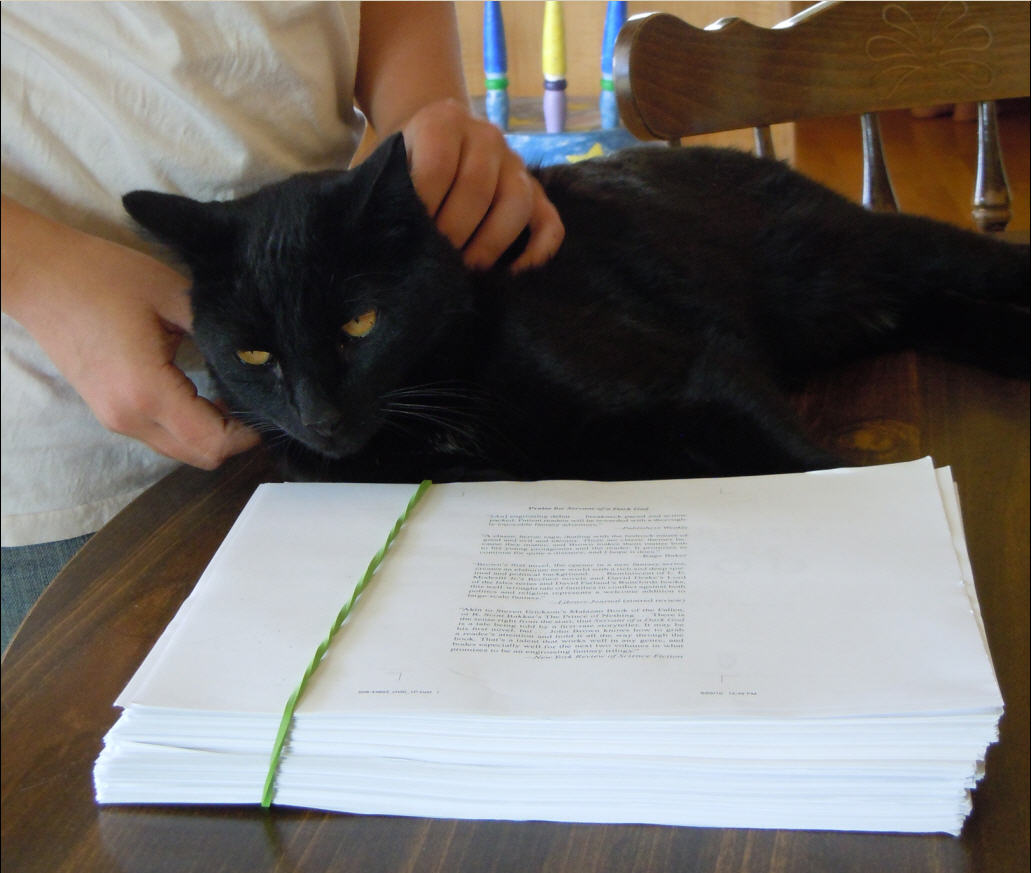
    Two bits of news about Servant of a Dark God. I received the proofs for the paperback version in the mail this week as you see below. The cat is used because he deserves a cameo. This is Panther giving us either his “Sigh, whatever, I’ll submit to your weird human ways” or “Umm, scratches” looks. He’s the last of the original eleven cats we inherited when we moved to Laketown back in 2003 (nine of them were black, one was a gray tabby, another a sort of tortoise color). Dutchess, the one who liked to tear open our bread bags while we weren’t looking and eat the bread, got run over. Three others, including our talker Tabby, we think were stolen by a woman looking for “stray” cats because, golly, the rattlers keep getting all hers. Ours were obviously strays because we live in 2.5 acres surrounds by dozens and dozens of acres of open land around us and we let them roam the hills! A few were shot, we think, by a kid who came to visit his grandfather who lived 1/2 a mile down the road. We think coyotes might have gotten the rest. So Panther is the last survivor. 7 years old. We love the old man.

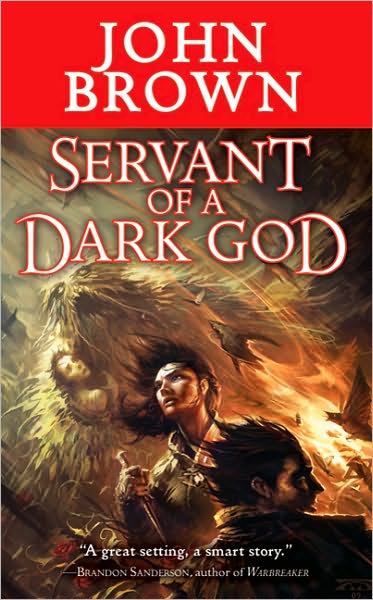
    I have just a few days to go through the proofs and find any typos and punctuation errors and get it back. The paperback version is scheduled right now to be released in November. And here’s the cover the publisher is using on Amazon and Barnes & Noble. You can see the difference between it and the hardcover by comparing it to the image in the sidebar.

    *

    As for Curse of a Dark God, I typed the last word of the final battle and climax on Saturday. As it now stands, the final battle required 34,429 words to write. Holy schnitzel! Again, many adult novels average around 90,000 – 110,000 words total. So this is a significant sequence. For those of you who like to think in pages, it’s going to be anywhere from 100 – 140 pages depending on how the publisher configures the book. I have one more short chapter to write and the draft is finished. Well, I have a few things to seed into earlier chapters so that the ending etc. works, but that’s small stuff. The next step is to have a few readers go through this draft. Make any necessary edits. Then get it out to my agent as quickly as possible. Once my editor accepts it, we’ll be able to set a release date. And I might feel the sword of editoral doom lift just a little from my head.

    *

    Finally, just wanted to give folks a heads up about the following events I’ve committed to.

    Date What Area Details
    Saturday, September 18, 1-4 PM Book signing Orem, UT The Orem, UT Barnes & Noble is having an authorpalooza. Come meet a boatload of authors.More details here: http://store-locator.barnesandnoble.com/store/2626 University Crossings Barnes & Noble
    330 East 1300 South
    Orem, UT 84058
    801-229-1611
    Saturday, October 9, 2010, all day Writers conference American Fork, UT The American Fork Arts Council writers workshops have become so popular that they’ve decided to start holding one conference in the spring and one in the fall. These conferences focus on giving concrete advice and encouragement to aspiring writers. I’ll be giving a keynote speech and participating in some breakout sessions. I was really happy to be invited back since I had to bow out of the last one two days before it was scheduled to run because of a death in the family.
    Share
  • David Morrell Workshop, June 6, 2008, Boise

    One of the things I love about writing is that there’s always something new to learn. There’s always new content and, therefore, lots of cool research, but there’s also a lot to learn about the craft. I have no illusion that because I now have a contract I’ve suddenly arrived as a master craftsman. This art is just too big.

    So you can imagine my delight when I saw that David Morrell is going to be giving a day-long workshop in my own backyard (out West, 5-8 hours is still in your backyard). I’ve signed up for Morrell’s workshop on June 6, 2008.

    He’s the guy who wrote Rambo and started Thrillers Inc. He was also a professor for many years.
    More on the Conference
    http://www.murderinthegrove.com/index.htm

    More on Morrell.
    http://www.shotsmag.co.uk/shots21/intvus_21/dmorrell1.html
    http://www.davidmorrell.net/
    http://www.writerswrite.com/journal/oct02/morrell.htm

    This was interesting.

    Ali: As a Professor of Literature at Iowa, what were your experiences in academia like? Did you tutor any students who became prominent in the fiction field?


    David : I have a Ph.D. in American literature and taught academic courses: the American Novel of the 19th Century, the American Novel of the 20th Century, American Realism, Hemingway and Faulkner, Hawthorne and Melville, that sort of thing. The University of Iowa has the famous Writers Workshop, but I had nothing to do with it. In fact, they hated the sort of books I wrote and hated even more that I earned money as a novelist. That was the official line. But in secret, students snuck to my office and asked me technical questions about craft or asked me to read contracts they’d been offered (to see if the contracts were reasonable). Sometimes they showed me their manuscripts. The most productive association of that sort was with Jon Jackson who later published a series of police novels about Detroit. My most gifted student was T. C. Boyle. He writes humorous literary novels and short stories that critics love. His latest is DROP CITY. I taught him nothing about writing – he was a genius. But he did ask me to direct an individual reading course that he needed in order to graduate. We had a lot of interesting discussions, and I’m thrilled by his distinguished career.

    Interestingly enough, T.C. Boyle was one of the writers that made life bearable for me while I was getting my BA in English. His novels, well, I never finished one of them. But his short work sings. Heck, his long work sings, but there’s not enough plot for my tastes.

    Share