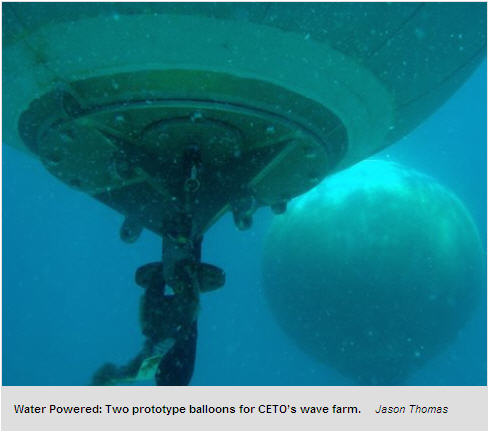
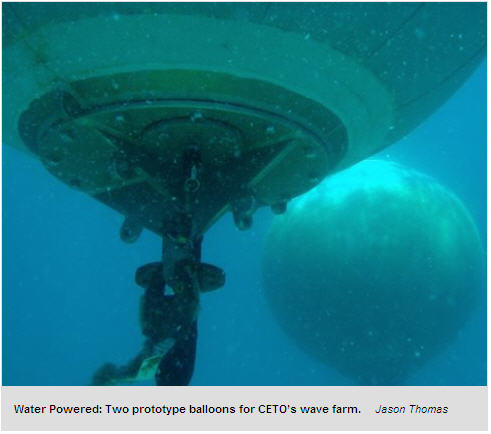
This is a fantastic article summarizing some key issues with wave energy and the solution Alan Burns, an oil bloke from Australia, has come up with. It appears he’s taking lessons from his expertise in off-shore drilling (it’s safer to work on the bottom of the sea) and applying it to wave energy. It’s a must read.
No ideas yet on how to use this in a story. If you have any, post in the comments section.
Wait, what if our hero is an inventor like Mr. Burns? Naw, what if we actually do go to the seas? It seems like a no-brainer. So we go to the seas. And our hero is the guy who is replacing parts. Humm, maybe. Of course, if our power generation is out there in the sea, then a perfect target for a terrorist is the pipe pumping the water in. Or what if they find a sea wreck while installing a huge one of these? And would the ocean floor suddenly become real estate? What kind of agent would sell it? Hummm
THE internet could soon be made obsolete. The scientists who pioneered it have now built a lightning-fast replacement capable of downloading entire feature films within seconds.
At speeds about 10,000 times faster than a typical broadband connection, “the grid” will be able to send the entire Rolling Stones back catalogue from Britain to Japan in less than two seconds.
The latest spin-off from Cern, the particle physics centre that created the web, the grid could also provide the kind of power needed to transmit holographic images; allow instant online gaming with hundreds of thousands of players; and offer high-definition video telephony for the price of a local call.
Can you imagine that game world? Can you imagine a world that’s an actual world? Where adventurers set out to find fortune and encounter all sorts of nasties being played by hundreds of thousands of other people around the globe?
So, folks. Maya has a fascinating life (as do most people when you start to get the details). So fascinating that you can’t help but want to write about someone like her to see where the story goes. Go read her blog and tell me you don’t agree. It doesn’t get any better than this.
In fact, what would happen if I took a Maya and put her in that thriller I’ve got incubating?
I’ve got about 20 folks in The Netherlands and Belgium who visit this site regularly. I just wanted to say I hope you wonderful kaaskops and frites find your shoes full of good gifts this Sunday!
For those who don’t know, folks in the low lands celebrate Sinterklaas on the 6th of December and Sinterklaasavond (Saint Nicholas eve) the night before. The name is a contraction of Sint (Saint) Niklaas (Nicholas). Yes, the real Santa. In America we give gifts on Christmas. But the Dutch and Belgians do gift giving on Sinterklaas. Christmas is a more religious celebration.
However, Nellie and I figure we can catch Santa coming at the first of the month AND going at the end (no need to miss any opportunity for presents), so, of course, we will be putting our shoes by the door Saturday night. Hopelijk zal Sinterklaas niet stilletjes ons huisje voorbij rijden.
Here, watch this book trailer for Scott Westerfield’s Leviathan.
Yeah, I know you want to–go ahead, watch it again.
Miller looks at book trailers, sees that the vast majority of them are lame, lame, lame (actually, this is the FIRST I’ve seen that’s any good). Sees that they reach no markets and then concludes that all trailers are silly. It’s true: lame trailers ARE a waste of time and money. But ANY advertisement (print, video, audio, whatever) that’s lame is a waste of time and money. Making killer trailers that nobody sees is an even bigger waste of time and money. But that’s true of ANY killer advertisement that nobody sees.
Look. I’ve never read Westerfield. Don’t know much about him or his books. But I saw that clip and now want to read that book. Hum, trailer worked for me. I AM a reptoid mutant, but I suspect there are others out there like me. I mean, come on. Good gravy, woman–“Do you oil your war machines? Or do you feed them?” Killer!
Movie trailers, book trailers–any advertisement–isn’t about delivering what the person is going to experience on the spot. If that were the case, then you’d never show a print ad of a meal at Olive Garden because it doesn’t deliver the goods right there on page 10 of Woman’s Day. Nope, all you’d do is go around giving out samples in places with Italian mood.
Miller’s error is not understanding the difference between making an offer and delivering on one. What an ad is supposed to do is make the offer. Let you know this thing is available. Because you’re not delivering the actual experience, you can make the offer via all sorts of media. Now, if you can give them a taste, that’s great. But you don’t need to deliver the full deal right there.
So what do you need in an offer? You need the offer to say, “Hey, I’ll deliver this type of experience.” It needs to call to some action, either directly or by implication–“buy this” or “be here.” You also need it to say, “You can trust this will be worth it” and make the consumer believe that’s likely to be true. It communicates this last bit by being a quality piece of work.
Making an offer is exactly what book covers do–they make the offer and give the consumer a little taste. And book covers matter. This has been proven over and over. Just like most people, when I see a cool cover, I pick up the book and check it out. When I see a lame one, or one that offers something I’m not interested in, you’re going to have to threaten me to pick that book up. Or it better dang well have some righteous word of mouth. It’s that simple. We all judge books by their covers because the cover is making an offer. And lame offers don’t get very many takers.
Book trailers are nothing more than deluxe book covers. The cool thing about them is the cool thing about movie trailers–you can make the offer by providing a little taste. You do that by giving the audience the story situation, the pitch. You do it by communicating the feel of the experience and raising curiosity. You do it by making it a pro job. The good ones make you laugh, say cool!, or raise curiosity and expectation.
And that Westerfield trailer does that.
Dang, “Do you oil your machines? Or do you feed them?”
Run that on TV. Run it on the radio. Put it up on sites where people are likely to see and click. Confirm it in print. Make the offer to real people. Get it infront of young readers. I’ll stake my eyebrows that ad can sell as many books as a good movie trailer can sell movie tickets.
Very effective advertising for the book. I think the content of the book is crap, but that trailer made me pick it up just to see what it was all about.
Do you notice that this one and the Westerfield one combine extreme professionalism AND they make the pitch in a clear and grabbing way? The pitch for both was what the book was about. For fiction it’s the concept. For non-fiction how to it’s the promise.
So many of the book trailers lack one or more of those things. For example, look at the book award finalist for THE FALLEN: http://www.youtube.com/watch?v=vsLE6bNaIrk. I don’t know what the heck the book is even about after a long 2 minutes. They’re trying to make a movie.
Something else. On both of these you have a voice over PITCHING the book to you just as someone might do it in person or to an editor. It’s a powerful method, I think.
Notice also how short the Westerfield one is. Just over a minute. Westerfield’s really is like a query pitch or cover copy–in just a few lines tell me what your story is about. We get genre, setting, character, and the story problem or concept.