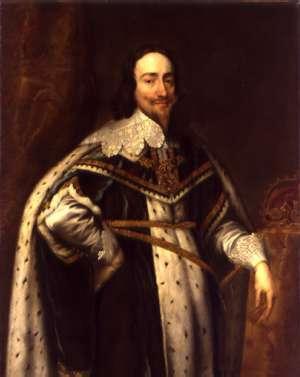
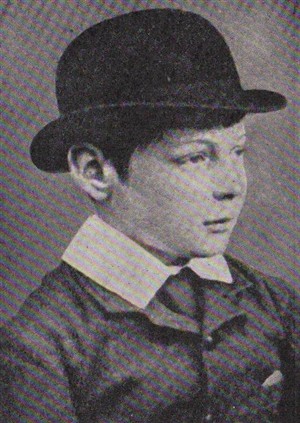
Leonard and Lady Randy (yes, that kind of randy)
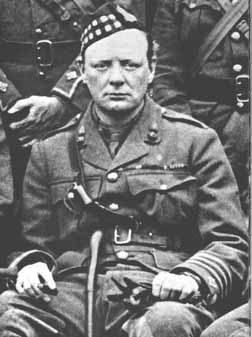
Maybe you’ve heard this one from Paul Harvey. Can you guess who it is?
“Escape!
Of all the positions in the field of journalism, that of war correspondent is perhaps most dangerous. Some are captured, some escape. Some die.
Twenty-five-year-old Leonard Spencer was the London Morning Post’s newest correspondent. His assignment was the Boer War, in South Africa.
Had young Leonard foreseen the peril awaiting him, he would probably have taken the assignment anyway. That’s how Leonard was.
About twenty miles from Ladysmith, Leonard could hear the booming guns. He was aboard a British armored train that would take him as close to the front as he could get.
The train got too close. There was a sudden crash. The train had struck a boulder on the tracks … a Boer booby trap. It was an ambush!
Immediately, a fusillade of rifle fire followed. Surprised, British troops on the train fired back.
And Leonard? Leonard ignored the gunshots and exploding shells. He jumped off the train, directed the British defense, helped to clear the wreckage.
In fact, without the aid of this youthful correspondent from the Morning Post, the train might well have been lost and the British troops massacred.
Instead, the wreckage was cleared, the train did pull out of the trap and carried a good many British soldiers with it.
The one left behind to face the enemy…was Leonard! No, the story does not end sadly there.
Leonard was captured, unharmed. Even though Leonard was technically a war correspondent, the Boer commander was sufficiently impressed with his bravery…to have Leonard thrown into prison at Pretoria.
The Pretoria prison was among the world’s most carefully guarded strongholds. Still, that did not stop Leonard from plotting an escape with two other British captives.
As darkness fell, the trio waited for their opportunity. It was now pitch black. The sentries exchanged their posts. Leonard sprang across an open area, hurdled a fence of barbed-wire mesh. When he looked back, there was no one. His comrades had missed their chance!
Three hundred miles of hostile territory lay between Leonard and his freedom. For a while, he followed the railroad tracks to the east, stumbling alone, through the dark, dodging enemy patrols. Tired, hungry, thirsty…Leonard plodded long into the night, knowing that, each painful foot of the way, one false step could be his last.
The night turned to day and back to night again, until the days and nights blurred.
Finally Leonard reached a mining town. His luck wearing thin but holding, he knocked on the door of the only Britisher in the territory and was smuggled onto a train loaded with bales of wool.
The train would carry him to the British consul. To safety.
And that’s how Leonard Spencer, the London Morning Post’s fledgling correspondent, got his story…and his reputation for daring.
History has all but forgotten this incident in his life in order to make room for later glory.
The fortune that once seemed to be wearing thin had only begun…and one day rubbed off on all of England.
For the young correspondent who once upon a time saved a British armored train and escaped the enemy under impossible circumstances…continued to do the impossible for the rest of his life.
We knew him as Sir Winston Leonard Spencer Churchill!
And now you know THE REST OF THE STORY.”
Um, no, not even close.
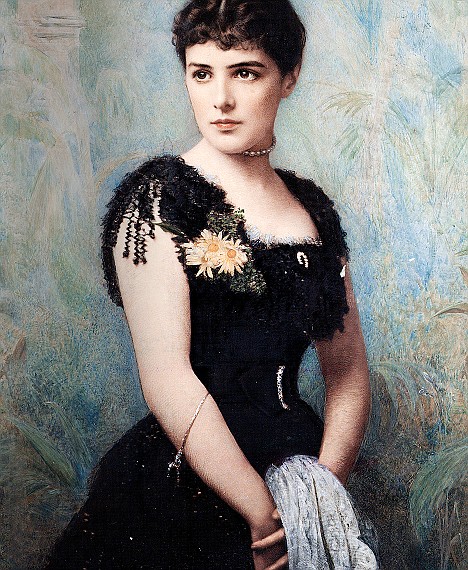
When I read about the childhoods of famous historical figures I’m often surprised. For example, I’m still freaking out that Hitler was a street artist. So I ran across this article today about Winston Churchill’s childhood and his mother who was nicknamed “Lady Randy” for her promiscuity (rumored 200 lovers).
She had no time for Winston. Other people raised him. Yet she wasn’t completely absent in his life. Apparently, she called on favors from previous lovers when Winston needed to learn French. Nevertheless, it appears Winston was raised without a father or mother, yet ends up being the kind of man who could lead a nation at war.
This is fertile ground for drama of the best kind.
I’m going to be seeking out some biographies. It’s going to be fascinating seeing how Winston pulled it off and who influenced and helped him along the way.
There’s one thing more. These facts aren’t all that drew me. What Winston wrote upon his mother’s death, well, it’s the finest poetry I’ve heard this last month.
“I do not feel a sense of tragedy,” he said, “but only loss. Her life was a full one. The wind was in her veins.”
That metaphoric power of that last sentence given her history and relationship with him–it’s stunning.
Read a summary of the documentary here.