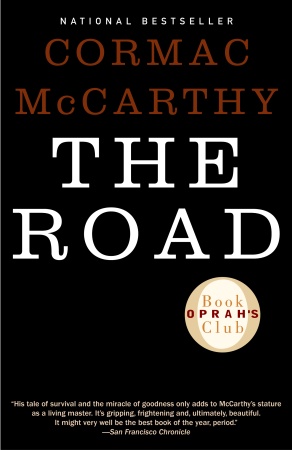
The Road by Cormac McCarthy

If I’d known Cormac McCarthy’s The Road had won a Pulitzer Prize in 2007, I might not have picked it up. So many books that have won the award just bore my underpowered literary sensibilities to death. Luckily, I’d listened to McCarthy’s All The Pretty Horses a few years ago and enjoyed it. So when I saw the audio book, performed by Tom Stechschulte, in the library I checked it out. I’m so glad I did.


The story is set in the Eastern US (although you don’t learn that into well into the book, and then only by one reference to them traveling through “the Piedmont”) years after a holocaust (meteor, nuclear, a caldera–it’s not ever really confirmed) and the resulting choas that turns America in a bleak place of ash and death. A father and son travel a mostly deserted road south to warmer weather, pushing a grocery cart with their few belongings. The father’s sick; he might be dying. And if he dies, we know the boy will die too because there’s nothing to eat but tins of what they can scavenge from houses that were ransacked and abandoned years before. And because others who survived have turned to hunting and eating people.

This is an incredible story about the relationship between this father and son and the dangers they face. McCarthy tells the story in plain detail. In fact, his understatement and attention to detail in this terrible landscape make it all the more powerful. Stechschulte’s reading is perfect.

The film is due out in 2009 and features Viggo Mortensen. But I wouldn’t wait for the movie if I were you. I’d get the book now. Or the recording. I couldn’t put this tale down. I’m betting you won’t be able to either.

Is 90% of everything really crap?

Whenever you talk in speculative fiction circles about quality writing you will inevitably hear someone cite Sturgeon’s Law.

Theodore Sturgeon, a science fiction writer, defended science fiction against critics of the genre who said that 90% of science fiction was crap by saying that 90% of everything–film, literature, consumer goods, etc.–was crap. Therefore, pointing out that 90% of science fiction is crap is ultimately uninformative because science fiction conforms to the same trends of quality as all other artforms do. So neener neener neener.

The problem with this “law” is that it isn’t a law. It’s not something discovered through rigorous testing and careful evaluation of data. In fact, no testing was performed. It’s an opinion, but “Sturgeon’s Opinion” lacks the authoritative power needed to silence the critics. 

Unfortunately, while citing the law may be a good way to give the literati what for, it’s a terrible way to think about books. I say this because we often mistake “poor quality” with “it wasn’t to my taste.” By doing so we mislabel diamonds as dirt.

How can this be? The answer is in the true nature of quality.

The business world has spent many years and much treasure trying to understand what quality is. I think writers and readers can benefit from the paths they’ve blazed. I found a great summary of quality on Wikipedia.

Business has tried to define quality in a producer-consumer context, with the following variations:

  1. ISO 9000: “Degree to which a set of inherent characteristic fulfills requirements.”[2] The standard defines requirement as need or expectation.
  2. Six Sigma: “Number of defects per million opportunities.”[3] The metric is tied in with a methodology and a management system.
  3. Philip B. Crosby: “Conformance to requirements.”[4][5] The difficulty with this is that the requirements may not fully represent customer expectations; Crosby treats this as a separate problem.
  4. Joseph M. Juran: “Fitness for use.”[5] Fitness is defined by the customer.
  5. Noriaki Kano and others, presenting a two-dimensional model of quality: “must-be quality” and “attractive quality.”[6] The former is near to the “fitness for use” and the latter is what the customer would love, but has not yet thought about. Supporters characterize this model more succinctly as: “Products and services that meet or exceed customers’ expectations.”
  6. Robert Pirsig: “The result of care.”[7]
  7. Genichi Taguchi, with two definitions:
    a. “Uniformity around a target value.”[8] The idea is to lower the standard deviation in outcomes, and to keep the range of outcomes to a certain number of standard deviations, with rare exceptions.
    b. “The loss a product imposes on society after it is shipped.”[9] This definition of quality is based on a more comprehensive view of the production system.
  8. American Society for Quality: “a subjective term for which each person has his or her own definition. In technical usage, quality can have two meanings:
    a. the characteristics of a product or service that bear on its ability to satisfy stated or implied needs;
    b. a product or service free of deficiencies.”[5]
  9. Peter Drucker: “Quality in a product or service is not what the supplier puts in. It is what the customer gets out and is willing to pay for.”[10]

The common element of the business definitions is that the quality of a product or service refers to the perception of the degree to which the product or service meets the customer’s expectations. Quality has no specific meaning unless related to a specific function and/or object. Quality is a perceptual, conditional and somewhat subjective attribute.

What does this mean for writers and readers?

It means that your audience defines quality. But your audience is never all of those that read. It’s only the narrow segment that reads for the type of experience you’re offering.

It means that a story can be of the highest quality, but you still may not like it. You might even hate it.

It means that Sturgeon’s Law is, no disrespect intended, crap.

All writers should consider NY Times best-seller Tess Gerritsen’s experience writing for two different audiences.

I’ve had too many smart and well-read friends like stories I do not. I’ve loved too many stories that others could not. I’ve seen too many stories I couldn’t read more than two pages of picked up by editors and find audiences. And the tales of editors passing up on stories that some other editor picked up and which became mega-sellers are legion. 

Quality has never been an absolute. The truth is that while I enjoy many stories in a variety of genres, a lot of what’s published is not to my taste, but it’s still very good.  

A more accurate statement of Sturgeon’s Law would be something like “90% of what’s out there isn’t to my taste.”

For readers this means we need to be careful to distingush between something that doesn’t work for the audience it’s intended for and something that simply doesn’t work for us. For writers this means we need to write the best story we can and then avoid pressing it onto the wrong audience. And when we do get a bad review, we need to figure out if it’s the quality of the story or just a matter of taste.

Washington Irving, Family, & Writing

How do writers juggle writing and family?

One of my heroes is Mary Higgins Clark who, as a single mom, started a career. She got up very early, wrote for 1-2 hours in the morning, and became a mega-seller.

I have four girls. And a full-time job. When the first two were little my wife was working and I was Mr. Mom going to school. Then we switched.

Here’s my experience. While I love writing, my stories do not run to me and give me wonderful strangling hugs after school like my youngest. While I laugh at the humor I come up with in my stories and enjoy it, it cannot replace the uncontrollable giggling I experience when I go on dates with my second. While writing lifts me, it does not fill my office with notes and wallpapers of love like my oldest. And writing never drags me out to play ghosts in the graveyard or hide and seek–daughter #3. Nor will my stories and novels be there for me when I’m old.

While writing is incredibly fulfilling, my wife, kids, and other relationships are a joy it cannot replace.

What all this means is that I try to recognize that I can’t let family and writing compete. They can’t be equal priorities. Family comes first. But this doesn’t mean I don’t write. I block out times to write. These are my writing times. I get up early to make time for this. I don’t watch a lot of TV. I don’t read a million blogs, nor, alas, can I read fiction at the level I used to. I make time. But I also make blocks when I just forget writing (even though it can be hard).

Specifically, here’s my average work week.

5:00 AM rise, wake and get centered for the day
6:00 AM work (“work” is my day job and writing)
6:30 AM family and breakfast
7:30 AM go to work (at home). Try to get in 7-8 hours at day job and 2 hours writing. When I did commute I wrote for 1 hour during lunch and 1 hour in the morning before I went to work. Then I’d take a 2 hour block on Thursdays.
5:30 PM family etc.
9:30 PM bed

On Saturdays I get a few more hours writing. Sunday I forget everything but family.

With the new book contract I have to become a bit more creative. But if it ever comes down to sacrifice the last 2 years of my oldest being at home and writing, well, the books will go.

When my writing plans meet reality, I try to adjust and find other slots for writing. It wasn’t easy in the beginning, but it’s become much easier. And I don’t worry about what I might have accomplished in writing if I’d just had the extra time. Such what-if’s, I’ve found, are almost always poisonous. And who the heck cares? Because while I want to write wonderful stories, I think the greatest loss I think I might experience at the end of my life (believing in an after life or not) is looking back and seeing that I traded the opportunity for wonderful relationships for a rapidly mouldering spot on the shelves.

Washington Irving wrote a funny and wonderful piece on this mouldering in his “The Mutability of Literature” in THE SKETCHBOOK OF GEOFFERY CRAYON. I recommend every writer read this to put life and writing into perspective.

Some Key Concepts for Love Stories

My first four professionally published short stories were all love stories of one kind or another. I love good love stories. And so when the Writing Excuses team podcasted about this topic with Dave Wolverton, I was excited to hear what they had to say. Of course, they didn’t dissappoint. However, I would like to add a few things here.

1. A love story or romance is a happiness story. The problem is one of danger to, lack of, or opportunity for the happiness that comes with having a close bond with someone else. To be loved and included, to be valued by someone.

2. Love stories don’t have to be between two characters who are romantically interested in each other. They can be between two people who become friends or a person who is on the outs with a particular group as with RAINMAN, or between a father (or father figure) and son as in TREASURE PLANET, or a mother and daughter.

3. It seems to me that these social story problems can be broken down into four elements.

  1. Raising the idea
  2. Making the characters attractive
  3. Raising obstacles and conflict
  4. Showing signs of progression

RAISING THE IDEA

Just as with any story problem, we have to know there’s an issue. The idea of possibility or lack has to be presented to us. And the specific person who we hope the character bonds with has to be identified. How is this done?

Lots of ways. But I can see two big ones right off the bat. The first has to do with what a character notices about the other person. In a romantic love story, it might be some thoughts about another’s attractiveness, either looks or character. This could happen when the character sees the other person, touches them, hears them speak. And it doesn’t have to be a stranger. Perhaps they had a crush on that person when they were younger. There are all sorts of cues we use to signal romantic potential. All we have to do is raise a few of those for the reader and the idea is planted.

The second way the idea is raised is by having some other character raise it. Someone else notices the person and thinks them attractive. Or they make a suggestion that our character getting together with them is a possibility.

So when Jack sees Mary he can think about when the blankety blank she’s going to get off the commando team because all she does is distract the men. Not him, of course. Or Bill can tell Jack that Mary has been watching him. And Jack can say, she can look all she wants because she’s never going to get a piece of this.

MAKING THE CHARACTERS ATTRACTIVE

The second thing I see that’s necessary is that the other person is attractive to the reader. Or, at least, the reader could see how the character could be attracted to this person. This doesn’t always have to be physical beauty. Nor does it have to be sexual attraction. A buddy story would be about something else–about someone who we think is admirable in some way. But it has to happen for the reader to believe the story.

Of course, our hero may be duped. Jack might be falling for Cindy when she’s really just after his money. The readers know both sides and can see how Jack’s choices make sense, even while we feel great anxiety of the trouble coming down the line. 

RAISING OBSTACLES AND CONFLICT

These are key, of course. No obstacles or conflicts and there is no story. Jack sees Jill. Says I love you. They marry. The end. So we have to have obstacles. They can start immediately with the character recognizing a possiblity. For example, Jack is simply oblivious to Jill’s interest in him. And when he decides to trust his friend’s advice to pursue her, he sees her with another man. She’s not an option for him afterall.

If we think about yes-buts and no-furthermores and that usually the hero has to fail at the end of act 2 for us to feel triumph at the end of act 3, we’ll see that obstacles and conflicts progress just as they do in any other story.

There are many obstacles or points of conflict. Distance (CASTAWAY), social status, fears of rejection, a stuttering problem, another person who Jack is interested in or who Jill is interested in, something Jill does that Jack doesn’t agree with, jobs that are demanding and keep them apart or make them keep secrets (TRUE LIES). Are too closely related. It’s against your vows or values (you’re a nun or he’s a client) Etc.  Many are internal and have to do with trust, fear, competing desires, and commitment.

The key to the obstacles, I’ve found, is in making it hard to choose or fulfill commitment. It isn’t about sex or kissing. Because you can have a story where two people have sex and it doesn’t resolve any tension in the love story (what if the guy is seen that night with another woman?). It’s about two people being able to say I love or value you and meaning it.

And so anything that would keep them from commiting works. And after they’ve committed, anything that would make one recant. Or be unable to enjoy that love going forward.

SHOWING SIGNS OF PROGRESSION

The last thing is that the audience needs to know that things are moving forward. In plotting, we need a few yesses along the way or the story’s over. How do we do this? What are the signs? I can think of a few.

  1. The character’s thoughts are more and more about the other person, noticing all sorts of things, dealing more and more with inner dilemmas.
  2. The character’s actions become more and more open. The lingering looks, or glances she tries to  hide, the touching. The character’s words become more and more direct. Usually oblique at first and then more clear later.
  3. There is more validation from other characters.

Why do so many stories have the characters in a romance dance? Not because dancing is some mystical thing. No, it’s a romantic cue. We associate romance with dancing. And being in such close proximity raises the pulse. But you can put people in close proximity in many other ways–in a crate as they’re being smuggled into the country, standing smashed together in a subway, retracting a bullet from the leg, cutting and washing hair (John Travolta in PHENOMENON), etc.  The reason why we do this; however, is so that we can get a yes, a sign of progression. Of course, we could also use it to raise a devestating conflict as when Maria dances with Captain Von Trapp in THE SOUND OF MUSIC. But that’s only devestating because during the dance they had declared in subtle ways that they were interested in one another.

So we raise obstacles and show signs of progression, back and forth, the obstacles pointing more and more toward disaster until at the end of act 2 Jack loses…and we get the no-but plot turn. No, he’s failed completely. But then a desperate glimmer of hope…

In the end we need final confirmation. One thing that says, yes, they’re committed. Often in romantic love stories writers use sex as a blunt confirmation. I think it’s often the lazy way out. Here, show Jack and Jill having sex. Okay, next plot point. It’s lost most of its power for me. And such a thing should be anything but cliche. My advice is to think of many other ways that show commitment and value. A few examples off the top of my head are what Dean Koontz in his ODD THOMAS series did this for Odd and Stormy, FAR AND AWAY with Joseph and Shannon, WHAT ABOUT BOB, and SABRINA. In fact, having sex was turned on its head in this one. Lovely.

At least think about other options because romantic love stories are not about sex. Sexual tension stories are. But that’s a different problem. A different type of story. And it seems writers sometimes confuse these two. Romantic love stories are about two people finally saying, yes, I love you, I value you, and I mean it, and always will. And as an audience, we believe.

And if that doesn’t move you, then remember that one of the things we go to stories for is surprise. Something new. How wonderful would it be if something as simple and Jackbiking into Jill’s work place with a parrot on his shoulder is the ultimate moment of the story, and says everything that needs to be said? And when Jill looks up at the commotion, her heart to this point hardened or desolate, and sees the bird, the audience weeps or cheers…