Just wanted to give a heads up. I’ll be joining an author panel and book signing Saturday Oct 10th (tomorrow) at the Barnes & Noble in Sugarhouse from 12 PM – 3 PM.
Barnes & Noble McIntyre Center (Sugarhouse)
1104 East 2100 South
Salt Lake City, UT 84106
801-463-2610
This is going to be fun. I’ll be there with authors Jessica Day George (Dragon Slippers trilogy), Larry Correia (Monster Hunter International), Mette Harrison (The Princess and the Hound, The Princess and the Bear), and Paul Genesse (The Dragon Hunters).
We’re going to participate in a panel about writing SF/Fantasy, sign and chat about our books, and then demonstrate true magic by flying above the stacks in precision formation. I think Larry’s bringing a cannon for special effects.
Okay, so my imagination got carried away. I’ll admit the panel was a bit over the top. 😉
If you’re in the area, come on by. We’ll take a few photos and sign your books. If you’re really nice, I will shower you with free bookmarks.
Here’s the latest version of the book description that will accompany the book on the various sites and on the back cover of the trade paperback. It’s purpose is to advertise: to let folks know the feel of the book and pique their interest.
A young man.
The girl he is hunting for using the dark and terrifying magic of Slethery.
And the monster who only wants to be free.
So begins the towering fantasy series that introduces an elaborate new world, a multifaceted system of magic, and a cast of compelling characters and creatures.
Trapped in a web of lies and ancient secrets, of right becoming wrong, the three must struggle not only against each other, but also a being of irresistible powers. A creature who is gathering her servants to oversee the impending human harvest.
If the three win, they will save those they love the most. If they fail, the clans of the land fall with them.
What people are saying:
~ Best Novel of the YearWhitney Awards, speculative fiction
~ EngrossingPublishers Weekly
~ ProvocativeBooklist
~ Starred Review!Library Journal
~ A great setting, a smart storyBrandon Sanderson
Do you think you can do better? See anything to cut? Have some book descriptions you think work really well? If so, comment. I’d love to see what you come up with.
Today was awesome for writing. First, I got five hours in, and I was in flow the whole time. When you’re in flow, you’re in the scene, seeing it, smelling it, experiencing it. It’s awesome.
Second, during my review of the first draft, I came to the final battle scene and realized I’d made it much too convoluted. Way too convoluted. When I wrote it, I thought it was great, but coming to it fresh, it was just too much. So I drew a big red line through all those pages and made a note to rewrite it. Today I got to rewrite that section plus a bunch before and after it.
I have to say I love sheriff Hood, the female character who is teamed up with Frank. The woman is spectacular. And I love this fight scene. I don’t think I’ve ever seen or read a thriller fight scene like this one. Sorry, won’t tell you what it is (no spoilers), but I can tell you I can’t wait to get this out to readers. I’m as pleased with this as I was the snow mobile sequence in Bad Penny.
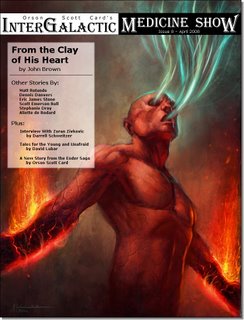
More good news! I just found out that my novelette, “From the Clay of His Heart,” will be included in this year’s annual Year’s Best Fantasy anthology edited by David Hartwell and Kathryn Cramer. The anthology will be released in the summer of 2009.
I’m working in the middle of chapter 8, deviating in a few spots from my working outline. The goal is to get 20 hours of writing in this week and add 10k more words. Let’s see, what kind of preview can I give? Here we go: drones, desert, and the villain on his three-speeder bicycle.
Smart Pop publishes smart, fresh, and engaging articles on the best of pop culture TV, books, and film, with a particular focus on science fiction and fantasy television and literature.
You want to hear what Scott Westerfield (Uglies, Pretties, etc.) has to say about Buffy? Go to Smart Pop.
What about Orson Card’s thoughts on Joss Whedon’s Firefly universe? Smart Pop.
What about the venerable Lawrence Block on Robert B. Parker’s Spenser series? Um, Smart Pop.
Strange. Do you see a pattern emerging?
Whether it’s Mad Men, House, Hunger Games, George Martin’s epic fantasies, Halo, True Blood, or Alias, Smart Pop gathers together New York Times bestselling authors, television writers, psychologists, philosophers, and others–folks who love of pop culture and have something worth sharing about it–and asks them to share their insights.
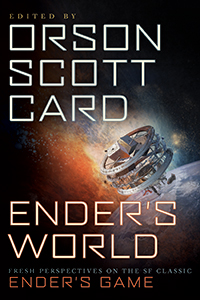
Recently, they’ve been putting together just such a collection on Ender’s Game. It’s called Ender’s World: Fresh Perspectives on the SF Classic Ender’s Game. It’s coming out February 2013. You can read more about it here.
I’m announcing this now because The Man was fortunate enough to be invited to contribute. I love Ender’s Game. LOVE IT. How cool is it that I get to write about it in an anthology edited by the folks at Smart Pop and Card himself? And then get to read what everyone else has to say, including military strategists Colonel Tom Ruby and Captain John Schmitt. As well as the little bits they’ll include on things like why the battle room is the shape it is and why they were recruiting kids.
But I’m also announcing this because in addition to the essays all we Ender-lovers get to write, Smart Pop is also going to include a series of Q&As with Scott Card, and they are currently soliciting the question from readers. FROM YOU. Right now.
From a writer’s pov, I have to tell you that the folks at Smart Pop have been nothing but enjoyable and insightful to work with. I’m looking forward to this book!
Folks, a huge thanks goes to Stephen Nelson for putting all this together. You may kiss his hand when you see him.
This is a recording of “How to Write a Story that Rocks,” a two-hour seminar Larry Correia and I just put on at the annual BYU’s Life, The Universe, & Everything symposium. I think we had 130-140 people attend. This symposium is focused on writing fiction. And while the panels and presentations do include things specific to the science fiction, horror, and fantasy genres (both adult and young adult), a lot of time is also spent on story writing fundamentals that apply to ALL genres. So when I developed this workshop, I made sure I took the fundamental approach.
The two-hour seminar has been broken down into 12 segments. To switch between the segments:
Hover your mouse pointer over the YouTube below
Click the forward and back arrows that appear on the right and left sides to move to the next or previous segment, OR
Scroll through all 12 segments and select the one you want using the playlist control at the bottom
I’ve found whenever I develop any presentation or training that it takes a few iterations and revisions before it’s the best it can be. This is the first iteration of this seminar. And so below this video I’ve provided additional comments on each segment explaining key concepts, principles, and techniques that we might have failed to discuss or convey as clearly as we’d hoped. Enjoy!
It’s documented–right-wing gun nut Larry Correia sang “Kumbaya.” What’s next? The hugging of small trees? Oh, Larry, the disilluion. The disillusion.
The reason why I had Larry sing was not for his mellifluous performance, but to demonstrate the difference in reactions between him and our happy volunteer (“Country Road” by John Denver–this really was a love fest). The volunteer balked because he hadn’t taken any thought to know what to sing before he was commanded to do so. On the other hand, Larry and I had spoken before the seminar. So Larry had something to sing BEFORE he sang it. It’s a simple demonstration, but it illustrates a principle a lot of new writers forget. Writing is a performance. It helps to know what it is you’re going to perform before you perform it.
It’s one thing for you to tell yourself to write. It’s much easier to tell yourself to write the scene where the rancher finds out one of his illegal ranch hands has been kidnapped.
Now this doesn’t mean that you have to know everything. Or that you can’t write exploratory drafts to figure out what it is you want to write. But it does illustrate that whatever techniques you use, you’ll be a lot more effective in your writing when you have something to say first.
But what do you develop? What are the things that bring the story to life? How do you go about getting those things to say? That’s precisely what I wanted to address in the seminar. In the segments that follow, I try to:
Explain what I’ve found are the most important things to develop, the things that define the essence of story, that make the story come alive in the writer’s mind–the things that really matter
Demonstrate techniques to develop those things so you have something to say
Segment 2
I think this segment went fairly well. What rocks will different from person to person, even though there will often be a huge overlap between people. So it’s important for authors to seek to develop the kinds of stories that rouse their passion. Watch this interview with best seller Debbie Macomber to see what I mean. So I can’t tell you what to write about. Or if whath you think rocks will resonate with a large number of people. However, what I can do is share the techniques I use that have been most productive in helping me develop initial ideas into something that has much more power.
You can use the techniques to juice up any of the four parts of story. However, I will say that I find that the most productive, the most important parts, are character and problem. Plot and setting are important. I love them and work to juice them up. But when I get a good character and problem, that’s when the writing seems to flow the easiest.
And no, I don’t list theme as a part of story. Everyone talks about theme, but when I read what they have to say or press them for examples, it seems that it always either boils down to (1) a story element or topic that’s repeated, (2) a story problem/issue stated in an abstract manner, or (3) some moral situation. Les Miserables is about the “theme” of mercy versus justice. But saying justice versus mercy is just an abstraction of the story problem and dilemmas the story deals with. So, no theme.
I’ll be adding my comments to the rest of these segments over the next few days.
Segment 5
Segment 6
Segment 7
Segment 8
Segment 9
Segment 10
Segment 11
Segment 12
Dan Wells on Story Structure
Check it out: Dan Wells on How to Build a Story (story structure). I find Dan’s “start with the ending” technique helpful as well as thinking about a worst fears realized moment. Watch the videos and see if there isn’t something there that can help you develop your story idea.