|

Ender’s World: Fresh Perspectives on the SF Classic Ender’s Game

Smart Pop publishes smart, fresh, and engaging articles on the best of pop culture TV, books, and film, with a particular focus on science fiction and fantasy television and literature.

You want to hear what Scott Westerfield (Uglies, Pretties, etc.) has to say about Buffy?  Go to Smart Pop.

What about Orson Card’s thoughts on Joss Whedon’s Firefly universe? Smart Pop.

What about the venerable Lawrence Block on Robert B. Parker’s Spenser series? Um, Smart Pop.

Strange.  Do you see a pattern emerging? 

Whether it’s Mad Men, House, Hunger Games, George Martin’s epic fantasies, Halo, True Blood, or Alias, Smart Pop gathers together New York Times bestselling authors, television writers, psychologists, philosophers, and others–folks who love of pop culture and have something worth sharing about it–and asks them to share their insights.   

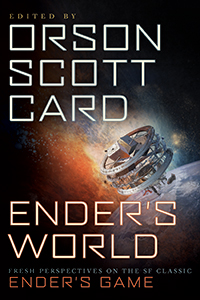
Recently, they’ve been putting together just such a collection on Ender’s Game.  It’s called Ender’s World: Fresh Perspectives on the SF Classic Ender’s Game. It’s coming out February 2013.  You can read more about it here.

I’m announcing this now because The Man was fortunate enough to be invited to contribute.  I love Ender’s Game.  LOVE IT.  How cool is it that I get to write about it in an anthology edited by the folks at Smart Pop and Card himself? And then get to read what everyone else has to say, including military strategists Colonel Tom Ruby and Captain John Schmitt.  As well as the little bits they’ll include on things like why the battle room is the shape it is and why they were recruiting kids.

But I’m also announcing this because in addition to the essays all we Ender-lovers get to write, Smart Pop is also going to include a series of Q&As with Scott Card, and they are currently soliciting the question from readers. FROM YOU. Right now.

You ever wonder about a character or part of the setting or event in Ender’s Game?  Ever wanted to know what inspired Card? Ever wanted to ask any question at all about Ender’s Game?  Now’s your chance. Just submit you question here: http://www.smartpopbooks.com/ask-orson-scott-card-a-question-about-enders-game/

You can see questions already submitted at Smart Pop’s Tumblr.

From a writer’s pov, I have to tell you that the folks at Smart Pop have been nothing but enjoyable and insightful to work with. I’m looking forward to this book!

Share

Similar Posts

  • |

    Testicles and the Zing Life

    Diana Rowland of MagicDistrict.wordpress.com invited me to guest blog. I was happy to provide “Testicles and the Zing Life.”

    Testicles do not taste like chicken.

    I know this thing. At least the ones taken from cattle don’t. But this Nobel prize-winning discovery is not what’s important. What’s important is why I know this. Read more.

    Enjoy!

    Share
  • Good Stuff! Science as Storytelling

    I know the word ‘atheist’ presumes a lot, but it’s just an easier way of describing someone with a rational mind.

    Joe Konrath, a self-avowed atheist, awesome fighter for authors, and leader in the indie author movement, said that almost a year ago in his Konrants post.

    My response then was the same as it is now—right, the rest of us run around eating socks and wondering if there really are gerbils under the hoods of our cars.

    Shoot, wouldn’t it be great if we could get us one of them rational minds?

    In the comments of that post, I had a very interesting conversation with Joe about God, belief, and evidence. Joe brought up a number of valid points about the errors we can make when we formulate beliefs using something other than science.

    However, he didn’t point out the errors we can make when we formulate beliefs based on science. He didn’t want to talk about the limits of science. What he wanted to focus on was the claim that if God existed, we should not only be able to observe things about him, her, or it, but we should also be able to subject those observations to the scientific method.

    If we couldn’t do that, Joe claimed, then there was no rational basis for believing in God. God did not exist until he was proven to exist. And the only way to do that was by using science.

    So here’s the question: is Joe right?

    To answer that, we first have to understand what science is. And what it is not.

    And I’m happy to report that earlier this year I read probably the best article explaining what science is that I’ve ever read. It’s called “Science as Storytelling” and was written by Barry R. Bickmore, a professor of Geological Sciences at BYU, and David A. Grandy, a professor of Philosophy at BYU with a strong interest in the philosophy of science.

    Hold on, John. Is this some anti-science thing?

    Not at all.

    In fact, it’s just the opposite.

    They wrote the first version of this article help students with simplistic views of science and who tended to “dismiss scientific conclusions that challenge their preconceived notions—especially those connected with religious or political views.” They also wrote it to help scientists who are not religious, downplay the supernatural, or “share in certain inaccurate views of the nature of science.”

    What they have fashioned is a way to “help science students (and professors) gain a more productive view of both the nature of science and the science-religion interface.” And, as good scientists, they put their theory to the test and found that their approach was indeed effective at both secular and religious colleges.

    So, is Joe right? Is science the only way to prove or disprove God?

    Let me suggest you read the article. Let me suggest that this is the most productive way of talking about the issue that I’ve found. As you read, you might want to look for the answers to the following questions:

    • What makes science different from things like astrology?
    • Does science have any blind spots?
    • Is science fiction because its stories change?
    • Is it possible for natural phenomena to exist upon which you can do no science?
    • Under what circumstances could science prove the existence of a God?

    If you’re interested in science or religion, I think you will love this article. Not only because it clarifies and reaffirms science, but it also because it helps us understand its limits.

    I would, of course, be interested in your responses to it. And in another post perhaps we can talk about how we’re supposed to proceed about a subject when we can’t do science.

    Share
  • Two Jillian Workouts & Gottman’s Seven Marriage Principles

    Jillian Michaels is, in the words of my brother-in-law, “the woman who chases the fat people around.” And indeed, as one of the main trainers on the TV series Biggest Loser, she gets those folks moving. But I didn’t know anything about her or the show earlier this year when a friend recommended her 30-Day Shred DVD workout (thank you, Mr. Dayton).

    I’m a cave dweller. I sit in my little basement office and do my thing. And I have to make sure I get some type of exercise lest I turn into a great jelly. So I’m always on the lookout for a good workout. But it’s got to meet certain standards. I don’t want anything that’s Mickey Mouse. And I don’t want any froo-froo.

    So I asked this friend if these workouts featured a bunch of women dancing around in fruity outfits, because I can tell you right now, as open to new experiences as I am, I wasn’t going to buy a leotard and tip toe through the tulips with them. My friend assured me it was froo-froo free. And boy was he right.

    Jillian shows up with two other gals, gives you a two-minute warm up, and then proceeds to bust your hiney with three circuits of strength, aerobic calisthenics, and ab exercises. The strength exercises include things like push-ups and squats with dumbbell military presses or curls. The aerobic segments have you doing jumping jacks and jump rope. The ab portions run you through all manner of crunches and lower ab exercises. The three circuits take twenty minutes to complete. And there are three different levels of workouts on the DVD.

    I walk or hike three miles a day four days a week, and so I thought I was in reasonably okay condition. Jillian disabused me of that silly notion. I couldn’t keep up. Heck, the first dozen times through the workout I think I spent half the time either catching my breath or trying not to faint.

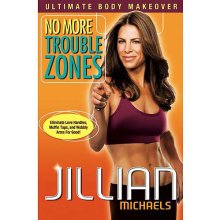
    But I kept with it and got stronger. And then I found Jillian’s No More Trouble Zones. This is a forty-minute workout. And I defy any of you he-men out there to try it and tell me you can keep up with this broad in this DVD. I still pant like a dog and have to take breaks when I do the workout. My only consolation is that Jillian and her two smiling evil pals work out with three-pound dumbbells while I work out with seven, fifteen, and twenty-five pounders.

    Like the shred workout, this forty-minute workout is comprised of circuits. But in the trouble zones workout there is no jumping about. It all double-whammy exercises that have you working both your upper and lower body at the same time or doing some killer ab maneuver. You’ll do pushups, squats, curls, a vicious plank circuit, and a dozen other exercises. You’ll work your triceps, biceps, shoulders, back, abs, and legs multiple times. This workout is no joke. 

    If you’re looking for an intense workout that doesn’t waste your time, I think you’ll enjoy either of these Jillian DVDs. All you need are a few dumbbells, a mat if you’re working on a hard surface, and prayer beads for those moments when you suspect you’re about to give up the ghost in a muscle-burning cardiac arrest.

    *

    Back in April of this year, Dr. Liz Hale, a licensed clinical psychologist, started her remarks to a local audience of more than 100 mental health professionals by saying, “Dear fellow colleagues, you are in danger of having an affair.”

    Her point was that every marriage, even those of the marriage gurus, is vulnerable to infidelity–be it sexual or emotional. Individuals have to actively curb all the subtle and often innocent beginnings that lead to unfaithfulness.

    “We make the mistake of thinking (marital) vows will keep us safe; and they don’t,” she said. She went on to say that couples cannot depend on love or similarities to keep their marriage intact. It’s not enough.

    Emotional or sexual infidelity isn’t as rare as we might think. But even if we don’t stray into some type of unfaithfulness, that doesn’t mean a marriage will stay together. Like anything worth having, a good relationship takes work.

    But what kind of work? What are the key principles for making a marriage last?

    For many years the prescriptions of marriage gurus were based on anecdotal evidence and rules of thumb—on opinion. Because the opinions weren’t tested, they led to all sorts of errors. For example, many yet believe that the road to marital bliss is through communication, specifically through successful conflict resolution. According to this idea, happy couples are those that have learned to resolve all their conflicts in a nice manner. The problem is that when conflict resolution was put to the test, the studies showed it didn’t work. Marriage therapies based on conflict resolution share a very low success rate—over the long haul they only work about 20% of the time.

    So what does work?

    John Gottman is a marriage counselor who took a different approach and started to collect rigorous scientific evidence on over 650 couples, tracking the fate of their marriages for up to fourteen years. The results of his work are startling.

    He uncovered a number of relationship myths, including the one about communication. He found that happy marriages were never perfect unions. These satisfied couples often had differences in temperament, interests, and family values. They argued over money, kids, and housekeeping, just like unhappy couples did. They had problems and faced issues. However, all these satisfied couples also practiced seven principles, even if they didn’t know it, which helped them navigate their way through all the difficulties and keep their marriages happy and stable.

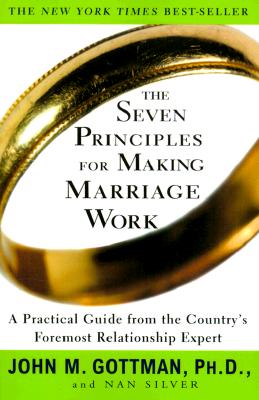
    And it’s not just opinion. The success rate for the type of marital therapy based on his research is 80%. He knows what makes marriages work and has written it up in a fabulous book called The Seven Principles For Making A Marriage Work.

    Every marriage is vulnerable to failure. It takes work to enjoy a satisfying relationship with a spouse. But it’s so much easier to improve and maintain a relationship when you’re working on the things that actually make a difference. If you want to improve your marriage, give Gottman’s book a read.

    Share
  • Why I’m gonna purchase Correia’s MONSTER HUNTER ALPHA on Monday

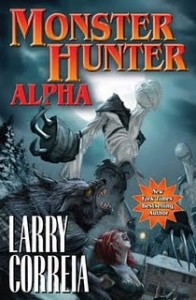
    I’m going to be purchasing MONSTER HUNTER ALPHA by Larry Correia on Monday.  Here’s why.

    Reason #1: Correia delivers the goods

    I read MONSTER HUNTER INTERNATIONAL.  I ended my review of MHI saying Correia was going to be a writer to watch.  Well, for those of you who haven’t been watching, not only did Correia  sell tons of copies of MHI, he also made the New York Times best seller list with his second book AND sold TV rights to the MHI series to a major TV producer.

    Why would his books generate such a response? Because they’re so dang fun. That’s why. And Correia isn’t just a flash in the pan one-trick pony. Far from it, as demonstrated by Reason #2 below.

    I told you in my review of INTERNATIONAL that I don’t read books that don’t suck me in. I don’t give them 70 pages to warm up and get going.  I don’t care who wrote the book. I don’t care if the author is a big lug with guns. I don’t care if he has status and money or friends who can put the hurt on me. I don’t care if the author is my girl’s godmother and brings me Walker Shortbread Rounds (which are evil cookies that exert mind control). If the book bores me, I put it down. That doesn’t mean that books which bore me aren’t wonderful. Sales and numerous reader exclamations of delight and satisfaction attest to the the fact that many are. It’s just that I’m a reader of little patience. I love it when a book starts with a bang and keeps me hooked. And Correia’s books do exactly that.   

    Reason #2: Correia’s getting better

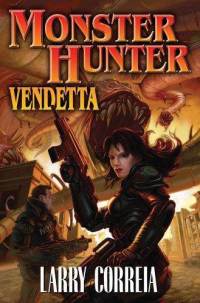
    I read MONSTER HUNTER VENDETTA recently.  I should have reviewed it, but I’ve been so freaking busy I barely have time to shave or appear in public because I’ve begun to look like the Unabomber. But here’s the deal with VENDETTA–it’s better than INTERNATIONAL.  

    Yes. Better.
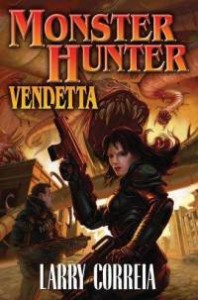
    Well, expect for maybe the opening paragraphs. The quote and first few paragraps that opened INTERNATIONAL are hard to beat. This doesn’t mean the opening of VENDETTA is weak. Heck, no. VENDETTA trounces the openings of most novels and steals their lunch. And then it continues to delight all the rest of the way through. It’s just that it didn’t quite deliver the same jolt as MHI. But 500 or 503 watts, what’s the difference?

    So with VENDETTA, are there guns? Yes.

    Monsters? Check.

    Action? There’s action galore.

    It appeals to my testosterone right off the bat (even though Larry reports that a good number of his readers are women). But there are guns, monsters, and action in a lot of stories that stink. What Correia does is not only give us great action, but he also gives us wonderful new situations.  For example, you will never see the scene set in the ghetto of Birmingham, Alabama that appears here in any other book. Never. It’s a Correia original. But even more important than great new situations, is that he gives us a first-person narrator who is delightful to be around. I’m talking about Owen Zavasta Pitt, the accountant monster hunter. His responses to the situations he gets in just make me laugh, as do a number of the responses of the other characters. My only wish is that Correia would tone down some of his language just a bit.  It is possible even when writing about military characters.  But you can’t have everything, and Owen’s such a loveable lug, I overlook it.  Hey, maybe Milo will help him out on that as the series progresses.

    Furthermore, Pitt isn’t the only character who I find delightful or interesting.  In VENDETTA there is also Holly, Agent Franks, and G-Nome, one of Correia’s best yet. Of course, there’s also the Doctors Nelson, the former hunter Carlos, Melvin the troll, and Earl Harbinger who have their own moments to shine. As do Owen’s dad and brother. And Dorcas, MHI’s secretary with the plastic leg. Heck, I even like Susan.

    So how many is that–eleven already? How many wonderful characters do most authors give you in one book? Two or three?

    And that’s one of the things that is is better with VENDETTA than INTERNATIONAL.  In INTERNATIONAL, as good as it was, some of the characters just didn’t get the stage time they needed to shine. But here Correia declutters his scenes so we’re not trying to focus on too many people. The result is that those we do focus on each have the their moments and lines. The other thing I noticed was that Correia deftly orients us to each new situation. For those of you who are writers, let me suggest you look at Correia’s technique in VENDETTA for introducing characters and settings. 

    Another good thing: he wipes out a Girls Gone Wild camera crew in the first chapter. Anyone who does that gets a few points in my book.

    VENDETTA doesn’t attempt to become bigger in scope than INTERNATIONAL (as if it could). Instead, it feels like another episode in a great tale. And I’m happy with that because it promises more to come. I’m back with characters I like and situations that make me laugh and magic crap that evokes some oohs and aahs and every now and again makes me wish I’d come up with it for my own use.

    Finally, VENDETTA leavens the humor and action with a couple of poignant moments. I’m thinking of a chapter with Carlos, another scene with Owen’s dad, and one with G-Nome.

    As you can see, VENDETTA’S packed with goodness.

    With ALPHA, I’m expecting to hook up with at least one of the gang for more exploits and laffs. Will Correia get even better? I have no doubt he will. But who cares–he’s already delivering great stuff.  

    Reason #3 Did I mention that Correia makes me laugh?

    Just didn’t want to forget that. Furthermore, I swear I read somewhere that laughter increases your health and makes you live longer. So not only am I getting a great read, I’m extending my days upon the land.

    Reason #4 Monday is a special day

    Not any old Monday. But the 25th of July.

    Why is this special?

    Because it’s the first day of the first week of the book’s release.

    Now I know I’m going to buy this book sometime. But buying it in the first week lets me do something I might not be able to do at some other time.

    Because Correia has given me hours of pleasure, I figure I can tip him for his good service by helping him make the best seller list again.  And a book has the best chance of making that list in the first week of release. (For those of you interested in how that works, Larry gives a good explaination here.) Making a best seller list does all sorts of good things for an author, and, as a result, that author’s readers.

    So Monday’s my day to leave the tip on the table and tell the owner to keep up the good work.

    The New York Times list is a good one. But I’d like to see him on the USA Today list, which measures sales so much better than any other list out there. My fingers are crossed.

    For those of you who are Correia fans or who have been putting off giving his stuff a go, now’s the time to either get MHI and begin the series or ALPHA and continue the delight.

    EDIT: After I posted, I couldn’t wait and just went ahead and processed my order. Pre-orders will count in that first week, and after writing this I couldn’t resist. Looking forward to more hours of laughter and some great characters.
    Share