interviews

  • Author Interview: David Farland

    David Farland has been a big influence on me. It was his workshop back in the 90’s that actually made me think I could write professionally and led directly to my first publication as a Writers of the Future winner. Later Dave gave me comments on my first novel which helped me write a second, much better one that attracted Tor Books. And it was Dave who showed me the ropes on my first ever author tour.

    But long before all that, Dave was a writer whose work I loved. I read ON MY WAY TO PARADISE when it first came out and enjoyed the heck out of it. SERPENT CATCH and PATH OF THE HERO were next. I gobbeled them up too. Then came the THE GOLDEN QUEEN. By the way, SERPENT CATCH and THE GOLDEN QUEEN are two of my favorite novels. Now, all of those were written under Dave’s given name–Dave Wolverton. When he switched over to fantasy he used the Farland pseudonym.  His first Farland book was RUNELORDS. Folks, RUNELORDS is, in my opinion, one of the top 10 epic fantasies ever written. Ever.

    Of course, Dave has written many other novels and was involved with some Hollywood producers. Now he’s doing something new. He’s started his own publishing company–East India Press–and is releasing the first of his enhanced books through it.  Enhanced meaning far more than a book in print or electronic form–there’s also a soundtrack and art. NIGHTINGALE is that book. I asked him to share with my readers a bit more about it. Here’s his reply.

    *

    JOHN:  Tell us about how you came up with the idea for Nightingale?

    DAVE: Years ago, in the late 1980s or early 1990s, I read a book by a doctor who had worked for the CIA, experimenting with drugs that would erase both long- and short-term memories.  It was fascinating work, and he eventually won the Nobel Prize for it.  So I became interested in memory transfer.

    Later on, one Christmas, I got to thinking about the three “Wise Men” from the bible.  Normally, a “wise man” is called a wizard.  A “maji” is called a magician.  Why was it that the writers of the bible were using double-speak when discussing these guys?  Weren’t they astrologers?  Doesn’t the Old Testament condemn these folks to death?

    So I went back to the Hebrew and found out that indeed these three gentlemen were in the same class of magicians that the Old Testament condemned to death, the m’khashepah—which originally referred to a class of magicians that hung around royal courts.  Of them the bible says, “Thou shalt not suffer a m’khashepah to live.”

    So the thought occurred to me, “What if they weren’t just coming to give Jesus gifts?  What if they really had come to be . . . advisors.  What if they wanted to give him wisdom?”

    That started a whole train of thought dealing with memory transfer—transfer of memories, the possibility of training reflexes, transfer of memories on a cellular level, and so on—which led to the creation of my magic system. 

    The questions arose, what would people do with such power? 

    And of course from that a novel was born.

    Nightingale tells the story of a young man named Bron Jones, who is abandoned at birth.  Raised in foster care, he’s shuffled from home to home.  At age 16, he’s kind of the ultimate loner, until he’s sent to a new foster home and meets Olivia, a marvelous teacher, who recognizes that Bron is something special, something that her people call a “Nightingale,” a creature that is not quite human. 

    Suddenly epic forces combine to claim Bron, and he must fight to keep from getting ripped away from the only home, family, and girlfriend that he has ever known.  He must risk his life to learn the answers to the mysteries of his birth: “What am I?  Where did I come from?  Who am I?”

    This is a big project, an enhanced novel with illustrations and animations from half a dozen talented illustrators.  It has a sound track by the head of the National Composer’s Guild, James Guymon, with a dozen professional musicians and vocalists.  We’re releasing the novel in several formats, as an enhanced novel, a normal e-book, an audiobook, and as a hardcover.

    But we did one last cool thing.  The enhanced book was designed for the iPad, though you will also be able to read it on just about any other pad or smartphone.  But we had our programmers create a web app so that you can enjoy the book on your computer—read a few chapters, take it for a test drive, or simply buy it for reading online.  You’re free to go check out the results at www.nightingalenovel.com.  If you like it, remember to “Like” us on Facebook.  Better yet, re-post our site info and tell your friends on Facebook.

    Oh, and while you’re there, check out our short-story contest, where you can win $1000.

    *

    John sez: I’m very excited to see where this goes. I’ve loved Dave’s stories for a long time. And the premise of this book sounds great. Samples are available at: www.nightingalenovel.com

  • Interview with Author Bradley Beaulieu

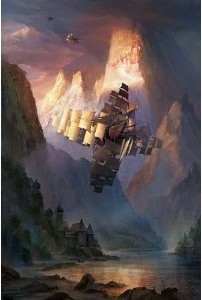
    Bradley P. Beaulieu just had his first novel released on April 1st. It’s called The Winds of Khalakovo and is the first of three planned books in The Lays of Anuskaya series publishehd by Night Shade Books. In addition to being an L. Ron Hubbard Writers of the Future Award winner, Brad’s stories have appeared in various other publications, including Realms of Fantasy Magazine, Orson Scott Card’s Intergalactic Medicine Show, Writers of the Future 20, and several anthologies from DAW Books. His story, “In the Eyes of the Empress’s Cat,” was voted a Notable Story of 2006 in the Million Writers Award. His agent is Russell Galen.

    Brad is a software engineer by day, wrangling code into something resembling usefulness. He is also an amateur cook. He loves to cook spicy dishes, particularly Mexican and southwestern. He lives in Racine, Wisconsin with his wife and two children. As time goes on, however, Brad finds that his hobbies are slowly being whittled down to these two things: family and writing. In that order . . .

    I recently had the opportunity to interview Bradley. Among other things, we talked about how he broke in and how he comes up with his ideas. He also convinced me to use his picture method, which I’m finding very handy on my current thriller project.

    ***

    JOHN: In your novel an elemental spirit attacks an incoming windship, murdering the heir to a kingdom. The person believed to be behind this is a child, an autistic savant. This sounds like Orson Card tale (grin). Did you come up with this character first, the magic, or something else. Tell us the genesis of the tale and this character in particular.

    BRADLEY: The genesis of the book is actually from a series of postcards of fine art that I picked up in Edinburgh, Scotland. (I posted about it on my website if you’re curious to learn more.) I used that artwork to first generate and then crystallize my thoughts about the book. Initially, I tried not to let any one thing rule the brainstorming I would do from time to time. I didn’t even know who the main characters were at first. I was quite taken by the picture of the three sisters, though, and I knew right away, the moment I laid eyes on the original in the National Gallery, that they would play a major part in the novel.

    But in the end it was the picture of the boy with the flaming brand that kept leaping out at me, calling for attention. The artist is Godfried Schalcken, and the piece is called A Boy Blowing on a Firebrand to Light a Candle. This character eventually became Nasim, the autistic savant. As I was studying the characters, I began to realize that this boy was not going to be a point-of-view character, but he was going to be a prime mover. In the end, he embodies much of what Winds is about. The story truly does revolve around him and his unique powers.

    The brand that he holds in the painting also came into play. I didn’t know what the magic was going to be about. I hardly had a single preconception about the book going in. I just wanted the artwork to speak to me, to advise me as to what the story was going to be–from the characters to the world to the magic. The boy blowing on the brand got me to thinking about elemental magic, and I realized that Nasim was one who could do this without even thinking. It came as naturally to him as did breathing. That’s a difficult place to put a character, however. As a writer, you have to be careful of all-powerful things, and so I needed something to balance Nasim’s abilities. And this, of course, is where his disconnection from the world came from. Nasim, as written in the book, is often lost. He has difficulty relating to others in even the smallest of ways. This both limited his power and made him in some ways more dangerous and more scary than a calculating villain, simply because of the unpredictability.

    I’d be remiss if I didn’t also mention Rehada, who started out as a somewhat minor character but grew into the most complex and perhaps the most compelling of my three main characters. Rehada came from Andrew Geddes’ Hagar. It’s another beautiful painting, filled with emotion. I was drawn to the fact that she was crying. I wondered why. I spent a lot of time answering that one question. After knowing that her people were essentially pacifists, I realized that Rehada was not. She felt she had betrayed her people and their ways because she had taken to the path of violence. It was from this, from that one single tear, that the entirety of the Maharraht–the fanatical splinter group that came to embrace violence as a means to an end–was born.

    By this point, I understood that I wanted there to be an aristocracy of some kind, and I fairly quickly landed on a culture that was modeled loosely after Muscovite Russia. I don’t remember why, exactly. It might have been that the other artwork reminded me of Russian Czars a bit, but I think the biggest driver here was that I definitely didn’t want something that was centered around western Europe, because frankly that’s been done to death. I wanted something more unique, and I’d always sort of like the mystique and darkness that seemed to hover around that time period in Russia. They’ve always seemed like a hard people, a people that would do whatever it took to survive, but in the same light, they took time to live life fully when they could.

    Given that I had the loose guidelines of the aristocracy, the peace-loving, indigenous Aramahn, and finally the will of the Maharraht to do whatever it took to regain the islands as their own, it created a crucible from which the story flowed fairly easily. I spend a lot of time building my worlds so that the conflicts within them come naturally, and that was definitely the case here.

    JOHN: The description of the world and your process for getting into the story is fascinating. From the article on your site it sounds like using images was a new technique for you. Is that correct? And if it is, was your process previously to have some other physical object of which you’d ask questions?

    BRADLEY: Yes, using artwork as a starting point was a new technique for me. I had no idea if it was going to work or not. An interesting thing came up when I was doing it, though. One of the things I learned at a few of the workshops I’ve been to (Writers of the Future and Orson Scott Card’s Literary Bootcamp) was to create stories in very little time using a few unrelated things as starting points. One unanticipated result of having restrictions in some areas (such as the elements involved in the story) is that it opens your mind in other areas. You’re forced to become more creative in some ways because certain avenues have been closed to you. I think it was the same with the portraits I used to represent the characters.

    Before that, in the previous three novels I’d written, I didn’t really have any specific brainstorming techniques. I would start with a premise and perhaps a loose idea of the characters and a mood, and I would go from there, trying to stay true to those things as the story evolved and grew. Although part of the problem with those early stories was that I was young in my craft, I also think my brainstorming wasn’t very efficient. I think, as I alluded to above, that there were too many possibilities. I had trouble narrowing the story down, and it led to stories that were ok, but nothing great. Too often they became a bit generic. Nothing really stood out.

    So while the artwork I used is one of a great many possible brainstorming techniques, I like the idea of challenging yourself with restrictions in order to force the story to stretch and bend in unpredictable ways.

    JOHN: Wow. That’s a striking insight. I think I’ve found the same thing occurs when I run workshops or do my own brainstorming, but I don’t know that I’ve ever crystallized it the way you have. (See folks, this is why I love these interviews.) So I see _The Winds of Khalakovo_ will be published by Night Shade books. You’ve had quite a few short stories published, but this is your first novel. How did you make the sale? Did you have an agent? Was the editor someone you knew? Gives us a bit of the story behind this.

    BRADLEY: As you said, I’d been making steady progress throughout the years in short story sales. I had attended a number of workshops, and I think my name had at least some recognition by editors, either from short stories I’d published or personal connections I’d made at conventions. As an aside, some people will say that you shouldn’t go and sell yourself at conventions. If an opportunity comes up, they say, and an editor or agent asks you what you’re working on, go ahead and take advantage of it. I don’t doubt that that’s good advice for some. Just not for me. I believe that editors and agents are at cons not just to meet with their authors and speak with agents, but to see who’s coming up in the field. They’ll get to know a certain percentage of the newcomers from their short sales, or even novel sales, but they can’t read everything. They can’t even read a small percentage of the fiction that comes out each year. So, frankly, it’s up to me to make them aware of who I am.

    Now, that doesn’t mean you should be pushy. You should be friendly and businesslike. Keep things short and sweet and as casual as you possibly can. And that’s exactly what I tried to do. I approached Jeremy at World Fantasy in San Jose (2009) and told him I had an epic fantasy that he might like. I pitched it as “The Song of Ice and Fire meets Earthsea.” He asked me if I had an agent. I said no. Night Shade doesn’t normally take unagented mss (and I should probably ask Jeremy some day if he gets annoyed that I tell this story), but he said he liked the cool pitch and said to send it his way. Roughly five months later, I got an email from Jeremy, offering to publish the book. 

    At that point, I moved quickly to find an agent, and believe me, agents will move quickly as well if you tell them you have an offer on the table. That doesn’t mean they’ll be clamoring to sign you up. It just means you have their attention. I was lucky enough to be picked up by Russell Galen of the Scovil Galen Ghosh Literary Agency. Russ and I are simpatico on a number of levels, and to be frank, as an agent he kicks serious ass, so I feel honored and blessed to be under his wing.

    JOHN: What a great breaking in story. And you’re right, Galen is tops. So to give my readers perspective, did you approach a lot of editors this way? Or was Jeremy at Night Shade one of a select few? And did you encounter any annoyance? I know my editor, David Hartwell at Tor, doesn’t much like to be approached at cons. But obviously, that’s not the case with all editors.

    BRADLEY: Well, I had not approached anyone else for Winds. However, I had previous novels, and I’d approached a variety of agents and editors over the years. Not scads of them, mind you, but a number of them, and there were more agents I spoke to than editors because the general rule of thumb is that you can approach and/or query multiple agents at the same time, whereas editors you typically ask for exclusives, even at the partial stage. I was also careful about who I approached, and when. I went to the Pikes Peak Writers Conference for several years. They had pitch sessions there, where you can sit down with an acquiring agent or editor and talk to them about your novel. I certainly took advantage of this, but I also wasn’t afraid to approach them outside of those sessions. At conferences in particular, I think the invited guests are open to being approached at the bar, at the dinners, and at the parties. Again, though, I tried to keep things as casual as I could, and I kept the pitch short and sweet so that they could determine quickly whether it was a project that interested them. Most often I got a “Sure, send me 50 pages” type of answer, but I got a few requests for fulls by doing this as well.

    Conventions are another beast. It’s a looser environment than a conference, so I was much more choosy about when I approached agents and editors. I’ve never encountered annoyance, but I’ve certainly felt stiffness from those who perhaps would rather not be approached. I learned from this early on and adjusted my approach. I would try to meet them first and strike up a conversation and see where it went. Often, if you can just be humans with one another, the subject of what you write and what projects you might have ready will come up. Try to take that approach, because there’s nothing to put off an editor that already keeps unknown writers at arm’s length than the smell of desperation. In the words of Monica Geller, keep it breezy.

    JOHN: Well, I’m excited for you. Night Shade is a great publisher. So I have one more question: what’s next?

    BRADLEY: I’m contracted for two more books, so that’ll occupying my time for a little while yet. But I’ve started brainstorming the next project. (I like to let things germinate for quite a while, so it’s important for me to get my hindbrain working on these as early as possible.) I have two possibilities that I’m mulling over. The first is a science-fantasy called The Days of Dust and Ash. Think Nausicaä of the Valley of the Wind meets The Coldfire Trilogy. I’m excited about this story, because it’s a departure from what I’ve written in the past, though it will still be fantastic and wide in scope. The story focuses on a young girl who is summoned from the dust, a global consciousness that was created as the last great age of technology fell under a nanite plague.

    The other is called From the Spices of Sanandira. I sold a novella with the same title to Beneath Ceaseless Skies last year, and it will be appearing sometime this spring. It’s a story that springs from Sanandira, a large desert oasis known for its caravan trade and spice bazaars. It’s got a strong Thousand and One Nights feel to it. The novel is not so much an expansion of the novella as it is a re-imagining of it. It will probably focus on a pair of twins: one boy, one girl. The sister is sold to one of Sanandira’s famed assassin rings at a young age. The boy (the protagonist) finds his sister by happenstance years later, and because of this chance meeting is drawn into the world of intrigue his sister walks every day.

    ***

     JOHN SEZ: I just love hearing how other authors work. As I said before, after this interview I decided to use the image technique myself on my current thriller project. Images of people and places and thing. I’m finding it helpful to help the story come to life. I also think Bradley’s breaking in story illustrates one key thing: work. And that’s exactly what I need to do right now 🙂

  • Interview with Edmund Schubert, editor of IGMS

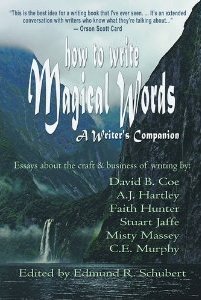
    I recently had the wonderful opportunity to interview Edmund Schubert, the editor for Orson Scott Card’s Intergalactic Medicine Show, about How To Write Magical Works: A Writer’s Companion, a collection of essays about the craft and the business of writing that he edited. Ed’s someone to listen to. But so are the authors whose essays fill the book: Faith Hunter, David Coe, C.E. Murphy, Misty Massey, A.J. Hartley, and Stuart Jaffe. Here’s what he had to say about this book.

    John: Edmund, you recently edited How To Write Magical Words: A Writer’s Companion. It’s chock full of advice from some pretty successful fiction authors, and an editor who, having purchased one of my stories, has shown exceptional taste (grin). But there are a lot of how-to’s by successful authors out there. What makes this book different, do you think? What’s the special value this book brings to the table?

    Edmund: I think the biggest thing that differentiates this book from others on the subject is its diversity of opinions. Most how-to books are written by one person, giving on perspective, but the truth is that there are many paths to success in this business. The Magical Words book was intentionally designed to replicate the give-and-take that exists on the MW blog. Sometime the MW writers agree, sometimes they don’t. The other thing that makes this book different is that it also includes some of the follow-up questions asked by readers of the blog, and the accompanying reply. That makes this book feel/read more like a writer’s conference than your basic info-dump book.

    John: I think the concept is great. And the contributors have quite a bit of experience. I know you can’t comment on every essay in the collection, but are there one or two that stood out to you while editing?

    Edmund: There were a few that stood out to me. One by Catie and one by David, both on the subject of money/advances. Those stood out to me because of how very blunt and honest they were about finances, and it’s information I think more people need to be aware of.

    The other one that stood out for me did so for personal reason. Catie’s essay about Visualizing The Story made me feel so much better about myself as a writer and my chances of success, because for years I’ve been hearing all these other writers at conventions talk about how their stories are like movies in their heads and all they have to do is record the action and the dialogue, and I used to hear that really worry because at best I might see a slide show of of bits and pieces of the action, but I’m totally making the rest up. Hearing Catie say that she didn’t/couldn’t visualize the story that way either gave me hope.

    John: I’m sure aspiring authors are going to be very interested in what Catie and David say about money. It’s also interesting that sometimes we writers hear other successful writers talk about how the invention process works for them, compare our process with theirs, and assume we’re lacking. In reality, the way we approach it might be just as effective. That’s one of the things I like about this book—it has multiple contributors. Let me ask one more question. You see a lot of stories as editor of Intergalactic Medicine Show. What are some of the topics addressed in this book that, based on the biggest issues you encounter in submissions, authors would be wise to carefully consider?

    Edmund: Magical Words as a group have two mantras: the first is that there is no one right way to do this crazy thing called writing, and the second is the exception that proves the rule: the one and only true answer to everything is BIC. Butt In Chair. You put your butt in the chair and you write. You figure it out as you go along. And the more you write, the more the other advice you hear will make sense. You want to be a writer? Write. The rest is details.

    ***

    John sez, amen to that. And amen to this book. I really enjoyed the format and the insights shared. I never tire talking about craft and business with other writers. With over 100 essays and 313 pages, this book has lots to share. If you want to hear what some very smart and a few very published authors have to say about writing, you’ll want to pick up your own copy.

  • Interview with Author Kelly Barnhill

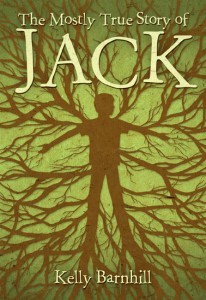
    Kelly Barnhill is a writer, teacher and Mom from Minneapolis. Her fiction has appeared in Postscripts, Weird Tales, Clarkesworld and other publications. She’s also published a number of high-interest science books for children. They have wonderful titles like Sewers and the Rats That Love Them, Blood-Sucking, Man-Eating Monsters, Sick, Nasty Medical Practices, and The Wee Book of Pee.  She states that “I’ve had like nine million jobs before this, including being a janitor, a park ranger, a wildland firefighter and a bartender (among others).” Kelly’s first novel, The Mostly True Story of Jack, will be published this year. I had the opportunity to interview her about the book and writing, and have to say I had a delightful time. Enjoy!

    * 

    JB: I have to start by saying I love the title of your book. It raises all sorts of questions in my mind. Was that part of the inspiration of the story or was it something you had to arrive at after a lot of hard work?

    KB: On the first question: Oh my. Titles. This title is the culmination of a whole lot of blood, sweat and tears. Okay, that’s not entirely true. Neither blood nor sweat, just tears – mine specifically. This book was originally called The Boy Without A Face, then Jack Be Quick, then The Curious Face in the Cornfield, then Uprooted, then the House at the Far Edge of Town, then the A Child of Earth and Magic, then…..oh lord, I can hardly remember. 

    The thing is, I typically don’t have a problem naming pieces. The title usually comes when I’ve untangled the first knot of text and the beating heart of the story is just starting to assert itself. This time, not so much. I was stymied from the beginning. I asked my kids their opinions, my agent, my agent’s assistant, every editor I’ve ever heard of. I asked my students, my Sunday School kids, kids on the block, kids at the park. 

    But that’s the thing when you have a title that doesn’t work – no amount of wanting it to be right will make it right. So I was bound to struggle and I was bound to hate – well, everything – because I just hadn’t hit on the right one yet. Until I did. And the fussing stopped (much to the great joy of everyone involved).

    JB: (laughing) That’s hilarious. I can see the desperate author hounding some kid on a swing. Of course, it shows persistence. And I’m betting it isn’t just a title that’s defied you. Have you run into plot or character snags that have been especially troublesome? If so, what do you do as a writer, how do you approach that?

    KB: Oh, clearly. I am one of those authors who does absolutely no planning before starting a project. Instead, I’ll get a little knot of text stuck in my head (usually when I’m out for a run) – something pleasing to the ear or gentle in the mind’s eye. And then I spend a whole lot of time figuring out the story behind it. What that means is that when I begin, I typically don’t know what exactly I’m writing. Is this a short story? A novel? A children’s book? A poem? It takes me a while to figure that out.

    Insane, you might say. Absolutely barking mad, you might mutter.

    Well, obviously, says I. But it’s fun.

    Anyway, I did a lot of select-all-deletes over the course of this novel (sometimes, deletes to the tune of 300 pages), retaining the characters, retaining the little bright spots that I managed to scrawl onto some note cards, but recomposing largely from memory, and re-engaging with the story in a fresh, new place.

    It’s a process I can’t really recommend. Except that I do. Whole-heartedly. There’s something thrilling about entering into a manuscript that doesn’t have any mistakes in it yet. Of course, it typically doesn’t have any words in it either at that point, but never mind.

    Along the way I’ve had to remove some fairly major characters, which forced me to completely re-imagine and recompose the book (again), but as I did so, the story was better, the writing was better, and I learned a lot doing it. So, I don’t like to call them “snags”. I like to call them “learning opportunities”. (Okay, fine, I also call them “throw-my-computer-in-the-creek-while-shouting-obscenities moments” but that’s not very nice to talk about.)

    JB: Kelly, I have to say, to find a simmering joy in the dreaded select-all-delete (folks, she’s wild, WILD!) Although I will say that starting a new project is always a thrill for me as well. So maybe we’re not too far apart, although I do enjoy my planning. So, what was the knot of text that started this story? Is it even there anymore? And how did it develop into the fantastic magic that’s at the heart of the tale? (Folks, as an aside, I have to tell you that the magic in this book is unlike anything I’ve read.)

    KB: Okay, you asked for it. Here is the original page. I’ll make the letters green, just because:

    Outside the house, a girl stood on the darkening street looking up. Her hands were shoved deep in the pockets of her ratty cut-offs, and her red-brown curls struggled out of the long braid that hung down the length of her back. Her bike lay on its side on the ground, the front wheel still slowly spinning around and around, until it finally stopped.

    Two boys walked slowly down the quiet street, their sneakered feet scarcely whispering against the pavement. One boy wore a bright orange seed cap over his even brighter blonde hair. He smiled at the girl as they approached. The other boy was very tall and he walked with a limp. Half of his face was obscured in a red knot of scars that bloomed over his skin like roses. He kept his eyes on the ground and did not speak. He never spoke. Both boys stood next to the girl. The boy with the cap tilted his chin towards the attic.

    “That kid get in today?” he asked, his eyes on the silhouette of the stranger in the window.

    “Yep,” the girl said.

    “Think he knows?” He turned to face the girl. His face, handsome and tan from so much time out of doors, shone in the last weak rays of the orange and pink sky.

    “How could he?” she asked. She reached over to the boy on her left, who was taller than her, though his pronounced slouch made it difficult to tell. She put her arm around his shoulder, and he, in turn, laid his face, bad side down, good side up, on hers. Only when they stood like this, could people see that they were brother and sister. “But he will,” she said.

    I wrote this while on a positively lovely run through Fort Snelling State Park in Minnesota. Well, that’s not exactly true. I thought it while I was running. I wrote it when I got home. But that’s how a lot of stories start for me – a bit of fluff twists into a thread and thickens to a cord and winds into a knot. And then I have a hell of a time figuring out where the thing leads.

    Now, that actually wasn’t everything that led me to JACK. There was another bit that I can’t find anywhere that was a conversation between a kid and his mom as they drove in a rental car towards a farm house in Iowa, where the kid would be staying while his parents worked through the details of their divorce. I didn’t realize that the kids on the street would occupy the same story as the kid in the car. Indeed, I had no idea that the kids on the street were talking about the kid in the car. I also had no idea that I was writing a book with magic in it either. That was a surprise.

    But to answer your earlier question, neither the conversation nor the bit about the kids looking at the house are in the book anymore, though little images and descriptions have drifted into the later drafts and taken root. That’s the magic of revisions – every cut is necessary, and every cut hurts, but something new always grows. And sometimes the bits of your novel that once were broken and wobbly and weak transform into some very pretty bits of fiction. It’s the transformation that gets us every time – or me, anyway. Honestly, it’s why I keep coming back to the page: I like change.

    And as far as the magic at the heart of the story – I can’t really say. I think that the magic was simply there, waiting for me to find it. Everything I know about the strange history of that town, the terrible events that happened in the past and the necessity for Jack and his friends to set things right – I only discovered those things by accident. I discovered them because I cared about Jack, and cared about his loneliness and his lack of place, and I wanted to understand him. (And yes, I totally get it that he’s not real, but in the end that doesn’t really matter, does it? I’m a mother, and a child in need is a child in need.)

    (Did I even answer your question? Why is it that every question sends me tumbling in all directions? I think I might be a dreadful interviewee. Maybe you should ask me easier questions. Like about darning socks.)

    JB: (laughing) You’re a wonderful interviewee. I love these answers. And I think my readers will appreciate very much what you’ve shared. In fact, I’m betting they’d want me to keep asking questions for quite some time, but I’ll limit myself to two more. First, the prose of your book has a flow to it. I haven’t pinpointed what it’s doing yet (I have noticed some parallelisms), but the prose is compelling. Just picks you up and carries you along. Is that flow important to you? Do you labor over it, or is it just something you enjoy, maybe seek out in other authors, and, therefore, seems to come naturally? Tell us your thoughts on this.

    KB: Oh, John, I am so glad you asked me this question! (Also, that you noticed, because I worked really hard on it!)

    Let me back up before answering that, though, because I think it’s really hard to separate how a writer builds text and uses words from how they think. There are people on earth – lots of them – who are visual thinkers. I am not one of them. In fact, I am not a visual thinker at all. Even now, when my house is quiet and my kids are at school, it is difficult for me to call up a mental image of their faces – but the texture and timbre of their voices is with me all the time. And it’s always been like that for me as a reader – I’m much more attracted to books with a strong aural sensibility. I like prose that is rhythmic and rich. I think language works best when it is a sensual experience – not just in what it evokes (though that’s clearly important) but how it feels in the mouth, how it feels in the ear.

    Now I think part of the reason for this is that, as a little girl, I was a delayed reader. And when I started reading, I was stuck in the bottom group (they never tell you you’re in the bottom group, but oh! As children we know. We know!). This is not to say I wasn’t experiencing and engaging with stories. Every night my dad read to us – first the Grimm stories, then Narnia, then Tolkein, then Dickens. I also had a little fisher-price record player (that I bought at a garage sale with my own money, so of course I thought it was awesome) and a bunch of dramatized books on records – Treasure Island, 20,000 Leagues Under the Sea, Watership Down, Call it Courage, Anne of Green Gables, and some others that I can’t remember.I would listen to those things so often that my siblings threatened to throw my record player out the window. So I’d lock myself in the closet and listen some more. And even now, I love stories out loud. My husband and I read to one another every night, I read to my kids, and I read my own work out loud as I revise, over and over and over again.

    My book sounds the way it does because I’ve read that thing out loud, cover to cover, approximately nine million times. Actually, that might be a conservative estimate. I want my stories to feel like a whisper on the skin, an insistent voice that you can’t shake. Now, mind you, I’ll probably never actually reach that goal, but it’s good having a target, anyway.

    JB: Wow. That’s lovely. You know, I’m not a style over substance guy, but I like sound. I’m attracted to prose that sings, even if it’s softly. This seems to be what you’re suggesting you look for. Not prose that necessarily stands up and shouts for people to look at it. But prose that, well, as you said, is a whisper on the skin. Oh, there’s a whole interview right there. In fact, I think, if you’ll agree, I’m going to have you back, maybe around the time Jack comes out to discuss that. In the meantime, I see you have a whole bunch of projects slated to come out. The Final Exile of the Insect King is another killer title. But Iron Hearted Violet is the one coming out next after Jack. Tells us about that one or anything else you think readers should know about. And since Jack is a ways off, tell us which of your published stories you’d suggest readers try while they’re waiting. I see a whole bunch you’ve linked to on your site.

    KB: Thanks John! This has been really fun, and I’d love to pop back over to your corner of the internets around launch-time (August 2! Mark your calendars!).

    Anyone who is interested in reading any of my fiction online can head over to my blog for a list of links (www.kellybarnhill.com). And any of you who are interested in buying some pretty cool collections could check out Sybil’s Garage #7, which has my story “The Dead Boy’s Last Poem” or Apex’s recent anthology Dark Faith, which has my story “Hush”. Another story that I feel pretty good about  is called “The Taxidermist’s Other Wife”, which appeared on Clarkesworld in December. That particular story came from an experience I had up in northern Minnesota (about ten miles south of the Canadian border), when I was teaching a fiction workshop to a bunch of hockey-playing high school seniors. One boy was telling me that it took him over an hour each way to get from home to school and back again. He said he’d been doing that for the last six years, ever since his town closed down the school. I asked him if all the kids in his town had to make the same kind of crazy commute, and he said, “Those of us who’re left, sure. There’s not many of us anymore. You kill the school, you kill the town. Everyone knows that.” The idea that the lifeblood of a town is bound up in its school  – and indeed, that a town can be killed, stuck with me, and transformed into an odd, mournful little piece. There is a deep love as well as a devastating sorrow that binds the people of my beautiful (and very cold) state to the land that surrounds them – and I feel that this story is the closest I’ve ever come to actually pinning those twin emotions down onto the page. 

    As for Iron-Hearted Violet  – that has been a devilishly tricky book to write, but I’m pretty happy with it. How to describe it? Hmmm. It’s the story of a girl who unwittingly releases an imprisoned, wicked god, and must sacrifice all that she knows and all that she loves in order to stop it from enslaving her – and every – world. There are banned stories and dragons with missing hearts and a grieving girl and  friendship and a magic book and sleeping gods and a multitude of universes gathering in great foamy waves and crashing against the shore. Mostly, getting the language and tone just right was incredibly tricky, and I went through something like a million drafts, so for me to say that I’m feeling happy with it is a pretty big deal.

    JB: Well, that gives us all some great things to try out. I’m personally looking forward to Jack.

    *

    John Sez: now there is someone who just loves to write. I love her sense of adventure in discovering the story and her willingness to generate a lot of stuff to get to the final story. And the sound of her prose. Not that all books have to have this, but it is nice. Furthermore, Kelly was just enjoyable to talk to. That fun voice comes out in her blog. She’s going to be someone to watch. In the meantime, for the rest of us, it’s back to work.  

    LINKS

    Kelly Barnhill’s website

    Codex Author Blog Tour 2011

  • Interview with Author Judson Roberts

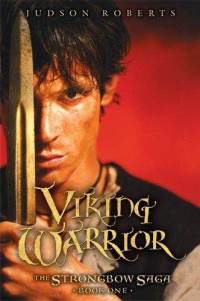
    I’m very excited to present an interview I did with Judson Roberts, author of the Strongbow Saga.

    Over his long and varied career, Judson Roberts has been a police officer, federal agent, organized crime prosecutor, and private investigator. He is also reputedly a distant descendant of Rollo, also known as Rolf or Hrolf, the Viking leader who in 911 AD entered into a treaty with the King of the Western Franks and was granted the lands located around the mouth of the Seine River which eventually became known as Normandy, after the Northmen who settled there. He currently lives in Houston, Texas, but is looking forward to moving. (I’d think–what’s a Viking gonna do in landlocked Houston except go crazy?)

    Here’s what the scion of Rollo had to say. BTW, you’re going to see how ebooks have changed things so much for authors.

    *

    JB: Judson, you’ve had quite a rollercoaster ride with publishing these last few years. You were picked up by HarperTeen for a trilogy. Orson Scott Card reviewed the first novel and called it “A well-written, well-researched, exciting, moving historical novel.” But some things didn’t go as planned. Give us the story.

    JR: That’s a good way of putting it: some things didn’t go as planned. The whole experience has been a valuable lesson for me, in part about what realistically to expect when dealing with a big publisher, but even more so, that often in life, things that seem like disasters at the time can, in the long run, prove to be opportunities we never could have found otherwise.

    My experience with HarperCollins was not a happy one. But before I get into that, I should give a bit of background information. The books that HarperCollins published are the first three volumes of a historical fiction series, set in the world of the Vikings during the 9th century, which I plan to eventually be five books long. I always envisioned the series as adult fiction, and wrote each book as such.

    I initially had a very hard time finding an agent. After a year or so of trying, I saw an advertisement about the Maui Writers Conference in Hawaii that said that authors could submit a “resume” consisting of a brief excerpt and a pitch for their current work to the conference-for a fee, of course-and the resume would be circulated to all agents and publishers attending the conference. I gave it a shot, and ended up being contacted by three agents as a result. One was especially eager—she asked me to give her an exclusive look at the full manuscript, but promised to give me her decision within two weeks. In fact, she asked to represent me within a week. Her agency primarily handles children’s and young adult books, but she assured me she also handled some adult fiction and wanted to handle more, so that, and her enthusiasm, won me over.

    She ended up being unable to interest any adult fiction editors in the book—at that time, I’d only actually written what is now book 1 of the series, Viking Warrior, although the way that book ends there’s obviously more of the story to come. So she asked if she could try to sell it as YA fiction, I agreed, and not too long after that, she secured a three book contract for the Strongbow Saga with HarperTeen, part of the children’s books division of HarperCollins.

    My editor at HarperCollins was very good-whatever I may feel about other divisions of that publisher, I’ve had nothing but good experience with editorial staff there-and was very enthusiastic about the series. She never made me tone the books down in any way—as intended adult fiction, and historically accurate to the period, there are some scenes that are quite violent. She even went so far as to say that she could see the series developing the kind of enthusiasm across different age groups-becoming a cross-over book for teens and adults-whose popularity might last for many years, similar to The Lord of the Rings, and she. That was a bigger vision than I had for the books, but it was certainly an exciting comparison to hear-The Lord of the Rings has been my favorite book since I first read it decades ago in high school. Unfortunately, the marketing side of HarperCollins apparently did not share her vision.

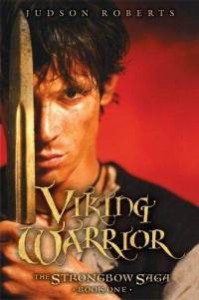
    Trouble in paradise initially began with the cover design. Someone in marketing decided that the group of targeted readers (and as it turned out, the marketing side never had any idea of trying to reach adult readers—they worked for the children’s division, after all) least likely to be attracted to a book about the Vikings was teenage girls, so they developed a series of covers, using different samples and focus groups, specifically designed to attract them. The results look a lot like covers for romance novels, though at least without the bare chests.

    In the months leading up to the release of book 1, I asked the marketing department what plans they had to get the word out about the new series, and what I could do to help. They responded that their primary focus was going to be libraries, that they’d be pushing the books hard to librarians, using them as a gateway to get the books in front of young readers. They’d also be sending out the typical round of advance review copies prior to release.

    The reality was far different. Had it been a test of stealth technology, Viking Warrior’s release would have been a great success, but book releases are not supposed to totally invisible. It was not reviewed in a single major review venue—my agent said she had never, in her entire career, seen a new series being launched in hardback by a major publisher get no reviews at all. I’d suggested a number of specialized venues to send review copies to also—publications specifically targeted at fans of history and historical fiction, reenactors, and the like, and none of them put out reviews, either. Eventually I started contacting a number of these smaller venues, and learned than none had received review copies of my book. It looked like someone on the marketing side made a huge mistake and somehow failed to send out review copies, although HarperCollins has repeatedly refused to admit that had happened.

    Eventually a few scattered reviews were received months after Viking Warrior had been released, but by then the damage had been done. I learned a new term: “sell through.” In publishing, that term refers to how many of the copies of a book that are shipped out to distributors and booksellers are actually sold, instead of being returned. The first months after a book’s release are the most carefully scrutinized—publishers want a new book to hit the ground running and sell lots of copies quickly. Needless to say, if no one has ever heard of a book, and its only sales occur when someone just happens to discover it on a bookstore’s shelves (and on the shelves of the children’s books section, in the case of my books) that kind of early momentum does not happen.

    The promised campaign to reach out to librarians never happened, either. About two or so or so years after the series first came out, I began periodically receiving emails from school librarians who had belatedly discovered the books, fallen in love with them themselves, and had become eager advocates for the series to their students. Over and over, I’ve heard from these librarians, “Why have I never heard of these books before?” One even confronted a HarperTeen representative at a big library conference, asking why they didn’t publicize the series more, and the rep didn’t even know what books she was talking about. And always, they asked when the next book in the series would be coming out.

    That was a painful question. Because the sell through numbers were so low for book 1, each of the next two books had successively smaller printings, and again received little or no support from the publisher. By the time the third book came out, the series was unofficially dead. My editor said that, based on the numbers, there was no way she could persuade HarperCollins to buy the other two books in the series. However, the publisher had the right to buy them locked up with an option clause in the contract, so I was unable to publish them any other way, either. It was not until 2010—after my original editor had moved from HarperCollins to another of the big publishers, and after the decision had been made to start taking the series out of print-that the option clause was released, and I had the unrestricted right to finish my own series.

    JB: Oh. My. Heck. Wow, talk about a sucker punch. Body blow, body blow! I knew some of the details from Card’s review, but this just fills me with dismay. How could that happen? I don’t know. Mistakes are made, but geez. I’m sure those must have been a rough couple of years as a writer. Of course, you knew you had a good book. So what happened next?
    JR: There were certainly a couple of grim years in there. I couldn’t write the next book in the series because HarperCollins was keeping it locked up with the option clause of the contract, my sales—and royalty income—were dropping to minimal levels, and my agent—now my former agent—basically said it was all a tough break, and I should just give up on the series and move on to something else. Given that I’d spent years of research developing my base of knowledge and expertise about the Vikings and their time period, that suggestion didn’t sit very well.

    What really sustained me as a writer during this period were the emails I received from readers. Understand that when I starting writing this series, my goal was to try to write a story that  would have the following attributes, of the novels I’ve read over my lifetime that I’m most enjoyed and that have stuck with me as lasting favorites: I wanted the world the story takes place in to be exotic and different from our own, but so vivid that the reader is swept into it (and since the series is historical fiction, I also wanted it to be as rigorously accurate as possible), and I wanted the characters to become real for the reader, so that readers would become emotionally involved with them. But I truly never anticipated the kind of responses the story seems to be evoking in some people. For example, I had several emails from a major in the Australian Army, stationed in Afghanistan, who said the books are part of his permanent inspirational collection, and that he and his young son both love them. A young man told me the books had helped him during a difficult period when he was going through drug rehabilitation, and recently a young woman wrote to tell me that her cousin, who’d recently returned from a tour in Afghanistan and was deeply disturbed by his experiences there, had enjoyed the books and they’d given him comfort. I’ve been tremendously moved, but also more than a little amazed, at how deeply some readers are connecting Halfdan, the protagonist of the series, and I am resolved to finish the story for them.

    I eventually decided to sidestep the option clause by writing a stand-alone historical thriller, which involves some of the characters from the series but not the protagonist, which will in some ways also be a prequel to the series, in that I’m using it to introduce a new character who will play a major role in the final novel of the Strongbow Saga when it’s written. The new novel—its title is The Beast of Dublin—is set in Ireland about five years before the series begins, and part of its plot involves a twist on the Beowulf story. I’m still in the midst of writing that novel—Ireland in the mid-ninth century proved to have horribly difficult history and culture to research and understand, so I’m far behind my planned schedule.

    Meanwhile, during 2010 things started to happen. Around the middle of the year I begin hearing about an author named J.A. Konrath and his experiences self-publishing through Amazon’s Kindle e-book store. He had a number of books that had previously been traditionally published but had gone out of print, so he made them available again as e-books, and also self-published some books he’d written that had never sold. He has experimented a lot with pricing, cover designs, etc. and has published his results on a blog he writes, to spread the word about how Amazon has changed the game for authors, giving them a way to make a living through their writing free of the problems inherent in the traditional publishing system. As an experiment and to learn how to create an ebook, I published a roughly 30,000 “first look” preview of The Beast of Dublin for any Strongbow Saga fans who wanted to get a glimpse of what I’m currently writing—almost every email I receive from readers asks when my next book is coming out.

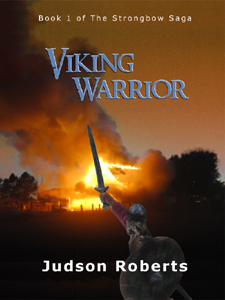
    Also around the middle of 2010, I noticed that Amazon had started listing book 2 of my series, Dragons from the Sea, as unavailable. It took months to get HarperCollins to even admit they’d taken that book out of print, and then to respond to a request I sent them that rights to the book be reverted to me, but finally, in October, I owned that book again. While I was waiting for the reversion to come through, I worked with a tremendously talented computer and graphics designer named Luc Reid to create a new cover which does justice to the book, and after the time consuming process of re-editing the book (is any author ever satisfied enough with a finished book to forego a chance to tweak it one more time?) and the excruciatingly slow process of converting it into Kindle format—I do NOT have any skills at computer language or programming—I managed to get the book live in the Kindle store by late October.

    In the meantime, HarperCollins took book 1 of the series out of print, so the whole process—request reversion of rights, design new cover, re-edit, and convert to Kindle format, began again. Book 1 of the series, Viking Warrior, did not go live in Amazon’s Kindle store until December 24th. Christmas had been my target date, because Amazon has surprised every analyst and expectation by selling somewhere between seven and eight million Kindles during 2010, many during the months leading up to Christmas, so even the traditional publishers have been expecting to see a huge surge in e-book sales beginning in early 2011.

    It’s still early days yet, but so far I’m tremendously encouraged by how my books are moving on Amazon. The total numbers still probably would not impress a big traditional publisher looking for the quick sell-through blitz, but thanks to Amazon’s generous royalty program, I’m starting to see my series produce some meaningful income. In October, when book 2 first went live for part of the month but book 1 was unavailable, I earned barely over $100. During November, despite the fact that book 1 was still unavailable, sales earnings climbed to about $470. In December they jumped to over $800, and if the rate of sales for January keeps up for the entire month like the first two weeks have gone, they’ll easily pass $2,000.

    And the earnings alone aren’t the whole story. Amazon’s sales reports reflect that a significant portion of these sales are taking place outside of the U.S., and I’ve begun having contacts from new readers in the U.K., Scandinavia, and even Spain. HarperCollins had insisted on acquiring foreign rights with their contract, but then essentially did nothing with them. Now I have a chance to get the story into overseas markets.

    I’m not yet ready to say I’ll never try the traditional publishing route again—I’ll probably at least test those waters with The Beast of Dublin once it’s finished. But I will, without question, self-publish book 4 of the series through Amazon once it is written. There are just so many advantages, not the least of which is that I can get the book to readers within a month or two after I’ve finished writing it, compared to a year or longer via the traditional publishing route. The world we as writers are working in is changing dramatically.  I don’t think anyone really knows what it’s going to look like ten years from now, but so far, it’s looking like the changes could be very good for writers.

    JB: Hey, I’ll take an extra $1-2k any month (grin). I’m so excited to see this series find its audience. What particularly impresses me is the resonance the books have had with some of your readers. You know, there’s art that entertains, art that gets in your face on purpose, art that enlightens, art that gives solace—I’m sure there are dozens of other things that art does. You mentioned your goals with the book in your response. But do you have another ultimate goal? Or maybe I should say, what’s your view of yourself as an author? What is it you see yourself providing the reader?

    JR: I view myself as a storyteller. My goal is to provide readers with entertainment, escape, to touch them emotionally, and maybe occasionally subtly provide a bit of inspiration.

    JB: I love it. It’s clear you’re succeeding. I think I have two more questions for you. First, I’d like you to tell my readers about Viking Warrior, the first book in the Strongbow Saga, itself. It should be clear now that it’s a historical, but what’s it about?

    JR: The story is set during the mid-ninth century. When it begins in Viking Warrior, Halfdan, the protagonist, is a fifteen year old slave living on the estate of a Danish chieftain. His mother, also a slave, is an Irish noblewoman stolen years ago in a raid, and his father the chieftain whose estate they live on and belong to.

     The chieftain is mortally wounded in a raid on England, and is brought home by his son, Harald, to die. The chieftain wants Halfdan’s mother to accompany him on his death voyage to the next world (an actual custom sometimes practiced in Viking society). She cuts a bargain that will cost her her life–if he tries to force her, she will call upon the god of the Christians to curse him and derail his death voyage, but if he agrees to free Halfdan and acknowledge him as his son, she will go willingly.

     After the funeral, Harald, now the head of the family, undertakes to train Halfdan in the skills he will need as a free man and a warrior. But Halfdan’s new life is soon shattered by a terrible act of treachery that leaves Harald and most of his followers dead, and Halfdan on the run with the warriors of an enemy chieftain hunting him.

    JB: (Folks, if Card’s review and that description doesn’t induce you to read this excellent book, I don’t know what will.) Dude, talk about a setup. I think anyone who is a Bernard Cornwell fan should enjoy this. You’ve mentioned a bit about what books you’re working on, but give us the details about what’s coming next and what’s available right now.
    JR: Currently the first three books of the Strongbow Saga series are available, although paper editions of book 1, Viking Warrior, and book 2, Dragons from the Sea, are temporarily out of print. I hope to get a new print edition of Dragons  back out within a week or so.  It will take a bit longer to get the new print version of Viking Warrior  into circulation, because I have to hire someone to set up the print format, and I’m at the mercy of their time constraints. However, for now new and used copies of both are still available–often quite cheaply–on Amazon through affiliated booksellers, and they’re also available as e-books through Amazon’s Kindle store.

     I’m currently in the middle of writing the novel I mentioned earlier, The Beast of Dublin, which is set in same the world as the series and includes a number of characters from it, but takes place in Ireland about five years before the series begins and will be a stand-alone historical thriller. As soon as I finish it, I’ll begin writing the fourth book of the Saga–I’ve already got the plot roughly outlined. Over the five books of the series, readers will journey with Halfdan over much of the Viking world. Books 2 and 3 are set mostly in western Frankia–the kingdom that became modern France–and in book 4, Halfdan’s pursuit of his sworn enemy will carry him from Denmark to Sweden and down into Russia.

    JB: It looks like you’re going to be keeping busy. Judson, this has been great. I really enjoyed the interview. Thanks so much for taking time out to share your experience with us.

    JR: Thank you, John. It was my pleasure. You’re a thorough interviewer.

    *

    John sez . . . first of all, wow. Talk about a fighter. Bam, bam, bam and the series is on the floor, bleeding and written off as dead. A lot of authors might have given up at that moment and gone onto pole dancing or avocado picking. Not Roberts. He gets back up and finds new distribution and continues to write (this time a cool Beowulf thriller). And, lo, his books are finding their audience–all over the world! Second, I think five years ago Roberts could have only come back under a different name. But now, heck, he’s selling on Amazon. And not just floating around with a book sale every month. He’s in the 2000’s out of hundreds of thousands of books. Holy schnitzel. Look at this ranking as of 1/24/11 5:11 PM my time (the most important time).

    Amazon Bestsellers Rank: #2,349 Paid in Kindle Store (See Top 100 Paid in Kindle Store)

    A book and series considered dead is selling as well as or better than thousands of other “live” books. Long live the zombies. Ebooks have changed everything. Everything. So much power is shifting to the creators. It’s totally exciting to me.

    LINKS

    Judson Robert’s website

    Reviews & Praise

    Viking Warrior on Amazon

    2011 Codex Blog Tour