Interview with Edmund Schubert, editor of IGMS
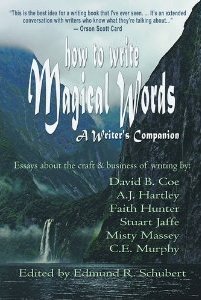
I recently had the wonderful opportunity to interview Edmund Schubert, the editor for Orson Scott Card’s Intergalactic Medicine Show, about How To Write Magical Works: A Writer’s Companion, a collection of essays about the craft and the business of writing that he edited. Ed’s someone to listen to. But so are the authors whose essays fill the book: Faith Hunter, David Coe, C.E. Murphy, Misty Massey, A.J. Hartley, and Stuart Jaffe. Here’s what he had to say about this book.

John: Edmund, you recently edited How To Write Magical Words: A Writer’s Companion. It’s chock full of advice from some pretty successful fiction authors, and an editor who, having purchased one of my stories, has shown exceptional taste (grin). But there are a lot of how-to’s by successful authors out there. What makes this book different, do you think? What’s the special value this book brings to the table?

Edmund: I think the biggest thing that differentiates this book from others on the subject is its diversity of opinions. Most how-to books are written by one person, giving on perspective, but the truth is that there are many paths to success in this business. The Magical Words book was intentionally designed to replicate the give-and-take that exists on the MW blog. Sometime the MW writers agree, sometimes they don’t. The other thing that makes this book different is that it also includes some of the follow-up questions asked by readers of the blog, and the accompanying reply. That makes this book feel/read more like a writer’s conference than your basic info-dump book.

John: I think the concept is great. And the contributors have quite a bit of experience. I know you can’t comment on every essay in the collection, but are there one or two that stood out to you while editing?

Edmund: There were a few that stood out to me. One by Catie and one by David, both on the subject of money/advances. Those stood out to me because of how very blunt and honest they were about finances, and it’s information I think more people need to be aware of.

The other one that stood out for me did so for personal reason. Catie’s essay about Visualizing The Story made me feel so much better about myself as a writer and my chances of success, because for years I’ve been hearing all these other writers at conventions talk about how their stories are like movies in their heads and all they have to do is record the action and the dialogue, and I used to hear that really worry because at best I might see a slide show of of bits and pieces of the action, but I’m totally making the rest up. Hearing Catie say that she didn’t/couldn’t visualize the story that way either gave me hope.

John: I’m sure aspiring authors are going to be very interested in what Catie and David say about money. It’s also interesting that sometimes we writers hear other successful writers talk about how the invention process works for them, compare our process with theirs, and assume we’re lacking. In reality, the way we approach it might be just as effective. That’s one of the things I like about this book—it has multiple contributors. Let me ask one more question. You see a lot of stories as editor of Intergalactic Medicine Show. What are some of the topics addressed in this book that, based on the biggest issues you encounter in submissions, authors would be wise to carefully consider?

Edmund: Magical Words as a group have two mantras: the first is that there is no one right way to do this crazy thing called writing, and the second is the exception that proves the rule: the one and only true answer to everything is BIC. Butt In Chair. You put your butt in the chair and you write. You figure it out as you go along. And the more you write, the more the other advice you hear will make sense. You want to be a writer? Write. The rest is details.

***

John sez, amen to that. And amen to this book. I really enjoyed the format and the insights shared. I never tire talking about craft and business with other writers. With over 100 essays and 313 pages, this book has lots to share. If you want to hear what some very smart and a few very published authors have to say about writing, you’ll want to pick up your own copy.


Share

Similar Posts

  • |

    No Apology

    The Book

    Political TV ads can be fun. And annoying.

    Debates can be fun. And maddening.

    You can indeed learn things about the candidates from watching the ads and debates. But fifteen and thirty second snippets of information really don’t give you the full picture. And sometimes they actually hide the facts, producing nothing more than informational smog.

    Recently, I decided I wanted to really know what Mitt Romney thought.  What he was about.  What he hopes to accomplish if he wins the presidency. If Mitt was someone in my neighborhood, I’d go visit the man, and we’d have a chat.

    I’d ask him about his ideas and past. I’d ask him to give me examples. Because of the nature of the issues at stake and the number of them, I imagine our chat would probably last a few hours.  It might stretch over a number of evenings.

    Of course, I’d want time to consider our chat and determine where I did and didn’t agree with him. I’d want to hear what others thought. And I’d want to look into his history, his successes and failures.

    But the first step would be to go to the man himself and hear him out.

    I hate it when people put words in my mouth. I’m sure Romney, or anyone else running, hates that same thing. If I were running, I’d would hope folks would take the time to hear me out. They may ultimately disagree with me on many or a few things. But I’d hope, as they are gathering information, that they would take the time to actually go to the source and listen to what I myself had to say.

    Unfortunately, I can’t walk around the corner and knock on Mitt’s door. But he did write a book that was published in 2010, and it’s probably the next best thing to talking to Romney at his kitchen table. The book is called No Apology: The Case for American Greatness.

    I’ll admit I thought it was going to be a dry guide book explaining his position on every hot political issue. It’s not a guide book.  In fact, he leaves a number of topics out. Nor was it dry.

    I also suspected it might be a scathing attack piece on the Obama administration. It’s not that either.  Not even close. He does criticize some things where he and Obama differ, but he also commends him on a few things. Either way, Obama is a very small part of the book.

    So what IS this book?

    Romney states its purpose in the introduction: it’s “about what I believe should be our primary national objective: to keep America strong and to preserve its place as the world’s leading nation” and “the course I believe we must take to strengthen the nation in order to remain prosperous, secure, and free” (2). It’s about his ideas on how to make sure America does not falter as so many nations have, but remains wealthy, happy, and productive.

    I finished the book yesterday. I found it interesting, personable, sometimes surprising, and insightful.

    I found Mitt Romney to be a man self-deprecating humor.  He’s also a thinking man, one who likes to look at data to see what it shows. It’s clear he’s a man who does NOT think he knows everything or has a monopoly on every good idea, but he’s also a man who demands evidence.  I also saw a man who is kind.  He doesn’t talk much about his 14 years of service as a lay minister in his church in this book, but you can see how those years changed him as he discusses helping the unemployed, out-of-wedlock births, and single-parent families.  Finally, I saw a man who loves, LOVES, America and is convinced she can remain the hope of the earth, but only if we do things that foster our strength.

    This book outlines what he thinks those things are.

    The book is written in a conversational and easy style with many examples from his personal experience, studies, and history. Romney’s record of accomplishments demonstrates his skills and hard work ethic. This book explains to what end he would apply that skill and work.

    If you’re planning on voting this November for the president of the United States, I think you’ll find this book very useful.  You may end up agreeing with many things he says. You may end up disagreeing with him on many points. But before you can do either, you need to understand what Romney’s position actually is.  And the first step in doing so is to fully hear the man out, in his own words, from his own lips.

    As a result, whether you end up deciding he’s your candidate or not, you WILL come away with important insights into the issues discussed.

    What’s Next

    I want you to know that I do not worship George, Ben, Tom, Adam or any of the other guys who formed our constitution and started this nation.

    They put their lives and fortunes on the line for what they believed in. And I am immensely grateful for what they did.  I enjoy tremendous freedoms because of their courage, determination, and sacrifice. Those guys, by-and-large, rock!

    But I do NOT believe that their words are scripture nor that their ideas are sacrosanct—merely to be accepted and not to be considered and questioned and disagreed with.

    Even so, these guys were gutsy and brilliant. They attempted something everyone thought would fail.  Something that HAD failed every time it had been attempted in their recorded history. But they pulled it off and changed the world.

    These guys believed in the common man. They believed that the educated common man was the best person to hold the reins of government. Thomas Jefferson thought up a rhyme to make the idea easy to remember.  He said, “If a nation expects to be ignorant and free in a state of civilization, it expects what never was and never will be.”

    I can’t argue with that.

    Of course, we’re not going to become experts on every policy issue. But we certainly can become informed on the broad principles and issues. And we can certainly become informed about the candidates.

    Because I found No Apology so useful, over the next few days I’m going to summarize Romney’s main points, chapter by chapter, here. I’ll also point out interesting ideas and facts he shares as well as share any questions, quibbles, or disagreements I have.

    I hope you find it useful. More importantly, I hope you read the book and join in the conversation.

    Share
  • Good Stuff! 3 Books to Introduce You to the Middle East

    ISIS, the Taliban, Al Qaeda, the Muslim Brotherhood, Iran.

    What drives these groups?

    What are they really about?

    Why is there so much religious strife in the Middle East?

    For that matter, what is Islam actually about? Is the religion really defined by these violent actors, or are they just the most visible because they’re what’s reported on in the media?

    I set out to find the answers to these questions, and what I have found so far surprised me. If you are interested in understanding what’s going on in the Middle East today, you have to understand Islam. And it’s a fascinating story. There are a lot of books on the subject, but you don’t have to sift through all those I did. I want to share with you three slim books that I found to be the most clear and engaging introductions I’ve come across.

    The first is Understanding Islam: An Introduction to the Muslim World by Thomas W. Lippman, an award-winning author and journalist who specializes in the Middle East and spent years living in Egypt, covering the events, and traveling from Tunisia to Pakistan. Again, this is a slim, easy-to-read volume, but it is packed with information. If you want to know the basic beliefs of Islam, who Muhammad was, what all this business about Sharia is, and who the major Islamic groups of the Middle East are today, this is the book to start with. One note, you want to make sure you get the third edition of this book.

    Understanding Islam by Thomas Lippman

    The next book is by Bernard Lewis, a man internationally recognized as one of our century’s greatest historians of the Middle East. The book is called The Crisis of Islam: Holy War and Unholy Terror. Again, another slim, engaging, but information-packed volume. In it, Lewis explains what it is in Islam that is breeding these extremist groups. And what is leading them to target America, which is especially interesting because for most of the 1900s the United States was seen as the good guy by the Islamic world. What changed? Read this book to find out.

    The Crisis of Islam by Bernard Lewis

    The last book, a lively, engaging read, is called After the Prophet: The Epic Story of the Sunni-Shia Split by Lesley Hazleton, another veteran Middle East journalist. When you finish this book, you will understand why Saudi Arabia supported ISIS before they so recently turned against it. You’ll understand why they recently joined Israel, of all nations, in condemning Iran’s nuclear program. You will also understand one main reason why the Iraqis can’t seem to get along. In this book, Hazelton goes back to the beginning of the religion and tells the story of the splitting of Islam–the split between the Shias and Sunnis. It’s as significant a split as that of the Protestants from the Catholics in the time of Luther. But unlike that split, which has lost almost all of its heat, the antagonism between Sunni and Shia still leads to war. You cannot understand the Middle East today without understanding this.

    After the Prophet by Lesley Hazleton

    So there you have it. If you’ve been wanting to learn more about Islam and the Middle East, you’ll find these the perfect introduction. And if you’re religious at all, you’ll find much to ponder. There isn’t one god-fearing Christian, Jew, Hindu, or what have you who doesn’t think that submitting our will to God’s won’t help us build a better families, communities, nations–a better world. Would it surprise to you to know that Muslims believe the same thing? That Islam means “to submit” to God?

    There are of course many differences between Islam and my own Christian beliefs, but there are also many striking similarities. And the experience I kept having reading these books was seeing over and over again echoes of my own faith and the history of Christianity. There are cautions, to be sure, but also things worthy of emulation. If nothing else, it felt like it did when I learned Dutch. Yes, it was all foreign, but I saw the ties and the differences and, surprisingly, understood my language better than I ever had before.

    Now there are three other equally fascinating books I want recommend that focus on Al Qaeda, fighting terrorism, and Saudi Arabia, but I’ll save those for another time. Go treat yourself and read these fine introductions.


    Share
  • “Like Diamond Tears From Emerald Eyes” by Eric James Stone

    Take a runty warrior and a slow-witted wizard who have been contracted by a veiled bride willing to pay diamonds to anyone who would fetch an oh so precious box from the castle of a dead wizard. A castle from which no adventurers have returned. Well, except for Thogar the Mighty. Of course, he’s now Thogar the One-Armed Madman. But let’s not quibble.

    At first blush you might think, whopee, another fantasy quest. But this isn’t another quest. This is an Eric James Stone quest, and it’s full of surprises.

    I was fortunate enough to hear Stone read his story at CONduit this May. He takes his listener on a ride full of humor and adventure. Then, if you’re like me, he will make your heart lurch. I loved this story down to the last line which is pure poetry.

    You can find it in issue 13 of Orson Card’s Intergalactic Medicine Show.

    Share
  • Good Stuff! Mitty, Non-Stop, and The Winter Soldier

    the-secret-life-of-walter-mitty-poster-bigThe previews for The Secret Life of Walter Mitty didn’t look interesting at all. Furthermore, I’m not the biggest Ben Stiller fan. He’s a fine actor; I just haven’t been in the audience for a lot of his movies. Then someone I know recommended the film, and I decided to give it a go with Nellie.

    We didn’t have high hopes. I mean, look at the movie poster. Does that get you excited? She thought it was going to be dumb. I thought it was going to be dumb. But after five minutes, we found ourselves enjoying the characters and story. We finished it, both of us absolutely delighted. I liked it so much I corralled my two daughters into watching it with me. Then I watched it again. I think I watched it four times total. And I enjoyed it as much, maybe more, each time.

    Walter is a great guy who has had to play it safe and practical his whole life. When his and his co-worker’s jobs are threatened, he takes action and finds himself on a journey that starts in, ta-dum, Greenland. The movie’s got adventure, a slow-burn romance, and a cast of funny and quirky characters. But it isn’t mad-cap humor. It’s not a gushing love story. It’s something else. Something that left me feeling like my life had been leavened with a fine light joy. Give it a shot; I think you’ll be glad you did.

    * * *

    non-stop-movie-posterThe previews for Non-Stop with Liam Neeson and Julianne Moore looked great. I’m happy to report that it was every bit as good as the previews promised.

    Neeson plays a federal air marshal. While on a flight from New York to London, he gets a text telling him that unless 150 million dollars is transferred to an offshore account, someone will die every 20 minutes. But it’s not so easy finding the killer. The deaths are almost inexplicable. And things soon start to spin out of control.

    This movie is filled with surprises and suspense. And it moves. Thrillers normally move quickly, but this one was on turbo. But that doesn’t mean the story was a bunch of light and noise. Quite the contrary. The writers skillfully balance the mystery, action, suspense, and even the character backstories. A lot of folks liked Taken. I liked this better than that film. In fact, it’s one of the better thrillers I’ve seen these last few years.

    * * *

    winter-soldier-poster-no-maskI’m a superhero lover, have been since I was a kid watching the Superfriends cartoon every Saturday morning. But I never know if I’m going to enjoy a superhero movie. I love the genre, but for some reason so many of the films go for effect over story. It drives me nuts. The movie ends, the lights turn on, and I sit in my seat and go “huh.” So I’m happy to report that Captain America: The Winter Soldier actually delivers.

    I cannot say the same for Captain America: The First Avenger, the first in this series. That movie fell apart halfway through the film. The beginning was this wonderful story about a runt trying to do his duty and volunteer. The second half lost all its heart and turned into one big yawn. So for those of you who didn’t like that first film, know that this is a case of the sequel being far better than the original.

    In this one, SHIELD, the organization that directs the Avengers, comes under attack from within. Captain America and Black Widow have to uncover who is behind it and stop them before it’s too late. There are a lot of cool visuals and awesome action scenes. For example, I loved how Captain America “parachutes” into the opening mission. I enjoyed watching him and Black Widow fight in their distinctive ways. But the film didn’t focus on the tech or the super powers. It focused on the characters and the story. The plot includes a number of delicious surprises and reveals. There are funny moments and some poignant ones. And not only did this movie, unlike the first one, develop a single story all the way through, but it also echoes with our current search for national security.

    If you liked Iron Man and Iron Man 3, I think you’ll enjoy Captain America: The Winter Soldier.

    Share
  • The Meth Epidemic, The Marines

    The Meth Epidemic

    Mamphetamine is the most addictive illegal drug in America. Unlike marijuana, cocaine, or heroin, all of which are synthesized from easy-to-obtain plant material (cannabis, cocoa leaf, opium poppy), meth requires ephedrine or pseudoephedrine, which are very complex to make and require a lot of know-how and high-tech processing. The only folks who have that ability are legitimate chemical factories. In fact, there are less than a dozen such factories around the world that produce these chemicals. Which means it should be easy to stop illegal use at the source.

    “Should” is the key word there.

    When you’re trying to halt drug trafficking, you can work two sides. There’s the demand side and the supply side.

    When you work on the demand side, you try to affect people’s desire and use.  For example, in the 1960’s the Federal Trade Commission, along with other government agencies and private groups, began a campaign against tobacco. Using government policy, public awareness, and education over the last forty years, these groups have significantly altered demand for tobacco in the United States. In 1963 more than half the nation smoked. 4,345 cigarettes were consumed per capita. But as these groups worked to affect demand, those numbers dropped steadily until by 2006 only 1,619 cigarettes were consumed per capita.

    That’s astounding, folks. A whole culture was changed.

    When you work on the supply side, you try to reduce the production and distribution of drugs. This can sometimes be almost impossible to do. For example, almost anyone can grow marijuana. And it takes very little knowledge to harvest and package the parts that are used.  Same with alcohol–home brewing has been practiced for ages. In both examples, the ingredients are easy to obtain and the processing is relatively simple and easy to hide.

    But there are some drugs that are very difficult to produce. The key ingredient for barbiturates is one. In the 1950’s and 1960’s barbiturate abuse was increasing. But the government instituted some regulations on the legitimate businesses that produced these ingredients, and it reduced the amount available on the streets until we very seldom hear of barbiturates being used these days.

    So where does meth fit in? Well, as I stated above, there are less than a dozen factories that create the key ingredients. Meth is a perfect candidate for supply side intervention. Unfortunately, regulation isn’t as easy as it may seem.

    PBS’s Frontline recently aired “The Meth Epidemic” which explains the history of meth in the United States and the battle raging over its cure. If you’ve ever wondered about what meth is and how it affects our nation, you’ll want to watch this. I think you’ll find it eye-opening and well worth your time. Watch it for free here: http://video.pbs.org/video/1933783731.  

    The Marines

    The US Marine Corps is a fascinating organization with special capabilities. With the exception of the Coast Guard, they are the smallest of the United States’ armed forces, although they’re still bigger than the entire British army. Part of what makes the Marines unique is that they have the ability to rapidly deploy an independent task force (infantry, air support, ships) to almost anywhere in the world within days. Because of this, they are usually the first boots on the ground in any engagement. They pave the way and the Army and other branches follow to provide overwhelming and continuous force.

    But the differences include more than their mission. The Marine Corps emphasizes authority and responsibility downward to a greater degree than the other military services. It members are, on average, younger. And its creed “Every Marine’s a Rifleman” has special implications for its commanders and troops.

    In order to do some research for a novel I’m writing, I’ve been watching a lot of documentaries about special operations forces and the Marines. One of the best introductions to the Marines I’ve come across is the 2007 PBS documentary called The Marines. It examines what it takes to become a Marine and what it truly means to be one, outlining the rigorous training process that each recruit must endure to become a commissioned officer. I found it fascinating.

    If you have ever been curious what makes the Marines different from the other branches of the military and what it takes to become one, you’ll want to watch this film. I couldn’t find it on the PBS site, but you can find it split into 10 parts at YouTube.com. Just go to site and search for “pbs the marines”.

    Share
  • Monster Hunter International by Larry Correia

    MonsterHunterInternational_LarryCorreiaThere’s a joke that all horror movies would be over in two minutes if you just made the hero smart and gave him a gun.

    Well, Correia gives his likeable hero a gun, but not just any old thing. If you’re going to kill a vampire, why not use a rocket propelled grenade or a flame thrower? In fact, if there were enough monster outbreaks, you might have a government agency. You might also find that agency was willing to outsource some of the monster hunting to private contractors (ala Blackwater). And you can bet they won’t be hunting with pea shooters. They’ll be doing it right, with brains and firepower. Correia, someone who loves guns (used to own a gun shop and shoot competitively in rifle, shotgun, and pistol) and monsters, wrote a story that does just that.

    The idea of Larry Correia’s Monster Hunter International might remind you a bit of X-Files or Men in Black, but it’s neither. However, it is as  good as or better than both. Correia tells the story of Owen Pitt, a big lug of an accountant, who, as he was working late one evening, gets called into the office of his boss. No big deal, right? Except the fat man is naked, transforming into a werewolf, and vows to eat Pitt’s heart. It’s not quite how you want to end your day tallying debits and credits. Pitt almost dies in the encounter, but manages to “live the American dream” and throw his incompetent jerk of a boss from the fourteenth-story window and splatter him on a double-parked Lincoln Navigator below.

    Good work for a bean counter. When Pitt finally recovers, he gets an offer he can’t refuse (mostly because of the alluring agent that comes to recruit him), and he joins Monster Hunter International (MHI), the private contractor who sends out special force teams to use any means at their disposal to kill monsters. Unlucikly for Pitt, one of the baddest monsters around is just about to ruin the world forever, and Pitt finds himself in the middle of the fight.

    Correia fills the book with enough action for any red-blooded male, a variety of bad mamba jamba monsters, and wonderful characters. There’s romance and heroism (I got a lump in my throat at one part toward the end), but his signature is his humor. I laughed again and again.

    Part of that humor stems from the fact that Correia has an ear for good lines. Part stems from his delight in taking common tropes and stereotypes and twisting them. And this is another one of the things that I enjoyed immensely about the book. For example, the team of newbie hunters that Pitt joins is not made up of square-jawed males and females with Navy SEAL backgrounds, although some in the company do have that. Nope, Correia puts together an accountant, librarian, school teacher, and stripper (all people who faced some kind of monster and are ready for payback), and he makes them believable hunters. 

    This tongue-in-cheek tweaking is everywhere. There are elves in this book unlike any you have ever seen. But he also makes it personal. Owen is not your typical accountant. Even a number of the minor characters get this treatment. For example, one of the people on the team is a Black guy with Rasta hair. But Correia doesn’t choose from what Correia calls one of the four Hollywood stereotypes. Nope, this guy plays against those types. He isn’t the comic relief, the gangsta, the sports dude, or scary male. He’s his own man, a shy virgin with a good heart. Correia also gives his characters interesting backstories. And one of the delights is discovering them.

    I encountered a few minor flaws in the presentation, but these are easily overlooked. Easily. There’s also quite a bit of profanity (and so those who wish to avoid it are forewarned). However, when I turned the last page Friday night, I looked up at Larry who was lying on his bed in our La Quinta hotel room in Denver, his concealed .45 and 9mm guns on the floor beside him, and said, “Wow. WOW.” And then I think I said, “Dude, what a marvelous read” or maybe it was “Oh, great lord of zombie destruction tales do not smite me,” but I’m not sure because I was still thinking about the perfect last line of the perfect last scene of the last chapter.

    Now, those exclamations of satisfaction and delight had nothing to do with the guns on the floor, that Larry’s a deadly shot, or that he’s a big 6’3″ Portugese. It has nothing to do with the fact that he and I were on a book tour together. I don’t read books that don’t grab me. End of story. I stopped doing that long ago. I don’t care who wrote them. And I don’t give false praise. False praise irks me to no end and does nobody any good, especially not the receiver. The truth is that Larry’s book was simply too good to put down. It pulled me in with the opening quote and kept delivering the goods until the end. And if you don’t believe me, you read the quote that both inspiried and opens the book and tell me you don’t want to turn the next page.

    “You know what the difference between me and you really is? You look out there and see a horde of evil, brain-eating zombines. I look out there and see a target-rich environment.” ~Dillis D. Freeman Jr.

    Yeah, it got ya, didn’t it. The ride is waiting folks. Just go on over to Amazon. Correia is going to be a writer to watch.

    Share

2 Comments

  1. Looks like I need to grab a copy for myself!

    Sorry to nag you, John but I wondered if we could have an update on your writing. I’m dying for the next installment of the Dark God series!

Comments are closed.