The Snake that Could Eat a Cow
Titanoboa. 43′ long. Weighs more than a ton. Could eat Bessie. Literally.
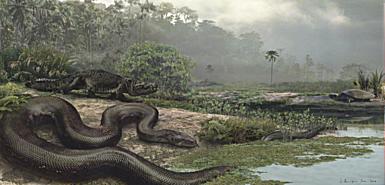
The picture below is of a python slithering over the vertebra of a titanoboa.

More here in Times Online article, USA Today, and LA Times.
Titanoboa. 43′ long. Weighs more than a ton. Could eat Bessie. Literally.
The picture below is of a python slithering over the vertebra of a titanoboa.
More here in Times Online article, USA Today, and LA Times.
Not many people understand creativity. Dewitt Jones, a National Geographic photographer, does. And this video on the creative process, HOLY COW, it’s so good I had to buy it so I could watch it whenever the yearning took me.

But this isn’t just for artists. The principles of creativity apply to any creative endeavor–from writing and drawing to building microchips and parenting.
Go here. Watch the brief clip. Then watch the whole Clear Vision video. Tell me what you think.
Capture the zing!
Laura Miller at Salon.com has it all wrong when she says promoting books with movie-style trailers is a silly idea.
Here, watch this book trailer for Scott Westerfield’s Leviathan.
Yeah, I know you want to–go ahead, watch it again.
Miller looks at book trailers, sees that the vast majority of them are lame, lame, lame (actually, this is the FIRST I’ve seen that’s any good). Sees that they reach no markets and then concludes that all trailers are silly. It’s true: lame trailers ARE a waste of time and money. But ANY advertisement (print, video, audio, whatever) that’s lame is a waste of time and money. Making killer trailers that nobody sees is an even bigger waste of time and money. But that’s true of ANY killer advertisement that nobody sees.
Look. I’ve never read Westerfield. Don’t know much about him or his books. But I saw that clip and now want to read that book. Hum, trailer worked for me. I AM a reptoid mutant, but I suspect there are others out there like me. I mean, come on. Good gravy, woman–“Do you oil your war machines? Or do you feed them?” Killer!
Movie trailers, book trailers–any advertisement–isn’t about delivering what the person is going to experience on the spot. If that were the case, then you’d never show a print ad of a meal at Olive Garden because it doesn’t deliver the goods right there on page 10 of Woman’s Day. Nope, all you’d do is go around giving out samples in places with Italian mood.
Miller’s error is not understanding the difference between making an offer and delivering on one. What an ad is supposed to do is make the offer. Let you know this thing is available. Because you’re not delivering the actual experience, you can make the offer via all sorts of media. Now, if you can give them a taste, that’s great. But you don’t need to deliver the full deal right there.
So what do you need in an offer? You need the offer to say, “Hey, I’ll deliver this type of experience.” It needs to call to some action, either directly or by implication–“buy this” or “be here.” You also need it to say, “You can trust this will be worth it” and make the consumer believe that’s likely to be true. It communicates this last bit by being a quality piece of work.
Making an offer is exactly what book covers do–they make the offer and give the consumer a little taste. And book covers matter. This has been proven over and over. Just like most people, when I see a cool cover, I pick up the book and check it out. When I see a lame one, or one that offers something I’m not interested in, you’re going to have to threaten me to pick that book up. Or it better dang well have some righteous word of mouth. It’s that simple. We all judge books by their covers because the cover is making an offer. And lame offers don’t get very many takers.
Book trailers are nothing more than deluxe book covers. The cool thing about them is the cool thing about movie trailers–you can make the offer by providing a little taste. You do that by giving the audience the story situation, the pitch. You do it by communicating the feel of the experience and raising curiosity. You do it by making it a pro job. The good ones make you laugh, say cool!, or raise curiosity and expectation.
And that Westerfield trailer does that.
Dang, “Do you oil your machines? Or do you feed them?”
Run that on TV. Run it on the radio. Put it up on sites where people are likely to see and click. Confirm it in print. Make the offer to real people. Get it infront of young readers. I’ll stake my eyebrows that ad can sell as many books as a good movie trailer can sell movie tickets.
Crimeny, now I want to be Scott Westerfield.
I have seen another book trailer that’s as good as Westerfield’s. Do you remember this: http://thesecret.tv/movie/trailer.html ?
Very effective advertising for the book. I think the content of the book is crap, but that trailer made me pick it up just to see what it was all about.
Do you notice that this one and the Westerfield one combine extreme professionalism AND they make the pitch in a clear and grabbing way? The pitch for both was what the book was about. For fiction it’s the concept. For non-fiction how to it’s the promise.
So many of the book trailers lack one or more of those things. For example, look at the book award finalist for THE FALLEN: http://www.youtube.com/watch?v=vsLE6bNaIrk. I don’t know what the heck the book is even about after a long 2 minutes. They’re trying to make a movie.
Something else. On both of these you have a voice over PITCHING the book to you just as someone might do it in person or to an editor. It’s a powerful method, I think.
Notice also how short the Westerfield one is. Just over a minute. Westerfield’s really is like a query pitch or cover copy–in just a few lines tell me what your story is about. We get genre, setting, character, and the story problem or concept.
 Scott Card recently wrote “Marriage needs lots of humor.” It’s an awful title for one of the best articles of his that I’ve ever read.
I’m not going to spoil it for you. But I will say that I’ve found that it’s the small things that seem to make the biggest difference in relationships. And this is one of those small things that packs a HUGE punch. But not until this article did I realize it.
And for you writers who are wanting insights on what makes characters interesting and sympathetic–there’s a little treasure trove here for you as well.
Enjoy!
 The bee. We slather its delicious vomit on bread and muffins. We send colonies out to pollinate our crops. Now Colin Henderson and his University of Montana colleagues have partnered up with bees to “locate buried land mines” and do it more quickly and thorougly than any dog.
“We can survey in one day what takes more than a week with dogs,” he says, “and humans stand 300 yards away.”
Bees can find not only land mines, but also drugs and decomposing bodies. Oh, and they are smart enough to recognize a sugar daddy when they see one.
Here’s the full article. Read it. Enjoy. Things like this are part of the wonderfulness of life.
