Good Stuff! TruContain, Johnny Walker, Great British Baking Show

I love the sunny winters we get up at Bear Lake. I hate the snow that my car brings into the garage. Because the snow melts, and the water runs to the bottom corners of the garage and pools there, creating a huge mess until I get out there with my cement squeegee.

Who wants to continually be moving crap in and out of the garage so you can squeegee it? And in the winter when it’s freezing?

Not me.  

For years I’ve wanted to do something about it, but what can you do after the concrete of your garage is poured?

Well, this year, after the first big storm, I got sick and tired of traipsing through the water and mud and cleaning all that crap up. So I put my massive Google-fu skills to work. And, lo and behold, I discovered a product called TruContain.

It’s a car mat for your garage. It’s made of thick vinyl and has raised edges.

I bought one.

The UPS man delivered it not many days later.

The installation instructions were simple. Two steps. The perfect number for me to manage. Step one was to let it warm up in the house for twenty-four hours so it was easier to unroll. I did that. Step two was to unroll and position it in the garage where we park our car. That took about a minute. So far so good.

No soon after the mat was deployed, we had another snow storm. The van went out for daily driving and came back with an undercarriage covered in ice and snow. We parked the van on the mat. The ice and snow melted. And the mat caught it and contained it.

I was delighted.

The next day the van went out for another day’s use and came back all covered in snow and ice again. The snow and ice melted, along with a bunch of dirt. And the mat caught it again!

I was whooping for joy.

I’m still whooping for joy because my garage is dry!

If we get a lot of water on the mat, I’ll use the shop vac to suck it up. I took out five gallon of dirty, cold water the first time. Five gallons that would have flooded my garage! If there’s not too much water on the mat, I’ll drag the mat out with a helper and dump the water on the lawn.  

I love my TruContain garage mat.

If you have winter water mess in your garage, you’ll want to consider it. I got mine from the manufacturer garageflooringllc.com.  

One word of advice. If you get one, don’t get one bigger than you need. If it’s too big, then the mat will stick out from the sides of the car, and when you go to step out, you’ll be stepping out into your mini garage lake.

#

I enjoy books about Army Rangers, Navy SEALS, Special Forces soldiers, etc.  Almost all of them are written from the point of view of the operators. But I just found and enjoyed one, not about the operators, but about a guy who helped them in Iraq.

The book is called Code Name: Johnny Walker and was written by the guy the SEALs called Johnny Walker with the help of Jim DeFelice.
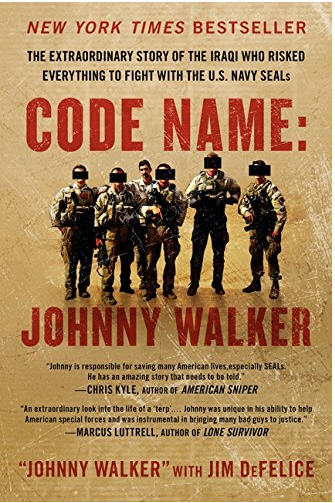
Who is Johnny Walker?

He was a resident of Mosul and was what they called a “terp”, an interpreter who went with the SEALs on their missions. He went on hundreds and hundreds of missions with them. And he offers a fascinating glimpse into what life was like in Iraq during the Iraq War for those Iraqis who helped the coalition forces.

The SEALs appreciated his service. I know this because a host of them have blurbed his book. Furthermore, they helped him eventually immigrate to America. That’s how grateful they were for his service.

If you like these types of books and would enjoy new insights, I think you’ll really enjoy the book. Johnny Walker does swear a bit. But I tend to take people as they are. And it was well worth time I spent listening to him.

#

For Christmas my daughter received a number of seasons of The Great British Baking Show. It’s a competition baking show. I’d heard about it before, but I’d seen episodes of American competition cooking shows and didn’t enjoy them at all.

However, my daughter said this was nothing like the American shows, that it was awesome, and it was so awesome she wanted to the DVDs for Christmas so she could watch the episodes again. I needed to give it a try, she said. So I gave it a try.

I’m happy to report that I and my family have are enjoying the heck out of her DVDs.

The British folks that are competing in the challenges are down-to-earth and interesting. Some of them are funny. The tips about baking are interesting. And, best of all, the British show makers know how to create suspense.

They start each season with a group of twelve amateur bakers. Two professional bakers give them a baking challenge with a time limit and then judge the bakes. After a series of three challenges, the pros name a star baker for that series and then also announce who was at the bottom of the pack and will be leaving the show. If you like cooking or have ever found yourself watching a cooking program all the way through, I think you’ll really enjoy these fun, British bakers.

Share

Similar Posts

  • |

    All you need is a little beating and robbery

    Mrs. Brown, my wife, teaches language arts for the 7th and 8th grades as well as reading comprehension. She’s big on reading. She wants to provide every opportunity for kids to not only get good at it, but also learn to love it.

    And so her walls are lined with bookshelves full of awesome books teens love. She reads the first chapters of books to her classes to let them sample various stories. She features their book reports. She has them paste the covers of the books they’ve read on pages displayed around the classroom. And the school’s awesome librarian supports with her own programs.

    The 7th and 8th grade students at Rich Middle School are marinated in a big celebration of reading.

    In Mrs. Brown’s class, it’s fairly straight forward to get an A on reading, which is a huge part of your grade—all you’ve got to do is read.

    But how much reading do they need to do? How do you track it? And what books should they read?

    Check this out.

    First, she tests each student to see what his or her reading speed is.

    Next, she takes the number of hours they’re supposed to be reading each week for homework (I think it’s 2 or 2.5), then does the math to get a feasible reading word count for the trimester for each student. She may adjust it a bit, depending on the student’s ability.

    Third, she presents that number to the student, and the two of them set a word count goal for the trimester. Talk about an individualized goal.

    If you want to get an A in reading, all you have to do is reach that word count goal.

    How do you know how many words a book has?

    The Accelerated Reader program provides that information.

    But how does she know that they’ve read the books?

    She uses the Accelerated Reader tests. And if there isn’t one, the student can write a report.

    And what books do the students read?

    Any dang book they like.

    I love this. The kids get to select their own books and just read, read, read.

    Another part of this is that she pings each student once a week to ask them what book they’re reading, what page they’re on, and what they think of the book. This weekly check-in provides the more frequent accountability students of that age need.

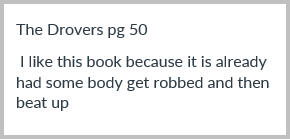
    Yesterday, she received this report from one of her 8th grade boys who is reading Prey, the first book in The Drovers series.

    Oh, yeah.

    I’ll take that any day (grin).

    Rock on, budding reader.

    Share
  • Good Stuff! A clear-eyed view of the Founders

    When it comes to politics, we frequently talk twice as much as we should and listen half as much as is deserved. With our mouths open so much of the time, we fail to get the facts. And this often leads us to paint things in hyperbolic black or white.

    One area where we seem to do this regularly is with the Founding Fathers. Depending on our side, we label the Founders as devils or demigods and the constitution as a wicked document or holy writ.

    Is it possible both sides are distorting the truth?

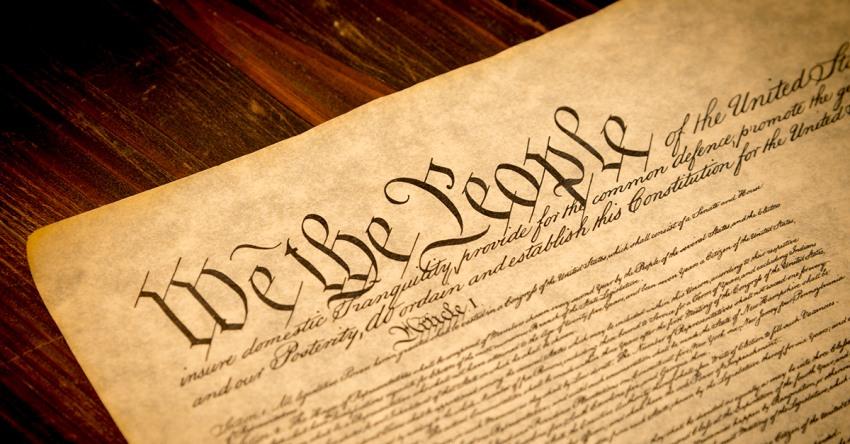
    Joseph Ellis, one of the nation’s foremost scholars of American history, suggests that we are. He has written an excellent article for the online Encyclopedia Britannica called “Founding Fathers” that points out both the amazing things the Founders achieved with the birth of this nation and some of their most egregious failures.

    I don’t know about you, but I find clarity a good thing. I think it helps us have more productive conversations. If you agree with me, I think you’ll enjoy the clarity Ellis brings to the Founders and the nation they set up. Read his article here.

    For my part, I think the Founders set up an awesome system. Not because it was perfect at birth, but because it was a system that got enough right to allow us to get where we are today. Look at how far we’ve come on so many fronts! And it got enough right to allow us as a nation to get even better in the future.

    Just consider what the Founders implemented that was in no government at that time. The ideals of individual liberty, the separation of powers, the ability for a huge swath of citizens to elect their leaders, the ability to change the constitution itself, the separation of church and state, and the engine of democratic capitalism that has lifted more people out of poverty than anything else the world has seen.

    The Framers didn’t create the Constitution in a vacuum, but nowhere in the world had anyone set anything up that went so far. There was nothing like it, no real examples to follow. And many thought it would fail, just as France’s attempt in their revolution failed just a few years later.

    As for things they got wrong. Well, they themselves soon recognized the way we elect the president and vice president didn’t work and adjusted it. Their idea that political parties wouldn’t form was wrong. Their idea of a militia for common defense didn’t work (see my writeup here). Their compromise on slavery was a festering sore that came to a head before the Union was 100 years old. Their treatment of the Indians was awful. Their reasons for excluding women and those not owning land was bone-headed.

    So, yes, they got some things wrong. Some of them held some beliefs that we find appalling today. And the nation has not implemented their stated ideals as well as we might have hoped. However, the Founders got so many things right. And what’s more, they did it as men living in the times they lived, having grown up with the beliefs and values of that time, not those of 2019!

    While we as a nation have progressed from some of their failures (thank heavens), in other ways the Founders may be are our betters. There are a great many lessons to learn from them, both from their successes and failures. One is their humility—they knew what they’d created wasn’t perfect. Let’s not imagine that we or our ideas are perfect either.

    If you’re at all interested in politics, I recommend Ellis’s article and its view of the Founders. Read it article here.

    Share
  • What’s driving the rise in school shootings?

    Homicide rates are down in America, but school shootings are up. What’s going on? What’s driving this?

    Some say it’s guns.

    I have an hunch that I think deserves some study.

    Back in the 1970s we had 30 school shootings with a population of about 216 million.

    Today we have a population of 320 million. If we had the same ratio of shootings to population today, we’d have 44 shootings total in the decade between 2010 and 2020. But from 2000 – 2010, we had 60. And since 2010 (if my data is correct, and it appears that’s a big if–see Edit 2 at bottom) we’ve had 146. That’s a 300% increase!

    If we want to solve the school shooting problem in the long term, we need to figure out what’s fueling it. One way to get at this is to ask what’s changed since the 1970s and 80s when the rates were lower.

    Are we killing at a higher rate in general? Is that what’s changed?

    No. FiveThirtyEight reports homicide rates have dropped. Here’s their chart.

    We’re down.

    But school shootings are up. Way up!

    Clearly, what’s driving school shootings doesn’t seem to be the same thing that’s driving general homicide rates. Otherwise, the rates would be moving in the same direction, but they’re not.

    Is it gun ownership rates?

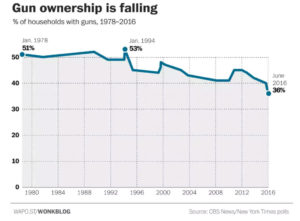
    According to the Washington Post, ownership rates are at their lowest in quite some time. Here’s their chart.

    This means that if general gun ownership rates were a major factor, then we’d be seeing school shooting rates fall. We’re not.

    Furthermore, some of the US states with the highest gun ownership rates have the lowest murder and school shooting rates. (For those wanting to know more about guns, magazines, the definition of an assault rifle, gun control, etc. see Larry Correia’s informational post below.)

    Now, it could be that while overall gun ownership rates have fallen, ownership in certain population segments has risen. That’s something to look at. But when looking at the overall ownership rate, we don’t find an answer.

    Is there anything else to study? Anything else that might be different now?

    Here’s my hunch–it’s the internet. My hunch is that an unintended consequence of social media and the ease of finding certain types of content have facilitated the development of the mindset and ability of certain youth to commit these crimes.

    We do things when we are prompted to take a specific action and we have both the ability and desire necessary to take that action. So action requires three things:

    1. A prompt
    2. The ability
    3. The desire

    If the rates are going up, then one or more of those things have changed. Either more kids are being prompted to take this specific action, we’ve made it easier for them to do it, or we’ve increased their desire to do it. Or some combination of those three.

    Let’s see if the internet might be a factor.

    First, from what I’ve read, it seems a lot of these kids feel like outcasts and seem to be seeking some kind of revenge. Does social media foster and facilitate more bullying and isolation and, therefore, more resentment? Has it increased the desire to conduct such attacks?

    Second, it is dramatically easier for kids to learn how to do all sorts of stuff now. Back in the 70s and 80s, it was hard to learn about the methods and tactics of crime, firearms, etc. Now, if you want to learn how to shoot, scope a place out, plan an attack, do all sorts of things, you can watch YouTube videos on it. Has the easy accessibility of how-to instruction facilitated the ability to plan and carry out these attacks?

    Third, back in the 70s and 80s you had limited programming. Gilligan’s Island, Brady Bunch, The Love Boat, The Donny and Marie Show, Lawrence Welk, etc. They all fostered good-citizen values. Today, kids have easy access to all sorts of crap. Violent rape porn. Evil games like Blue Whale that give challenges to the player, and the last is to kill yourself. Are there certain types of programming on the internet that foster a violent mindset? That prompt these very actions and makes them seem like a good alternative?

    Fourth, look at how well political conversations go on Facebook. Chat rooms, blogs, etc.–we all know they foster more incivility than when you talk in person. Does our social media, by its very structure, anonymity, etc. foster a more anger-filled approach to disagreements? Has it prompted, even trained, more kids to behave this way?

    Is one of the unintended consequences of the internet and social media a rise in school shootings?

    I’m not saying it’s the only part of the puzzle. But I do think it’s worth studying. We need a long-term solution.

    At the same time, we need something now while that long-term solution is being researched and implemented. One of the best ideas I’ve seen so far to stop the killings is the one mentioned here.

    Such people are screened, trained, and on-site. They can respond immediately. Plus it’s voluntary. If you’re a teacher that doesn’t want to do this, you don’t have to. Plus this doesn’t add security guards to schools. Nothing changes at the school until the shooter shows up, and suddenly there are half a dozen, dozen, two dozen deputies immediately there.

    I think at our tiny 1A middle school, there are probably 6-8 people who would do this, including my wife. The teachers know the kids, know where other teachers are likely to be, know the place like the back of their hands. We know security deters threats. I can’t see anything but positives.

    I don’t like the fact that we have to contemplate this. I want to go back to my youth in Bountiful, Utah where this never happened. Maybe we can get back to that type of a society. Until then we need an immediate, practical, and effective solution. This seems like a good part of a multi-approach solution.

    But what’s the long-term solution?

    I wonder if has to do with the internet.

    Is any organization seriously studying this?

    Do you see anything else that might have increased the prompts for this specific action, the ability to plan and conduct attacks, or the motivation to do so?

    Edit 1 – gun retention

    On Facebook today, a former deputy sheriff I know and respect was asked “Should teachers carry guns?” His answer: “No. Weapon retention is never even considered when politicians and others come up with that. Imagine some big, unfriendly student disarming a teacher during some classroom issue. Instant problem.”

    This is a good point to raise.

    I didn’t think of it. It’s clear none of the teacher defense plans are complete without it.

    But is it a show stopper?

    First of all, how big a risk is this? How many student-teacher scuffles do we have in grades 1-6 where the teacher is overpowered by a third-grader? How about in middle school? I’m sure the risk is higher in high school.

    But just because there’s a risk doesn’t always mean you shouldn’t do something. Male and female agents and officers are trained in retention. My question is whether such retention training is ineffective? Should officers not carry guns because of this?

    If it is effective, then it seems to me that if you’re trained, you’re trained. A big senior boy has just as much chance to disarm a trained cop as a trained non-cop of the same size and strength.

    This is another reason I like the suggestion of the sheriff above. It’s not just any teacher that would do this. They need to be screened and trained. They’re deputized. I could see them doing training on a frequent basis. Something goes down at at school, and you immediately have 6-8 trained deputies on site. Maybe a dozen or more. Is that not a game changer?

    It’s good to identify risks. But what would reduce the risks identified? Could we reduce them to acceptable levels? It’s a question that needs answering.

    Edit 2 – is the “rise” due to bad data?

    Just saw this. Is the “rise in school shootings” even real? Or is it bad data? Here’s an opinion on USA Today, suggesting it might not be as bad as we think. One of the things that’s maddening about all of this is what seems to be a lack of good data!

    Sources

    Share
  • Good Stuff! Mike Loades on Swords and Bows

    Mike Loades is an expert on medieval fighting. He brings energy and, not just bookish learning, but insights from hands-on use. I loved the five-part Weapons That Made Britain television series for which he was the host and chief consultant. And so I looked to see if there was anything else he’d done. I found he’d written two books, which I am so happy to have read.

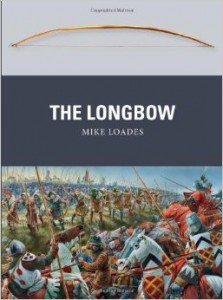
    The Longbow is not just a book about the longbow. It’s about its construction and how it impacted the development of armor, and types of armor, and the wood used for the bow, and how to make arrows, and what the various points were for, and how people trained, and then cared for the bows, and how it was used in war. And, again, the insights are not just bookish ones. He’s walked the battlefields. He’s used bows for years. He’s performed tests with them. It is a 80-page book that carries a monstrous bang for the buck and one of the best purchases I’ve made for my library. I loved it.

    MikeLoades_TheLongBow

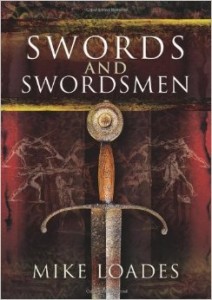
    Of course, after that experience, I had to get his Swords & Swordsmen. This book is almost 500 pages long, and I was rapt reading each page of it. Instead of focusing on one version of this weapon, Loades discusses exemplars of various types of swords through time, starting with the sword of Tutankhamun in Egypt all the way through the swords of J.E.B. Stuart and G.A. Custer in the American Civil War. There are 15 chapters all discussing different eras and swords that provide a mountain of insight. The love Loades has for and the practical experience he has with the topic shines through on every page. Just as with The Longbow, you’ll learn about use, construction, the interplay with armor, and much more. Heck, I got the ideas for at least three novels reading this book. I loved it as much as I loved the first.

    MikeLoades_SwordsAndSwordsmen

    If you enjoy military history and arms and armor, you will love these books. Guaranteed.

    While you’re waiting for them to arrive in the mail, treat yourself to five hours of fascinating video below.

    Weapons That Made Britain E01 – The Sword

    Weapons That Made Britain E02 – The Longbow

    Weapons That Made Britain E03 – The Lance

    Weapons That Made Britain E04 – The Shield

    Weapons That Made Britain E05 – Armour

    Share
  • Good Stuff! Lindybeige Rocks!

    I’ve been watching Lindybeige videos for a few years now. Lindybeige is the online name for Nikolas Lloyd, a smart, funny geek of the re-enactement, fencing, and RPG line. He’s got a youtube channel that is chock full of videos in which he makes witty and insightful points about ancient and medieval warfare, archaeology, dance, and anything else that takes his fancy.

    For example, have you ever seen folks pushing each other about with swords? Is that realistic?

    Interesting, what about pushing in a shieldwall?

    Food for thought, isn’t it? It makes me want to go read up on shieldwalls. Were they really as he concludes they were? But enough about history and conjecture. What about the truth? What about science? For example, if you believe in science, must you also believe in a certain approved list of theories?

    But surely that doesn’t apply to Global Warming Theory, which is now called Man-made Climate Change because the warming bit never panned out. No?

    Wow, and he even accepts the data on the warming. Okay, enough about the truth. Back to fantasy geekiness and weapons in fantasy worlds that make sense.

    I love this guy. If you’re a fantasy geek and haven’t yet begun to watch Lindybeige, you’ve got a lot of enjoyment ahead of you.

    Share
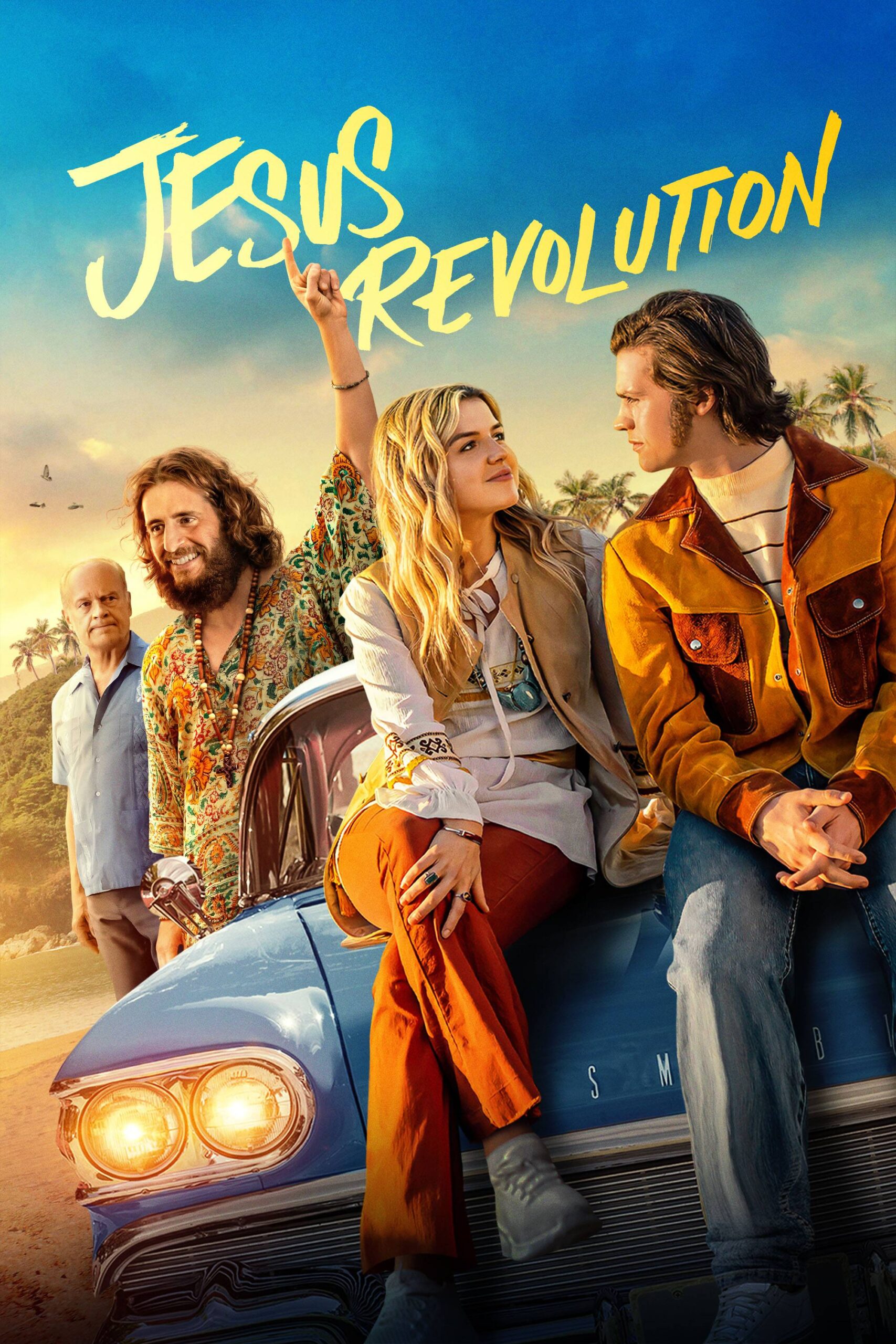
  • Good Stuff! Jesus Revolution

    Jesus Revolution poster

    In 1969, Greg Laurie, was seventeen and going to high school Newport Harbor High School in California. Fourteen miles from Disneyland. Just one mile from the beach.

    Laurie was raised by a single mother who had seven marriages and struggled with alcoholism. They moved often, sometimes to very different locations such as New Jersey and Hawaii. He was not raised in the Christian faith or a church environment.

    He began participating in the hippie movement, doing drugs, dropping out, because it was fun and because maybe this was the way.

    The 1960s and early 1970s was the height of the hippie movement, which sought love, beauty, honesty, freedom, and fun. Hippies felt that “The Man” (the establishment, the authorities, those in charge, Big Brother) had caused huge problems. And they wanted to drop out of that society. Leave it utterly. Find a new way.

    Why? What was the problem?

    The 1960s was the decade of the Vietnam war. It was the decade when we came to the brink of a nuclear World War 3 with the USSR over the Cuban Missile Crisis. It was the decade when a huge portion of the United States strove for equal rights for minorities and women against a lot of opposition. There were riots. Protests. Beatings. This was the decade when Martin Luther King Jr. and John F. Kennedy were assassinated. There were problems galore.

    Now the 1960s was also a terrific decade. We passed civil rights legislation, men landed on the moon, super nerds introduced BASIC computer code which opened the door to the computer revolution. It was a decade of many good things, including the year when Lovely Wife was born. Let’s not forget that.

    But it was certainly a tumultuous decade. And the hippies offered a counterculture. A different path.

    A lot of youth followed that path. For example, in 1969 half a million hippies showed up at the Woodstock festival to protest the war, capitalism, and convention, and celebrate peace, love, and individual freedom.

    This is the world young Greg Laurie was living in. And he was heading down the drug-hippie path.

    But then he met a man named Lonnie Frisbee who looked like a hippie, had been a hippie, right at the epicenter in San Francisco, but was now inviting fellow hippies and youth to a different path.

    A path that featured Christ. But not in the way of many of the churches at the time.

    How was this path different? Did Greg turn around?

    There’s a new movie out that is based on these true events. You can watch it and find out.

    It’s called Jesus Revolution.

    Nellie and I enjoyed the heck out of it. We laughed. We were on the edge of our seats, moved, and inspired. In fact, I enjoyed it so much I want to watch it again.

    It’s a great entertainment for the whole family.

    If you’re looking for a terrific, feel-good show, I think you’ll love Jesus Revolution. Give it a try.

    Share

2 Comments

  1. BTW, a low-tech solution for snow melt in garages – if it is not properly sloped – is to get a can of expanding foam and build up a small berm around the usual parking spot. Don’t put it at the garage door end, just make it three sided. Not pretty, but it will work. And easy to scrape off come spring.

    For a low-tech squeegy – get a pool noodle from the Dollar store. Use your metal rake and jam it into the noodle. Presto! A quick water squeegy ! Just lay the noodle on the ground and find the best place to stab it with your metal rake. Easy, and cheep.

    Although the floor mat will work, the above tips are a bit cheaper. Not as pretty as your solution, though.

Comments are closed.