Similar Posts
Ugandan Monkey Boy

I thought all such things were hoaxes. Above is a picture of John after having been found and saved.
John Ssebunya, the Ugandan Monkey Boy
Date found: 1991
Age when found: 6
Location: Uganda
Years in the wild: 3
Animals: monkeysJohn ran and hid in a forest, about 2-3 km from his house after witnessing the murder of his mother by his father. His father was known to be an alcoholic and violent.
John says he was so frightened of his father that he stayed in the forest. It is possible that he had some degree of mental handicap at that time and this may have contributed to the fact that he did not understand that he should have sought help from other adults.
He was aged roughly 4 or 5 at the time that he was found in 1989 according to witnesses like Mrs Milly Sseba who found him in the forest. There is no birth certificate…
John identified the mokes as Cercopithicus Aethiops (the common African Grey or Green Vervet Monkey). This is very significant as this is one of the very few species of mammal that lives in social groups and will accept and tolerate a lone individual of another species of monkey living alongside their group. Other monkeys and apes will not do this — chimpanzees for example would simply eat a human child.
Indeed zing, but heart wrenching.
Australian Uses Oil Background to Harness the Seas
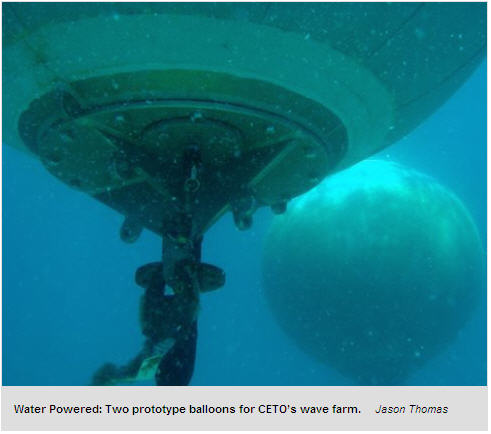
This is a fantastic article summarizing some key issues with wave energy and the solution Alan Burns, an oil bloke from Australia, has come up with. It appears he’s taking lessons from his expertise in off-shore drilling (it’s safer to work on the bottom of the sea) and applying it to wave energy. It’s a must read.
http://www.popsci.com/kalee-thompson/article/2008-09/burning-tide
No ideas yet on how to use this in a story. If you have any, post in the comments section.
Wait, what if our hero is an inventor like Mr. Burns? Naw, what if we actually do go to the seas? It seems like a no-brainer. So we go to the seas. And our hero is the guy who is replacing parts. Humm, maybe. Of course, if our power generation is out there in the sea, then a perfect target for a terrorist is the pipe pumping the water in. Or what if they find a sea wreck while installing a huge one of these? And would the ocean floor suddenly become real estate? What kind of agent would sell it? Hummm
Growing Your Own Replacement Parts

This is simply incredible. Watch the video about Claudia Castillo growing a replacement to part of her windpipe with her own stem cells. She didn’t grow the complete tube, but nevertheless…
Ms Castillo, who was born in Colombia, had suffered a tuberculosis infection that ravaged her airways, leaving her unable to do simple domestic tasks. Disease had caused her windpipe, or trachea, to collapse just at the point where it entered her lung. Without the pioneering operation in June, the lung would have been removed. Today she again has a normal life and is able to look after her two children. She can walk up stairs without getting breathless and has even been dancing.
Oh, my. Can you believe this? What the future holds for all the folks with damaged parts…
And does this mean as we age, we’ll be able to swap out the old for new? How will that affect aging? This is simply incredible.
Is Product Popularity Random?

In Why Publishing is Making You Crazy—and What You Can Do About It: The Tao of Publishing, Steven Axelrod and Julie Anne Long write an interesting post that takes some findings made by Duncan Watts and attempts to explain why writers should only focus on the quality of their work because they cannot reliably affect popularity in any other way.
I agree with them that social-influence seems like a good explanation for the sometimes unexplicable successes we see in publishing and the difficulty publishers have in both predicting and producing a steady stream of hits. However, I do not find support for their main conclusion that writers can do nothing but write. In fact, I suggest that Watts’ findings show quite the opposite.
Axelrod and Long base much of their argument on an experiment conducted by Duncan Watts that tested the power of social-influence on music selection in some controlled music websites. Watts summarizes his findings in the excellent Is Justin Timberlake a Product of Cumulative Advantage?.
In his part of the post, Axelrod points out that the Watts findings indicate “50% of the factors affecting your career could be totally outside of your control—totally random” and that “unless we can separate out those random factors which contributed to an author’s past success [and we can’t, Axelrod suggests], anything we can say or predict about why she succeeded will invariably be way off-the-mark.” And therefore “what’s interesting—and chilling, as well—is that there’s evidence that the harder a person works to make sense of a random event, the farther they’ll end up from the truth.”
In other words, the only thing an author can reliably do to improve the popularity of his stories is focus on their instrinsic quality. And get more stories out so he has more shots in the fickle social-influence game.
I agree that having more product in the market increases your odds. I also agree that focusing on the intrinsic quality of the writing can do the same. I even agree that this is where authors should spend most of their time. However, Watts’ studies do not indicate other efforts are wasted. In fact, they suggest the opposite.
Watts does not controvert anything we now know about marketing. What he does is clarify the power of social-influence in our decision making and the dynamics of ONE type of endorsement system. What Watts shows is:
- A perceived non-bias endorsement of your product can have a huge effect in the product’s popularity.
- The intrinsic quality of the product has an effect on popularity, but social-influence plays as large or larger role.
- Popularity in the system set up in the test websites depended on the decisions of a few early-arriving potential endorsers, i.e. good early reviews (downloads in this case) are amplified and lead to an effect he calls “the richer getting richer.”
- In this one endorsement system, neither a future endorsement nor the identity of the early endorser can be predicted.
These findings, however, need to be put in context. From cars, to camcorders, to recipes, the popularity of a product depends on three main factors. These aren’t new ideas and publishing is no different than any other industry. The factors come from long-standing marketing practice:
- Visibility (people know about it)
- Endorsement (recommendation from an attractive person, trusted authority or friend, or trusted system like the perceived unbiased reviews on Amazon or “most downloads” stats)
- Attractiveness (intrinsic to the product, the perceived value offered the target market, and the social effect as pointed out by Watts)
Each of these three affects the other two. Visibility makes endorsements and initial attractiveness possible. Endorsements make a product more attractive and more likely to be visible. Attractiveness makes something more visible and more likely to be endorsed. And round and round we go.
It’s true that Watts shows 50% of the effect is due to endorsement. But nowhere does Watts suggest an author cannot increase the probability of visibility and endorsement.
In the study, the endorsement method used was a counter showing the number of times the song had been downloaded. It was random, anonymous, and perceived as unbiased. That was a controlled environment. However, what if a singer had been able to ask all those he knew who loved his song to download it from the site? Or what if someone organized such a campaign independent of the singer? Both actions would immediately affect the probability of the song increasing in visiblity and endorsement and, hence, popularity.
It’s too bad Watts didn’t test this in one of his sites to see if he could make a winner. As it was, all Watts was doing was seeing if he could predict a success by quality alone. He was passively observing, not actively taking measures to increase visibility and endorsement.
Furthermore, the counter is just one type of endorsement system. There are a number of others. We’ve all seen how an Oprah endorsement can move the market. The identity of that endorser is NOT random and has great predictive value. Her decision to endorse is still random. But what if you have a way to make your book visible to her? Would it be a waste of time to do so?
Robert Sawyer loves to tell of one action he took with someone with much less endorsement power than Oprah and the effect it had on his sales. Was Sawyer guaranteed visibility and endorsement from that action? No. However, he DID increase the probability, and it resulted in sales. Here’s his account.
Watts confirms that endorsements have a mighty effect on popularity. Even something as simple as a “most downloads” counter can easily overwhelm a listener’s own reactions. But the logical conclusion is not to do nothing. The logical conclusion is that if authors want to increase their popularity, they must not rely only on the intrinsic value of their product, but they must also search for ways to increase visibility and endorsement.
Axelrod is correct that it’s sometimes difficult to see the effect of any given marketing campaign or tactic. This is because marketing efforts are probabilistic, not deterministic. However, probabilistic does not mean random. Furthermore, it does not indicate you cannot increase the probability of success. While publishers may not be able to produce best sellers every time, I’m confident if they decided to stop marketing altogether, sales would drop.
Will all efforts succeed? No. Any marketing progam needs to consider the effect of diminishing returns. The effectiveness of some actions may be difficult to test. Furthermore, authors may not have the budget to run a campaign large enough to increase their probabilities, although there are strategies to become a big fish in a small pond (see Geoffery Moore’s Crossing the Chasm).
Despite all these issues, we know, in general, getting endorsements helps. In general, the right placement in book stores increases visibility. Author visits to schools, if done right for middle age readers, can also increase visibility. Radio interviews, if done right, do the same. There are many things that DO improve an author’s odds. We can increase the probability of visibility and endorsement by taking intelligence, consistent action.
And that’s good news. We might not be able to guarantee a hit, but one thing IS certain—we’ll have no direct influence on visibility and endorsement if we do nothing.
(BTW, for those interested, here’s a great presentation on a related idea:Six Degrees: The Science of the Connected Age a presentation by Duncan J. Watts.)
Mongoose Robot Duo
I always thought mongooses (or is it mongeese?) were cool. I mean, they kill and eat snakes. What’s not to like about that? But it appears they’ve got more than one trick up their sleeves.
Mongoose-robot duo sniff out landmines on the cheap
Here’s more at NewScientist if you’ve got a sub.
Why crows are better than flying monkeys
I’ve wanted a cool animal friend for some time. And I mean a friend, not a pet. Pets you have to take care. Friends come, delight you, then leave. And lest you think I’m a meanie, I’ve got five cats that came with the house we moved into a few years ago. Love ’em, but I don’t need any more pets.
But a friend, now that’s different. Up here in the sticks we’ve got lots of interesting candidates: foxes, coyotes, raccoons, neighbor dogs that get into your garage and abscond with nifty chew toys like your expensive new hiking boots.
I’ve always wanted a bird gang as friends (I think it’s an unfortunate Disney heroine-envy syndrome). We’ve got eagles and magpies up here. But we also have crows and ravens. And ravens, according to some sources, are as smart as wolves. In fact, I’m so taken with the bird gang idea that I’m using it in the series I’ve titled LORD OF BONES. The hero has two raven friends who will be characters in their own rights.
So you can imagine my delight when I read the article on NPR and saw this.