|

Become A Story Idea Machine
Now’s your chance

Apply to take the next Novel Writers Academy course: How to Create Story Ideas That Beg To Be Written.

  • Six-weeks
  • Starts: Jan 2, 2022
  • Ends: Feb 21, 2022
  • Gobs of hands on practice
  • One-on-one guidance from me

At the end of the six weeks you will be a story idea machine.

I will be working with only a small set of people. And so you need to apply to get in.

The deadline for applications is midnight, December 11th. So contact me now to get the application instructions.


A cracking good story idea requires five critical elements.

Until you have all five, you’ll struggle to plot. You’ll write a few scenes and run out of gas. You’ll feel like the story just isn’t going anywhere.

And that’s because it isn’t. It can’t. A story isn’t a story without all five elements.

However, once you develop these five things, your story will suddenly roar to life. There are a few other elements that are important as well, but these five things form the core of the story setup. 

In this course you’re not going to merely learn about all of those story elements. You’re going to go deep and learn what can only be learned by actually doing the work and developing story idea after story idea with personal one-on-one feedback from someone who knows what they’re doing.   

When you finish, you won’t just know story theory. You will be a story idea machine. And you will be that because you have put in the work. The right work.  

Again, this is not a course full of lectures and videos. This is a course where you’re going to work. And develop the insights and skills that only come from doing the work.

You’re actually going to:

  • Come up with story setup after story setup after story setup
  • And improve them with one-on-one feedback. 

It’s going to:

  • Eliminate years of you wandering about in the story wilderness trying to figure things out on your own. 
  • Put you miles ahead of other writers who have no idea what’s really at the core of story. 

You are going to learn how to develop killer story ideas on purpose instead of on accident. Which means you’ll be able to do again and again. Reliably. Like clockwork. 

Course details

The focus of the class is not on learning about story, although you will do that. The majority of your time will be spent on developing stories. 

You can’t become a carpenter by watching videos and reading books about it.

You have to get out on the work site, cut wood, and pound nails. You have to make the mistakes all beginning carpenters make, get feedback, and improve.

The same goes for writing.

And you’re going to work in this class. You develop 21 story setups. In fact, you develop more because the 21 are just the ones you turn into me. And with each one your skills, insights, and abilities grow.  

In the beginning, your setups will be bare bones. By the end, they’ll be fully developed setups that beg to be written. Setups you can use to immediately write the first draft  of your novel, whether that’s in outline or chapter form. 

Here’s what you do each week. 

Week 1.

  • Uncover the secrets of what’s really at the heart of story and how to generate ideas. 
  • Define your genre requirements
  • Create story setups 1-3

Week 2.

  • Uncover the secrets to compelling characters 
  • Create character sketches
  • Create story setups 4-7 

Week 3.

  • Uncover the secrets to formidable obstacles
  • Create story setups 8-11 

Week 4.

  • Uncover the secrets to interesting casts
  • Create story setups 12-15

Week 5.

  • Uncover the secrets to managing multiple storylines and series
  • Create story setups 16-19 

Week 6.

  • Create story setups 20-21. These are your capstone projects where you apply everything you’ve learned and take it to the next level

In this class you develop story idea after story idea after story idea. You are going to be marinated in the work of developing characters, THOMs, goals, obstacles, settings, casts, and more. And because of that, each week will not only bring an explosion of insights, but new skills and abilities.

Every week you get two private, one-on-one, live sessions with me where you get encouragement and feedback on what you’ve developed. And you’ll have access to a private Facebook group where you can apply the principles to brainstorm even MORE ideas for each other’s stories. 

At first you might feel a bit shy and worried about your ideas and abilities. But you’ll soon get over that. By the end of the course you’ll be one of those people that can generate terrific ideas easily. And you’ll be able to do that because you will have put in the work to become a different writer.  

What’s the price?

Hours of one-on-one instruction from a professional editor or author costs thousands of dollars. An MFA program can cost $25,000 to $30,000 or more!

But this course won’t cost anywhere close to that.

Plus you’re going to learn things here you’ll never get in an MFA program (I know. I was accepted into a top-ranked program).

The cost of this course is $799. And I personally guarantee your results. You’ll be totally oh-my-gosh-I’m-so-happy-I-took-that-class satisfied, or I’ll give you your money back. No questions asked.

Now’s your chance to stop spinning your wheels. I can’t tell you how much I wish I’d had something like this when I’d started:

  • The secrets about the true core of story.
  • The secrets about how to come up with ideas. 
  • Actual work with personal one-on-one feedback. 
  • Laser focused on what actually matters, not a bunch of ridiculous writing rules. 

When you finish, you will be a story idea machine. 

You won’t know plotting. That’s a different course and set of skills. You won’t know how to write chapters. But you’ll know how to create the engine that powers all the rest of that. You’ll know how to create the core that makes awesome plots and chapters possible. 

If you want to take this course, click the button below and contact me. I will tell you exactly how to apply.

I’m not going to be able to accept everyone who wants to take the class. I have a very strict limit on the number of students I can work with. So you need to get your application in before the deadline of midnight, December 11th.

Don’t wait!

Contact me now to get application instructions.

Share

Similar Posts

  • Generating Story 8: Creative Q&A part 2

    I realized I needed to blather a bit more on this topic to warn you against something before I bring the other authors on.

    You’re going to be tempted.  You’re going to be tempted to seek for some Holy Grail list of magic development questions.  Some of you are going to be tempted to compile some big old honking list of “the questions that will produce a killer story every time and all I have to do is ask them.”

    That list doesn’t exist. If you seek for it, you’re going to waste a lot of time and end up having to fight killer rabbits and fetch shrubberies for weird knights.

    Don’t fall for it.

    But, John, didn’t you say there were core questions?

    I did.  You need answers for those.  But you need to also understand that a writer will ask a great number of development questions when writing a specific novel, some of which he might only ask once.

    Last year I was out on the forum at CodexWriters.com and one writer asked the rest of us how we approached developing our stories.  He was looking for some kind of development map, e.g. I have this piece of the story, now I need to develop the rest–how does one go about that? 

    That discussion led directly to this series on getting and developing story ideas. My thoughts then were that you need to define and understand the basic elements of story.  Knowing the key story principles behind each element leads us to a handful of core development objectives and questions.  But–

    I DO NOT think there’s a comprehensive must-do list. 

    Why?

    Because it’s been my experience that no two stories are exactly the same, and so no two stories require the exact same questions. And even if stories are similar, questions and techniques don’t always produce the same results each time. One question or technique might prove fruitful one time, but it might be unfruitful the next, or even unnecessary.  So the point of this is NOT to get a checklist of a hundred questions that will lead you to generate the whole story in your mind before you write.

    The goal is to develop the six parts. Use the questions you need to develop those parts.

    Look at the many setting and character profile question lists that float around. As I’ve used those, I always run out of steam because while some of those questions are interesting and helpful, quite a few of them just don’t apply to the project at hand. They bore me. Maybe I felt a spark of life with one question, but instead of following it as the way into the story, the whole checklist format suggests I need to move on to the next one and fill in the blanks.

    But my goal isn’t to fill in blanks. My goal is to make the story come alive in my mind, to make the character come alive, to develop someone sympathetic, deserving, and interesting (if he’s the hero).

    So while I think looking for productive questions is important, and I DO think there are some core questions that need to be answered every time, I think a person will be more productive if they step back and identify the key things they want in the story, the scene, the particular character.  This means we’ll have some standard questions and techniques based on how stories work, but it also means we’ll learn how to do the creative Q&A process on the fly, following the zing for the current project, coming up with questions that we could never predict we’d use. 

    And we’ll use the objectives for the six core parts as the guide then build upon them.

    For example, when finishing up my last draft of Curse of a Dark God, I wrote the opening to a big battle chapter. I know that for things to be clear to the reader, I need to set the stage, have a hook, give the what, why, where, etc. I need to transport them as best I can. Those are my objectives. The questions, while not formally stated, flowed from them–what are some options for a good hook, how do I want to set the scene, etc.

    These are fairly standard objectives/questions. They’re story fundamentals. And there weren’t a lot of them. You can get overwhelmed with too many niggling objectives and criteria. I’ve found it’s best to focus on KEY things. To ask myself–what are the Pareto factors, the handful of things that really have the biggest effect in story with character, plot, scene? Once I identify those factors I can easily turn them into questions.

    So I had those handful of objectives. But I had some others that were very specific to that scene that I probably won’t use in any other scene ever.  And I couldn’t have really even known about them until I got to the point where I was writing the scene.

    For example, one was how to introduce the Dogman of Toth and his pack of maulers in a way that makes the reader say “ho-lee crap those guys are screwed!” Another one was how to introduce the kitemen in a cool way. Another was based on a feeling I was getting from my Spidey-sense that the scene I was writing was going to undercut a later one if I made the hero’s objective to kill one certain character. So I had to ask, what is the right progression of these scenes? Who should the hero attack here so it feels right, like a progression?  Another objective was to make this whole battle scene awesome, thrilling. That’s certainly something I’ll want to do with other battle scenes. But not on all scenes.

    With the very next scene I was asking–how can I make this scene tender and heart-breaking? These ad hoc questions about the Dogman and kitemen and the story progression are all great questions flowing from objectives, but they were for that one particular scene.

    So I think there are some core objectives or principles of how character, setting, problem, plot, and text work. These are based on key story factors. I listed those out in the last post and in my series on suspense. You can make a “standard” list of objectives and questions out of these. For example, one of those key objectives is for the reader to care about the hero. Another is to find him interesting. I can indeed translate these core objectives into some standard POWER QUESTIONS that might be put on a list.  Along with some core questions, there are favorite techniques (tools) we each use to help us work up what we need and get into a story, scene, character, problem, etc.

    But I think a lot of writing is using the creative Q&A on the fly because it’s just impossible to think up all the objectives and questions you’ll encounter before you get into it. 

    Have I said that about twenty times now in this post?

    Let me suggest you not try to develop everything up front before you begin to draft.  Some development questions occur when you’re sketching or outlining. Others when you’re in details of draft mode. It’s a mistake to try to get it all up front in some list.

    The key, I think, is to have our handful of CORE development objectives/questions and ALSO expect to use the QA process along the way. This allows us to move forward in the creation without needing to develop everything up front, which is impossible (no, it really is impossible), and then step back and formulate questions when the need arises, based on our objectives of the moment, and use any number of methods to generate the answers until we have something that rocks.

    But John, how do you know when you’re ready to move forward?

    For me I need to have generated the story concept–the basics of the character, setting, and problem.  When I have that, I’m usually beginning to “see” things, although certainly not everything.  Often I’ve envisioned a couple of moments or scenes.  Maybe some dialogue, etc.  When I get to this point, I’m able to write a Story Setup statement.  And then I generate a sketch of the plot with a working outline.  I DON’T have all the details, but the story’s alive enough in my mind to proceed. 

    Sometimes I begin to draft what I sketched and find out it doesn’t work.  And sometimes I have to draft to get my story concept. Eloise McGraw (I love her book The Moorchild) usually found she had to draft seven chapters before she really knew what the story was about. That’s fine. The key isn’t to use a certain set of tools in a specific sequence. The key is to get to the point where you understand the story you’re telling. If I can do that with a bit of sketching and a little drafting, great.  If I need to do a bit more exploratory drafting to have the story come to life in my mind, that’s fine too.  The key is to know what I need to know about the story and work until I know it. This is writing that’s based on objectives, on principles, not on procedures.

    So there ARE core questions you’ll need to answer for every story.  But it’s also true that you will be hunting mythical rabbits if you look for a secret magic question procedure that lists all the questions you need to ask, EVAR!  Having said that, I’ll now let these other authors finally get a few words in edgewise.

    For more in this series, see How to Get and Develop Story Ideas

    Share
  • |

    The Pareto Principle, Form Follows Function, and Story

    There are a thousand things to “remember” when writing story. New writers who make lists of these things soon begin to drown in them. But I’ve come to realize that many of these “rules” don’t matter.

    They don’t matter because many ignore the function of story. And so you can’t know how and when to apply them, or if they’re even something you should apply in the first place. Furthermore, a good number that do tie back to function often have little impact.

    The more I develop and write, the more I begin to see that the key is to focus on a liminted number of fundamentals. To focus on the things that matter most.

    So what really matters when you’re writing a story?

    I’m going to be speaking for an hour at the Book Academy tomorrow. It’s at Utah Valley University. The week after I’ll be presenting all day at the American Fork Arts Council’s autumn writer’s conference. I will probably write up all my thoughts and post them to my site at some time.  But for right now this is where you can hear them.  

    I truly believe the Pareto Principle applies to writing. But you can’t go searching for those vital few factors until you know the effects they’re supposed to produce. Form follows function. And the function is something that happens in the reader.

    Here’s a nibble. This quote from David Howard is an example of what I’m talking about.

    “As we’ve seen, what the audience hopes for and what the characters hope for need not be the same thing. The same is true of our fears versus their fears. But how do hope and fear fit into the scheme of storytelling? Hope and fear are about the future. They derive from uncertaintly about future events in the story, future decisions the characters might make, future discoveries or revelations that might be unearthed, future outside forces and how they will influence the journey of the characters. When we discuss hope verusus fear in dramaturgical terms, this uncertainty is a function solely of the audience and its experience [my emphasis]. This is dramatic tension. We hope the man with the cobra in the shoe box won’t open the box; we fear he might and get himself or someone else bitten. We don’t know what will happen, but we know what might happen and therefore feel tension about those possibilities” (How to Build a Great Screenplay, 52).

    Readers buy novels because novels provide a service. They provide something to the reader. They DO something to the reader.  That’s why readers pay good money for them, and stay up late at night (well past smart bedtimes) with them, and spend hours of their lives reading them.  

    What do stories do? What are the key factors that have to be present in the stories for them to be able to do these things? How do you help readers hope and fear for what might happen?

    I’m no story guru, but I do hope to share some of the vital few factors I see in the presentations I’ll be giving this week and next.

    Share
  • Nameless Thriller Started

    Those who check the progress bars, will notice that I’ve started the first draft of the thriller, which remains nameless.  Poor thing. You’ll also notice I haven’t finished the working outline. That’s because sometimes–well, often–I need to do some drafting to get the feel of the story and characters before I finish that working document. And also because story development has never been a linear thing for me. 

    I did a lot of work on the premise (the story setup) these last few weeks. Ran into a lot of dead ends.  However, it was all good. I got snippets of scenes throughout the process. Did a lot of useful research. Developed characters. I wrote a few drafts of another beginning that I realized didn’t feel right. It was telling the wrong story, had the wrong angle. A few days later, I figured out the right angle on the premise.  And it is so delicious to me.  Then during another work session–letting my mind run while I showered–I got the outline of the first chapter. I give you the first 300 words below. I’m sure they’ll change, but it’s a taste of what’s to come.

    CHAPTER 1: Cowboy Donut 

    Trying to get a straight job as an ex-con was a lovely experience.  Kind of like being dragged behind a bus.

    No matter how tidy you looked or how sharp your resume was, it all came down to one question: “And what were you in for?”  Frank knew it would be stupid to lie about that.  First of all, he was trying to go straight.  Second, any employer who didn’t have a carrot for a brain was going to run a background check.  So there was no use trying to hide. 

    Frank was now sitting in the back office of Cowboy Donut in Rock Springs, Wyoming across from Mary Rogers, the sun-wrinkled owner.  She was probably in her fifties and had two-tone hair that seemed to take its inspiration from a skunk or badger: all bleached up on top and dark underneath.

    Ms. Mary had just asked the question.  Frank had just dropped his bomb—voluntary manslaughter, a security job gone bad.  He’d been protecting the wrong kind of noun for the wrong kind of people.

    Ms. Mary narrowed her eyes.  “What else am I going to find on your RAP sheet?”

    “That’s it,” Frank said.  “Just the one unfortunate incident.”

    “Murder is a pretty big incident.”

    “Manslaughter,” he corrected.  “Not murder.”

    She made a noncommittal sound and looked down to study his resume a bit more.  Like maybe something new would pop up there. 

    This was always the fun part, waiting for the reply.  First interviews were like first dates.  And Frank had basically told his date he had an Ebola monkey virus that would make her eyes bleed, and would she now like to kiss?  He’d done this now a couple dozen times and knew the best thing was just to be quiet. 

    Poor Frank. And in just a few pages things are going to get so much worse when he finds two old associates waiting for him at his house.

    Share
  • Free audio version of “Bright Waters” available April 7th!

    Mark your calendars. Just got word from the folks at PodCastle. The audio version of “Bright Waters” is set for release on April 7th! You’ll be able to get it then. Remember: Everything on PodCastle is free.

    Again, this is my story about a fearsome Dutch trapper, a spunky Irish woman stolen as a girl in an Abenaki raid, and a small Iroquois tattoo…

    Just go to the PodCastle site. Enjoy!

    Share
  • New series on writing coming next week

    I believe that there are three things you need to know to write stories. The better you know them, the better and more stories you’ll be able to write. Those three things are:

    1. What stories do, i.e. what you’re trying to do as an author.

    2. The principles of how character, setting, problem, plot, and text work to do those things.

    3. The principles of coming up with and developing stories.

    About this time last year I wrote my series on the key conditions for creating reader suspense, which went into depth on things 1 and 2. And I’ve written a bunch of other blogs on those topics. This year I’m going to be doing one on the key principles of getting and developing killer story ideas. I’ll be presenting it in a shortened form at this year’s League of Utah Writer’s roundup on Saturday (see my calendar for more details). One neat thing about this series is that I will have a number of other authors illustrate the principles with their own work. When learning this type of stuff, I don’t think we can’t get enough concrete examples. Keep your eyes open. I think it’s going to be a good one.

    Share
  • Halfway finished with 10% trim of CURSE

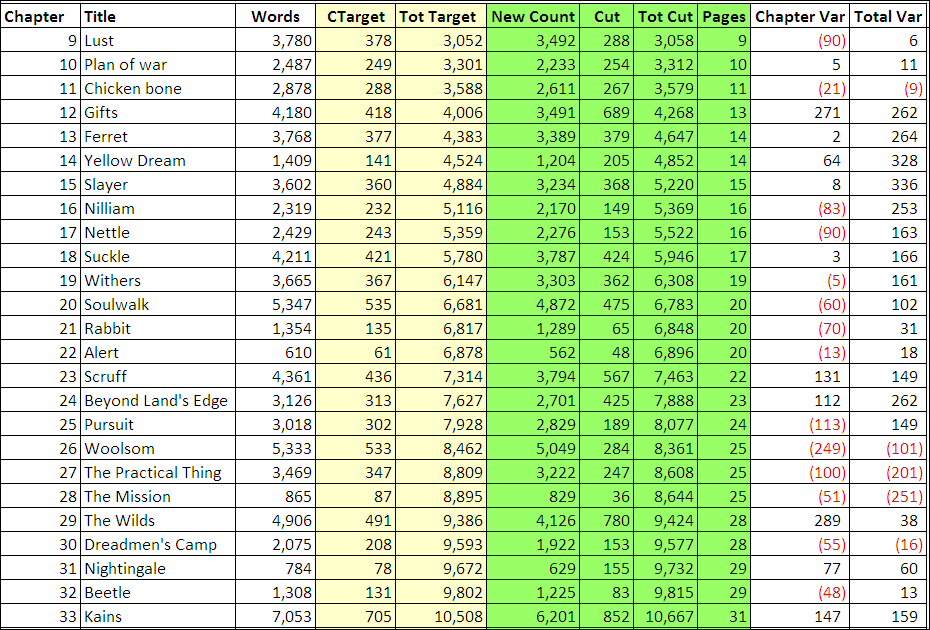
    I’m at the 51% mark with my trim and have cut 10,000 words. Right on target. And I haven’t cut any story, just flab in the writing. Usually when I revise, I add words. I thought I wrote lean, but that’s clearly not the case.  Strangely enough, I have to say that I’ve enjoyed every hour of this. I’m loving this edit,  improving the flow and immediacy, cutting out redundancies and superflous lines. Who would have thunk?

    For those of you who are numbers geeks, here’s a peek at the spreadsheet I’m using to track my trim goals and actuals. “Var” means variance. “CTarget” is the target to cut from the chapter.  

    Share