Good Stuff! The Man Who Invented Christmas

If you love funny, feel-good movies, today’s you’re lucky day.

Because I’m going to tell you about one that will help brighten your Christmas season.

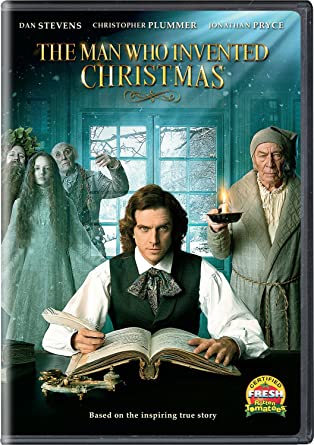
The movie is The Man Who Invented Christmas.

It’s about Charles Dickens, the author of A Christmas Carol.

Now some of you might already be groaning. Please, no, not another story about Scrooge.

I felt the same way. I haven’t enjoyed a movie about Scrooge for a long time. No, not even the one featuring Scrooge McDuck.

So I didn’t want to watch this, but I kept hearing so many good reviews, I finally caved and gave it a shot. I’m so happy I did.

This delightful movie reinvigorates the story with a whole new twist because it’s not about Scrooge. Not directly.

Instead, it’s about Charles Dickens. It’s 1843 and Dickens is suffering financial hardship because his last three books bombed in the marketplace. He determines to write a new book and publish it himself to restore his finances. That book is A Christmas Carol.

Dickens needs to finish it in six weeks so it can be ready for Christmas. That’s difficult enough, but will anyone read it? His friends and publishers keep telling him that the book will be a failure because, at the time, many thought Christmas irrelevant and didn’t celebrate it. Furthermore, the story isn’t developing as it should.

Now the movie does take some dramatic license, but, by the end, I think you’ll agree the message of Scrooge is never more poignant. I watched the final scene with Scrooge multiple times and thought about it for days afterwards.

If you want to laugh, be inspired, and feel the spirit of Christmas, I think you’ll love this movie.

Share

Similar Posts

  • Temple Grandin, Butternut Soup, & Five Guys

    Must-See Movie

    Time magazine has named her one of the 100 most influential people in the world. This summer, the National Cattlemen’s Beef Association’s honored her with the Lifetime Achievement Award. She serves as an animal-welfare consultant for international companies like McDonalds, Wendy’s International, and Burger King. Her work has transformed the design of cattle handling facilities worldwide. In fact, fifty percent of the cattle in the U.S. and Canada are handled in equipment she has designed for meat plants.

    She is one of the most fascinating people I have read or listened to. Her name is Temple Grandin. And she’s autistic. When she was four years old she couldn’t speak a word. The doctors, at the time, wanted her mother to commit her to an institution. But her mother wouldn’t accept that. Temple learned to read. She was tormented in junior high and high school. But she persevered, got into college, was almost expelled, and ultimately earned a PhD in animal science.

    Recently, HBO produced a film about her called Temple Grandin. It is one of the best films I have seen in the last five years. It’s full of drama, heartache, triumph, and good humor. When you’re done, Temple Grandin will likely become one of your heroes.

    Claire Danes does a fabulous job playing Temple. The movie also features Julie Ormond as Temple’s mother, Catherine O’Hara as her aunt, and David Strathairn as Dr. Carlock. Earlier this year, the film won seven Emmy Awards. But I didn’t need that to know how good it was. All I had to do was look at my wife and girls who sat rapt as the story unfolded. Get it on DVD. And if you want to know more about Grandin’s ideas, go to www.grandin.com.

    Squash Devils

    My wife was recently possessed by an evil squash spirit.

    How do I know this?

    Simple. Have any of you out there ever been sitting around and suddenly got a mighty hankering for pureed squash? Even when you were in the Gerber bottle stage?

    No, didn’t think so.

    So what else would explain her sudden need for a bowl of butternut bisque?

    Alas, I did recall once having a tasty pumpkin soup in a fancy restaurant in California, and so I didn’t immediately call the Brethren in for an exorcism. Instead I went to allrecipes.com and looked up a recipe for her.

    I found “Butternut Squash Soup II” by someone named Maplebird, which inspired tons of confidence since all the great chefs are named after tree-animal mixes.

    Then Nellie made the soup. I partook. And the evil spirit must have jumped into me because I’m telling you right now that I could not get enough of it. The mouth feel, the taste—the TASTE. There wasn’t a thing squashy about it.

    Folks, this is the real deal. And at least 494 other people out on allrecipes agree with me and have rated it an average of 4.5 starts out of 5.

    Ingredients

    • 2 tablespoons butter
    • 1 small onion, chopped
    • 1 stalk celery, chopped
    • 1 medium carrot, chopped
    • 2 medium potatoes, cubed
    • 1 medium butternut squash – peeled, seeded, and cubed
    • 1 (32 fluid ounce) container chicken stock
    • Salt and freshly ground black pepper to taste

    Directions

    Melt the butter in a large pot, and cook the onion, celery, carrot, potatoes, and squash 5 minutes, or until lightly browned. Pour in enough of the chicken stock to cover vegetables. Bring to a boil. Reduce heat to low, cover pot, and simmer 40 minutes, or until all vegetables are tender.

    Transfer the soup to a blender, and blend until smooth. Return to pot, and mix in any remaining stock to attain desired consistency. Season with salt and pepper. Say a prayer and call for a priest or someone with the Melchizedek priesthood to be on hand just in case.

    Burger Salvation

    Okay, I know some of you are rolling your eyes. Squash? Have you got to be kidding?

    If that’s you, then let me recommend Five Guys burgers and fries. Burgers started to bore me years ago. But a buddy recently recommended Five Guys, and I’m so glad I went. They’re a national chain. In Utah, we have eight of their joints from Layton to Orem.

    They don’t offer salads or wraps or yogurt. They make four kinds of burgers, three kinds of dogs, and two kinds of fries. That’s it. You order the toppings you want–the regular things like grilled onion, cheese, and pickle, but you can also get grilled mushrooms, bacon, jalapenos, and BBQ sauce. More importantly, your burger is cooked fresh, right before your eyes. No microwaved unmeat retrieved from a mystery bin. It comes to you hot and juicy. The fries, cooked in 100% peanut oil, are served up sizzling. And there are a lot of them. I ate mine with a Cherry Coke.

    If you’re ever in the mood for burgers and fries, you’ve got to try Five Guys.

    Share
  • Good Stuff! Sergeant Nibley and Whole

    There are many good accounts of soldiers in World War 2, but I just finished one that is unlike any others I’ve read. It’s the delightful Sergeant Nibley PhD: Memories of an Unlikely Screaming Eagle by Hugh Nibley and Alex Nibley.

    It details the experiences of Hugh Nibley, the famous BYU scholar of ancient history, as a soldier in the war, starting from when Nibley was on his mission for The Church of Jesus Christ of Latter-day Saints and met Hitler coming out of a bathroom in Germany.

    This book made me laugh and wonder and sorrow. It includes insights, surprises, and anecdotes that I haven’t found anywhere else. The authors also include many pictures that help the whole thing come alive. If you like history or biographies or are a fan of Nibley’s works, I think you’ll love this book.

    *

    Some of the wonderful residents of Rich County, Utah where I live are not going to like this next one. But I have to share it because if what’s detailed in this next book is accurate, it could help so many.

    The book is Whole: Rethinking the Science of Nutrition by T. Colin Campbell who has been one on the forefront of nutrition research for over forty years.

    Campbell’s legacy, the China Study, is the most comprehensive study of health and nutrition ever conducted. He’s a renowned researcher at Cornell University. He has worked as a senior science adviser to the American Institute for Cancer Research, and sits on the advisory board of the Physicians Committee for Responsible Medicine.

    I share all that to simply suggest that he might have a little bit of expertise that’s worth listening to.

    Campbell grew up the son of a dairy farmer and went into the field of nutrition, believing animal protein, specifically dairy, could help solve nutrition problems in countries with starving populations.

    What he found shocked and surprised him. And at first, he didn’t believe it. But he and others ran study after study, and the science led to one conclusion: a diet high in animal products and processed foods increases the risk of many cancers, heart disease, diabetes, and a host of other maladies just as surely as tobacco increases the risk of lung cancer. What he found is that the healthiest populations ate a whole-food, plant-based diet.

    Now that goes against a lot of what we’ve been told. Milk is supposed to do a body good. And surely there’s nothing more healthy than lean cuts of meat. And aren’t there studies that prove this?

    In this book Campbell explains the science behind the evidence for what he and other scientists are seeing, the ways our current scientific paradigm ignores the fascinating complexity of the human body, and why, if we have such overwhelming evidence that everything we think we know about nutrition is wrong, our eating habits haven’t changed.

    I know this may seem like yet another whiplash science report. You know the kind—one report says red wine is bad for you and the other says red wine is good. But in this book, Campbell explains why we get such goofy and contradictory claims.

    If you or someone you love is dealing with heart disease, cancer, including breast cancer, obesity, or diabetes, you will want to hear him out. Whether what he has to say persuades you and what you will do about it, is up to you. But I think you’ll benefit from listening. If you’re interested in science, this book will give you surprising insights about its practice that you probably haven’t considered. Listening to Campbell has been eye-opening. I highly recommend this book. If, after hearing it, you want more information, I recommend his previous book called The China Study.

    Share
  • Tales From Earthsea

    Tales from Earthsea (The Earthsea Cycle, Book 5) 

    When I was in 7th grade I read Tolkien’s The Lord of the Rings trilogy. Of course, I wasn’t the sharpest literary tack back then, and so great sections of The Two Towers and The Return of the King went over my head and, therefore, bored me. But, with the help of the Hildenbrant calendars, enough came through to thrill. I wept at the events in the mines of Moria with Gandalf, geeked out over the elves, orcs, and Nazgul, was fascinated with the Ents and wizards, and generally wanted to stay in that world forever.

    When I finished the trilogy, I mourned–the dream was over. I read Smith of Wootton Major and Farmer Giles of Ham. Both were delightful, but neither was the same as LOTR. Then I saw The Silmarillion. It had a cool cover, a map.

    Oh, joy! I bought it and took it home.

    Alas, that book was about as much fun as reading a ten-pounder on the history of baroque cornices. I tried mightily to push through, but I don’t think I was able to finish more than 15 pages total from all the sections. So I mourned again, and then, still feeling the loss, went looking for something else that might whisk me away.

    One of those whisking stories was Ursula LeGuin’s A Wizard of Earthsea. Of course, the fact that there was a wizard in it was important, but as equally delightful to my then puny literary prowess, was that the story was a slim thing. As were its two companions The Tombs of Atuan and The Farthest Shore.

    Here’s the cover the drew me in so long ago.

    I relished all three and moved on to other stories.

    Time passed and I forgot about LeGuin. Almost 10 years later I was newly married. My wonderful new wife started reading to me as we’d drive. And on one of the three-hour drives to her parents, she pulled out this little book and began to read.

    It was A Wizard of Earthsea! And it was just as marvelous the second time with a bigger brain as it was the first time with a smaller one. In fact, Nellie’s reading to me was so enjoyable I slowed down to 40 mph so I could extend the 3-hour drive. Of course, she quickly caught on to my scheme, shut the book, and told me she wouldn’t read another word unless I drove 65 mph, at the very least.

    What can a guy do? I kept it at 65 (well, 60) and joyed in the wonderfulness of a new wife who would read aloud to me (you mean this model reads, too?!), the night and the stars spread above those lonely Utah and Wyoming roads, and the amazing story unfolding before me.

    And this is the cover of the one my wife read to me.

    We read all three to each other and moved onto other stories.

    More than 15 years passed and I’d mostly forgotten LeGuin (I really never could get into her Hainish stuff). I was in the library looking for some good audio. And there on the shelf stood Tales from Earthsea by Ursual LeGuin.

    Just a little slim container of cassettes. Why not? I thought.

    Holy heroes, Batman—it was gold. LeGuin’s a master of building that feel: the wonder of fantasy, the mystery of things long forgotten or rumored to exist, the pull of learning arcane powers. I loved every minute of it (well, except for the slogging first four pages of backstory, but get through that, which isn’t too bad with Karr’s reading, and you’re into the kingdom). The first story, “The Finder,” read by Amanda Karr was incredible. It takes us back to how Roke became was it was in the first trilogy. But the delights do not end there. Four more stories follow.

    I liked them all so much, I just checked the audiobook out again so I could listen a second time. And, it appears, LeGuin was busy in my absence because she has more Earthsea than this.

    • A Wizard of Earthsea, 1968
    • The Tombs of Atuan, 1971
    • The Farthest Shore, 1972 (Winner of the National Book Award)
    • Tehanu: The Last Book of Earthsea, 1990 (Winner of the Nebula Award)
    • Tales From Eathersea, 2001 (a collection of short stories)
    • The Other Wind, 2001

    I just got the last two from Amazon. I can’t wait to enter into LeGuin’s magic spell yet again.

    More cool Earthsea stuff.

    Share
  • Hunger Games the Movie – Excellent, but marred . . .

    So is the movie as good as so many are saying?

    I liked the book a lot. You can see my review here: http://johndbrown.com/2010/09/amano-jasons-deli-and-the-hunger-games/

    Yes, but is the movie as good as the book?

    Let’s start with the beginning of the movie. During the first 10 or 15 minutes I was so annoyed and angry that I almost rose up out of my seat to shout “Stop it! Stop it! Stop it!” at the screen.

    Was this because the movie wasn’t faithful to the book?

    Because the actors sucked?

    Because the popcorn triggered a terrible case of restless leg syndrome?

    No, no, and no. 

    Then, why, John? Why?

    Because the director, Gary Ross, who wrote the wonderful Seabiscuit and Big, just couldn’t trust the material, the story, to work its magic. No, he thought that it would be a really good idea to MAKE ME SICK by overexaggerating and overusing HANDHELD CAMERA MOVEMENT. You know, the idea that if you confuse the viewer and make them uncomfortable, that will help them FEEL the wrongness, the stress, and the fear of the situation.

    A common technique for doing this is the tilted shot. Tilt the shot just a little and viewers subconsciously get the idea that something is wrong. You don’t notice it. The movie plays on, but you do feel that something is wrong, that trouble is brewing somewhere or someone is lying. A similar technique is used in action scenes. To help the viewer feel the “speed” of the action, they give us quick cuts. But the traditional tilted shot and quick cuts preserve understanding. They’re more of an unconscious effect. You still see the movie unfold and understand it. 

    However, some directors in the last few years, maybe with Spielberg’s use of this in the beginning of Saving Private Ryan (is there a movie history buff out there who can confirm?), decided that if a little was good, good golly, ten times that would be a LOT better.  So instead of realizing that action sequences like the one in the beginning of Casino Royale or the fights in Inception, ones you can easily follow, are the kinds audiences want, they figure they need to push the shots and cuts until audiences can’t make heads or tails of what’s happening.

    Instead of giving the audience tremendous thrills and suspense, they give them confusion.

    Wow, that’s a good trade off.

    And now, Gary Ross, who seems to have inexplicably bought into this, decides that what he needs to do is not only deliver confusion but nausea and annoyance as well.

    Stop, people. Stop. PLEASE! A little spice enhances a dish and takes it to the next level. But when you dump a cupful of thyme on my plate, all you do is make me want to gag.

    I’m not the only one who noticed. My 14 year old and my 19 year old noticed it as well and were bugged by it. It got so bad I told myself if it didn’t stop, I was going to walk out and ask for my money back.  Luckily, Ross toned his nonsense down and finally let the actors and story take center stage. 

    Which is what he should have done from the beginning because the acting was great. I loved Jennifer Lawrence (Winter’s Bone) as Katniss. Loved Willow Shields as Primrose and Josh Hutcherson as Peeta. Stanley Tucci playing Ceasar Flickerman, the blue-haired talk show host, was perfect. And the story was indeed a faithful translation of the book. I’m sure a huge part of that is due to the fact that Suzanne Collins, the author of the novel, helped write the screen play.  The other writers were Gary Ross and Billy Ray. 

    They did change a few minor things like Buttercup the cat is now black and white (I’m so utterly devastated I won’t be right for years), and Primrose gives the mockingjay pin to Katniss instead of Madge. They added scenes with the President of Panem.  They cut some scenes with minor characters and some twists in the plot. For those who read the book, even though the lost and changed parts added texture to the story, I think you’ll still be very pleased. For those who haven’t read the book, I think you’ll be wowed and sobered by the end. You’ll think about the Romans and their gladiators. You’ll wonder how we can we humans can do things like this. And I think you’ll feel a great indignation take root in your breast against the villains who control the world of the story.

    So, the move is a great experience that would have been over-the-top excellent if the director hadn’t marred it with way too much of something that should be used as spice instead of the main course.  Nevertheless, I recommend it. If you like action and drama, I think you’ll love the movie and the book. And hopefully my comments above will innoculate you to the opening scenes because you know to expect them going in.

    EDIT: Matthais Stork writes about “Chaos Cinema: The Decline and Fall of Action Filmmaking“. And his response to his critics. Anne Billson of The Guardian agrees that “Action sequences should stir, not just shake“.  But here’s a fellow trying to defend chaos cinema in a way that reminds me way too much of those I met in my English degree who assumed that the highest reading was one that focused on meaning, one that assumed the story was really not a story about people to be experienced, but a clever puzzle that needed to be decoded.

    EDIT: The issue with chaos cinema is that it replaces showing with telling.

    It presents “big fight” and “exciting chase” instead of showing the big fight and exciting chase. It’s similar to voice over narration: using the soundtrack to tell us about what’s happening instead of showing it to us. But it goes beyond even that because at least the narration told us what was happening. Chaos cinema at its most extreme doesn’t do even that. It replaces clarity with confusion. And this is its biggest downfall.

    For someone to react with emotion to a situation, they must (1) understand what’s going on AND (2)believe that the situation is real. The moment you deliver confusion, you take away one of the two necessary antecedents, and prevent the audience from responding emotionally. They now can only respond intellectually, e.g. Ah, I congnitively see that we are having a fight; I have no idea what’s happening and how that affects the guy I’m rooting for, but I see we’ve inserted the “fight” concept. (For those interested in the excellent discussion of emotion and stories, you’ll want to read Jenefer Robinson’s DEEPER THAN REASON: Emotions and it’s role in literature, music, and art.)

    Take it too far and you remove the second antecedent as well because now, instead of reacting to the story, you’re thinking about the camera man. Which is what happened with me when I just about came out of my chair to shout at the screen at the beginning of HUNGER GAMES. And what happened to half a dozen others I know who couldn’t look up because it would make them dizzy, and another half dozen who did look up and got sick.

    Chaos cinema trades in the super powers of cinematic storytelling for a bunch of rocks.

    Share
  • Gladwell, Dish Cloths, and Higher Technology for Tuna

    The Tipping Point by Malcolm Gladwell

    After reading Made to Stick, I decided to read the book that inspired it—The Tipping Point: How Little Things Can Make a Big Difference by Malcolm Gladwell. I’d read Blink and Outliers by the same author and found both fascinating.  I’m happy to report The Tipping Point is just as good. In it, Gladwell examines what conditions cause ideas, behaviors, messages, and products to spread like outbreaks of infectious disease. 

    In the book he shares a number of situations and studies, including the sudden drop in crime in New York city in the 1990’s (which started by attacking graffiti in the subway), the dramatic popularity of the Blue’s Clues TV program with pre-schoolers, Paul Revere’s success in rousing the citizens along his route (versus the almost total failure of the other guy who rode that night), the resurgence of Hush Puppies shoes, syphilis in Baltimore, Columbia Record’s amazingly effective golden box ad campaign, and a dozen other outbreaks.  From all of these, he extrapolates three rules of social epidemics—The Law of the Few, The Stickiness Factor, and The Power of Context.  

    The arguments Gladwell presents are thought-provoking and powerful, but what makes him such a treat to read is how he writes.  Like the best science writers (in fact, I think he IS one of the best), he tells great stories with interesting characters.  He puts the reader on the edge of the seat with mystery, insight, and humor. He makes things that could be incredibly complex seem like first grade math. It’s as if he’s standing right there with you chatting about the subject. Moreover, he does all this from page one.

    Here’s what I mean. I left the book out on the kitchen table one night after reading a few chapters.  The next morning Super Wife came down to quickly eat breakfast and get herself to a meeting.  She made the mistake of opening the book to glance at the first page. Twenty-five minutes later she came up for air and realized she was going to be late and dashed out the door. The writing is pure mind control.  And I loved every minute of it.

    If you’re at all interested in advertising or how fads and movements start, if you want to affect the behavior of customers or local teens, if you just like to read how things work, I think you’ll love this book.

    Sunflower Dish Cloths

    I used to suffer along with subpar dish cloths.  There were the dish cloths with mesh on one side that were so small you had to rinse them after every wiping stroke.  There were the hand cloths made of terri that belonged in a bathroom but were repurposed and were far too big. Then were the cloths that had some slippery crap in the thread that refused to soak up water.  And there were the crocheted things that I think we should have put out of their misery when we first got them. Folks suggested we go to sponges. So we did sponges and had similar results.

    Oh, woe, woe, woe.

    Then a kind and loving friend gave us a set of mystery cloths that were incredible.  They were large enough that we didn’t need to rinse with every wipe.  They had this fantastic weave that was open, yet absorbent, and dried quickly.  And the weave had enough of a texture that you could use it to scrub.  We received those back in 1999.  They lasted us for years and gave us much kitchen cleaning joy.  But, alas, like all of mortality, those brave cloths finally began to give up the ghost. 

    My problem was that I didn’t know who had made those cloths and where I could get more.  We looked all over and couldn’t find them.  And then, at this year’s Garden City Raspberry Days craft fair, we saw them nestled amidst all the kitsch!  We bought as many as we could afford, and went our way rejoicing, fully expecting these to last us until we have grandchildren.  Maybe we’ll pass them down as priceless heirlooms.  Maybe some day they’ll be featured on Antique Roadshow.  Maybe they’ll be resurrected with us and become the official dish cloth of the Millennium when the world is renewed (it could happen).

    If you’re sick and tired of sponges and crappy dish cloths, let me suggest you pick up some Sunflower Dish Cloths made by Sangamon Mill. You can order them in bulk at http://www.sangamonmill.com/ , or in smaller quantities online from places like Amazon.

    Everiholder’s Veggie & Tuna Press & Strainer

    Do you eat tuna? If so, you know the biggest pain is draining the can. But you don’t have to suffer along any longer using the lid, which doesn’t do a good job at all anyway.  There’s a better solution, which Super Wife discovered. It’s called the Tuna and Veggies Press and Strainer by Evriholder: http://www.evriholder.com/Tuna-Veggie-Press.asp.  With this little blue piece of higher technology you easily and quickly press all the juices away, and nothing slips out the sides. We love our.  You can order it online, although Super Wife found it at our local evil empire Wal-Mart store.

    That’s it for now.  In the next review, I’m going to reveal two killer recipes over which all who partake will salivate and drool—Chocolate Éclair Cake and Dill Potato Salad.

    Share
  • Miss Potter, Downton Abbey, Human Planet

    Miss Potter, a true romance

    How many shows are good enough that you can walk into them partway through and within a minute become completely engrossed? I found two this week. The first is the 2006 film Miss Potter, which tells the story of Beatrix Potter (1866-1943), who is the best selling children’s author of all time. You might know her by the most famous of her 23 illustrated children’s stories: The Tale of Peter Rabbit.

    As a side note, Potter spent a lot of time at her family’s country home in the Lake District. I was lucky enough to be able to vacation there once, but never knew until I saw this film that the gorgeous landscapes that had been preserved were partially due to her donation of 4,000 acres.  

    The movie opens with the fact that Potter, who is played so well by Renée Zellweger, has missed her early chances of marriage. She’s a young spinster, and, having a number of her illustrations purchased, is determined to make some money publishing her own illustrated stories. The movie follows her journey to publication, which met with opposition from both publishers and her family, but the real heart of the film is the story of her meeting and falling in love with Norman Warne, whom her parents, especially her mother, don’t approve of because he’s a tradesman. The film is full of wonderful drama, humor, tragedy, and solace. I can’t recommend it highly enough. In fact, I found myself watching it a second time two days later with my girls with just as much enjoyment.

    Downton Abbey, a period drama

    The second show is the BBC miniseries Downton Abbey.  Its first season of seven episodes aired last year in the USA on PBS’s Masterpiece Theater.  The second season will air at the beginning of 2012.  

    The series is set in the fictional Downton Abbey and follows the lives of the aristocratic Crawley family and their servants. The stories take place over the time period that starts with the sinking of the Titanic in April 1912 to the outbreak of the First World War on 4 August 1914.

    The main story line running through the episodes is the fact that the Crawley family must give up the estate to a distant relation because they have no male heir. But what I find so refreshing is that the stories of various servants are included. Some are funny. Some pull at your heart strings.

    So far I’ve met and enjoyed some truly delightful characters as well as a couple of villains. If you enjoyed the BBC’s Pride & Prejudice or the Cranford series, I think you’ll enjoy this.

    Human Planet, an amazing documentary

    These last two weeks I’ve watched with fascination the eight episodes of the BBC and Discovery documentary series Human Planet. One species on our planet has adapted to every environment on earth—that’s us. The series looks at a number of remarkable ways humans have adapted to the various habitats.

    You’ll see people from all over the globe who do things you never would imagine. Here’s just a small sample:


    • -Folks in Churchill, Manitoba Canada who trick or treat on Halloween with hungry polar bears stalking the streets
    • -A man in Papua New Guinea practicing the ancient art of shark calling in a small canoe
    • -Dolphins that help humans fish in Brazil
    • -A wild honeyguide bird working with Maasai boys to steal honey from wild African bees
    • -Mongolians using tamed golden eagles to hunt fox
    • -People in the eastern Amazon who love their pet monkeys so much they breastfeed them
    • -Inuit Canadians who risk death going under the arctic ice during low tide to gather mussels
    • -Three Dorobo in Kenya stealing food from a lion pride of more than twenty lions


    Oh, and how could I not mention the three children who hunt tarantulas in Venezuela, roasting them up as tasty treats that taste a little like crab. I could go on and on. There are sixty-three of these stories in all, grouped into eight episodes that each focus on a certain habitat, including deserts, the Arctic, jungles, mountains, grasslands, rivers, and cities. Each episode also includes a behind-the-scenes story about the filming of one of the episodes. And some of these are as thrilling as the stories themselves.

    In fact, that’s one of the things I love about this series. In addition to showing me fascinating things I’ve never seen, a number of the stories also raise the adrenaline just a bit. And yet, that’s not all. Because while presenting “strange” cultures, the stories humanize these folks so that instead of presenting aliens, these people feel more like fascinating distant relations. This is storytelling at its finest. If you like nature shows at all, you’ll be totally delighted with Human Planet.

    Share