Can you write for love AND money?

Many artists think you can’t. And not simply because they envy those who are selling hundreds of thousands of copies.

The reason they think this is for the simple fact that the creative process is fueled by following the zing. It’s ruled by passion. You have to care about AND believe in what you’re writing. You have to because if you think it’s boring or unbelivable, then it’s likely everyone else will as well. 

For example, let’s say you are deeply bored by vampires, but see that vampire love stories are making piles of cash and decide to write about one with smoldering eyes and a bad habit of chewing tobacco even though it leads to dental problems with the fangs (hey, why would her man-toy care?), then you’re substituting passion (that which springs up from within) for graphs and plots about marektability (stuff that’s imposed from without).

And so many folks think that there’s a continuum. On one end is writing for passion. On the other is writing for money. And the two don’t cross. But this is a false dichotomy. The truth is that money and passion are independent factors.

Lon Prater, a writer friend, recently expressed it this way.

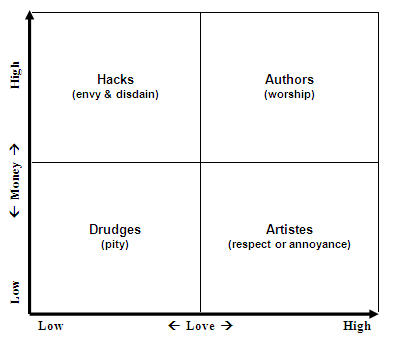
Not a dichotomy, but rather an X and Y axis, the way I see it.

There’s:

low love, low money (SEO writing?)

low love, high money (For me, this would be tech writing, or media tie-in to a universe I didn’t care about)

high love, low money (unfortunately too much of my writing!)

high love, high money. (Loftiest of goals) 🙂

You can find datapoints for every quadrant, and of course “love” is highly subjective and individualized, as are what counts as low and high for each writer.

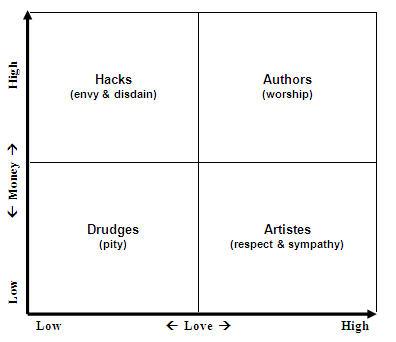
If we put labels to the quadrants, we get something like this, along with common emotions they tend to evoke in other writers. (Although I will say that envy seems to want to run amok in the author quadrant as well.) 

writer-love-and-money-quadrants2

Share

Similar Posts

  • |

    Ira Glass on Story and Surprise

    I found this a fascinating talk. It’s Ira Glass who is the executive producer of the This American Life radio program from Chicago Public Radio. It’s a show that merges true stories (and some short fiction) of everyday people, surprise, humor, and meaning. There’s a structure to the types of stories that they produce. It’s not a new thing. It’s used all the time in a venue many of us are familiar with. Maybe you’ll identify that venue immediately. If not, it doesn’t matter. Watch and listen. This is a fascinating talk and it highlights just how much humor, curiosity, and insight depend on surprise.

    Ira Glass at Gel 2007 from Gel Conference on Vimeo.

    Share
  • Stephenie Meyer, Envy, & Zing

    If were smart and didn’t compare myself to other writers, then I wouldn’t care that Meyer is a true overnight success, I wouldn’t be green with envy, I certainly wouldn’t be thinking that I should write YA romance.

    His eyes were smoldering…

    She couldn’t look away from his smoldering eyes…

    His yellow smoldering eyes were upon her…

    Alas, imperfect man that I am.

    Time has written an interesting article about the Meyer phenom. Of the many fine tidbits, I wanted to highlight one comparing Meyer with Rowling.

    But as artists, they couldn’t be more different. Rowling pieces her books together meticulously, detail by detail. Meyer floods the page like a severed artery. She never uses a sentence when she can use a whole paragraph. Her books are big (500-plus pages) but not dense–they have a pillowy quality distinctly reminiscent of Internet fan fiction. (Which she’ll readily grant: “I don’t think I’m a writer; I think I’m a storyteller,” Meyer says. “The words aren’t always perfect.”)

    I’m not a writer, she says.

    I’m a storyteller.

    There are volumes in that one paragraph. Meyer knows exactly why the vast majority of us fiction readers read. And it ain’t for style.

    Here’s an even more interesting video clip of Meyer talking about how she came up with her novel. Notice how this woman follows the zing. Notice how she makes time (novel completed in three months). And look at her success. A lesson to all of us wanting to tell great stories.

    …His red eyes were smoldering, and her brown eyes were smoldering, and together they were all smoldering…

    Share
  • Advice from one of the biggest writers of our time

    How would you like to sit down and get writing tips from someone who created or co-created nearly 40 television series? Someone who wrote more than 450 episodes for those and other series and then went on to produce around 1,500 more.  Oh, yeah, and then after his thirty or so years in television, he published 18 novels. Whoa–eighteen. Like I’m shaking, right?

    It’s not like the guy knows much about telling stories. I mean, millions of viewers entertained–big deal. Still, do you think you might be interested in seeing if he hasn’t maybe one piece of advice that’s useful?

    If so, the guy’s name is Stephen J. Cannell.  He wrote about 9,000 words on developing stories and called it his Writing Seminar. I thought it was pretty good. Well, for a piker.

    Share
  • Indie Thoughts: How To Sell Loads of Books

    From Russell Blake.

    This does not represent the only way to do things, but it’s my way, and is the synthesis of everything I’ve learned over the last 23 months of self-publishing:

    1) Pick one genre that’s popular and with which you are extremely familiar, and then write in that genre. Stick to it. Don’t hop around. It confuses your potential readers and muddies who you are in their minds, and will hurt your sales. If you want to write different genres, use a pseudonym, and if you like, let your readers know that moniker is you. But stick to one name, one genre, because you’re building your brand, and brand building is a function of clarity – clearly communicating what you do, and what your product is.

    2) Write a series. Why? Because readers like series, and you want to give readers what they like. Or you won’t sell as much. You can try stand-alone – I have – but my series outsell my stand-alone books 4 to 1. Once you have at least three books in the series, make the first one free. Earn your income from the rest, but give readers a whole novel to decide whether they like you or not.

    3) Write a lot. By that I mean try to write at least 3 novels a year. Don’t bother with short stories or novellas (40K or under) if you’re writing fiction – erotica, romance and non-fiction reportedly to do better with short form, but I don’t know from personal experience. Write 60-90K installments in your series, and release them AT MINIMUM every four months. Every three months would be better. Every two, better still. Momentum breeds success, and readers have short memories. The current market is a hungry animal, and you need to feed it, or risk being forgotten by the time your next one releases. Sorry. It’s the truth. And don’t start whining about how X famous author only puts out one book every Y years. If you’re Dan Brown and you sell tens of millions of novels each whack, then do whatever the hell you like. If you aren’t, listen up, or chock your strategy up to, “Become the next Dan Brown” and stop reading this drivel.

    . . . .

    5) Allocate time every day to write, and be disciplined. I suggest minimum one hour per day, or 1000 words. I actually ignore that and shoot for 5000-7000 a day when writing a novel, but that’s just my approach, and it’s not for everyone. My point is that you must be disciplined about your writing and develop that muscle. If you don’t make it a habit, you won’t write enough to put out one novel every four months, and you’ll already be way behind the curve.

    6) Allocate time every day to market. I recommend a 75%/25% writing to marketing mix. So spend an hour writing every day, and fifteen-twenty minutes marketing (social media, blogging, interviews, message boards like this). Two hours writing, half hour to forty minutes marketing. And so on.

    . . . .

    13) Price competitively and intelligently. Look at your genre. Where are most books priced? Are you undervaluing/underpricing your work? Price to sell, but don’t go cheap, no matter what Locke or Hocking did years ago. Use low prices occasionally to move product, as promotional pricing. But price your product consistently with the rest of your peers. Over time, you can increase prices, if your product warrants it and your readership is willing to pay it. My advice here is don’t price too low, or too high.

    . . . .

    19) Have realistic goals. Look at what the average person does in their first year, and their second. That’s average. It ain’t pretty. If you want to be different than average in a good way, you need to do something better/different, and you need to make your own luck. Don’t get bummed because you haven’t been an overnight sensation. I sold $300 of novels in November, 2011, after six months of 15 hour days and seven releases. In December, 2011, I released five novels I’d been working on for months, to create a massive Xmas surge. I leaped to $1450. With a dozen books out. That’s not exactly a ton for the big Xmas season. But I continued writing as though my work was in hot demand. And I kept investing in my product, losing money, until it turned the corner and I started making decent money in Jan of 2012.

    20) Book selling is a retail business, and retail businesses are promotions intense. You’re only going to be as good as your last, and next, promotion. Promotions are a necessary fact of life in retail. You have to generate noise – the product won’t do it by itself. There are millions of books out there. Yours are just more books. Figure out how to get some visibility. I won’t advise you on how – there are plenty of ‘experts’ that will charge you $5 for a book on what worked two years ago. Simply put, it’s constantly changing, so you need to experiment and push the envelope, share information with others and stay ahead of the curve. But if you aren’t promoting, you’re stalling. In business you’re either shrinking, or growing. If you aren’t promoting, chances are you aren’t growing.
    There are 28 tips in all at “How to Sell Loads of Books.”

    Share
  • Generating Story 10: Creative Q&A with Orson Card

    Back when Orson Card first started his online magazine Intergalactic Medicine Show, he wrote an essay in which he detailed how he developed the idea for one of the short stories he told in his Ender universe. Card’s essay is a valuable resource because he exposes his mental thought process, modeling how he approaches story development.  It’s not often that an expert takes the time to expose his mental thought process while working through something, and there’s always a lot to learn when they do.  Interestingly enough, it illustrates a number of the principles in the Story Development Framework.

    Please read How One Story Can Give Birth to Another by Orson Scott Card.

    While you are reading it, watch for:

    1. How often he uses questions as he develops the story.
    2. How story objectives influenced what he wrote.  For example, why didn’t he write from Peter’s point of view, and how did he want to portray the mother?
    3. How story principles guided his development.  For example, what were the three ways to get an audience’s interest and how did that affect the story development?
    4. What he did when his zing suggested he go another way.  Did he end up writing the story he set out to at first? (Card listens to his Spidey-sense, what he cares about and believes in, quite a bit.)
    5. What his first draft provided him.  What does this say about using drafts to help you develop the story? 
    6. How he used the four-scene “plan” he sketched of the story.  How did that outline help him?  When he had that, was he finished developing the story?
    7. How he uses improvising to continue the development as he drafts.  What did he need in order to improvise? And what was he actually doing?

    Did you notice the elements of the story–problem, character, plot, and setting?  Did you notice how his development continued while working on the text (drafting)?

    One thing I don’t think you should take away from this is that you must write exactly like Orson Card.  That you must not include much setting.  Or that your sketches of the plot, the “plan” of the story, needs to be just like his.  You may enjoy more setting than Card.  You may want more or less in your sketch.  That’s fine.  The goal here isn’t to suggest you follow his exact procedure and have his exact same objectives.  It’s to see how authors use creative Q&A to develop a story, to make it come to life.

    As a final side note, I would like to quibble with one thing Card says.  A lot of folks talk about showing and telling in writing.  The eleventh commandment is to “Show, don’t tell.”  But I would like to suggest that writers actually never show anything.  They can’t.  It’s all tell, tell, tell. 

    Showing requires the original sensory input.  So a movie can show.  A stage play can show.  Both can also provide raw auditory input.  But all an author can show are marks on a page.  Those marks guide a reader into imagining events, people, and things, but it’s telling–“imagine this, imagine that, now imagine this.”  The author can tell in scene or summary.  Both have their place.  But it’s important to realize that we’re helping the reader imagine.  I don’t have time to go into the implications of this right now, but try the idea on for a while and ask yourself what type of writing helps you imagine things more vividly.

    For more in this series, see How to Get and Develop Story Ideas

    Share
  • |

    John guests on Writing Excuses season 3 episode 18

    writing-excuses-the-guys2-300x139

    Here’s the second episode I recorded with the Writing Excuses guys.

    In the first podcast we talked about putting and not putting ourselves in our writing and making characters who don’t all sound like the author. In this one, we talked about how to not repeat ourselves in ways that make the reader feel like they’re getting the same old same old.

    As usual, the guys had some great insights. Check it out: How to Not Repeat Yourself.

    Share

2 Comments

  1. In a just universe, the author writes what’s he’s passionate about, the audience picks up on the passion and buys his work, and the universe throws buckets of money at his head. Alas and woe, the universe is an unjust place. If it throws buckets of money at me for this Project That’s Eaten My Brain Since July, no one will be more surprised than I.

    And then there’s the poor fanfiction writer, who writes for mad love and no money and is subject to both disdain and pity.

  2. Hum, I didn’t think of fanfic. But I certainly don’t think they go in the drugde area. I think they’re in the artiste area. LOTS OF PASSION. Very little moo-lah.

    But you’re right. Writing a lovely story, getting a contract, and finding an audience are all three VERY different things. You can succeed at the first or even the second and still bomb on the third.

Comments are closed.