How readers select books

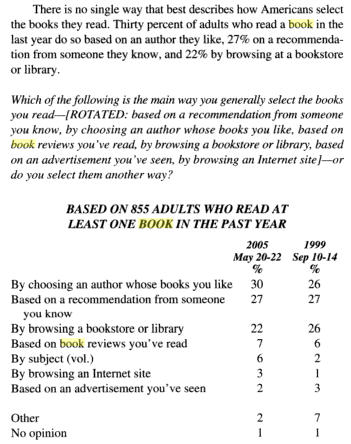
Gallup did a poll in 2005 asking readers how they selected the books they read. Here are the results.

gallup-poll-how-readers-select-books

What this says to me as an author is that the most important thing I can do to help my career is write the best dang story I can, seeing that almost 60% of what readers select is driven by the experience they or someone else had with the book.

The next most important factor has to do with helping my book stand out for browsers. This would include the cover, store placement, blurbs, flap text, and the opening pages. The only part of this an author can really focus on is the opening pages–again, writing the best dang story I can.

So it seems authors, especially debut authors, can’t do much to affect sales. But not being able to do much doesn’t mean they can’t do anything. Somewhere, somehow the first readers have to be enticed to give the book a go. Robert Sawyer talks about some of the methods to do that here.

EDIT: 4/8/2011

Kris Rusch adds more information that confirms the findings of the poll above in “The Business Rusch: Promotion”. READ HER WHOLE ARTICLE. Notice she does concede that publishers can get some notice for a book. So there ARE things that can be done to make the offer. But I agree with her advice that the best thing to do is get more product out the door. The studies she cites are:

2010 Survey of Book-buying Behavior by VERSO Advertising. The key conclusion on book-buying is that “Multiple factors impact consumer awareness of a particular title, but final purchase decision (online and offline) driven by author reputation, personal recommendations, and price.” If I were you, I’d read the whole presentation.

# Reason % Respondents
1 Author reputation 52%
2 Personal recommendation 49%
3 Price 45%
4 Book reviews 37%
5 Cover artwork/blurbs 22%
6 Advertising (including on-line) 14%

2007 Survey on what motivates readers to by a book by Spier Advertising, reported in Publishers Weekly

# Reason % of Respondents
1 Friend’s Recommendation 49%
2 Familiarity with Author 45%
3 Description on Jacket 32%
4 Reviews 22%
5 Advertisement 21%
6 Place on bestsellers list 17%
7 Reading group pick 16%
8 Cover design 12%
Share

Similar Posts

  • |

    How to Write a Story that Rocks

    Folks, a huge thanks goes to Stephen Nelson for putting all this together. You may kiss his hand when you see him.

    This is a recording of “How to Write a Story that Rocks,” a two-hour seminar Larry Correia and I just put on at the annual BYU’s Life, The Universe, & Everything symposium. I think we had 130-140 people attend. This symposium is focused on writing fiction. And while the panels and presentations do include things specific to the science fiction, horror, and fantasy genres (both adult and young adult), a lot of time is also spent on story writing fundamentals that apply to ALL genres. So when I developed this workshop, I made sure I took the fundamental approach.

    The two-hour seminar has been broken down into 12 segments. To switch between the segments:

    • Hover your mouse pointer over the YouTube below
    • Click the forward and back arrows that appear on the right and left sides to move to the next or previous segment, OR 
    • Scroll through all 12 segments and select the one you want using the playlist control at the bottom

    If you prefer, you can watch all 12 on the How to Write a Story that Rocks YouTube playlist page.

    I’ve found whenever I develop any presentation or training that it takes a few iterations and revisions before it’s the best it can be. This is the first iteration of this seminar. And so below this video I’ve provided additional comments on each segment explaining key concepts, principles, and techniques that we might have failed to discuss or convey as clearly as we’d hoped. Enjoy!

    Handout

    How to Write a Story That Rocks – Handout

    Segment 1

    It’s documented–right-wing gun nut Larry Correia sang “Kumbaya.” What’s next? The hugging of small trees? Oh, Larry, the disilluion. The disillusion.

    The reason why I had Larry sing was not for his mellifluous performance, but to demonstrate the difference in reactions between him and our happy volunteer (“Country Road” by John Denver–this really was a love fest). The volunteer balked because he hadn’t taken any thought to know what to sing before he was commanded to do so. On the other hand, Larry and I had spoken before the seminar. So Larry had something to sing BEFORE he sang it. It’s a simple demonstration, but it illustrates a principle a lot of new writers forget. Writing is a performance. It helps to know what it is you’re going to perform before you perform it.

    It’s one thing for you to tell yourself to write. It’s much easier to tell yourself to write the scene where the rancher finds out one of his illegal ranch hands has been kidnapped.

    Now this doesn’t mean that you have to know everything. Or that you can’t write exploratory drafts to figure out what it is you want to write. But it does illustrate that whatever techniques you use, you’ll be a lot more effective in your writing when you have something to say first.

    But what do you develop? What are the things that bring the story to life? How do you go about getting those things to say? That’s precisely what I wanted to address in the seminar. In the segments that follow, I try to:

    1. Explain what I’ve found are the most important things to develop, the things that define the essence of story, that make the story come alive in the writer’s mind–the things that really matter
    2. Demonstrate techniques to develop those things so you have something to say

    Segment 2

    I think this segment went fairly well. What rocks will different from person to person, even though there will often be a huge overlap between people. So it’s important for authors to seek to develop the kinds of stories that rouse their passion. Watch this interview with best seller Debbie Macomber to see what I mean. So I can’t tell you what to write about. Or if whath you think rocks will resonate with a large number of people. However, what I can do is share the techniques I use that have been most productive in helping me develop initial ideas into something that has much more power.

    You can use the techniques to juice up any of the four parts of story. However, I will say that I find that the most productive, the most important parts, are character and problem. Plot and setting are important. I love them and work to juice them up. But when I get a good character and problem, that’s when the writing seems to flow the easiest.

    And no, I don’t list theme as a part of story. Everyone talks about theme, but when I read what they have to say or press them for examples, it seems that it always either boils down to (1) a story element or topic that’s repeated, (2) a story problem/issue stated in an abstract manner, or (3) some moral situation. Les Miserables is about the “theme” of mercy versus justice. But saying justice versus mercy is just an abstraction of the story problem and dilemmas the story deals with. So, no theme. 

    Segment 3

    Loved this bit about scenes from David Mamet: http://www.slashfilm.com/2010/03/23/a-letter-from-david-mamet-to-the-writers-of-the-unit/ 

    Segment 4

    I’ll be adding my comments to the rest of these segments over the next few days.

    Segment 5

    Segment 6

    Segment 7

    Segment 8

    Segment 9

    Segment 10

    Segment 11

    Segment 12

    Dan Wells on Story Structure

    Check it out: Dan Wells on How to Build a Story (story structure). I find Dan’s “start with the ending” technique helpful as well as thinking about a worst fears realized moment. Watch the videos and see if there isn’t something there that can help you develop your story idea.

    You can get the PowerPoint of How to Build a Story on Dan’s site.

    If you find this approach useful, you might want to check out what novelist Larry Brooks has written about the same material on StoryFix.com.

    Share
  • How many copies do average authors sell?

    I posted earlier about the sales number for best-selling authors. What about the average author?

    Here’s Patrick Nielsen Hayden, an editor at Tor Books, in an interview on io9.com about the future effects of e-text on publishing:

    io9: Does it make a difference to you if an author has an online reputation? Does that go into your decisions to acquire books?

    PNH: Obviously it makes a difference if an author has a public online profile of some sort, even just down to the level of having a moderately popular blog. Most books sell 5, 10, or 15 thousand copies. Most are midlist books. With those people, even a modest online presence can make a difference in sales.

    The whole interview is interesting. In fact, he says something that I think is important to note about what today’s novelists and, to a lesser degree, short story writers are actually providing:

    One thing I’m sure of is that we’re [Tor Books] going to be in linear immersive narratives that produce the reading trance. We won’t be moving towards a “choose your own adventure” thing. People will do those things, but those are different art forms. There’s something about immersive text that you can read in order – it’s persisted through many technological changes. This fiction stuff works pretty well. It’s been around a long time

    I think he’s right. The EXPERIENCE you get in the reader’s trance, similar to the one you get in a movie, is a strong experience. The media used to convey that experience doesn’t really matter as long as it makes it easy to get into the trance.

    Check out the whole interview.

    Share
  • “The Only Law of Literature” by James Maxey

    james-maxey

    You already know how I feel about writerly rules. So when I read James Maxey’s “The Only Law of Literature,” I had to share it.

    I want to quote the whole thing here. But I’ll resist and quote only the conclusion.

    [In response to critiquing stories that don’t work for you] All the literary analysis of writing techniques, of style, of world building, of creating characters–it all has it’s place, but it’s almost completely useless as a guide to writing a good book. You are never going to be able to think or study or analyze your way into writing a book that people love.

    There is only one law of good literature: Write what you’d love to read.

    Not what you have read and loved. What you love, but haven’t yet read.

    To quote myself from the Impish Idea thread:

    Every thing you write should be a love story. Not a romance. But a story written because you loved it.

    Follow your passion. Don’t worry about pleasing everyone. Fill your book with the stuff that makes your heart race and leave out the stuff that bores you. If you don’t make it into print, at least you’ll have a book you can look at with pride as being truly your own.

    Once you’ve learned this secret, everything else falls into place.

    Go read the whole post.

    It’s important to learn craft. You cannot get away from it. But craft is only useful as a tool to tell this cool, wonderful, poignant, amazing thing we’ve invented and discovered.

    Share
  • On writing lesson 5 is up

    In lesson 5, I share insights on creativity that elude many who start down the path of writing. Not knowing them can cause a lot of frustration and convince writers to quit. Don’t be frustrated. You’re going to learn:

    • What creativity really is
    • How it actually works
    • What it requires
    • And two of the main tools that will help you practice it–hunting zing and creative Q&A

    Here it is: Lesson 5: How do you get and develop ideas?

    Enjoy!

    Share
  • |

    Ira Glass on Story and Surprise

    I found this a fascinating talk. It’s Ira Glass who is the executive producer of the This American Life radio program from Chicago Public Radio. It’s a show that merges true stories (and some short fiction) of everyday people, surprise, humor, and meaning. There’s a structure to the types of stories that they produce. It’s not a new thing. It’s used all the time in a venue many of us are familiar with. Maybe you’ll identify that venue immediately. If not, it doesn’t matter. Watch and listen. This is a fascinating talk and it highlights just how much humor, curiosity, and insight depend on surprise.

    Ira Glass at Gel 2007 from Gel Conference on Vimeo.

    Share
  • Generating Story 8: Creative Q&A part 2

    I realized I needed to blather a bit more on this topic to warn you against something before I bring the other authors on.

    You’re going to be tempted.  You’re going to be tempted to seek for some Holy Grail list of magic development questions.  Some of you are going to be tempted to compile some big old honking list of “the questions that will produce a killer story every time and all I have to do is ask them.”

    That list doesn’t exist. If you seek for it, you’re going to waste a lot of time and end up having to fight killer rabbits and fetch shrubberies for weird knights.

    Don’t fall for it.

    But, John, didn’t you say there were core questions?

    I did.  You need answers for those.  But you need to also understand that a writer will ask a great number of development questions when writing a specific novel, some of which he might only ask once.

    Last year I was out on the forum at CodexWriters.com and one writer asked the rest of us how we approached developing our stories.  He was looking for some kind of development map, e.g. I have this piece of the story, now I need to develop the rest–how does one go about that? 

    That discussion led directly to this series on getting and developing story ideas. My thoughts then were that you need to define and understand the basic elements of story.  Knowing the key story principles behind each element leads us to a handful of core development objectives and questions.  But–

    I DO NOT think there’s a comprehensive must-do list. 

    Why?

    Because it’s been my experience that no two stories are exactly the same, and so no two stories require the exact same questions. And even if stories are similar, questions and techniques don’t always produce the same results each time. One question or technique might prove fruitful one time, but it might be unfruitful the next, or even unnecessary.  So the point of this is NOT to get a checklist of a hundred questions that will lead you to generate the whole story in your mind before you write.

    The goal is to develop the six parts. Use the questions you need to develop those parts.

    Look at the many setting and character profile question lists that float around. As I’ve used those, I always run out of steam because while some of those questions are interesting and helpful, quite a few of them just don’t apply to the project at hand. They bore me. Maybe I felt a spark of life with one question, but instead of following it as the way into the story, the whole checklist format suggests I need to move on to the next one and fill in the blanks.

    But my goal isn’t to fill in blanks. My goal is to make the story come alive in my mind, to make the character come alive, to develop someone sympathetic, deserving, and interesting (if he’s the hero).

    So while I think looking for productive questions is important, and I DO think there are some core questions that need to be answered every time, I think a person will be more productive if they step back and identify the key things they want in the story, the scene, the particular character.  This means we’ll have some standard questions and techniques based on how stories work, but it also means we’ll learn how to do the creative Q&A process on the fly, following the zing for the current project, coming up with questions that we could never predict we’d use. 

    And we’ll use the objectives for the six core parts as the guide then build upon them.

    For example, when finishing up my last draft of Curse of a Dark God, I wrote the opening to a big battle chapter. I know that for things to be clear to the reader, I need to set the stage, have a hook, give the what, why, where, etc. I need to transport them as best I can. Those are my objectives. The questions, while not formally stated, flowed from them–what are some options for a good hook, how do I want to set the scene, etc.

    These are fairly standard objectives/questions. They’re story fundamentals. And there weren’t a lot of them. You can get overwhelmed with too many niggling objectives and criteria. I’ve found it’s best to focus on KEY things. To ask myself–what are the Pareto factors, the handful of things that really have the biggest effect in story with character, plot, scene? Once I identify those factors I can easily turn them into questions.

    So I had those handful of objectives. But I had some others that were very specific to that scene that I probably won’t use in any other scene ever.  And I couldn’t have really even known about them until I got to the point where I was writing the scene.

    For example, one was how to introduce the Dogman of Toth and his pack of maulers in a way that makes the reader say “ho-lee crap those guys are screwed!” Another one was how to introduce the kitemen in a cool way. Another was based on a feeling I was getting from my Spidey-sense that the scene I was writing was going to undercut a later one if I made the hero’s objective to kill one certain character. So I had to ask, what is the right progression of these scenes? Who should the hero attack here so it feels right, like a progression?  Another objective was to make this whole battle scene awesome, thrilling. That’s certainly something I’ll want to do with other battle scenes. But not on all scenes.

    With the very next scene I was asking–how can I make this scene tender and heart-breaking? These ad hoc questions about the Dogman and kitemen and the story progression are all great questions flowing from objectives, but they were for that one particular scene.

    So I think there are some core objectives or principles of how character, setting, problem, plot, and text work. These are based on key story factors. I listed those out in the last post and in my series on suspense. You can make a “standard” list of objectives and questions out of these. For example, one of those key objectives is for the reader to care about the hero. Another is to find him interesting. I can indeed translate these core objectives into some standard POWER QUESTIONS that might be put on a list.  Along with some core questions, there are favorite techniques (tools) we each use to help us work up what we need and get into a story, scene, character, problem, etc.

    But I think a lot of writing is using the creative Q&A on the fly because it’s just impossible to think up all the objectives and questions you’ll encounter before you get into it. 

    Have I said that about twenty times now in this post?

    Let me suggest you not try to develop everything up front before you begin to draft.  Some development questions occur when you’re sketching or outlining. Others when you’re in details of draft mode. It’s a mistake to try to get it all up front in some list.

    The key, I think, is to have our handful of CORE development objectives/questions and ALSO expect to use the QA process along the way. This allows us to move forward in the creation without needing to develop everything up front, which is impossible (no, it really is impossible), and then step back and formulate questions when the need arises, based on our objectives of the moment, and use any number of methods to generate the answers until we have something that rocks.

    But John, how do you know when you’re ready to move forward?

    For me I need to have generated the story concept–the basics of the character, setting, and problem.  When I have that, I’m usually beginning to “see” things, although certainly not everything.  Often I’ve envisioned a couple of moments or scenes.  Maybe some dialogue, etc.  When I get to this point, I’m able to write a Story Setup statement.  And then I generate a sketch of the plot with a working outline.  I DON’T have all the details, but the story’s alive enough in my mind to proceed. 

    Sometimes I begin to draft what I sketched and find out it doesn’t work.  And sometimes I have to draft to get my story concept. Eloise McGraw (I love her book The Moorchild) usually found she had to draft seven chapters before she really knew what the story was about. That’s fine. The key isn’t to use a certain set of tools in a specific sequence. The key is to get to the point where you understand the story you’re telling. If I can do that with a bit of sketching and a little drafting, great.  If I need to do a bit more exploratory drafting to have the story come to life in my mind, that’s fine too.  The key is to know what I need to know about the story and work until I know it. This is writing that’s based on objectives, on principles, not on procedures.

    So there ARE core questions you’ll need to answer for every story.  But it’s also true that you will be hunting mythical rabbits if you look for a secret magic question procedure that lists all the questions you need to ask, EVAR!  Having said that, I’ll now let these other authors finally get a few words in edgewise.

    For more in this series, see How to Get and Develop Story Ideas
    Share