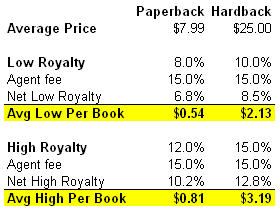
What does an author earn per book?

People are always curious about this, so I thought I’d post it and refer to my previous post about what kind of sales numbers it takes to make a living as a fiction author in the US. Of course, the royalty rates depend on what’s in your contract. Many contracts have sales volume break points. For example, an 8% royalty on the first 50,000 paperbacks sold, 10% on anything above that. But this should give you a good feel.

Earnings per book

Share

Similar Posts

  • Advice to new writers

    Recently a fellow writer brought up this post by author Kameron Hurley. He has a lot of interesting things to say (and some cool covers in his sidebar). A Steve Martin quote features prominently: “Be so good they can’t ignore you.”

    That sounds like excellent advice, doesn’t it?

    Until you start to think about it.

    Are there authors out there who strive to be just okay? That set goals to be mediocre?

    “Marge, keep the kids away! Bring me no lunch. Because today, do or die, I am determined to write a middling tale about lukewarm characters with a so-so plot!”

    !?

    I believe our writer of measley aspirations just might just be a strawman.

    Be good enough they can’t ignore you, Martin says.

    Wow, sounds good. Except let’s test it out. Let’s take some of the least-ignored authors of our day.

    For millions of readers J. K. Rowling is NOT a great writer. And neither is Harper Lee. Or Steven King. Or Orson Card. Or Brandon Sanderson. Or Lee Child. Or Nora Roberts. Or whomever. Insert whom you will–the vast majority of the reading public ignores or eschews them.

    The vast majority of the reading public is not moved by them in the least.

    Stephenie Meyer is a great writer for some. She gave them such a moving experience they dress up and relive it all at balls. She’s a horrible writer for others. Most people haven’t read her or gone to see her movies.

    The Bible is THE most life-changing, most moving book that millions have read. For others it’s a piece of trash.

    It seems that following Martin’s advice is a really good way to lose a lot of time galavanting after shrubberies only to then have your throat ripped out by the Rabbit of Caerbannog.

    Woe is me, for I should have stayed home with my lovely wench and lovely children and eaten more peas and read about sparrows. Zounds, but the blood my mother gavest me, at nine-month cost, now flows silently onto the sterile rocks. . .

    You can create great product, stuff made with extraordinary skill, and still not be Great because you’re earth-shattering stuff speaks to and shatters only a small portion of readers.

    I say forget greatness!

    Just sing. And revel in the singing. And the new songs your voice can carry as your skill grows. And share that reveling with all who enjoy such singing.

    Because it’s not about greatness. It’s about the song.

    And then go home and enjoy the laughter and coversation of the woman/man at your hearth, the children/cats at your feet, and the lovely taste of the fresh green peas.

    (Dear me, I believe I just equated children with cats. And yet, does it not sound just right?)

    John, you ask, what about goals? What about being all you can be? Are you saying it’s okay to schlub your way through life and writing?

    You must choose your own path. But I would never say don’t have goals. Nor would I say don’t try to write the best book possible . . . for the particular type of story you’re trying to tell.

    I think we all benefit by singing our types of songs to the very best of our ability and then trying to enlarge that ability as much as we can.

    That generates more joy in the giver and the receiver.

    But the quest to be Great so some amorphous “they” (who is they?) can’t ignore you seems foolish. It disregards the idea that it’s impossible to write great books for all audiences. But that’s not its only problem. It also seems to be all about the writer, and not the sharing. Me-me-me is, ultimately, such a hollow prize.

    It seems to me that it’s so much better to quest after singing, not to be noticed, but to deliver a service that I and the reciever can both rejoice in together. And then to increase that joy.
    Share
  • |

    John guests on Writing Excuses season 3 episode 18

    writing-excuses-the-guys2-300x139

    Here’s the second episode I recorded with the Writing Excuses guys.

    In the first podcast we talked about putting and not putting ourselves in our writing and making characters who don’t all sound like the author. In this one, we talked about how to not repeat ourselves in ways that make the reader feel like they’re getting the same old same old.

    As usual, the guys had some great insights. Check it out: How to Not Repeat Yourself.

    Share
  • How Inequity and Deservingness Propel Readers Through Story

    Inequity and deservingness are two of the main factors that keep readers reading. If we want to write killer stories, we need to know how they affect readers. A few years ago I wrote an essay on this and thought it probably too technical for most folks’ taste. But I passed it on to a recent attendee of the killer workshop and he found it helpful. In fact, when he watched Pride & Prejudice shortly after reading the essay, he saw how these factors dramatically affected his rooting interest. So I’m thinking others will find it useful as well. 

    In order to understand it you must first read George Saunders’ short story “The Bohemians.” You’ll find it here in The New Yorker, January 19, 2004. It would probably be rated PG for some profanity.

    Now if the story doesn’t pull you in, stop reading. Because the essay probably won’t make any sense to you. You’ll only be able to understand it if the story works for you. But if it does, then ask yourself what the main character’s problem was and what drew your interest? Then read my essay, “How Inequity Evokes Reader Interest.”

    Please note “The Bohemians” does present a character with a problem, and the story cycle applies, but not in the straight-forward manner it does with most stories. BTW, if you’ve ever read Patrick Rothfuss’s excellent Name of the Wind, you’ll see inequity is what shapes the story there as well. If you haven’t read it, I recommend you give it a go.

    I’ll be interested to see your responses to Saunders’ story, my essay, and/or Rothfuss’s novel.

    Share
  • Runts, widows, and orphans

    A typesetting mystery solved–Runts!

    OrphanRuntWindow

    And now for something for your typesetting hearts.

    You know what orphans are–A short line appearing at the bottom of a page. Sometimes the first line of paragraph appearing at the bottom of a page.

    You know what widows are–A short, paragraph-ending line appearing at the top of a page.

    But what’s the last word or part of a word of a paragraph stranded by itself on a line?

    I went to the store, looking for
    Paul.

    I could never find an answer. Some called it an orphan as well.

    But David Blatner revealed the name in the comments of his post What Are Your Favorite Word and Character Space Settings for H&Js?

    He actually coined the term years ago when he couldn’t find a name, and I love what he came up with and am going to use it forever.

    He calls them “runts.”

    Ha!

    Hyphen Control

    BTW, those settings he mentions in that article are awesome. Drastically reduced weird hyphens, which reduced time formatting.

    What do the big boys control for?

    Furthermore, I noticed something in the big time author Stuart Woods volume I happen to be reading. And then I checked it against a James Patterson and a Lee Child.

    1) They don’t care about most runts. As Blatner said, there’s a runt zone, but the zone where they control for runts appears to be less than 5 characters if that includes the end punctuation.

    For example, I just opened a random page of the Woods book and see the following runts:

    a) results.”

    b) entry.”

    I flipped to another page and saw:

    a) said.

    b) trunk.

    c) them.

    And the thing is that I DIDN’T notice them in the least while I was reading. Only when I started looking for them.

    Of course, there were no runts that were smaller than those. Nothing like “tie.” or “do.” or “for.”

    2) They don’t control for orphans either.

    3) They DO control for widows. However, when you’re not controlling for orphans and most runts, controlling for widows is easy. And sometimes the control is just to increase the tracking just a tiny bit to make it span the whole line.

    I spent a number of hours on Saturday formatting my book only to find when I finished that I had set the leading at 18pt instead of 16pt. That meant I had to reformat the whole bleeping thing.

    But I adopted the Big Boy rule, allowing all runts that end at or beyond the first line indent of the paragraph. I ignored orphans. And I controlled for widows. And it took me a fraction of the time and still looks great.

    Here’s to runts and orphans!

    Share
  • Indie Thoughts: 10 Things I Wish I’d Been Told

    From Russell Blake.

    I get a lot of emails from authors who are just starting out, or who are on the road but frustrated at the level of success they’ve seen thus far. I wish I had more time to correspond with everyone, but the truth is I’m usually slammed with writing/publishing related tasks, and don’t have a lot of opportunity to do more than offer a brief sentence or two.

    But the last few missives I received got me thinking about what I wish someone had explained to me before I started self-publishing in June, 2011. So here’s my top 10 list, such as it is:

    1) There are lots of talented writers out there. Lots. And it seems like everyone’s now got a book, or books, on Amazon. Being good isn’t enough to guarantee you anything but satisfaction for a job well done. It should, but it doesn’t. Don’t take it personally.

    2) There are lots of crap writers out there. Lots. And while many sink to the bottom of the swamp with nary a whimper, some sell well, and some even become bestsellers. This is because the world’s unfair and, depending upon the genre, oftentimes readers don’t care much whether they suck or not, as long as the story entertains or reaffirms some conviction or bias the readers have. These authors succeed in spite of their abilities, rather than because of them. Don’t take it personally.

    3) The internet is filled with gurus who know nothing. It’s hard to turn around without bumping into a writing or self-publishing expert. Most of them are completely full of shit, and don’t sell many books – but that doesn’t stop them from trying to get you to part with your money to hear them tell you what you need to do to sell well. Whenever you hear advice, consider the source. If it’s a million selling author, that means more than from someone whose work ranks slightly lower on Amazon than the collected love poems of Adolf Hitler in original German. Seems like everybody but me is selling seminars, courses, or how to books that promise much and deliver nothing. Must be a good business there, but I prefer labeling my fiction as such and putting in a car chase or gunfight rather than trying to trick the dim or desperate out of a few bucks.

    4) You need to be able to put out books at a decent clip. Sure, you might hit huge off one, but probably not. You’ll be building your readership the hard way, which means one reader at a time, and the more quality books you have on your virtual bookshelf the more likely one will catch someone’s eye. This doesn’t appeal to a lot of authors’ wish that they could write a book every year or two and have a nice living. Sorry. I have yet to see that happen. But it’s a seductive siren song, so lots of newbies listen to it like it’s still a viable way to go. In self-publishing, not so much.

    More at “10 Things I Wish I’d Been Told”.

    I know, I know. Stop making blog posts, John, and finish CURSE.

    Share