Which cons should an aspiring author attend?

You want to meet editors and agents. But how? Where?

Writing Excuses recently held a great podcast listing the types of events aspiring authors might want to attend–conventions, conferences, workshops, expos, etc. But knowing the types still doesn’t tell you which events to go to.

If you’re looking to meet editors and agents, here’s a way to figure out precisely which events you should attend.

1. Instead of taking a random scatter-shot approach, get some laser precision. Do this by first identifying the specific editors and agents you’re interested in. Then find out which events they’re going to attend. Forget all the other events–these are the ones you want to go to.

These folks will often post their schedule on their websites. The workshops, conferences, and conventions will also often post guest lists. You can also query the agency or publisher itself and ask which cons so-and-so will attend (just contact the receptionist, you don’t need or want to contact the editor or agent specifically).

Now even if you don’t know exactly who you’re interested in, you can still narrow down your focus. Event X might at least have some agents or editors attending (even if they’re not in your genre) while event Y does not. So go and see if you can’t get tips from those agents or editors

2. Research each of the events. Some provide meetings with editors, some provide pitch sessions, some will require you to track the person down. Select the events that look the most promising to you.

3. If you feel a bit nervous or shy, develop a short script for what you’ll say and how you’ll approach these folks. Or make a list of potential talking points. Run it by some friends and other writers to  make sure you don’t sound robotic, dweebish, pushy, or pleading.

You have to remember that agents and editors are looking for new talent constantly. If they don’t find new talent, their income stream soon dies. They want and expect people to find them. They WANT to talk to YOU. They just want to be approached in a friendly and business like way. 

So you have your script, talking points, and plans and will probably end up deviating from them. However, just having that in your head when you go to the con and approach the person you want to talk to (even if it’s only two sentences) can go a long way to calming your nerves.

4. Attend the con and make adjustments to your plan as necessary.

5. Don’t miss unplanned opportunities. Writing is sometimes a lonely business. When I go to cons I have folks I want to meet and catch up on. But I also make sure I engage other con goers. I smile, I say hello, I ask things like “so are you here as a writer or a fanboy?” or “what did you think about panel?” or “Your Klingon ridge is looking mighty today.” We chat.

I do it because I learn a lot from others and its just plain interesting. And sometimes you make an acquaintance that can develop into a working relationship. For example, I met Larry Correia (new author with Baen) at a local con I just attended. He had a fascinating  story about his breaking in. We chatted for a while. There was no ulterior business/network motive. Just a great conversation. A month or so later a business opportunity arose and I thought of Larry. He’s now going on tour with me and Dave Farland this fall.

Be flexible. I’ve been invited and have invited others to go do lunch or dinner. And those have always been great chats. And sometimes business ops have arisen later because of them. But even if they hadn’t, it just makes the experience so much better. Good conversation is its own reward.

6. If all of this is too scary, bring back up. Get a friend or family member to go with you. 🙂

And if you stumble a bit, maybe stutter, maybe even feel like you’ve made a fool of yourself, do not stress. It’s to be expected the first few times. No big deal. Most poeple are shy and will either give you a break or be so worried themselves they won’t notice. With a few tries you’ll learn. If yo do make a fool of yourself, the good thing is that editors and agents meet so many people that your face will soon be forgotten, and you’ll be able to reboot and approach them next year with a clean slate (just remember to not wear the same belly dancing costume).

Of course, this doesn’t tell you what to do and not to do when approaching these folks. But as far as deciding where to go, this is one method that works.

—

Added 7/31/09

SFWA has some great articles on conventions and networking by Diana Rowland.

How to Network at a Convention

Networking 201: How to Work a Room

Share

Similar Posts

  • Who Will Play in The eBook Supply Chain?

    I was reading this Konrath post by Barry Eisler on the “Attack of the self-publishing memes” in which he argues that there isn’t an inherent conflict of interest for agents to also help authors epub their books. This got me thinking about the steps (tasks) in the current supply chain, who was going to provide them, and where the biggest value lay.

    Here’s the process right now as I understand it from manuscript to reader. The numbers are only task identifiers and don’t represent sequential order in every case, although I did try to sort them that way.

    PAPER CHANNEL TASKS THROUGH BRICK & MORTAR OUTLETS

    SELL MANUSCRIPT TO PUBLISHER
    1. Promote manuscript to editor at publisher
    2. Negotiate contract with publisher

    EDIT MANUSCRIPT
    3. Story edit manuscript
    4. Revise for story edits
    5. Copy edit manuscript
    6. Revise for copy edits

    PREPARE BOOK
    7. Create cover design and art (a marketing/advertising function)
    8. Obtain ISBN
    9. Typeset book
    10. Print book

    MARKET BOOK TO WHOLESALERS, RETAILERS, AND LIBRARIES
    11. Establish book selling hierarchy (lead book, second lead, etc.)
    12. Obtain reviews from trade publications, newspapers, websites, authors, etc.
    13. Create sales catalog and other sales documents
    14. Contact book buyers and promote books (calls, visits, conferences, etc.)
    15. Take orders

    DISTRIBUTE BOOK
    16. Ship to retail outlets and wholesalers
    17. Warehouse book
    18. Process reader purchases & returns

    PROMOTE BOOK TO TARGET AUDIENCE
    19. Publicity, including free copies
    20. Advertising
    21. Co-op display purchases

    SELF-PUB EBOOK AND POD PAPER CHANNEL TASKS

    EDIT MANUSCRIPT
    1. Story edit manuscript
    2. Revise for story edits
    3. Copy edit manuscript
    4. Revise for copy edits

    PREPARE BOOK
    5. Create cover design and art (which you could lump under marketing)
    6. Obtain ISBN
    7. Format book for ereaders and POD services (CreateSpace etc.)

    DISTRIBUTE BOOK
    8. Upload book to retail and library outlets
    9. Warehouse the bytes
    10. Process reader purchases & returns

    MARKET BOOK TO LIBRARIES AND TARGET AUDIENCE
    11. Obtaining reviews from trade publications, newspapers, websites, authors, etc.
    12. Publicity, including free copies
    13. Advertising, including website display etc.

    AUDIO BOOK CHANNEL TASKS
    There are actually two channels here–physical audio books (CDs) and downloads (Audible, etc.).

    I would assume the physical audio would follow the marketing, distributing, and promoting aspects of the paper channel tasks and add in the audio production tasks. Downloadable audio would follow the marketing of the ebooks and add in the audio production tasks.

    THOUGHTS
    I’m sure I’m missing some key steps somewhere. Somebody please supply them if you see gaps.

    As for the future, here’s what I see. The paper channel tasks aren’t going to change much. Nor do I think the people performing the various tasks will either. For example, I just don’t think POD machines are going to catch on in stores and wipe out distributors. They may take out printers (#10) of trade and mass market paperbacks. But I haven’t seen a POD machine that can do hardbacks. Maybe the PODs will move to the retail outlets. But I don’t think so. Somebody disabuse me of the notion.

    However, I do think there will be some interesting developments in the ebook/POD channel.

    Right now a lot of authors are spending time performing tasks 6, 7, and 8. Some literary agencies are wanting to charge 15% forever for those steps with maybe a little cover design. But tasks 6-8 are the tasks that require the least amount of skill and will soon be automated.

    Formatting for ebooks now is like coding html was for webpages 10 years ago–people in the code spending hours tweaking crap. Right now it takes you about a day to learn how to format a novel for the various ebook readers. Once you know how to do it, you’ll spend a day, maybe two, formatting your novel and uploading it. Or you can pay someone else to do it–any responsible teenager will do.

    But within the next year I predict an application coming (if it’s not already here) that will hook into Word and other programs that will make the labor obsolete. Creating a Kindle document will be like creating a PDF document in Word today—you just click Save.

    Uploading could be automated as well across various sites with some application. But it’s fairly easy now.

    So for which tasks are these ebook distributors wanting to charge 15% forever? Obtaining an ISBN?

    I don’t even think they even do that.

    Amazon and the other ebook retailers have a lock on 9 & 10. It would be incredibly hard to dislodge those gorillas. So I think the place where literary agencies and others who want to play in the indie ebook/POD supply chain are going to flourish is in the other tasks that require the most skills–editing, cover art, and marketing, which I’ve marked in blue.

    Authors interested in the indie ebook/POD channel are going to want service providers who can deliver great editing, cover art, and marketing. They’re going to want folks who can help them sell into traditional domestic and foreign paper distribution channels. They’re going to want folks who can help them sell rights to other buyers–audio, film, etc.  And they’re going to want help with their contracts.

    If I were an agency, graphic artist, editor, intellectual rights lawyer, or some other entrepreneur trying to serve indie ebook/POD authors, that’s where I’d spend my time.

    Dystel & Goodrich literary agency recently announced they would do something like this . . . almost.

    Over the past months and years we’ve come to the realization that e-publishing is yet another area in which we can be of service to our clients as literary agents. From authors who want to have their work available once the physical edition has gone out of print and the rights have reverted, to those whose books we believe in and feel passionately about but couldn’t sell—oftentimes, after approaching 20 or more houses—we realized that part of our job as agents in this new publishing milieu is to facilitate these works being made available as e-books and through POD and other editions.

    Right now, you’re thinking, oh, DGLM is going to be another of those agencies that has decided to become an e-publisher and charge clients whose books they can’t sell 50% of their income for the privilege of uploading their work. Some of you may be mumbling, “Uh…that’s a conflict of interest.” We get it and we understand how that can be the perception. However, we have no intention of becoming e-publishers. As we said above, we have too much respect for the work that publishers do and too much respect for the work we ourselves do to muddy the waters in such a way.

    Again, what we are going to do is to facilitate e-publishing for those of our clients who decide that they want to go this route, after consultation and strategizing about whether they should try traditional publishing first or perhaps simply set aside the current book and move on to the next. We will charge a 15% commission for our services in helping them project manage everything from choosing a cover artist to working with a copyeditor to uploading their work. We will continue to negotiate all agreements that may ensue as a result of e-publishing, try to place subsidiary rights where applicable, collect monies and review statements to make sure the author is being paid. In short, we will continue to be agents and do the myriad things that agents do.

    Our intention is to keep on trying to find books we think we can sell to traditional publishing houses, to negotiate the best deal (always), and to give our authors as many options as we can. Because we will continue to be commission-based, we will not be automatically pushing authors into e-publishing. Again, we want to give our authors options and empower them to do what they set out to do all along: have their work read by the largest possible audience

    However, from what I understand they’re not offering to perform the necessary tasks for 15% forever, only the project management of the tasks. Which means the author will still be paying for the editing and cover art and marketing.

    15% forever for project management (a list of to-do’s in this case) and a service provider contact list? Where the author still pays for the editing, cover design and art, and marketing?

    Ummmmm, no.

    Others like D&G will pop up. But the ones that indie authors will eventually go to will be those that deliver on the high-skill tasks for reasonable rates.  Those will be the ones playing in the ebook supply chain of the future.

    Many authors will contract the tasks separately themselves.  But a lot of authors won’t want to do that. They’ll want a one-stop-shop. Or one that does most of it. Some of those one-stop-shops will charge an upfront fee and will probably accept anyone who can pay. Others will make most of their money on a % of the sales to readers and libraries, footing the initial costs of the tasks, and will only work with clients they think will pay out, which if you think about it isn’t really an idie (self-pub) model at all. That’s the space traditional publishers play in right now.

    But in the ebook/POD world distribution is no longer a key barrier to entry for new competitors. And so I expect to see a whole bunch of new publishers coming to play in that space. Those that select, edit, and market well will flourish.

    Meanwhile, I don’t think most of us authors care which road we take and who we play with. Well, as long as they play nice and don’t poop in the sandbox. We just want to get our stories in to the hands of massive numbers of delighted readers.

    Share
  • |

    Do you want to meet authors and learn how to develop and write stories?

    Then you want to be in Provo, Utah this Thursday, Friday, and Saturday, February 11-13th, and attend Life, The Universe & Everything, the annual science fiction and fantasy writing conference. (I think students get in free.)

    If you live within a reasonable driving distance (I’m 2.5 hours away and consider that reasonable), then you should do everything you can to get down there. It’s going to be a blast. It and LDStorymakers are THE best conferences for writing that I know of in Utah, Nevada, Idaho, Wyoming, Colorado, and Arizona. And if you’re into SFF, then it’s the one. I mean, just check out the list of guests.

    I’ll be on the Role of Magic in Your Story and Distributing Your Novel panels. Look at the schedule and check out the guests who will be on those panels with me. Yeah. Awesome.

    And then I’ll be presenting Vivid and Clear by myself and Succeeding as a Writer with L.L. Muir, which is going to reveal some things that will surprise a lot of people.

    BTW, L.L. Muir is the best kept secret success story in Utah at the moment. She’s selling thousands of books, pleasing thousands of readers, and making, well, you’ll have to come to that presentation find out how much money she’s making. And what the secrets to her success are.

    Share
  • Edward Bear Shares His Proofreading Secrets

    One of the things I enjoy about being an author are the emails I receive from readers. A few months ago I received one from Mr. Edward Bear. He’d purchased Servant and, as he was reading, found an unclosed dialogue quote.

    Mr. Bear could have simply noted it and read on. But he did not. Mr. Bear is a proofreader. And so he practiced a bit of wizardry, found that I had a handful of quote goofs, and emailed them to me.

    Many of them ended up being weird smart quote issues Word introduced into the text when I broke a line of dialogue with an action like this: “You will not”–he scratched his nose angrily–“share another pair of my panty hose with that woman!”

    You’d think that would be enough for a doughty reader. But Mr. Bear didn’t just notify me of the errors. Oh, no. He also included the page from his proofreader’s grimoire that allowed him to find those quote issues in a matter of minutes in the first place.

    As soon as I had the time, I tested the spell on Bad Penny, and, voila, in a matter of a few minutes found a couple of issues in that text. I was delighted.

    But Mr. Bear wasn’t satisfied with mere delight. He then sent me another page from that grimoire to help with spelling. We luvs wizardly readers, Precious.

    Copy editing and proofreading require patience, painstaking reading, and a knowledge of what to look for. You have to know not only the mechanics of the written word (capitalization, spelling grammar, syntax, punctuation, abbreviations, usage, etc.) but also, if you’re reading for a printed edition, interior formatting (widows, orphans, word or hyphen stacks, headers, and so forth). There’s a lot to it. And anything that speeds up the process and minimizes errors is welcome.

    If you’re contracting your proofreading out, a cleaner copy can also translate into lower rates. Knowing that many of you who visit this website are writers, and because your host’s generosity knows no bounds, I asked Mr. Bear if he might be willing to share his wizardry with you. The wizard responded with a yes.

    Augmented Proofreading 1

    By Edward Bear I’m Ed Bear. I work, both professionally and otherwise, as a proofreader. I’ve gone over books for my publisher and I’ve done scan/OCR/check against paper books for republication, both electronic and back-to-treeware. When I mentioned some of the “ancillary tools” I have for aiding the work, John offered me this guest post slot in his blog. Feel free to pass this stuff around. I’ve found these techniques invaluable in getting the job done faster, and with better quality.

    First, though, I need to tell you about the tools themselves. The biggest component is the software for electronic text editing. However, I’m NOT talking Word or anything like that. I’m talking about an editing program which can a: work with plain text and b: handle Regular Expressions. (What are those, some of you ask? I’ll get to that.)

    Since I’m a windows user, I have two such programs available. My favorite is a program called TextPad (www.textpad.com).  I’ve used it for years and it’s become invaluable to my work. They currently charge $28 for a single user license, but IMO, the program’s so useful that, even though upgrades are free, I buy another license every time they bring out a new major release. The other program is free. It’s called NotePad++ (http://notepad-plus-plus.org/) I’ve tested it and it can handle the methods I use, but I haven’t used it much, since TextPad and I are long-time buddies. If anybody out there knows a program for the Macintosh which will do these jobs, please mention it in the comments.

    Regular Expressions

    You don’t have to be a wizard to use them. The tutorial over at http://www.regular-expressions.info/tutorial.html describes them elegantly:  “Basically, a regular expression is a pattern describing a certain amount of text.”  They are also called a regexp or regex, and I’ll be including the regexes I use in this post.

    I have a small library of regexes, and two of them are critical to aiding the proofreading process. One of them allows checking dialogue quotemarks, to insure that speech is properly closed off, and the other makes it possible to generate a word list of each unique word in the  book. I’ll be walking through the usage, including screenshots.

    Quote Checking

    One of the challenges of checking dialogue passages is that, with one exception, every opening quote (“) needs to have its matching closing quote (”). The exception, of course, is when the same character is speaking in the next paragraph. This can lead to a heavy false positive load if the characters are loquacious.

    The first time I tried this stunt, I found  73 paragraphs with unbalanced quotes. Only 6 of them were errors. But being able to find them quickly so they could be fixed in minutes instead of hours? That paid for the effort.

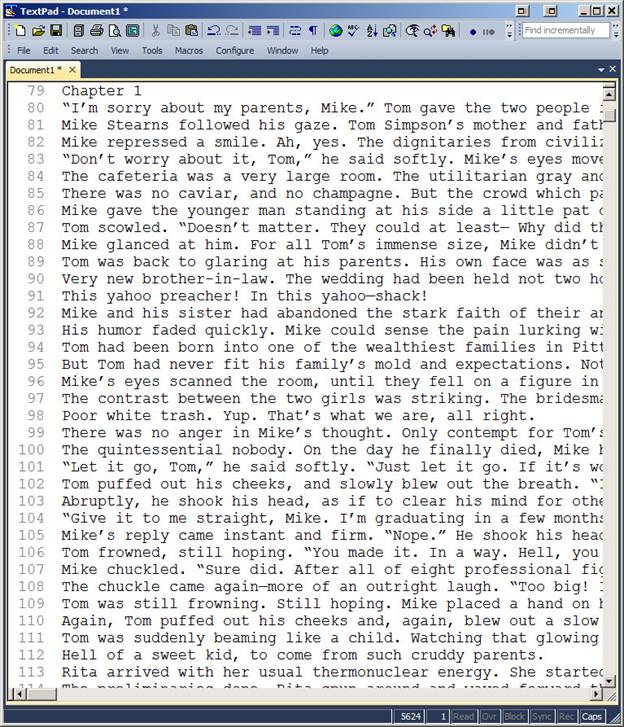
    The process itself is simple: You take the document and convert it to plain text. If it’s an RTF or Word document, you simply select ALL, hit copy, and paste it into Textpad.  The result will look something like this:

    image001

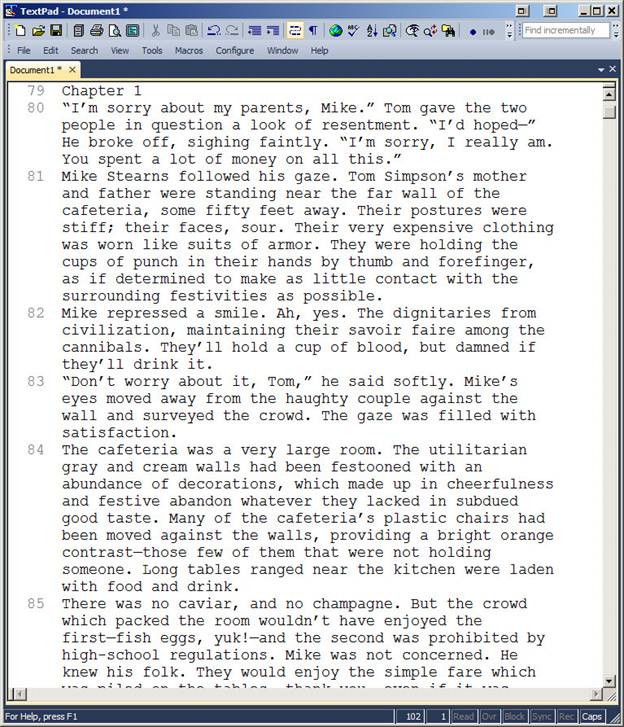
    What I normally do is turn on word wrap, so I can see the whole paragraphs as I go. So it looks like this:

    image002

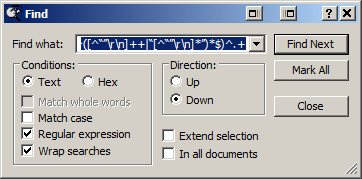
    Now, we go hunting. The next step is to set up the search pattern using a regex. The one I use for this is the following: (?!^([^“”\r\n]++|“[^“”\r\n]*”)*$)^.+ Complicated little brute, isn’t it. I didn’t write it, but I knew who to ask if he could write one, and the above is the result. FYI, there’s also one for straight quotes: (?!^([^”\r\n]++|”[^”\r\n]*”)*$)^.+ You use it the same way. So go into find, and put the regex into the “Find what:” box:

    image003

    Notice that the “Regular expression” box is checked. I also “Wrap searches” just in case I miss something and want to loop around. Click “Find Next” and:

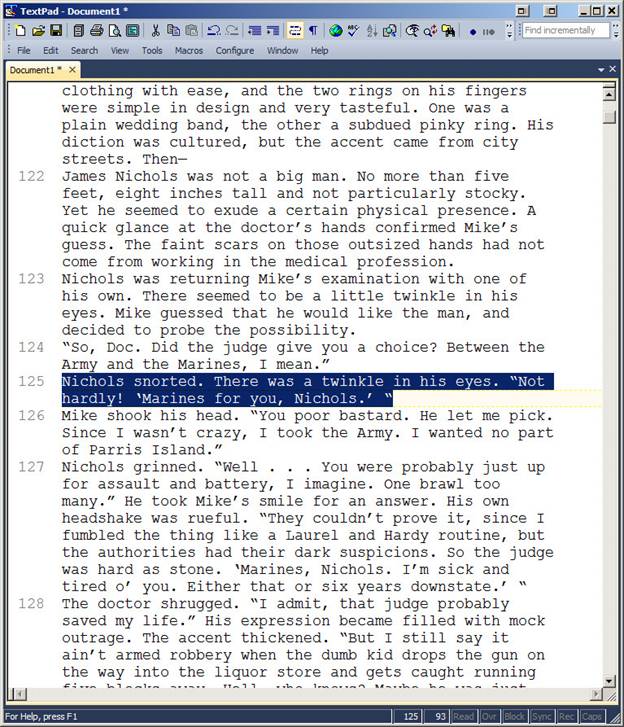
    image004

    The paragraph highlighted has two opening quotes, one at the beginning and one at the end. Word assumes that a quote preceded by a space is an opening quote, so you need to correct it in your RTF/DOC. Wash, rinse, repeat. You keep doing “find next” all the way through, checking for situations like the following:

    image005

    As I said, same speaker, next paragraph, so this one is good. This post is getting a little long for a blog entry, what with illustrations, so I’ll break off here. Stay tuned for part two: checking spelling and spelling consistency. In the meantime, here are the RegEx tool commands plus a few bonus goodies: RegExToolCommands.

    Share
  • How author Rachel Aaron wrote a novel in 12 days

    Well, not quite. It was 15.

    First read her essay “How I Went From Writing 2,000 Words a Day to 10,000 Words a Day”.  Now read about her 12 day triumph in “12 Days of Glory”.

    Amen on the pre-writing! I’d be lost without it. LOST. Sketching out scenes beforehand makes them SO MUCH EASIER to write. I can focus on the delivery, characters, dialogue, etc. instead of the events. It frees my creativity to focus on other things. Sketching out a novel beforehand does the same for the whole book. I have a simple sketch of the scene I’m going to write today. There’s no dithering about what to write. I KNOW what I need to write. So I do another more detailed sketch, the pre-writing for the scene before I jump into the day’s work. When I get the scene in my mind, the draft comes so much more quickly.

    Amen on time! I’ve found my mind is like a furnace: it takes time to get hot, and if I only dedicatetake small chunks of time, I’m forever warming it up. When I get 3-4 hours a day, I far more productive on a per hour basis than when I only get one.

    Amen on enthusiasm! There’s nothing worse than trying to write something that bores me. I can’t do it. And her little method for reviewing scenes is very similar to what I do.

    Great posts, Rachel! Now I just need to get back into my dedicated time groove.

    Share

3 Comments

  1. So . . .

    I’m attending World Fantasy in October. Using Publisher’s Marketplace and the list of people attending World Fantasy, it appears that there are several editors I may want to target. Tor is my publisher of choice, and there’s this fellow named David Hartwell attending.

    I understand you know the fellow, John.

    Can you offer me any tips or insights? I picked up a book he edited, The Dragons of Babel, and I plan to pick up your book, so I’ll have a starting point for conversation with him. Those should also give me a decent idea for what types of things he likes/looks for.

    But in the mean time can you offer any inside insight? Hopefully I can use all of this information to determine if he’s a good editor to approach.

  2. I love David. One thing you need to know is that he’s seen A LOT. He’s edited so many folks, done so much. So he’s a treasure trove of knowledge about the industry. I’ve found him very open to sharing his insights. I’m sure he’d be willing to help if he has the time. If you have a finished book, you can run it by him, but you can also ask him, since he knows everyone, who might be a good editor to approach with the project. BTW, David himself has said that what a first author is selling is himself. So just follow the advice here and linked to from here and you’ll do fine. He’s a very nice man.

    Don’t think of this as do or die, once-in-a-lifetime opportunity to break in. That will only stress you out. Instead, think of your chats with each editor and agent as the beginning of trade relationship. You WILL see them again. Some may develop, some may not. But think of yourself as a friendly businessman, chatting business with others. So get tips, see if they’re looking for new stuff. Be ready with your short pitch.

    BTW, you should be targeting agents as well. Don’t just focus on editors. Make sure you go with a list of agents you want to talk to.

Comments are closed.