Here’s Patrick Nielsen Hayden, an editor at Tor Books, in an interview on io9.com about the future effects of e-text on publishing:
io9: Does it make a difference to you if an author has an online reputation? Does that go into your decisions to acquire books?
PNH: Obviously it makes a difference if an author has a public online profile of some sort, even just down to the level of having a moderately popular blog. Most books sell 5, 10, or 15 thousand copies. Most are midlist books. With those people, even a modest online presence can make a difference in sales.
The whole interview is interesting. In fact, he says something that I think is important to note about what today’s novelists and, to a lesser degree, short story writers are actually providing:
One thing I’m sure of is that we’re [Tor Books] going to be in linear immersive narratives that produce the reading trance. We won’t be moving towards a “choose your own adventure” thing. People will do those things, but those are different art forms. There’s something about immersive text that you can read in order – it’s persisted through many technological changes. This fiction stuff works pretty well. It’s been around a long time
I think he’s right. The EXPERIENCE you get in the reader’s trance, similar to the one you get in a movie, is a strong experience. The media used to convey that experience doesn’t really matter as long as it makes it easy to get into the trance.
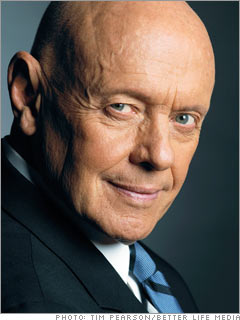
First of all, if I could look like Stephen R. Covey does in that picture, I would shave my head and never look back. Holy moly, I love that picture. But that’s not why I’m writing.
James Maxey is a writer who I respect and whose comments on the boards of Codex Writers often make me think or laugh. He recently started a thread about writing mission statements.
Ack!
I groaned when I first read the title of his topic. I know first-hand how useful goals are. I know how vital it is to identify what’s vital in any endeavor. Heck, I’m a Covey-lover through and through.
But every mission statement I’ve seen has either been useless corporate toilet paper (because they’re printed on stuff that’s too stiff and rigid to be of any help in the bathroom) or it’s a personal artifact that has a six week half life, after which it turns into something like that singing fish you bought and can’t for the life of you figure out why or where to put it now that you realize you could have eaten a steak for just as much money and the pleasure would have lasted longer.
And yet consciously thinking about how you want to live is so powerful. I think the corporate world ruined the term for me. I cannot bring myself to write a “mission statement.” I know what I want to do in my various roles in life. I know how I want to live. But I cannot use that label. Alas.
So here’s my “what I want to do” as far as writing is concerned. It’s not crisp and clean. And if I had to write it again, it would come out differently. But it has the gist.
—-
I want to make people fall in love like I did when I first watched the Sound of Music–that sweet, pure yearning. And when they’re out of love, I want them to see a way back.
Every once in a while I want the ground to shift under the feet of my readers like it shifted under mine when I first watched Les Miserables with Anthony Perkin.
I want them to laugh.
I want to give them the wonder and adventure that was given me when I read the Hobbit.
I want them, at least once, to shout in triumph.
I want to share my delight in people who are fascinating, flawed, salt-of-the-earth, odd, funny, strong or a hundred other wonderful things, but who show some courage, a little or a lot.
I want readers to weep at the hope of redemption. I want them to despair at loss.
I want the sun to shine. I want the world to crack.
And when my readers are done, when the book’s closed and they sit back, I want the story and people to linger, I want my readers to want to go back. I want them to feel it was, not only a surge of living, but a good thing to have once been lost in the pages of my book.
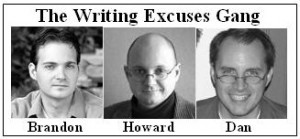
The Writing Excuses guys have posted another good podcast: this one on world-building a history.
I wanted to add a few comments. You’ll notice that a lot of the blurbs for my novel mention my world-building, so I guess it’s a strength in my writing. However, I don’t write huge world building documents in the pre-draft stage. I do write some history, of course. But I don’t think it would take up more than a few pages. A lot of world-building happens in draft.
It seems to me there are two levels of “history” and a lot of it can be done on-the-fly.
1. There are small hints of CHANGE in places and people.
Dave Wolverton taught me this one. You come upon an orchard in the woods that’s gone wild and is overgrown. It takes two lines to describe it and it gives a strong feel of past. The reader wonders who was there, what happened. Maybe you tell them. Maybe you don’t. You mention that the village Knight used to be fat but is wasting or vice versa. I find I can do these types of things usually on-the-fly as I’m writing. And I don’t need to know much about them. I just ask myself if anything has changed with the location or characters in the current scene.
A few touches of CHANGE throughout the novel give a strong sense of history.
2. There are events, groups, and individuals who impact or impacted your characters and their community in large ways.
There was a war with a neighboring country not five years ago. Your characters have to travel through that land, or maybe half the male population went to war and never came back. Or perhaps your character lost his sister in a drowning he could have prevented. Or he lost her to slavers. Or perhaps there is a secret police (like the Roman couriers) who arrived two years ago.
Again, many of these things can be thought up on the fly as you look for conflict and the stories of a place and community. However, I’ve found that it helps to ask a few key questions in the pre-draft stage to lay some (NEVER ALL) the groundwork.
— What kind of conflicts do these nations and groups have?
— What events have had a large impact on my character and his community? They can be terrible or wonderful events.
— Who in the community are my characters friends and enemies? What’s the history?
— What are the local and regional stories of events (or people) that were eccentric, odd, mysterious, dangerous, or revolutionary?
I never get all my answers up front. But I will get some. And then as I write I just keep in mind that it’s neat to indicate change every once in a while and to briefly bring up stories from the past that relate to the current matter at hand in the present story.
Finally, I really like the idea the Writing Excuses guys brought up of sharing multiple explanations for an event (multiple histories) when it fits and to include more than one cause, although I’m pretty sure the 80/20 rule applies to causation.
And still accommodate my writing schedule and commitments
The course that’s open for applications is called Create Story Ideas That Beg to Be Written. It’s purpose is to transform you into a story idea machine.
And you can be there in six weeks. Before the end of the year.
I will be working with only a small set of people. I can’t accommodate more and give you the one-on-one feedback you need. And so you need to apply to get in.
The deadline for applications is midnight, October 27th. So contact me now to get the application instructions.
A cracking good story idea requires five critical elements. Until you have all five, you’ll struggle to plot. You’ll write a few scenes and run out of gas. You’ll feel like the story just isn’t going anywhere. And that’s because it isn’t. It can’t. A story isn’t a story without all five elements.
However, once you develop these five things, your story will suddenly roar to life. There are a few other elements that are important as well, but these five things form the core of the story setup.
In this course you’re not going to merely learn about all of those story elements. You’re going to go deep and learn what can only be learned by actually doing the work and developing story idea after story idea with personal one-on-one feedback from someone who knows what they’re doing.
When you finish, you won’t just know story theory. You will be a story idea machine. And you will be that because you have put in the work. The right work.
Again, this is not a course full of lectures and videos. This is a course where you’re going to work. And develop the insights and skills that only come from doing the work.
You’re actually going to:
Come up with story setup after story setup after story setup
And improve them with one-on-one feedback.
It’s going to:
Eliminate years of you wandering about in the story wilderness trying to figure things out on your own.
Put you miles ahead of other writers who have no idea what’s really at the core of story.
You are going to learn how to develop killer story ideas on purpose instead of on accident. Which means you’ll be able to do again and again. Reliably. Like clockwork.
Course details
Here are the details.
6-week course
Starts: November 2
Ends: December 19
One week off right in the middle for the US Thanksgiving holiday
The focus of the class is not on learning about story, although you will do that. The majority of your time will be spent on developing stories.
You can’t become a carpenter by watching videos and reading books about it. You have to get out on the work site, cut wood, and pound nails. You have to make the mistakes all beginning carpenters make, get feedback, and improve. The same goes for writing. And you’re going to work in this class. You develop 21 story setups. In fact, you develop more because the 21 are just the ones you turn into me. And with each one your skills, insights, and abilities grow.
In the beginning, your setups will be bare bones. By the end, they’ll be fully developed setups that beg to be written. Setups you can use to immediately write the first draft of your novel, whether that’s in outline or chapter form.
Here’s what you do each week.
Week 1. November 2-7
Uncover the secrets of what’s really at the heart of story and how to generate ideas.
Define your genre requirements
Create story setups 1-3
Week 2. November 9-14
Uncover the secrets to compelling characters
Create character sketches
Create story setups 4-7
Week 3. November 16-21
Uncover the secrets to formidable obstacles
Create story setups 8-11
Week 4. November 30-December 5
Uncover the secrets to interesting casts
Create story setups 12-15
Week 5. December 7-12
Uncover the secrets to managing multiple storylines and series
Create story setups 16-19
Week 6. December 14-19
Create story setups 20-21. These are your capstone projects where you apply everything you’ve learned and take it to the next level
As you can see, in this class you develop story idea after story idea after story idea. I didn’t detail it above, but each week you will also be lifting the hood on your favorite stories and actually seeing how they work. Story after story after story. In this class, you are marinated in the work of developing characters, THOMs, goals, obstacles, settings, casts, and more. And because of that, each week will not only bring an explosion of insights, but new skills and abilities.
Every week you get two private, one-on-one, live sessions with me where you get encouragement and feedback on what you’ve developed. And then we’ll work as a group, applying the principles and brainstorming even MORE ideas for each other’s stories.
At first you might feel a bit shy and worried about your ideas and abilities. But you’ll soon get over that. By the end of the course you’ll be one of those people that can generate terrific ideas easily. And you’ll be able to do that because you will have put in the work to become a different writer.
Apply now!
The normal cost of the course is $899. But because this is the first time I’ll be running through it, and we’re likely to run into a few kinks that need to be worked out, I’ve dropped the price to $599. I personally guarantee my course. You’ll be totally oh-my-gosh-I’m-so-happy-I-took-that-class satisfied, or I’ll give you your money back. No questions asked.
Now’s your chance to stop spinning your wheels. I can’t tell you how much I wish I’d had something like this when I’d started:
The secrets about the true core of story.
The secrets about how to come up with ideas.
Actual work with personal one-on-one feedback.
Laser focused on what actually matters, not a bunch of ridiculous writing rules.
When you finish, you will be a story idea machine.
You won’t know plotting. That’s a different course and set of skills. You won’t know how to write chapters. But you’ll know how to create the engine that powers all the rest of that. You’ll know how to create the core that makes awesome plots and chapters possible.
If you want to take this course, click the button below and contact me. I will tell you exactly how to apply.
I’m not going to be able to accept everyone who wants to take the class. I have a very strict limit on the number of students I can work with. So you need to get your application in before the deadline of midnight, October 27th.
I saw this today and thought of the assignments I give in my workshops. Look at what this hugely popular writer did to learn and focus her craft:
Knew what she liked and followed HER passions (she knew what rocked her).
Took 4 books she loved and broke them down to look for patterns she could use. This is exactly what Bernard Cornwell did (link at bottom).
Identified what it was she wanted to deliver to her readers. I believe her four words were “Provocative,” “Relevant,” “Creative,” and “Honest” (form follows function).
Notice also how much she loves plot turns (story cycle–surprise and conflict).
What a delightful interview. I’m going to pick up a Macomber and give her a go. Anyone have a recommendation on a title?
17 Thou shalt not covet thy neighbour’s house, thou shalt not covet thy neighbour’s wife, nor his manservant, nor his maidservant, nor his ox, nor his ass [we’re talking animals, folks], nor any thing that is thy neighbour’s.
18 And all the people saw the thunderings, and the lightnings, and the noise of the trumpet, and the mountain smoking: and when the people saw it, they removed, and stood afar off.
19 And they said unto Moses, Speak thou with us, and we will hear: but let not God aspeak with us, lest we die.
20 And Moses said unto the people, Fear not: for God is come to prove you, and that his fear may be before your faces, that ye sin not.
21 And the people stood afar off, and Moses drew near unto the thick darkness where God was.
Dude, the “thick darkness where God was.” The thick darkness . . .
I love the images in that passage. Moses going to talk to God face to face. Talk about spectacle. As for the commandment, well, let me just say that I might be smite-worthy.
I do not covet many things. Certainly not any dude’s butt, but sometimes it’s so hard not to covet my neighbour’s writing success. And it’s not the big boys that kill me.
I read a Lee Child or Orson Card or whoever, and I can legitimately say, “Hey, those guys have been writing for years and have produced a lot of novels; it’s unrealistic to compare my skills to their current masterly levels.” I can legitimately say, “Hey, best-sellerdom takes craft and luck, and I just need to be ready the next time the opportunity train stops at my station.” I can even say of those who start off as best-sellers, “Dude, maybe they DID start out with more skillz than me. Doesn’t mean I can’t learn. Give me some more books, you’ll see the Brown dog rise.”
These are all true statements. I’ve got the big guys down. I can spot the Brain Nazi trying to hit me with them a mile away.
It’s the other folks that get me. The guys at my level.
I just had an email exchange with one of them. (No, I’m not going to tell you who it is. Author X might read this, get a fat head, and then be ridiculed and derided by small children. I’m not that heartless.) X comes up with great ideas. Has a ton of them. X is one of those other pro writers I meet who are always lamenting about how many ideas they have. Truckloads. Boatloads. They could employ all of the peasants in a small country like Mozambique just writing the fab things that flow from their brains.
I don’t have boatloads of ideas. I don’t have a truckful. I’ve got maybe two or three riding around on a Yike Bike.
Covet, covet, covet.
Author X is also funny. X can take a pedestrian idea, twist it, maybe with a great character or situation, and suddenly I’m dying to know more. X watches a TV show I’ve been watching for years. Bim! Bam! Comes up with another great idea I want to steal. (I think I average about two ideas a week I want to steal from other authors.)
Covet, covet, covet.
Author X has great sales. Better than mine, at least.
Gol-leeeee, Mother of Hacks, please, put me out of my misery.
Or not.
I’ve got this freaking Brain Nazi’s number as well. The truth of the matter is that while Author X may have some minimal amount of writer-fu, X has also sold his/her soul to the lizard people of the hollow earth. I think they’re going to breed X. So I could have writer-fu too, but I don’t want to become anyone’s genetic experiment. I have standards.