Writing update: Envy

Bible’s full of great stuff. Look at this.

(Old Testament | Exodus 20:17 – 19)

17 Thou shalt not covet thy neighbour’s house, thou shalt not covet thy neighbour’s wife, nor his manservant, nor his maidservant, nor his ox, nor his ass [we’re talking animals, folks], nor any thing that is thy neighbour’s.
18 And all the people saw the thunderings, and the lightnings, and the noise of the trumpet, and the mountain smoking: and when the people saw it, they removed, and stood afar off.
19 And they said unto Moses, Speak thou with us, and we will hear: but let not God aspeak with us, lest we die.
20 And Moses said unto the people, Fear not: for God is come to prove you, and that his fear may be before your faces, that ye sin not.
21 And the people stood afar off, and Moses drew near unto the thick darkness where God was.

Dude, the “thick darkness where God was.” The thick darkness . . .

I love the images in that passage. Moses going to talk to God face to face. Talk about spectacle. As for the commandment, well, let me just say that I might be smite-worthy.

I do not covet many things. Certainly not any dude’s butt, but sometimes it’s so hard not to covet my neighbour’s writing success. And it’s not the big boys that kill me.

I read a Lee Child or Orson Card or whoever, and I can legitimately say, “Hey, those guys have been writing for years and have produced a lot of novels; it’s unrealistic to compare my skills to their current masterly levels.” I can legitimately say, “Hey, best-sellerdom takes craft and luck, and I just need to be ready the next time the opportunity train stops at my station.” I can even say of those who start off as best-sellers, “Dude, maybe they DID start out with more skillz than me. Doesn’t mean I can’t learn. Give me some more books, you’ll see the Brown dog rise.”

These are all true statements. I’ve got the big guys down. I can spot the Brain Nazi trying to hit me with them a mile away.

It’s the other folks that get me. The guys at my level.

I just had an email exchange with one of them. (No, I’m not going to tell you who it is. Author X might read this, get a fat head, and then be ridiculed and derided by small children. I’m not that heartless.) X comes up with great ideas. Has a ton of them. X is one of those other pro writers I meet who are always lamenting about how many ideas they have. Truckloads. Boatloads. They could employ all of  the peasants in a small country like Mozambique just writing the fab things that flow from their brains.

I don’t have boatloads of ideas. I don’t have a truckful. I’ve got maybe two or three riding around on a Yike Bike.

Covet, covet, covet.

Author X is also funny. X can take a pedestrian idea, twist it, maybe with a great character or situation, and suddenly I’m dying to know more. X watches a TV show I’ve been watching for years. Bim! Bam! Comes up with another great idea I want to steal. (I think I average about two ideas a week I want to steal from other authors.)

Covet, covet, covet.

Author X has great sales. Better than mine, at least.

Gol-leeeee, Mother of Hacks, please, put me out of my misery.

Or not.

I’ve got this freaking Brain Nazi’s number as well. The truth of the matter is that while Author X may have some minimal amount of writer-fu, X has also sold his/her soul to the lizard people of the hollow earth. I think they’re going to breed X. So I could have writer-fu too, but I don’t want to become anyone’s genetic experiment. I have standards.

And with that, I’ll sign out. Happiness!

Share

Similar Posts

  • |

    Your local zombie author appears on Writing Excuses, Plus the Writing Debrief explained

    After a cancerous death, I appeared on Writing Excuses this week to groan and hold forth with the guys on writing second novels and second books in a series.

    During the podcast I talked about my practice of debriefing after every writing project. A reader just asked what that was, and so I thought I’d explain it here.

    The debrief is a simple thing. I learned it back when I worked as a business consultant. It always provides great insights. Sometimes  it provides massive insights. The principle is to pull back and look at the big picture every once in a while. So here’s what I do. When I finish a project, I sit down and simply list out what I struggled with, what went well, and anything I learned. I list out things I’d do again that worked particularly well and things I’d do differently. This might be about craft or process. Sometimes I might take some time to reflect on the nature of story and read a favorite book about the craft or perform a story analysis on another movie or book. Then I write up my insights in a form that I can read later and know what the heck I’m talking about. This can take a few hours or a few days. This last debrief after draft 3 of CURSE coincided with my preparation for a day-long workshop I had agreed to give on story, and so the insights came thick and fast. I recommend the practice highly.

    Share
  • |

    Maya Lassiter interviews The Man

    Maya has one of the most quirky goat-loving blogs around. I dare you to read just one of her blogs. You can’t do it.  You’ll find yourself going back to read another. And another. Anyway, she’s been doing a series called “How Writers Do What They Do” where she interviews authors on the creative process. Mine’s the latest, but there are a lot of other interviews in the series you will want to read. Enjoy!

    http://mayalassiter.com/2011/05/how-writers-do-what-they-do-john-brown/

    Share
  • My working process

    Because I get questions about how I work, whether I outline, etc., and to satisfy the curiosity of those waiting for Curse about what I’m doing right now, I’ve decided to share my working process.

    I use five types of documents in Word to write my books.

    1. Pre-draft documents
    2. Working outline
    3. Chapter development docs
    4. Manuscript drafts
    5. Book

    I then import the book into InDesign to create the ebook and POD versions.

    THE PROCESS

    1. PRE-DRAFT

    I start developing and collecting ideas for character, setting, problem, plot, and sometimes even text. This includes brainstorms, zings, setting sketches, character sketches, scene or dialog snippets, plot sketches, photos, maps, story setup statements or problem statements, etc.  I’ll often have separate pre-draft documents for character, setting, problem, and plot. Or it might be one big document. At some point all of that electricity has built to the point where the story starts to buck and kick in my hands. When I start to see scenes rolling out in front of me, I know it’s time to create the outline.

    2. WORKING OUTLINE

    Looking at my pre-draft material, I create a sequenced list of the events or scenes in the story. Sometimes I’ll describe an event with just one line, sometimes I’ll describe it with more. These events or scenes often match up to individual chapters, but they often change as I go because the outline changes as I work. This outline is usually 4-12 pages long.

    I usually have more detail about the first parts of the book when I start than I do the last parts. But even if some parts are sketchy, I usually have at least a line for each of the big events all the way to the end. When I start drafting (steps 3 and 4) and moving through the book, the details for those later parts begin to fill in. Again, it’s a “working” outline so things change.

    3. CHAPTER DEV DOCS

    When I finish the working outline to my satisfaction and start chomping at the bit to write, it’s time to start drafting. I open a new chapter development doc for the first event on the outline and copy/paste the event’s material from the outline into it.

    I do some sketching if necessary (see my posts on scene primers) in the new document. Then I begin to write with the outline material and scene sketch as a guide.

    If I run out of steam, or the take of the scene doesn’t work, I do another take. I just stop, create a new heading titled “Take 2” or 3 or 4 (whatever the take is), and start again. I may brainstorm as well in this document and do other pre-draft work that has finally presented itself to me to be done. There have been a couple of times that I’ve had to do 20+ takes to get a take that works. Most of the time I need 1-3 takes. Using Word navigation view I can see in the sidebar all the takes etc.

    The nice thing about these chapter development documents is that they’re working documents. I can be messy.

    4. MANUSCRIPT

    When I’ve gotten a good take of the scene, I paste that take into my manuscript document which contains all the final takes from the chapter development documents. This is “draft 1” of the manuscript. Usually each scene/event becomes a chapter, although I might split it if it goes long, or combine it with others if it’s short.

    5. REPEAT UNTIL DONE

    I repeat steps 3 and 4 until I’m done with the book. Using Word navigation I can see all the chapters in the sidebar.

    6. CHAPTER REVIEW

    Before I print the manuscript for the cold read, I will review the chapter breaks one more time based on what I feel is right for the length, the right effect, especially at the ending and beginning of the chapter, and what I think goes together.

    7. DRAFT VERSIONS

    After cold reading and marking up the printed form of draft 1, I copy the manuscript file and replace the suffix “draft 1” with “draft 2”, then make the edits for the cold read in draft 2.

    Then I send draft 2 out to my beta readers. When the manuscripts and comments come back, I copy draft 2 and change the suffix to “draft 3” and make the beta reader edits in draft 3.

    I do this for as many drafts as I go through, including those for the copy edits.

    8. BOOK

    When I’m done with drafting, I copy the final draft and replace the draft suffix with “book”. Then I add front matter and back matter (title page, copyright page, teaser, map, author’s note, table of contents, etc.) in preparation for importing into InDesign to create the ebook and POD (print-on-demand) versions.

    9. POD

    I create an InDesign document, import the Word book, then save it with the suffix “POD”. Next I finalize the interior formatting for printing. There’s quite a bit that goes into this with chapter breaks, widows, and orphans, breaks, etc. When that’s done, I upload it to CreateSpace and then print off the proof they provide.  By now the cover is finished as well.

    10. PROOF READ

    I read the POD proof to catch any last errors and make the appropriate updates to both the Word book and the InDesign POD document.

    11. EBOOK

    I copy the POD InDesign document and replace “POD” with “EBOOK”. I then add the appropriate changes (links etc.) to the front and back matter for the ebook. Next I export the InDesign document as an EPUB. I have to use Calibre Book Editor to edit a number of things in the EPUB. When that’s done I open the EPUB with the Kindle Previewer to create the MOBI version (Kindle file).

    12. PUBLISH

    The next step is the easiest–click a few buttons to upload the final version of the POD and ebooks to the various online retail venues. I go direct with Amazon, CreateSpace, NookPress, and Kobo. I use Draft2Digital for iTunes and Smashwords for all the rest. 

    Share
  • Generating Story 11: Creative Q&A with Author Janci Patterson

    I was introduced to Janci Patterson at a local convention by author Sandra Tayler (some may know Sandra because of her husband Howard who does the online Schlock Mercenary comic).  Janci told me she’d just signed with a YA publisher. That was exciting. I asked her what her novel was about. She told me, and I immediately hated her because it sounded like such a fun idea, and I wanted to not only read it, but also write the story myself. Luckily I have a few scruples and did not pay the local Klingons to off her and drop her body in the Great Salt Lake for the brine shrimp to feast upon.

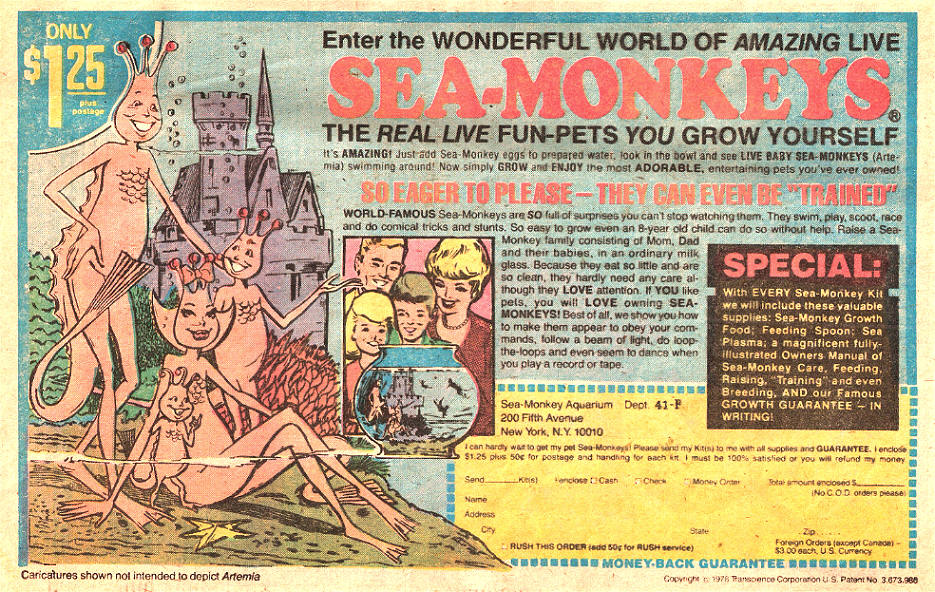
    BTW, did you know that back in the day hucksters placed this ad in Boy’s Life magazine?

    Look at that cute sea-monkey family. Look at the picture of the human family watching the sea-monkey family swim around a castle in a bowl. Click on it. See it large.

    As a young lad, I, as every good Boy Scout should, subscribed to the magazine. I saw that ad over and over.  Who wouldn’t want a sea-monkey? So I saved up my money, earned by watering plants and trees at a nursery in the hot Utah summer sun, and ordered me a family to put on my own shelf.

    The aquarium came. It was not a bowl and did not have a castle. But, hey, there were real live sea-monkey eggs right there in the packet. They weren’t just fantasy creatures! I mixed in the water and salt and dropped the eggs in. I can’t tell you how excited I was. Days later the eggs hatched. And what did I have?

    Brine shrimp.

    BRINE SHRIMP!

    I could have had my mom drive me to the lake where I could have scooped up a million of them. For free. That was, I believe, my first great disillusionment. The first great step from child to adult.

    Alas, sea-monkeys . . .

    Anyway, back to story. Janci was one of those Codex Writers who shared how she used Q&A to develop her killer story idea. She agreed to share it with you. Here’s Janci.

    ***

    The idea for CHASING THE SKIP started with a game of existential questions.  That’s like Twenty Questions, only with no question limit and much more confusing subject matter–like the Pythagorean theorem, or gas prices.  My husband and I like to play the game on long road trips, since a really good round can take two or three hours to play out. 

    On this occasion, I chose a bounty hunter.  It took Drew about five minutes to guess that one–not my finest subject ever.  But after he guessed it, we started talking.  I knew that bounty hunters still existed, but I had no idea how chasing down a fugitive could be a part of our contemporary justice system.  Just what is it that bounty hunters did, anyway?  How did it all work?

    After our road trip, that question stuck with me, so I began to do some research.  What I discovered fascinated me.  A bounty hunter could legally chase down his mark because of the bail bond process.  In order to be released from jail before a pending trial, an arrestee had to put up bail money as collateral, to ensure they returned for their trial.  Since most people can’t afford to post the full bail amount, a bondsman will post it for them, in exchange for a smaller fee.  When the arrestee skips bail, the bondsman is out the money–unless he can get bring the arrestee back.  In fact, he’ll have that person sign away their constitutional rights to privacy in addition to paying the fee.  He’s allowed to go find them if they don’t show up in court.  He can even break and enter to do so–dragging them out against their will.  But the bondsman is a busy man, so he signs those rights over to a bounty hunter, and off the bounty hunter goes, chasing down the skip.  If a person is good at it, bounty hunter can be a legitimate career.

    As I researched, I knew I had the beginnings of a story.  This had all the elements–reality with a touch of danger, crime with a touch of justice.  I wanted to make it work. 

    But I write YA novels, and no bondsman would sign on a teenager to go after his skips.  That would have all kinds of negative legal ramifications, and even if it didn’t, no reader would believe it. Enter my Creative Q&A, the question I always ask when I’m doing idea development for a novel: where can I put a teenager in this?

    Answer: she couldn’t be the bounty hunter, but she could be the bounty hunter’s daughter.

    That posed its own problems, of course.  No dad in his right mind is going to haul his daughter along on the road with him as he tracks down skips.  (Or, in question form, what would make a dad in his right mind bring his daughter into such a dangerous situation?)  I needed a crisis, so he had to bring her along, had to track down the skip, had to keep going with all of it, even when things got rough.  And if I could work in some interpersonal drama, all the better.

    And so it was that Ricki became abandoned by her mother, forced to ride along with her bounty hunter father, a man she barely knows, as he chases down a skip who is more dangerous than his usual mark.  Why would he take this particular job with Ricki along? 

    Ricki would like to know that, too.

    ***

    John Sez: ins’t that a great idea?  I hate Janci.

    While we’re hating her, did you notice that she got some random bit of zing playing 20 questions with her hubby? She followed it up by doing some research.  After doing that, she had a lot more zing. She also knew she had a general topic for a story.  She knew she had the beginnings of a story because her zing meter was going wild. 

    But she didn’t have a story yet.  She had a vocation, which is nothing more than a bit of setting.

    To have a story you need character, problem, plot, AND setting.  So she whipped out her Creative Q&A tool to help her find a character.  And the question she asked was one she’s found is very productive for her. It’s a basic question. But it’s an excellent question. And from that Q&A she started to develop the rest of the story parts.

    The take away isn’t that playing 20 questions on road trips is the key to story ideas.

    It isn’t that one question Janci asked, as fundamental and productive as it is.

    It’s that the principles we’ve been discussing in these posts work. Develop the 6 Core Parts. Think about objectives. Start anywhere. Hunt zing. Generate your own zing. Use Creative Q&A. Work on the various parts using whatever tools you have until you have developed enough that the story comes alive in your mind.

    I hope she sells a million.

    For more in this series, see How to Get and Develop Story Ideas

    Share
  • |

    Get great writing tips, for cheap!

    The annual Life, The Universe, and Everything writer’s conference is being held this year February 11-13. It’s chock full of panels and presentations from working authors. And this year you don’t have to live within driving distance of Provo, Utah to go because they’re doing it all online (thank you, Covid).

    I will be delivering two hour-long presentations. The first is about plot, where you learn the John Brown Story Framework that makes plotting so much easier. Heck, it makes story much easier. The second is for folks new to self-publishing and is called Indie Publishing 101.

    If you’re a new writer or looking to hone your craft, you will want to check it out.

    Share

5 Comments

  1. Ahhhh, writer envy. I think we all experience that, even when we try very hard not to. “Why is so-and-so having more sales and/or better publicity than I am? Why is so-and-so making more money?” It’s almost like it would be best if none of us ever were privy to what was happening to anyone else, that way we’d never compare and contrast, then feel bad because someone else always seems to be doing better — for reasons why cannot understand, or over which we might turn a little green.

    Hang in their, John. There are those of us who are quite covetous(sp?) of your three-book hardcover deal with TOR. Very. (wink)

  2. I know, I know–if I only had your problems. I think envy is the writer’s disease.

  3. Hey John,

    Don’t worry too much about it. From where I’m sitting, I’m covetous of everything that everyone else is doing. Granted, I don’t write a lot, but I’ve had a “novel” rolling around in my brain for over a year now. Total words written? 2000. Total number of awards won? 1 short story collection for a flash fiction piece, which still hasn’t been mailed to me.

    You just keep on rolling, because there are a great number of people who think you’re a truly great talent, including the people who judge the Whitney awards, if I’m not mistaken!

  4. I know. I shouldn’t be complaning. But I think it’s illustrative of how it goes.

  5. I don’t even know that I’d categorize it as complaining. I think we all do this to one degree or another. It’s just human nature. I’m especially bad at it when it comes to my wife’s school success. She’s almost finished with her masters, while I’m still sitting here a sophomore at 26 years old! There are plenty of reasons that I’m 26 and a sophomore that make perfect logical sense (mission, worked to put her through school, etc.) But I still envy her situation.

Comments are closed.