First of all, if I could look like Stephen R. Covey does in that picture, I would shave my head and never look back. Holy moly, I love that picture. But that’s not why I’m writing.
James Maxey is a writer who I respect and whose comments on the boards of Codex Writers often make me think or laugh. He recently started a thread about writing mission statements.
Ack!
I groaned when I first read the title of his topic. I know first-hand how useful goals are. I know how vital it is to identify what’s vital in any endeavor. Heck, I’m a Covey-lover through and through.
But every mission statement I’ve seen has either been useless corporate toilet paper (because they’re printed on stuff that’s too stiff and rigid to be of any help in the bathroom) or it’s a personal artifact that has a six week half life, after which it turns into something like that singing fish you bought and can’t for the life of you figure out why or where to put it now that you realize you could have eaten a steak for just as much money and the pleasure would have lasted longer.
And yet consciously thinking about how you want to live is so powerful. I think the corporate world ruined the term for me. I cannot bring myself to write a “mission statement.” I know what I want to do in my various roles in life. I know how I want to live. But I cannot use that label. Alas.
So here’s my “what I want to do” as far as writing is concerned. It’s not crisp and clean. And if I had to write it again, it would come out differently. But it has the gist.
—-
I want to make people fall in love like I did when I first watched the Sound of Music–that sweet, pure yearning. And when they’re out of love, I want them to see a way back.
Every once in a while I want the ground to shift under the feet of my readers like it shifted under mine when I first watched Les Miserables with Anthony Perkin.
I want them to laugh.
I want to give them the wonder and adventure that was given me when I read the Hobbit.
I want them, at least once, to shout in triumph.
I want to share my delight in people who are fascinating, flawed, salt-of-the-earth, odd, funny, strong or a hundred other wonderful things, but who show some courage, a little or a lot.
I want readers to weep at the hope of redemption. I want them to despair at loss.
I want the sun to shine. I want the world to crack.
And when my readers are done, when the book’s closed and they sit back, I want the story and people to linger, I want my readers to want to go back. I want them to feel it was, not only a surge of living, but a good thing to have once been lost in the pages of my book.
In the last part in this series we discussed the idea that readers don’t want your characters to be happy. They want them to hunted, stressed, threatened, freaked, and nigh unto some horrible fate for 90% of the novel. At that point, after all that trouble, readers want the characters to pull victory out of the jaws of defeat, exhale a big sigh of relief, and enjoy a Slurpee . . . until the next book in the series.
All through the big worry, readers don’t want to know what WILL happen. They want to know or suspect what MIGHT happen and HOPE and FEAR about those possibilities. And then they want a cathartic resolution of all that hope and fear, all that dramatic tension they have felt.
But our readers won’t hope and fear for just anyone. They will only hope and fear for those characters who evoke sympathy and interest. And so the second set of Pareto factors focus on the things, the conditions, that do this.
Pareto Factor 1: Troubles
Sympathy starts when we see someone in trouble. That’s not the only thing that’s required. Some people who are in terrible trouble only evoke pity or even antipathy. So there’s more to this than trouble, but trouble is where sympathy starts. So what kind of trouble are we talking about? I like the categories James Scott Bell uses. We feel sympathy for people who are:
In jeopardy or experiencing hardship
Are underdogs
Are vulnerable
When someone is in jeopardy, it means some significant aspect of their happiness is being threatened. Hum, sounds suspiciously like the first type of story problem I discussed in the last post, doesn’t it? That’s because it is. We have sympathy for people who are being threatened with death, slavery, drudgery, etc. We’re just wired for it. Likewise, we feel for someone experiencing a hardship. And a “hardship” is simply someone having to deal with a lack, the second type of problem we discussed. So we begin to evoke reader sympathy by just giving our characters significant problems to deal with.
And you can pile the problems on so that not only does our hero have to deal with the central problem of the story, but maybe he’s also broke and has nothing but one box of macaroni and cheese in the cupboard, or his car just got repossessed, or he’s just been dumped by his girlfriend, or he and his daughter are estranged because his ex-wife is pouring poison in her ear, or he breaks his arm, or he works in an awful job.
Do you remember Peter Parker in Spiderman 2? He gets fired from his pizza job, has no money, is losing his girl. Lots of hardship. And lots of reader sympathy.
But giving characters problems is not quite enough. Because if you recall, the readers want to fear for our characters. Nobody fears too much for someone else if we know that they can easily resolve any threat or hardship that comes their way. And so we need to stack the odds against the character. They need to be underdogs.
This means that the opposition starts off two steps ahead. It means they have more power, more resources, or more information. This is why strong antagonists make strong stories—they help the reader to fear for our protagonists.
Who worries about a Superman who is a hunk of burning love? Nobody. Unless he’s actually Clark Kent in other matters and stands to lose something like Lois. Or, when he is Superman, someone hangs kryptonite around his neck and turns him into a dweeb.
In this same vein, our characters need to be vulnerable. This means they can be squashed at any time. They can be shot, killed, ruined. Until the very end, the reader must know the characters can lose big. In the previous post, I said that problems have to be hard to solve, otherwise readers don’t worry. The things that make problems hard to solve are character limitations, ongoing and increasing troubles, conflicts, and surprises. All of those factors make characters vulnerable as well.
So, threaten your characters will all sorts of things, give them hardships, make them vulnerable underdogs, and we’ll feel sympathy for them.
Or will we?
There are some characters with problems who we don’t want to root for. Instead, we hope they fail. Villains, for example, have problems, but we root against them with vigor. In our minds, these folks deserve to fail. So you can’t rely on problem alone. There’s another quality that your characters must evoke if we’re going to hope and fear for them.
That other quality is deservingness.
Pareto Factor 2: Deservingness (likeability)
All of us have an automatic scale of justice inside of us. We can’t turn it off. Nor can we ignore it. It’s very simple. If someone’s bad outweighs their good, then we think they don’t deserve good things. Conversely, if someone’s good outweighs their bad, we think they should be happy.
Don’t believe me? Fine, let’s test it.
A boy breaks his arm and he whines, whines, whines about it all day long. Tells his teachers he can’t do his school work because of it. Mopes at home in front of the TV. Steals his sister’s money to buy candy because he has this awful injury and he deserves it. Maybe he makes all his friends listen to him talk about how hard it is, and he just goes on and on and on.
You know exactly what you’re thinking. You know exactly how much sympathy you have for him, which is none.
Another boy has a broken arm. But this one doesn’t whine. In fact, when his dad falls ill, he goes out and with the one good arm, and in pain, mucks out the horse stalls. He does this because his dad was going to lose his job if he didn’t. Then the boy comes back in and cleans himself up and doesn’t say a thing.
You like that second boy? You want good things for him?
Of course, you do.
Problems aren’t enough. They’re only half the equation. For us to root for someone, we have to feel they’re deserving. Or if you like the term better, you can say they need to be “likeable.”
So what makes someone deserving or likeable?
That’s going to be slightly different for each person because our moral codes are all slightly different. If you feel it’s a sin to kill animals, you might feel conflicted reading a story about a rancher who needs to get his cattle to slaughter. If you feel unions do nothing but harm, you might throw down a book that’s about a union boss trying to force a corporation into compliance. Nevertheless, there are many virtues and vices that people hold in common. Usually, we feel people are deserving if they weigh more on the one side of the table below than they do the other.
Deserving / Likeable
Not Deserving / Unlikeable
Unselfish, do nice things for others
Stand up for little guy
Funny
Sacrifice for someone else
Good-humored, don’t take themselves too seriously
Courageous
Hard-working
Actively trying to fix their own problems
Hopeful
Etc.
Selfish
Bully others
Dull
Whining
Cowardly
Take themselves too seriously
Sanctimonious and self-righteous
Lazy, only want to snivel or groan about their problems
Sad sacks
Etc.
We tend to like people more who show the characteristics on the left side. We tend to dislike people who show the characteristics on the right side.
Notice, a lot of this has to do with motive. In many instances it isn’t just the act that decides us for or against someone. It’s the act + the reason why they did it. Let’s go back to that example of the kid with the broken arm that mucked out the horse stall. We’ll love him if he made that sacrifice out of selflessness. We’ll feel something different if he does it only because it allows him to hide his and his father’s crime (maybe they killed someone and have temporarily stashed the body in the barn under the muck in a stall).
Furthermore, while we need to make the characters we want our readers to root for deserving, this doesn’t mean they have to be paragons of virtue. Remember that deservingness is weighed on a scale. Just as long as the characters tip the scales one way, we will feel they’re deserving. On the other hand, if they cross the line the other way, we’ll turn against them.
For example, let’s say your lead character is a thief who steals money from retired folks. But in your story she’s trying to save a kid from being kidnapped and sold into the sex slave trade. Yeah, our character may be a thief, but what she’s doing outweighs the bad, and we’re going to root for her.
Now let’s make our lead a child molester. He’s trying to capture a brutal drug cartel murderer who has just escaped prison. Along the way he has his way with a few children.
Who are you rooting for this time?
Yeah, me too. I hope the murderer finds the child molester and offs him. Or at least alerts the authorities to his crime and ties him up in a neat package for them to pick up.
So you don’t have to have perfect people as your leads. In fact, it’s sometimes more interesting to have someone with foibles just like the rest of us. But when those foibles turn into things we find despicable, we’ll turn against those characters.
And vice versa. For those of you who have read or watched Pride & Prejudice, did you notice how you rooted against Mr. Darcy when we interpreted his actions as smug condescension? The moment he changed, and we learned of it, we cheered for him. It was all a matter of deservingness.
If we want to hope and fear for our characters, they need troubles. But they also need to weigh in on the deserving side of our scale of justice. When they do, they become admirable, likeable, heroic.
In fact, heroes, the ones that make us stand up and cheer, are those people that put their own happiness at risk to do the “right” thing. They’re the very embodiment of deservingness.
So make your characters admirable in some way, if only just a little bit.
Still, we’re not done yet. We might have characters who are completely deserving, but they are so boring we can’t muster any interest in them. And that brings us to the third Pareto factor.
Pareto Factor 3: Interest
We want to hope and fear for a character for 90% of the novel. But will you stick around if the characters are utterly boring? Probably not. So you want to make your characters interesting. Heck, sometimes we don’t need much of a problem, but will read about someone just because they’re so dang interesting. Character interest is a key factor in a reader’s enjoyment of your story. It one of the things that produces the biggest bang for the buck.
The question is: what makes a character interesting? The answer: the same things that make real people interesting.
You’ll want to make your own list of things that make people interestings because what rocks you might not rock me, but I’ll share the types of things that spark my interest in other people below.
Your characters don’t have to exhibit all of the traits listed, but you might want to think of giving them at least one or three of them.
Power
People who have power draw our interest. That power may be one of many varieties:
Wealth. They might be super rich like Bill Gates or Warren Buffett or the Queen. They may drive the coolest cars and have the most luxurious houses or clothing.
Position. Someone in a powerful position like the CEO of a big company, the general of an army, or the leader of some gang. But it doesn’t have to be huge. A single cop draws attention. As does an IRS agent on your doorstep. The foreman of a crew has some power. The character might not even be the one to hold the reins of power but be a spouse or counselor of someone else who does.
Physical strength. They may be fast or strong or just huge individuals. Maybe they have been trained to be deadly weapons or at least use them.
Ability
People with extraordinary skills or talents draw our interest. It’s why, in fantasies, we’re so interested in those that can actually practice magic. In fact, ability is a type of power. And just like those with the other types of power, these folks evoke wonder, respect, and sometimes awe.
The skills and abilities you’re interested in may differ from mine, but we are fascinated by those who can do things well or have some gift. Maybe they are expert at selling, or making money, or framing a house, or painting, or doing gymnastics, or reading, or hacking into computers, or skydiving, or firing weapons, or riding horses, or hunting, or getting people to like them, or making pancakes, or a thousand other things. Maybe, like Edna Mode in The Incredibles, they have the ability to design amazing super-hero outfits.
Even though your characters have limitations that prevent them from immediately solving the problem they face, you can still give them some kind of an ability that makes them admirable to us. Some gift or talent. And maybe it helps them solve the problem in the end.
Extraordinariness
People who are uncommon in some way draw our interest. In fact, if you think about those with power and ability, you see that they possess this quality as well. However, you don’t always need power and ability to be extraordinary.
Maybe you’re a normal guy in an extraordinary job. You’re a CIA officer, a smuggler, or a spy. Maybe you raise wolves or are a bounty hunter. Or you hunt bears with a pack of dogs and a horse. Or maybe you have some other uncommon hobby.
You might argue that these are special skills. They are. But who says my categories can’t overlap? Still they don’t have to be extraordinary in that way. Maybe you simply have extraordinary experience. You fought in a war, escaped prison, were a bank robber at one time. Or maybe you’re just outrageous, bizarre, eccentric, odd, or have some exaggerated quirk.
Maybe you’re a loud-talker, a mumbler, a guy who takes his three parrots with him where ever he goes, a farmer who loves pies. Maybe you’re super thin. Or a cab driver with glasses so thick his passengers immediately wonder if they’ll arrive alive. Maybe you have squeaky shoes. Or are always dressed to the nines and smell of lemons. Maybe you’re one of these people that walk around in their sleep or hold loud conversations with ghosts. Or you’re a coffee freak and drink a pint of black mud each day. Maybe you just have an uncommon name like the folks in the Netherlands who surname is, no lie, Born Naked.
Sometimes these extraordinary things affect the plot. Sometimes they don’t. The point is that the extraordinary captures our attention. When you’re inventing your characters, add something extraordinary. You’ll be surprised at how much more interesting they are to you.
Beauty
People who are beautiful capture our attention. In movies we see a million bits of information at once. We can see the beauty and respond. But we can’t do that in text. And so we have to evoke the image of beauty in the reader’s mind. A few key details and the way others react to them should be enough.
Now you might think beauty is a superficial method for generating interest, but I think it’s a manifestation of something else more fundamental. If you think about a lot of the interest factors we’ve discussed so far–having special power, wealth, ability, or beauty–they all have a common element running through them. That element is wish-fulfillment.
Wish-fulfillment
We cannot help but be interested in characters who are, do, or have things we want. In fact, this is one of the main draws of fiction–experiencing something wonderful or cool, even if it’s vicariously. Phyllis Pianka states this so well in How to Write Romances:
“You cannot write an engrossing romance novel until you create a heroine the reader wants to identify with and a hero the reader can fall in love with . . . they are idealized; the heroine is someone women wouldlike to emulate: nicer, prettier, thinner, more intelligent, though not necessarily all of those things. She will have a flaw but it will be a minor one . . . the hero is the ideal lover and husband and father . . . Above all, he must be the man with whom every woman would like to fall in love [bold font added for emphasis]” (30).
A lead you’d like to be like in some way. A hero you could fall in love with. Or at least feel attracted to. Remember, readers are hoping and fearing for the characters. How can readers hope for a woman to enter a committed relationship if the readers feel the man is completely unattractive, physically or emotionally? How can we males root for the man if we feel the same about the female character? It doesn’t mean they have to be perfect. Wish-fulfillment, like many things in writing, slides along a scale. But we’ll be more interested as readers the more we can participate in the same attraction and desire.
Someone might be thinking this is just for love stories, but that couldn’t be farther from the truth. What’s one of the reasons why James Bond and all the other action heroes are so popular? Among other things, it’s because so many of us would love to live the adventures those heroes do. We would love to be the types of guys who know how to fight like Jack Reacher and get to use all the high-tech the gizmos and drive the deluxe cars. How many YA stories are about characters finding fairies or dragons or aliens? How much of fantasy is about having the powers magic grants? Wouldn’t it be cool! Of course. That’s wish-fulfillment.
So when developing a character, we can think of things we’d like to be, do, or have and give those things, or the opportunity for them, to our characters. Make them admirable or desireable in some way. Of course, this doesn’t mean you can’t give your characters flaws, or that you can’t write about someone we wouldn’t want to be like. Our readers don’t have to want to be like our characters in every way, but a little bit of wish-fulfillment helps. It’s something to consider.
Also, as with anything, what’s desireable to you might not be what’s desireable to me. Maybe I’m interested in anyone who has served in the armed forces or lives with some kind of risk and adventure. Maybe you can’t stand that and are enthralled instead with horses. Maybe you’d like to fly airplanes, but I’d love to fly dragons. One guy is drawn to those with happy marriages full of laughter. Another is drawn to the freedom of single life. You write your stories, and I’ll write mine. But we can both make our characters more interesting by adding, when it fits, some element of wish-fulfillment.
Humor
We love humor. Love to laugh. And so anytime you can create a character that does this to the audience, they will be interested in them. It might be our characters have witty lines or comments. Maybe they’re humorous types or find themselves in humorous situations.
One note. Don’t make the mistake of thinking that making a character interesting will make them deserving or admirable. Humor, just like beauty, can be given to characters we root against. Maybe the character is funny, but it’s a cruel funny. Maybe the character is mind-stealing beautiful, but they use their beauty for terrible purposes. Sympathy and interest are different things.
Danger
Anyone who poses a threat demands our interest. This is one of the reasons why Darth Vader is so interesting. Criminals present threats of all sorts, which is why we’re always interested in them. Recall, however, that many aspects of happiness can be threatened. It doesn’t have to be a threat to life, limb, or property. For example, someone may threaten my relationship to my wife or my belonging to a group or community.
We’re also interested in those who are in danger. This ties back to the first story element of problem. In fact, the problem might be so interesting and threatening that we could cast anyone in the role and readers would go along with them. Do you really remember the leads in Jurassic Park, for instance? There’s nothing fundamentally wrong with a plain vanilla character. In fact, that might be exactly what your story needs. However, I would still see if it doesn’t improve things to make your character interesting outside the context of the story problem. If you do, you just might end up with an Indiana Jones.
Secrets
We love mysteries. And so sometimes it’s wonderful to give characters secrets. It might be they present a bit of danger or have something to hide as Aragorn does when we first meet him in The Lord of the Rings. Or maybe they have a past they don’t like to talk about. Either way, we love to wonder about them and then have our questions answered in surprising ways. We like it even better when these secrets affect the deservingness of the character or our understanding of the situation the character faces.
Surprise
We are intrigued by characters who play against type, if only a little. So maybe you have a plumber who quotes Shakespeare or William Blake to his customers. Maybe you have a mixed martial arts fighter who is a woman with three kids. Maybe the hero has a fear of spiders. Or the villain is a magnificent artist or tends lovingly to his bees or his daughter. Maybe the super rich businessman secretly goes to poor neighborhoods to find folks to help. Maybe the bearded and tattooed biker carries around a Book of Mormon and reads it during quiet moments. Maybe, like Michael in the series Burn Notice, the super spy loves yogurt. Anything that runs against, or just doesn’t fit, our expectations of the type. This includes motives as well as external character tags.
Cast Variety
Finally, because we almost always deal with a cast of people in our stories, we need to make sure they’re interesting as a group. You will increase reader interest if you give each character some memorable and interesting trait, but you’ll get the most bang for the buck if you make those traits different.
For example, let’s say you have a team of characters who need to go behind enemy lines to find and dismantle a radar station. If every one of those team members is exactly the same–all wise-cracking blond farm boys from Oklahoma–we might find it funny and odd at first, but it will soon lose its appeal as they all say and do the same things. Compare this to a group where one is a silent-but-deadly farmer, another is a metaphysical mechanic, a third is a short woman’s man, the fourth is a wise-cracking American Indian. Maybe one joined the ARMY because he’s got first person shooter games dancing in his eyes, another because his father was a military man, another is there to conduct some kind of criminal heist, the fourth because he’s poor and needed help getting through college and supporting his wife and kid.
I know, I know, you women are probably saying the tall blond farm boys might not be all that bad. But after you finish oogling them, think of this: your readers might not all be into farm boys. Did you ever wonder why boy bands have a variety of types–the serious one, the good one, the bad one, the cutie? It’s because it broadens the appeal to a wider audience.
But it goes beyond that. Variety also avoids the problem of diminishing marginal utility. This is simply the idea that the more you experience something, the less power each experience provides. For example, the first time you hear a great joke it may be gut-busting funny. By the time you’ve heard it ten times the joke has probably lost its appeal. Imagine eating a meal that’s nothing but salmon or broccoli or fried okra or ice cream. Eventually, after twenty dishes of cheese, you will go blind. The same thing occurs with characters. This is why it’s always more powerful to have one villain instead of a hundred of them. One wise-cracking American Indian is awesome. Fifteen of them only water down the effect so that none of them are as powerful as the one could be all by herself.
And it doesn’t end there. There’s an even more important reason for giving your cast variety: it opens up possiblity for more conflict, surprise, and story. Maybe one of the lead’s team members turns traitor. Maybe one of the bad guys is thinking about doing his boss in. With some variety, you can not only write about the main problem, but you also add in subplots–a love story or a redemption plot. And both can complicate the central problem.
Vareity adds interest. Develop your characters–the major, minor, and bit roles, folks that help our lead and others who hinder or oppose them–but also develop them with an eye towards the effect of the cast as a whole.
Characters you want to hope and fear for
Our readers want to hope and fear for our characters. They want to feel sympathy. But they also want to be delighted and awed by them. They want to feel admiration for them. They want to laugh at and with them. These are some of the key joys of the experience they come to us for.
The way we deliver this is by giving our characters troubles, letting them demonstrate they deserve to be rooted for, and making them interesting.
But we’re not done yet. Right now we’ve only talked about the problem and the character. That’s just the beginning. Remember, readers want to hope and fear and then feel a cathartic release. But you can’t feel catharsis if your worries don’t build up to a certain point, if they aren’t extended.
Form follows function.
Think about the itch deep down in your cast that builds and builds and builds over days. It’s amazing when you finally scratch it. Think about the time you couldn’t drink or eat for a day or two and how hungry or thirsty you were. Think about how good it felt to finally satisfy that tension. The experience of eating after a fast is so different from the one when you eat when you’re still mostly full.
You need to make your readers hungry for a release. They want to be hungry. And that takes time. So while a six-hundred word piece of flash fiction can evoke some emotion, it’s nothing compared to the emotion and experience a 100,000 word novel can deliver. Because 100,000 word novels allow you to build the reader’s hunger, their tension, their hope and fear, to a sharp point.
You build this tension with plot. And that will be the next post in the series.
In the meantime, if you think of other things that make characters interesting or sympathetic, specific examples of the factors I’ve talked about, or have questions, please post them in the comments.
More great reading
A lot of the factors listed above that make characters interesting have to do with them being larger than life. If you want to read more on this, Orson Scott Card devotes a whole chapter to it in his wonderful book Characters & Viewpoint.
For those interested in exploring the factors that lead to sympathy, let me recommend Adam Smith’s The Theory of Moral Sentiments. That link will take you the wiki about the book. At the bottom of that wiki are links to the actual text.
Parts in the The Key Conditions for Reader Suspense Series
All you Utah and mountain area writers & teachers, or those close enough to travel, I will be presenting and conducting workshops from 9:00 am until 4:30 pm this Saturday, Oct 9thas part of the Autumn Writers Conference sponsored by the American Fork Arts Council and the National Endowment for the Arts.
The sessions I’ll conduct include:
Finding and Working With an Agent
How to Write a Story That Rocks: First Principles & Story Concept
Creating Characters that Rock
Plot
Writing Scenes: The Basic Units of a Novel
There are four other tracks. Find all the details, including cost and contact info, on the organizer’s site: CalebWarnock.blogspot.com. I’m totally stoked for this. I’ll be sharing what I think are the Pareto factors in each of these areas — things I wish I would have known when I started and would have shaved years off my journey to publication.
A number of other authors will be there including:
Annette Lyon (women’s fiction and a new cook book called Chocolate Never Faileth)
In part one, we talked about the story problem and its central role in reader suspense. We also talked about a man scratching his bum.
In part two, we discussed the three character factors that are critical for reader suspsense and how they also help make a character rock.
(For those of you just starting the series, you can find links to the other parts in the On Writing area of the site.)
So let’s say you’ve already got all that. You’ve developed a character who is sympathetic and interesting, maybe tugs on the reader’s sense of wish-fulfillment. You’ve given that character a problem that’s significant enough for readers to be intrigued. Now what?
Let’s go back to the objective. Readers want to hope and fear for a character; they want their tension to build to a pitch. Then they want to have a cathartic release.
Character and problem by themselves don’t go anywhere. You still have to build reader tension to a sharp point. So how do you do that?
You do it with plot.
Plot is nothing more than the character’s attempts to solve the problem and the results of those attempts. There’s no mystery to it. A character has a problem. Character tries to solve the problem. And something happens as a result.
The key is to remember that the plot has a job to do. You can’t have your characters go about solving the problem in any old way. You can’t have just any old results. Form follows function. To deliver what readers want, you have to develop the plot in a manner that builds the reader’s tension. If the story’s about a happiness problem, all of the attempts and results should increase the reader’s hope or fear for the character. If it’s a mystery problem, the attempts and results should increase the reader’s curiosity.
In this post, I’m going to discuss the Pareto factors for doing this. And these factors all revolve around making the problem hard to solve.
Clarity
The first part of making problems hard to solve has to do with clarity.
(Blink)
Wait a minute. Clarity? Um, what? How exactly does that make a problem hard to solve?
Clarity doesn’t make problems harder to solve. What is does is provide the critical function of allowing the problem to exist in the reader’s mind in the first place. The simple truth is that readers cannot hope and fear for anything if they don’t understand what’s going on.
So the very first thing you do is make sure the reader knows or suspects what’s at stake, i.e. what’s to be gained or lost. They need to understand something of the danger/threat, lack/opportunity, or mystery. They also need to know or suspect why it’s going to be difficult to solve the problem or take advantage of the opportunity. This means the reader will need to know about or suspect possible obstacles and conflicts the character may have to face.
This doesn’t mean you have to reveal all. It just means there must be something to fear and hope for.
When you don’t explain the danger or opportunity or mystery, then the most the reader can feel is confusion, maybe brief moments of surprise. Imagine a thriller that fails to establish that Bob kidnapped George’s wife who is a Chinese spy. George and Bob run around for 100 pages and the whole time the reader is thinking: “When’s the story going to start? What’s going on? Why is George chasing Bob?”
The classic example of this is given by Alfred Hitchcock in an interview conducted by Francois Truffaut. Here’s Hitchcock.
There is a distinct difference between ‘suspense’ and ‘surprise’, and yet many pictures continually confuse the two. I’ll explain what I mean.
We are now having a very innocent little chat. Let us suppose that there is a bomb underneath this table between us. Nothing happens, and then all of a sudden, ‘Boom!’ There is an explosion. The public is surprised, but prior to this surprise, it has seen an absolutely ordinary scene, of no special consequence. Now, let us take a suspense situation. The bomb is underneath the table, and the public knows it, probably because they have seen the anarchist place it there. The public is aware that the bomb is going to explode at one o’clock and there is a clock in the décor. The public can see that it is a quarter to one. In these conditions this same innocuous conversation becomes fascinating because the public is participating in the scene.
The audience is longing to warn the characters on the screen: ‘You shouldn’t be talking about such trivial matters. There’s a bomb underneath you and it’s about to explode!’
In the first case we have given the public fifteen seconds of surprise at the moment of the explosion. In the second case we have provided them with fifteen minutes of suspense. The conclusion is that whenever possible the public must be informed. Except when the surprise is a twist, that is, when the unexpected ending is, in itself, the highlight of the story. (François Truffaut, Hitchcock, pp 79-80)
Hitchcock gives two more great examples in his essay “The Enjoyment of Fear,” first published in Good Housekeeping in 1949. (I think there’s some zing in the juxtaposition of housekeeping and the enjoyment of fear, don’t you think? Magazines were so different back then.)
Readers feel surprise when something unexpected occurs. By definition, they do not see it coming, even if it makes sense after the fact. So to create this effect you need to withhold information and lead the reader to have different expectations. Then wham!
Readers feel curiosity when they’re given enough information to form a question but not the answer. For example, in a murder mystery, we know someone’s been killed, but who did it? And why? In another story, like McDevitt’s Ancient Shores, the character finds an odd thing in the ground at his farm. When he digs it up, he finds a modern-looking boat made of a material more refined than any known to man. We know what he found, but what is this and how did it get into his field? With other stories where characters face dangers and lacks, readers feel curiosity about what might happen next.
However, if we want our readers to hope and fear for a character, we have to give readers more information. We have to let them know what’s at risk—what’s to be lost or gained. We have to let them know what the obstacles and conflicts are, what MIGHT happen. After all, how can you fear for a character if it’s smooth sailing to the finish line?
No information = no possibilities in the reader’s mind = no expectations = no suspense.
This isn’t to say we must eschew surprise and curiosity. Both are delicious. In fact, both actually help create suspense. So the point isn’t to avoid them. The point is to make sure we understand that we cannot create suspense by withholding the situation. We create it by giving the reader all the information we can without giving away all the details of the resolution or key plot turns until the moment they occur.
BTW, I say “all the details” because sometimes, despite our best attempts, the reader will see some of the plot turns coming. But if we’ve done it right (fingers crossed), on those occasions they will only see a part, and the part they don’t see will pack enough surprise or particularity to delight.
Make the Problem Hard to Solve
So readers want to hope and fear for a character. To feel this, they must not know what WILL happen, but do need to suspect or know what MIGHT happen and feel tension about the possibilities. They want that tension to build, and then they want to feel a cathartic release.
The reader will continue to feel that tension as long as the problem is unresolved (the danger remains, the character continues to suffer hardship, the mystery becomes more puzzling) AND the situation changes in such a way that the reader’s worry grows.
How do we make sure the problem persists and intensifies for forty to seventy scenes (an average range for many novels) despite the character’s efforts?
We do this by throwing OBSTACLES into our character’s path. We make the problem hard to solve.
I’ve listed the types of things that do this below. But remember: these aren’t ingredients to a recipe; they’re options. You don’t need to think up something for every category. You just need enough to bring the problem to life.
1. Put the Character at a Disadvantage
The first way we make the problem hard to solve is by putting the character at a disadvantage. The disadvantage may be a small, medium, or large, depending on your taste and the kind of story you’re telling. There isn’t one type or level that’s best for all objectives. But our characters do have to have some disadvantage; otherwise, there’s no reason for readers to fear for them.
Lack of knowledge
One of the most common disadvantages is a character starting off not knowing how to solve the problem. Or not having a critical piece of information that will allow them to solve it.
For example, think of all the murder mysteries you’ve read or seen. The character starts off not knowing who the killer is or why they did it. In the movie Taken, the father doesn’t know who stolen his daughter or where they’d taken her. He had all the skills and power to resolve the issue once he found her, but he lacked vital bits of information.
Sometimes the characters think they know what the problem is, but when they try to solve it, they realize they didn’t really know what the problem was. It’s called misdiagnosis.
For example, in The Incredibles, Bob goes to the island thinking his problem is a rogue robot. But his real problem is Syndrome.
In another story, a man might think his problem is that his wife is stepping out on him. When he tries to resolve that, he learns she’s actually being blackmailed.
In Dean Koontz’s The Husband, a gardener starts off thinking he’s being threatened by people who want to get to his brother’s money. He tries to solve that problem only to realize that it’s a plot by his brother to kill him.
Anytime your character doesn’t how to solve the problem or doesn’t know the exact nature of the problem, it makes the problem harder to solve.
Lack of skills or power
You can make a problem harder by limiting the character’s skill or power in some way.
Luke Skywalker knows the death star is going to blow the world the rebel base is on into smithereens. We have no question about what’s going on. Luke knows what he needs to do—start a chain reaction that will blow the thing up. What Luke lacks is the power to easily go in and execute the plan. He doesn’t have his own death ray. Doesn’t have computers that can target with precision. All he’s got are dinky little X-wing fighters. He’s limited in his ability.
A Jewish woman is taken by the Nazis. Her lover, who is a Nazi soldier, wants to rescue her. But the lover has no power to order the men to release her. He has no money to pay them off. This doesn’t mean he can’t rescue her. But it does mean he’s going to have to find some other way. It means resolving the issue is going to become much harder.
Personality flaws
Sometimes personality flaws can put the hero at a disadvantage.
Maybe the hero is recovering from an addiction to some drug and finds himself being required to snort a line in front of the villain to prove he’s legit. Maybe he’s a bigot and won’t accept the help of a woman, but she’s the only one with the key. Maybe he’s too proud to admit he’s wrong. Maybe he’s a slob and loses things, including the key to the getaway car. Maybe he doesn’t know when to stop drinking. Maybe his lack of self-control leads him to follow after a woman who comes on to him and then leads him right into the hands of the villain. Maybe he lacks social graces, but needs some high class to infiltrate the villain’s circles. Maybe the character has an issue with trust, has been burned too many times, and begins to suspect the other team members.
Maybe the character’s virtue is the source of his flaw. He’s so willing to see the good in people he blinds himself to who the villain really is. She’s so committed to doing her duty that she’s sacrificing her relationship with her husband and children for it.
Of course, flaws affect our sense of deservingness. Take personality flaws too far and our hero will become annoying or despicable. At that point, the reader stops rooting and worrying for them. Still, they can be a rich mine for making the problem harder to solve.
Handicaps
If all a character needs to do is snap his fingers to solve the problem, then readers can’t worry for him. Unless, of course, he’s missing fingers. Any handicap will put our characters at a disadvantage.
Sometimes the handicap is physical. In Seabiscuit, the jokey is blind in one eye. This makes it very difficult during a race to see when someone is riding up on his blind side. It also makes it hard for him to see openings ahead. It puts him at a disadvantage in a race. In the movie Wait Until Dark, three criminals threaten a woman who is blind. In Gattica, the hero has DNA that makes him weaker than the others wanting to travel into space.
In other stories, the handicaps might be emotional, mental, or social. In Forrest Gump, the hero is mentally handicapped. In other stories, heroes are tormented by fears of snakes, spiders, being alone.
Handicaps can be interesting all by themselves, but when they become a disadvantage to the hero’s goal of solving the problem, they affect suspense.
Time limits
Another disadvantage is having a time limit. Of course, a time limit of a gazillion years doesn’t make most problems harder to solve. Time limits put our hero at a disadvantage when they don’t allow any wiggle room or when they simply don’t allow enough time to solve the problem by normal means.
Next time you read a book or watch a movie, notice how many deadlines, ticking clocks, and time bombs are used.
We Want Underdogs!
In the end, the disadvantages our characters have are only useful if they make the character the underdog when compared to the opposition.
Our hero can have all sorts of great qualities, but the opposition must have something that gives them the advantage–more money, more power, more knowledge, more connections, more training, more whatever is important in the story. This doesn’t have to be huge. Sometimes the hero is the underdog simply because he starts two or three steps behind the villain. The first part of many stories features the hero just trying to catch up.
For example, In Raiders of the Lost Ark, Indiana Jones has mad skillz and knowledge, but he’s outnumbered, outgunned, and outfinanced. And the Nazi’s always seem to beat him to the punch. In Dean Koontz’s The Good Guy, the hero has great skills, but it’s just him against the US government. In The Lord of the Rings, we’ve got a wizard who can work wonders and an elf that can see and hear for miles. But Sauron has so much more. By the end, all we are left with are two little guys and a smelly freak job.
The worse the obstacles and odds the characters face, the more tension and, therefore, relief the readers feel. Think about this. When do you cheer more? When your non-ranked, underdog sports team beats the number one team in the nation, or when they slaughter the local pee-wees?
2. Add Conflicts
The second way to make problems harder to solve is to introduce people and things that actively work against or resist our character. Your characters can come into conflict with others, the setting, and themselves.
Conflict with the opposition
You will have points of conflict with the opposition. That’s a given. The smarter and more powerful the opposition, the harder the problem is to solve, the more the reader can worry, and the bigger the triumph at the end. So you want to make your opposition character and team a real threat.
The best way I’ve found to do this is to play the story as one-man chess, thinking not just about the hero, but about the opposition as well. The hero is, for the opposition, a problem. And so I’ve found it very productive to develop the opposition’s goal, motives, and plan. Then as the story progresses I stop and think: what cunning/smart/scary reactions might this opposition character have to what the hero just did?
Remember, the better the opposition, the more tension the reader will feel. And the key to the opposition, villain or decent chap, is the goals, motives, and plans.
Conflict with the other good guys
Sometimes we think only about the opposition, but the other good guys can provide so many delicious conflicts. In fact, if you think about casting variety, this is just an extension of that topic.
So maybe the hero is about to break a moral code some of the other good guys won’t, or vice versa.
Maybe some of them just can’t stand the risk.
Maybe one of the good guys has lost the vision and turned traitor, as Cypher did in The Matrix.
Maybe the good guys have different reasons for being on the team. One guy joins the army because the judge told him he could join the army or join the convicts in the big house. Another guy joins because he feels a duty and all of the men in his family have served since the Civil War. Maybe another guy joined because he felt like this was the only way to prove to himself he wasn’t a coward.
Maybe the hero is teamed with someone that is a complete opposite. The hero’s a neat freak, the partner is a slob. The hero is highly-educated, but his right hand man barely got his GED. Maybe one of the team members is a KKK sympathizer, and another one is black.
As with the opposition, the key here is taking a moment to explore the other characters’ goals, motives, and plans.
Conflict with bit characters
After looking at the main characters in the story who have goals and plans that conflict with the hero’s, you might want to see if there are any bit characters who do the same.
Maybe the hero drives into some bad neighborhood to try to get some information from someone. When she comes out from her meeting, she finds her car stolen.
Maybe in one scene the bad guys start shooting at a playground. The hero rushes them, but a mother who is trying to get her son off the swing gets in his way.
Maybe the hero needs information, but the guy working security has a mortgage in default and can’t lose his job.
Maybe our hero is trying to get away and an vigilante truck driver hears the chatter over the police channel.
Think about the other people that might in the scenes and what conflicts they might pose. If one is too delicious not to use it, put it in.
Conflict with the setting
The setting includes everything that’s not a character with some part—geography, technology, culture, religion, government, etc.
Maybe the hero wants to stop the two men carrying his little boy off, but there’s a raging river between him and them.
Maybe the hero wants to get back to camp, but the temperature drops and drops and drops as in Jack London’s “To Build A Fire.”
Maybe the hero encounter asteroids, trains that are late, horses that are high-spirited, and insects carrying malaria.
Maybe a hurricane is coming in and making it rough for our brave gal to go out to sea to save her husband whose boat is swamped.
Look around in your setting and see what things might provide obstacles to your character.
Conflict with self
The last, and sometimes the most powerful, type of conflict is a character’s conflict with herself or himself. This type of conflict arises when a character wants two things that seem to be mutually exclusive.
For example, maybe the hero wants to marry the girl of his dreams.
“I love you, Luke”
“But you’re my sister, Leia.”
He wants that intimate relationship; we as the audience want it for him, but we also want him to avoid the freak zone. We can’t do both. Unless . . .
“But,” Leia says, “I take birth control.”
(Zoiks! Run, Luke, run!)
Maybe, like Katniss in Hunger Games, the heroine wants to live, but in order to do that she has to kill a boy who has been nothing but kind to her family. She wants to survive and be kind. She can’t do both.
Maybe like John Proctor in The Crucible the hero can keep his honor only if he dies. He wants his honor. He wants his life. He can’t have both.
Maybe like Bob in The Incredibles, the hero wants to escape a life of drudgery, but he also wants to keep his family safe. Alas, it seems he can’t have both.
Have you noticed how many love stories pit someone’s desire for independence against his or her desire for love? It’s simply hard to solve a problem when doing so means you must give up something else of great worth.
When developing your story, take some time to explore potential conflicts inside the main character. You don’t have to include these types of conflicts in every story, but when you come up with a good one, it’s such a lovely way to put your hero and readers through the wringer.
3. Make Progress with Continuing & Growing Troubles
The third way to make a problem harder to solve is by making it grow despite or because of the characters actions.
But that doesn’t sound like progress–how do you make progress if the character’s troubles not only continue but grow? Simple, the progress I’m talking about is in sharpening the reader’s tension. As the plot complicates, the reader’s tension grows.
Think about the flip side of this. The moment you solve all the problems in the story, the story is over because the readers have nothing more to worry about. So you must continue to give them troubles.
This doesn’t mean the characters can’t solve small parts of the problem along the way. It doesn’t mean good things can’t happen to the character. After all, we want to fear AND hope for the characters.
So, for example, in the middle of Hunger Games, we get two nice chapters where things are looking up for Katniss. Of course, we don’t want to think about the fact that she’s going to have to eventually kill the person she’s teamed up with. Or the fact that the careers are out there killing off everyone else, narrowing down the contestants until there’s nobody else but Katniss to hunt. So Katniss still has problems, but for a few chapters we get a break from the tension. And then we’re plunged back in, worse than before.
What this does mean is that despite the successes, our character still fails to solve the problem and, very often, makes it worse.
So as our character attempts to solve the problem, she will experience disasters, calamities, setbacks, misfortunes, upsets, betrayals, unforeseen obstacles, desertions, and failures. Plans will go awry. The villain will counter with shocking blows. The character will learn things that twist her (and the reader’s) understanding of the problem in more dangerous directions. The problem will become more intense (see part 1), more immediate, probable, significant, and specific. More in the character’s life will be put at risk.
Maybe the character starts the story being personally threatened by the villain, but as the story progresses the villain begins to threaten his children. Maybe our inexperienced team sets out and halfway through the story, their leader (Gandalf or Obi-wan Kenobi), the guy who was keeping them all from dying, is killed. Maybe our airplane gets shot and the fuel leaks out, and our perfect escape crashes into the mountains only miles from where we began.
All of these plot turns keep the tension building.
Another thing they do is keep the story from becoming monotonous. A fight where the positions of the hero and the opposition remain static quickly begins to bore. Think of a football game where the score remains at 0-0 for three and half quarters. Both sides keep getting the ball and keep having to punt after three downs. Nobody gets injured. Nobody makes any yardage. Nothing changes.
Boring.
So we keep the plot turning, keep adding complications and revelations and conflicts and surprises. We keep giving the reader something new to increase their hopes or fears.
4. Avoid Predictability with Surprise
The last way we make the problem hard to solve is by making sure nothing works as planned.
Readers will have a hard time hoping and fearing if they can predict what will happen. When they pull back and cogitate, they may suspect in the end that the hero will win. But if we’re telling the story effectively, they won’t be pulling back much. They’ll be focused, the details of the immediate events filling up the capacity of their working memory. They’ll be living in the moment on the page and worrying about the characters. And the surprises we deliver will put them off balance. They’ll make it so the reader can’t predict exactly what will happen next.
Remember: reader’s don’t want to know what WILL happen. They want to know what MIGHT happen and feel tension about the possibilities.
So some surprises will convince the reader that our hero MIGHT indeed lose. The hero’s smart and bold plan, which everyone expects to work, fails. The one sidekick we thought we could count on turns traitor. The opposition tricks our hero into a setup that now has the cops thinking he committed the crime.
Other surprises will give the reader reason to think they still MIGHT win. Our hero gets a critical clue that leads her one step closer to the killer. Maybe she beats up the villain’s henchman and escapes. Maybe the sidekick who rejected her at first decides to come help after all. Of course, we can’t give our hero an easy go of it. We still need them to fear. But our characters always have to have a chance, even if it’s tiny.
We evoke surprise in the reader when we lead them to expect one thing and deliver something else. Sometimes you do that by structuring the story so the lead character, and the reader, don’t have all the facts up front. And the current set of facts lead to one conclusion. Sometimes you skillfully plant ideas into the reader’s mind that misdirect their expectations. A classic example of this is the red herring in mysteries.
However you do it, surprises need to be believable to work. They need to be logical. Readers will not hope or fear if the opportunity or threat is hokey or forced. Rubber snakes only scare people when they’re mistaken for the real thing. So give the audience surprises that take their breath away, and watch their tension and delight rise.
Putting It Together with The Story Cycle
It’s good to know you need to make the problem hard to solve, but how do you use all the obstacles to develop the plot? How do you layer them in? How do you start and move forward?
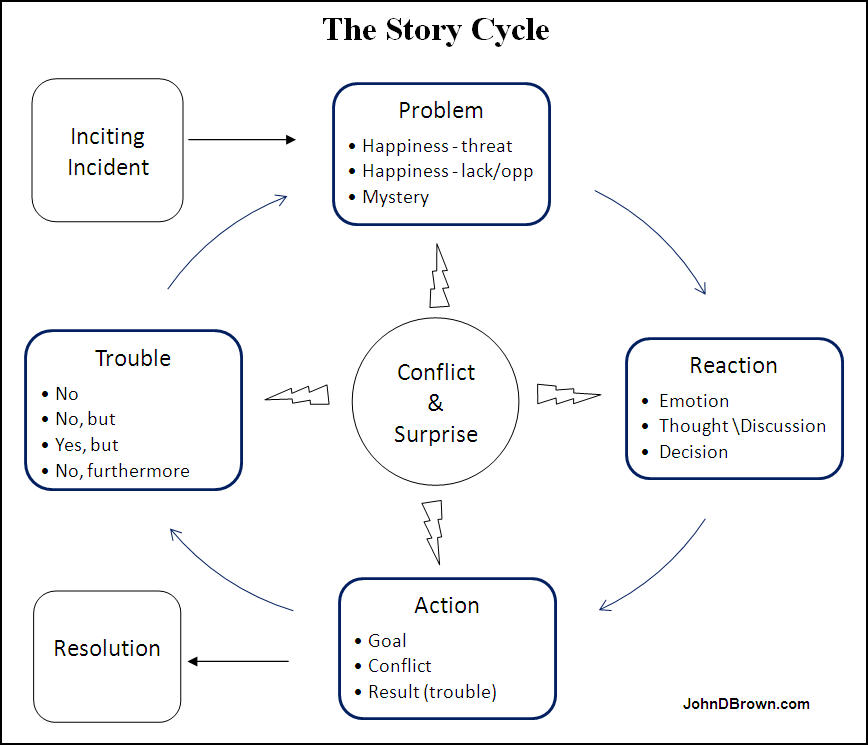
You follow the story cycle, which is simply a model of how we humans go about solving problems, and apply the techniques listed above in ways that make sense to you and spark your interest. You can move forwards or backwards, whatever is most productive to you at the time.
I’ve inserted a diagram of the cycle below and will explain each element. Please note that this is built on the wonderful discussions of scene and sequel found in Dwight Swain’s Techniques of the Selling Writer and Jack Bickham’s Writing and Selling Your Novel and Scene & Structure. I’ve added my own insights, but if you want an expanded discussion of this topic, you might want to read what they have to say there.
One thing to note before we dive in is that the parts of the cycle don’t always correspond to individual scenes on the page. You can present an action or reaction in a scene, a sequence of scenes, narrative summary, or, if it’s insignificant, you might not present it at all. The decision about what to put into scene, narrative summary, or leave out entirely is something I’ll discuss in the part of this series that focuses on scenes. For right now just know that story is about a character’s attempts to solve a problem and the results of those attempts and you’ll be sharing only those parts that make a difference.
Inciting Incident
Everything starts at the point when the problem arises. In fiction, we call this the inciting incident. In real life, it’s the “ah, crap” or “oh, no!” moment. Or, if this is a story about a lack/opportunity, it’s the moment of “dude!” and “oh-my-gosh, oh-my-gosh!”
So with a murder mystery, it’s the point in time when the lead character learns about the murder. In a story about a kidnapping, it’s the moment when grandma is shoved into the back of the van. In a love story, it’s the moment when the girl meets the boy.
The inciting incident thrusts the lead character and the central problem together. The central problem is the main problem the character will be dealing with throughout the rest of the story. Maybe Lead took action and found the problem. Maybe Lead was just minding her own business and the problem found her. It doesn’t matter.
There may be other subplots in the story. There will be changes, complications, and developments in the central problem as we go along. We don’t need to know everything about the problem in the beginning. We just need to know that the character has a problem and that this problem is going to be the one the story is about.
Reaction
So what do we do in normal life when presented with a problem? Let’s say water starts dripping out of the light fixture right above your kitchen table. Maybe the wiring starts to spark. What do you do?
First, you will experience some emotional response. It might be alarm (Oh, crap! That might start a fire!), or anger (Those morons who rent upstairs!).
Next, you consider your options. Maybe you need a towel or bucket under the fixture. Maybe you should go bang on the door of the apartment above. But maybe the people are gone, so you’ll have to break in a window or try to force the door, or call the apartment manager. Maybe you call your buddy who is in construction. Depending on the problem, you might find yourself in a discussion, performing some analysis or research, or sketching out a plan.
At some point, you decide on a course of action.
When we face any problem in real life, we follow that same sequence of:
Emotion
Thought
Decision
For our plot to feel real, we need to follow that sequence with our characters as well.
Sometimes in real life we move through the reaction process quickly. Sometimes it takes a while. This happens in a story as well. But because you want to make things clear, you’ll remember that any non-standard decision will need an explanation. So you’ll put that into the thought part so it makes sense to the reader.
Please note as well that reaction is the place where we have the most time to explore motive, including the past.
When the character finally arrives at a decision, the reaction phase is over. In fact, the character’s decision to take some action propels us into the next step. Even if the character decides to ignore the problem, that’s an action. And as you’ll see, it’s going to fail. Because plot is all about trouble.
Action
At this point, the character has decided to take some action. The goal or purpose of the action is to fix the problem or complete some step along the way to fixing the problem. The character will either reach that goal or she won’t. When the goal is clear in the reader’s mind, they form a question: will the character solve the problem? It’s a clear yes or no proposition. And because the character is deserving and the problem is significant enough for the reader to care, the reader will hope the character succeeds and fear she might not.
If, however, you fail to make the decision and goal clear to the reader, then they won’t worry and hope as much as wonder what the hero is doing. Too much of that and we’re back to confusion instead of suspense. So make the decision and goal clear right up front.
If it’s a scene where the opposition is doing something to the character, then you make the opposition character’s goal clear. Think about Hitchcock’s bomb in the example above. The hero doesn’t know about it. But the reader does. The reader knows exactly what might happen. And because they know about the awful possibility, they can worry about it.
Let’s say the hero decided to call the apartment manager. Often, in our normal lives, the first action will solve the problem. In this case, the manager is in. The manager immediately calls the maintenance man who goes up stairs, finds the renters above left a sink running, turns it off, mops up the mess, and fixes the issue.
Problem solved.
That’s real life. We solve all sorts of problems on the first or second try in real life. We keep tension down. But with stories we don’t want to eliminate tension. We want to build it. The reader wants to worry for a good long time. And so the form has to be different. This is why problems in stories aren’t fixed so easily.
So what do you do?
You change the result of the action to something that maintains or builds tension. There are four types of consequences that can occur when you attempt to fix a problem.
Yes: you fixed the problem.
No: you didn’t fix it.
No, but: no you didn’t fix it, but you did do or find something useful. For example, no, you didn’t find out who the murderer was, but you did find an important clue. Or no, you didn’t find the bad guy’s lair, but you did find a new ally. Or no, you didn’t capture the criminal, but you did get a license plate number.
Yes, but: you fixed the problem, but now you have a bigger or different problem. For example, yes you killed the monster, but now you woke up the monster’s mumma and she’s twice as big and ferocious as he was. Or yes, you killed the monster, but he bit you and you are now infected with a virus that will turn you into a monster. Or yes, you escaped the prison facility, but the guards were alerted and are on your tail. Or yes, you killed the assassin sent after you, but now the bad guys know where you are. Or yes, you caught the thief, but now realize this means there was someone on the inside helping him. Or yes, you killed the killer robot (Mr. Incredible), but there’s some mysterious person watching you (and you begin to lie to your wife and then they bring you back and the monster just about kills you).
No, furthermore: you failed to fix the problem, furthermore, you just made it worse. No, you didn’t kill the monster, furthermore, the beastie has now kidnapped your brother. No, you didn’t succeed in killing the king, furthermore, his guards caught you and now you’re in prison. No, you weren’t able to convince her to go on a date with you, furthermore, she thinks you were only asking so you could spy on her company. No, you weren’t able to convince your father to let you take the science class you so desperately need to get out of Nowhere-ville, furthermore, your father has cut off all your schooling privileges.
Which of those will make the problem harder to solve and increase a reader’s hopes AND fears for the character?
Not the first one. You cannot present a problem to your character and have them fix it on the first attempt. You can’t do this because then the story is over. There’s no hope and fear; there’s only “done” and they’re looking for a new story. You want to BUILD reader tension and curiosity and only release it after it’s grown to a sharp point. So a simple “yes” is out.
What about the others? A “no” will let you maintain tension. It doesn’t really change the story situation, but it can work. A “no, but” keeps the trouble in place but allows your character to make progress on solving the problem. This continues the fear and builts a bit of hope. That sounds good. A “yes, but” will allow the readers to hope for a while and then be plunged back into fear. That sounds good too. A “no, furthermore” will increase reader worry. We like worry, so that will work as well.
Of course, these kickers, the yes-buts and no-furthermores, will have more power if they also include an element of surprise. Not only does our hero experience a setback, but the situation has been altered in an unexpected that puts the readers on their heels—Crap! What will the hero do now?!
Again, the yes portion of the yes-but option can last for a scene or three. However, the other shoe must drop sometime. It might drop immediately. It might drop in the next scene when the villain reacts to what the hero just did. It might drop a few scenes later. But it must drop.
If the result truly is a yes, you must drop a new problem in its place. For every problem you solve, you need to raise at least one more or switch to another plot line (problem) that’s still active. There is no ideal length for the time between a “yes” and a “but.” There is only the principle that suspense depends on problem, and the longer you go without a problem, the more likely it is that your reader’s tension will decrease.
Of course, suspense is not the only delight stories deliver. If you ease up on the suspense and deliver a chapter or two of humor or wish-fulfillment, the reader might not notice or care. In fact, such a switch might be exactly what the reader needs. Nevertheless, the story can’t progress until we come back to the central problem. If readers complain that the story is slow or wanders, it just might be that you’ve strayed a bit too long.
Despite the variations just mentioned, for your story to continue, your character will enter the action with a goal and end up with trouble. In summary, the main parts of the action are:
Goal
Conflict
Trouble
Okay, the last part really should be “Result,” but for most of the story it’s trouble, and so I’m sticking with it to emphasize the point. When we give our hero more troubles, we kick the story back up to problem, which leads to a reaction, which leads to action, which leads to more trouble, and another reaction, and around and around we go. We continue to kick the story around the cycle until the very end when the final answer to the final action is a big resounding YES! Or it’s an everlasting no and the readers close the book and weep, or blog about heartless authors, or, like I did once, rip the offending ending out, write a better one, and glue it in place.
Conflict & Surprise – The Cycle’s Dynamo
You’ll notice I’ve drawn the graphic with conflict and surprise as the dynamo in the middle that gives energy to the wheel. The role of conflict and surprise cannot be overstated. They imbue every part.
The inciting incident leads the character smack into conflict and surprise.
The action revolves around obstacles and conflicts and surprises. More importantly, it ends in a great dose of conflict and surprise—that’s the very definition of a yes-but and a no-furthermore. The hero starts out thinking his action will work and finds it doesn’t. Surprise!
Even in the reaction stage we can include conflict and surprise. Maybe after our team’s setback, they regroup and discuss what they’re going to do now. This is a fine time to allow the varying motives of those on the hero’s team conflict. Maybe this is the time when one of the people we rely on defects to the other side. Maybe it’s the time when we begin to really see the impact of the disaster that just occurred. It’s also a wonderful time for our hero to come to a surprising insight or make a surprising but logical decision. Or let one of the other characters make a surprising suggestion.
Through it all, this conflict and surprise keep the character at a disadvantage. And that keeps the reader hoping and fearing and wondering what in the world will come next and how will the character ever pull it off.
Look for how conflict and surprise work in the stories you love. And if you’d like, you can see it work in a fabulous sequence in _Life_, season 1, episode 3.
Here’s the setup. Charlie Crews is a detective who was sent to jail for a murder he didn’t commit. Being a cop in prison made him a target for many beatings, hence the yellow faded-bruise face. Eleven years later they found none of the DNA at the murder site was his. So they released him, and, as settlement for damages, gave him a bunch of money, and allowed him to be a cop again. He’s been partnered up with Dani Reese. Nobody really wanted him, but she’s had problems of her own and got stuck with him. Crews had a car in the first episode, geeked out about GPS and hands-off telephone (stuff his missed in prison), but the ex-con lawyer Crews has put up in his mansion ran it over with a tractor. He’s been riding the bus. In this sequence, Crews and Reese are looking for a guy named Manny Umaga who carjacked a man and his wife then shot the wife. In this sequence they go find where he is and then go get him.
Watch it and then read my comments below. It runs from minute 15:49 to 21:15.
1. Surprise. You walk into a dangerous car shop. What are you expecting? You know you’re going to meet hard characters. They’re not going to want to talk to you. There’s some danger here and, therefore, a bit of suspense. So we meet some hard characters. But did you see the surprising particulars of Buscando Maldito–his neck tattoos and hat? Wonderful and new (at least to me). Then before we can have the expected confrontation–surprise–Crews sees the car of his dreams. Then we get that wonderful exchange between him and Maldito and El Repitito. Total humor. Totally unexpected. Then Maldito suggests a posse? Not only is he willing to talk, but he suggests he goes with them? Did you notice as well Maldito’s surprising responses to Reese’s questions—no on-the-nose dialogue here. When going to get Umaga, more surprises. Flash bangs? Big honking Samoan running like that? Busts down the door? Takes Crews by the neck? Crews pulls his own knife? Surprise after surprise after surprise.
2. Conflict. Between Crews/Reese and guys in shop, Maldito and Crews about the car, Maldito and Reese (didn’t you love that bit about the airbrush), between Umaga and Crews, between Crews and setting. Then Crews and Reese (with the knife).
BTW, look at this sequence with the lens of the story cycle. If you watch just a little bit more, you’ll see it’s a classic yes-but trouble. Yes, they find Umaga (not without a lot of conflict), but the victim won’t identify him as the killer. And around the cycle the story goes again.
Now look at the last few scenes in the current story you’re reading. Is the author using conflict and surprise as tools to move the story around the cycle?
Plots that rock
We present readers with sympathetic and interesting characters who are dealing with significant hardships or dangers. But readers don’t want to worry for two seconds and then have their tensions resolved. They want to feel a rush of relief. And you can’t feel a rush unless there’s something major to feel relief from.
When does cold sweet water taste the very best?
Not when you’ve just drunk a gallon jug of it. Not when you’re swimming in a freezing lake full of it. No, water is mind-blowing when you’re so thirsty your tongue cleaves to the roof of your mouth, when the spittle has dried all around your lips, when you’ve been thinking about that drink for hours and the world seems to be nothing but heat and rock and dust.
When you’re bone thirsty dry, that’s when the first sip feels like the rapture.
The magnitude of the relief experienced in the resolution is in direct proportion to the stress that comes before it. So the more tense the reader is when they get to the resolution, the bigger the relief. If you’re delivering a mystery, the more puzzled the reader is, the bigger the insight.
In the beginning of the story we introduce the problem, raising a reader’s curiosity and interest. In the end we resolve the problem and satisfy the reader’s thirst. But it’s the wonderful middle where we build the thirst. With great middles, our story resolutions bang. Without them, they ho-hum and fizzle.
And it all revolves around making the story problem harder to solve. In fact, I’ve found that as long as I keep thinking about how to keep making things harder on my characters, the story scenes seem to line up and present themselves.
Now, we’re not done with plot just yet. In the next part, I’ll discuss the big picture of plot. It’s called structure. I’ll share why I think it’s more helpful to think about structure in the context of problem-solving, plot patterns, and Pareto elements than it is to talk about mythic journeys or rigid act numbers, proportions, and plot points. I’ll also break down at least one novel so we can see how an example of how everything we talked about works in practice.
In the meantime, if you think you might see other things that make a problem harder to solve or affect the story cycle, please add them in the comments.
Bonus 1 – A little Hitchcock
The following is an excerpt of an interview, presented in two parts below, between Alfred Hitchcock and Huw Wheldon. It was filmed for the BBC television program “Monitor” and was first broadcast on May 5, 1964. Watch it, keeping in mind the points made above. Of course, the purpose of sharing this isn’t to quote it like scripture. We don’t want to accept anyone’s model of story without thinking about it and testing it against our experience and observations. So listen and then let me know if you think his ideas are accurate.
By the way, if you enjoy Hitchcock, you’ll want to read Hitchcock on Hitchcock: Selected Writings and Interviews, edited by Sidney Gottlieb.
Bonus 2 – Development Questions
In the last part in this series, I’ll talk more about using suspense principles to generate story ideas, but you can start trying to apply the Pareto factors that have been discussed right now. Here are examples of productive questions you can ask yourself.
Problem
What types of danger might my character face?
Who’s in the most danger?
Who stands to lose the most?
What’s a stake?
What are the character’s opportunities?
What kinds of hardship might they face now?
What are some potential mysteries in this world or with this problem?
How can I make the problems more intense?
Who might cause a lot of trouble in this situation?
Why would the opposition want what they do?
Character
What are some things that could make my character sympathetic?
What are some things that could make my character deserving?
What are some things that could make my character more interesting?
What are some ways I could provide cast variety?
Why types of people would be fun to put together?
Plot
What types of obstacles does the character face?
What are some things that can put my character at a disadvantage?
What are some possible fun points of conflict inside the character, with people on the character’s team, with the opposition, and with other bit parts?
What are some possible upsets the character can experience along the way?
In what ways might the problem get worse?
What are some surprises I can spring on my reader and character?
You don’t need to answer every question. Just take one and run with it listing as many options as you can. List out all the dumb cliches that come to mind. Don’t filter yourself. Dumb stuff works like manure on the garden of your mind. Cherish poop—it’s what makes flowers grow. As you generate your options, try to vary the nature of the solutions you come up. And try to think up some that are unusual. Sooner or later you’ll start coming up with ideas that spark.
Bonus 3 – An Invitation
I don’t want you to simply accept the model of the story cycle I’ve presented above. Please take some time when you next watch a TV episode or movie or read a novel and see if and how it works in the kind of fiction you love. You don’t have to break down the whole story if you don’t want to. Just do a scene or three. Then report back here what you found. You, me, and everyone who reads this will be better for your insights.
Parts in the The Key Conditions for Reader Suspense Series
I found this a fascinating talk. It’s Ira Glass who is the executive producer of the This American Life radio program from Chicago Public Radio. It’s a show that merges true stories (and some short fiction) of everyday people, surprise, humor, and meaning. There’s a structure to the types of stories that they produce. It’s not a new thing. It’s used all the time in a venue many of us are familiar with. Maybe you’ll identify that venue immediately. If not, it doesn’t matter. Watch and listen. This is a fascinating talk and it highlights just how much humor, curiosity, and insight depend on surprise.
Because I get questions about how I work, whether I outline, etc., and to satisfy the curiosity of those waiting for Curse about what I’m doing right now, I’ve decided to share my working process.
I use five types of documents in Word to write my books.
1. Pre-draft documents
2. Working outline
3. Chapter development docs
4. Manuscript drafts
5. Book
I then import the book into InDesign to create the ebook and POD versions.
THE PROCESS
1. PRE-DRAFT
I start developing and collecting ideas for character, setting, problem, plot, and sometimes even text. This includes brainstorms, zings, setting sketches, character sketches, scene or dialog snippets, plot sketches, photos, maps, story setup statements or problem statements, etc. I’ll often have separate pre-draft documents for character, setting, problem, and plot. Or it might be one big document. At some point all of that electricity has built to the point where the story starts to buck and kick in my hands. When I start to see scenes rolling out in front of me, I know it’s time to create the outline.
2. WORKING OUTLINE
Looking at my pre-draft material, I create a sequenced list of the events or scenes in the story. Sometimes I’ll describe an event with just one line, sometimes I’ll describe it with more. These events or scenes often match up to individual chapters, but they often change as I go because the outline changes as I work. This outline is usually 4-12 pages long.
I usually have more detail about the first parts of the book when I start than I do the last parts. But even if some parts are sketchy, I usually have at least a line for each of the big events all the way to the end. When I start drafting (steps 3 and 4) and moving through the book, the details for those later parts begin to fill in. Again, it’s a “working” outline so things change.
3. CHAPTER DEV DOCS
When I finish the working outline to my satisfaction and start chomping at the bit to write, it’s time to start drafting. I open a new chapter development doc for the first event on the outline and copy/paste the event’s material from the outline into it.
I do some sketching if necessary (see my posts on scene primers) in the new document. Then I begin to write with the outline material and scene sketch as a guide.
If I run out of steam, or the take of the scene doesn’t work, I do another take. I just stop, create a new heading titled “Take 2” or 3 or 4 (whatever the take is), and start again. I may brainstorm as well in this document and do other pre-draft work that has finally presented itself to me to be done. There have been a couple of times that I’ve had to do 20+ takes to get a take that works. Most of the time I need 1-3 takes. Using Word navigation view I can see in the sidebar all the takes etc.
The nice thing about these chapter development documents is that they’re working documents. I can be messy.
4. MANUSCRIPT
When I’ve gotten a good take of the scene, I paste that take into my manuscript document which contains all the final takes from the chapter development documents. This is “draft 1” of the manuscript. Usually each scene/event becomes a chapter, although I might split it if it goes long, or combine it with others if it’s short.
5. REPEAT UNTIL DONE
I repeat steps 3 and 4 until I’m done with the book. Using Word navigation I can see all the chapters in the sidebar.
6. CHAPTER REVIEW
Before I print the manuscript for the cold read, I will review the chapter breaks one more time based on what I feel is right for the length, the right effect, especially at the ending and beginning of the chapter, and what I think goes together.
7. DRAFT VERSIONS
After cold reading and marking up the printed form of draft 1, I copy the manuscript file and replace the suffix “draft 1” with “draft 2”, then make the edits for the cold read in draft 2.
Then I send draft 2 out to my beta readers. When the manuscripts and comments come back, I copy draft 2 and change the suffix to “draft 3” and make the beta reader edits in draft 3.
I do this for as many drafts as I go through, including those for the copy edits.
8. BOOK
When I’m done with drafting, I copy the final draft and replace the draft suffix with “book”. Then I add front matter and back matter (title page, copyright page, teaser, map, author’s note, table of contents, etc.) in preparation for importing into InDesign to create the ebook and POD (print-on-demand) versions.
9. POD
I create an InDesign document, import the Word book, then save it with the suffix “POD”. Next I finalize the interior formatting for printing. There’s quite a bit that goes into this with chapter breaks, widows, and orphans, breaks, etc. When that’s done, I upload it to CreateSpace and then print off the proof they provide. By now the cover is finished as well.
10. PROOF READ
I read the POD proof to catch any last errors and make the appropriate updates to both the Word book and the InDesign POD document.
11. EBOOK
I copy the POD InDesign document and replace “POD” with “EBOOK”. I then add the appropriate changes (links etc.) to the front and back matter for the ebook. Next I export the InDesign document as an EPUB. I have to use Calibre Book Editor to edit a number of things in the EPUB. When that’s done I open the EPUB with the Kindle Previewer to create the MOBI version (Kindle file).
12. PUBLISH
The next step is the easiest–click a few buttons to upload the final version of the POD and ebooks to the various online retail venues. I go direct with Amazon, CreateSpace, NookPress, and Kobo. I use Draft2Digital for iTunes and Smashwords for all the rest.