|

Writing update: brainstorming the ending of Curse

I’ve had a number of people ask me where I am with the second book. I have the progress bars on the side, but they don’t give any details. So I thought I’d start up a semi-regular post that would be something like a writer’s journal. We’ll see how it goes.

Right now I’m working on the climax of CURSE OF A DARK GOD. For the last two weeks I’ve been struggling trying to figure out the flow. I knew in general what I wanted to have happen. I had some images and the general feel–spectacle, revelation, battle at the fortress–knew I had to fulfill some expectations I’d raised with four characters. But I didn’t know the exact steps of the scene, the back and forth. I also hadn’t figured out the exact details of some of the magic that would be used.

I outlined the objectives and plans of the two opposing warlords and then the steps of the scene. I listed my objectives for the scene. I do this sketching, sometimes exploratory drafts, to help bring the scene to life in my mind. I find that until a scene is alive in my mind, it’s impossible for me to write. Anyway, over the course of two weeks I went through six takes of the scene, and it still didn’t feel right. I won’t give the details and spoil the ending, but it just wasn’t there and I was getting frustrated. I’m behind on my deadlines and a book’s ending it critical. I talked a few things over with Nellie and made some headway, but it just wasn’t there.

So I called a brainstorm meeting. I’ve never done this before for my writing work. I mean, I’ve bounced things off individuals (mostly Nellie) many times and found good resolutions, but I’ve never had a group. However, I felt I needed some extra input to get my mind going down new paths. Lenn Johnson, Amy and Alex Lamborn, and Miles and Becky Pinter came over. I borrowed a white board and easel from my church and made gingersnaps. When they arrived, I sat them around our kitchen table with Nellie and had them riff on one question while I captured their answers and ideas on the white board.

It was incredibly productive. Partly because they came up with some great ideas I’m going to use. But also because it got me thinking in a new way which allowed me to come up with an idea that resolved the main issue I was dealing with. That was last Thursday. The next day I sat down and outlined a scene that did everything I wanted it to, including giving me the “oh, baby” feeling. It feels right. I have the spectacle, the revelation, the fulfillment to the expectations for the characters. I’m excited to write it. Which means I can now move forward. This week and next I hope to finish. After that there are a few small things I need to insert and clean up. Then it’s off to my editor.

BTW, I did some calculations. For those interested, in this draft, the third, I ripped out 50% of the draft two and completely rewrote it. New problem and situation for two of my three points of view, major changes, etc. I heavily revised above 20% of the remaining 50%. I’ve put in a little over 500 hours working on this draft over the last six months.

500 hours  (remember, I still have a day job).

I am a slower writer than many. But it still would have been a huge task even if I could write twice as fast as I do. I think this is a perfect illustration of three things. First, if you don’t fix some things you feel are off when you find them, you might find you have a massive amount of rework later. Second, sometimes you don’t recognize you have those issues until you’re well into it. Third, writing requires the author to make time. I think this is the most important one. And the one that probably kills most aspiring writers. The fact is that if you can’t make time, you ain’t going to write 🙂

Speaking of making time as a new artist, watch this interesting interview with author Scott Turow.

Share

Similar Posts

  • |

    LTUE schedule posted

    ltuelogoLTUE has posted its schedule for the upcoming conference Thursday – Saturady, Feb 12-14. I’m, of course, stoked to present and participate on the panels. But I’m also looking forward to attending some of the sessions.

    Look at this one: How a Military Unit Works in Real Life: Zachary Hill, Brook West, Robert J Defendi, C. R. Asay, Mike Kupari (m)

    Or this one: All about armor: Zachary Hill, J. D. Raisor, Kay Mildenhall, Charles B. Stanford (m)

    Or what about this one: Law Enforcement: James Ganiere, Zach Hill, Robin Ambrose (m), which conflicts with one of mine, dang it!

    Or this: Making Creatures Realistic to their Environment: Keliana Tayler, Brian Hailes, Jessica Douglas, Bryan Beus (m)

    This: Applied Biotechnology: Derrick William Dalton, Mikki Kells, Charlie Pulsipher, Chersti Nieveen, Ali Cross (m)

    This: How to Create a Language: Maxwell Alexander Drake, Dirk Elzinga, Valerie Mechling, Samuel Stubbs, Bryce Moore (m)

    And tons of others.

    Oh, and what about the keynote address on Saturday by Toni Weisskopf?

    It’s going to be a great conference. I’ll be giving these presentations.

    • How to Build an Action Plot. In this one, Larry Correia and I team up to share a model of plotting that should make developing your action story much easier. Attendees will be able to use the methods on a novel idea Larry, Joe (Larry’s son), and I came up with called Mech Runners. Basically, Larry turned to Joe and said, “What’s awesome?” Joe said, “Giant robots, bandits, and murderers.” We took it from there.
    • How to Build a Romance Subplot. In this one, I team up with romance author LL Muir to share a model of plotting that should make developing your romance plot or subplot much easier. Attendees will be able to use the methods on a story idea Lesli and I came up based on The Hobbit. It’s called My Precious.
    • Tapping into the Power of the Story Setup. The story setup is a fabulous tool that’s not only helped me drastically cut down the time it takes me to develop my ideas, but it has also helped me develop better ideas. In this presentation, I will explain what the story setup is and how you can use it to help you nail your novel.

    I’ll also be moderating or participating on these panels:

    • The Hero’s Journey & the Virgin’s Promise: Patterns and Archetypes for Better Characters:Michaelbrent Collings, Tracy Hickman, Blake Cassleman, Renee Collins, John D. Brown (m). Did I tell you I think the hero’s journey is stupid? This ought to be a fun one.
    • Action Sequences: John D. Brown, D. J. Butler, Peter Orullian, Adrienne Monson, M. Todd Gallowglas (m)
    • Self-Publishing Pros And Cons: Jared Abram Barneck, John D. Brown, Mikki Kells, Joe Vasicek (m)

    Hope to see you there!

    Share
  • |

    New Workshop: How to Write a Story that Rocks

    Folks, the first tentative schedule for Life, The Universe, & Everything (LTUE) has been set. For the past few years I’ve been teaching a 2-3 hour workshop called “The 3 Things You Must Learn To Write Killer Stories.” I think I must have taught it over 15 times in different venues. Hundreds have attended and said they loved it.

    However, this year I’m going to be doing something different. I’m developing a new two-hour workshop called “How to Write a Story that Rocks.”

    I’ll be teaching it Thursday evening, February 11th from 5 PM – 7 PM at LTUE at BYU. It’s FREE and open to all.

    What I found was that a lot of new aspiring authors get lost in mountains of rules. But great storytelling isn’t about rules. They try to form stories with word counts, chapters, and weird plot diagrams. But stories aren’t about those things. They have a hard time knowing what to write next because they don’t understand how story works. In fact, some don’t know how to start at all. They just flounder in their piles of zing. Finally, even if they can get a bullet outline, they have a hard time turning that into a scene.

    So what we’re going to do in this workshop is this.

    1. I’m going to bring in some ideas for character, setting, and problem. We’re not going to generate from scratch as we’ve done in the past because I want to get to the next steps.
    2. Then I’m going to teach you how to go from idea to outline–we’re going to do it together, and you’re going to learn exactly how to know what comes next 
    3. Then we’ll go from outline step to scene sketch.
    4. Then from scene sketch to draft.
    5. At every step I’ll be pointing out key story development concepts and principles

    When we finish, you should be able to:

    1. Identify the essential story objectives and story development questions–get these right and the rest doesn’t really matter. This will include the HANDFUL of key things you need to worry about and develop with character and plot.
    2. Develop more likeable and interesting characters
    3. Develop more powerful story concepts (call it premise, problem, situation, whatever). Once you get this the story writes a lot of itself.
    4. Explain the real Story Cycle. Not Campbell’s mumbo-jumbo hero’s journey. Not the three, five, seven, nine acts. Not Freytag’s diagram. Story.
    5. Explain what it means to “move a story forward,” “increase the stakes and tension,” “complicate the plot,” “complicate the motive” and how that’s done using surprise, conflict, motive, and problem. Included in this are “turns,” “rugpulls,” and “reversals.”
    6. Use the Story Cycle concepts to generate a story bullet outline and take a bullet step idea and turn it into a scene.
    7. Explain the creative principles that help you generate stories more easily.

    Larry Correia will be there as well. So I’m expecting this to be a very helpful workshop. I’m going to do all I can to make it as good or better than the first.

    Share
  • Indie Thoughts: How much does it cost to publish a book independently?

    Is The Guardian right?

    Does it really cost $6,000 to publish a book independently?

    Is that the price to become Hemmingway these days?

    Lots of commenters at The Passive Voice said the numbers were rubbish. Far too high. They said this was yet another thinly-veiled bit of  flimflam The Guardian cooked up to depress indies and send aspiring authors into the arms of the zombie traditionalists.

    I actually thought the piece was good.

    Why?

    Because I like numbers. I did get a Master’s degree in accounting, after all.

    But is it just that numbers are sexy?

    It’s true the shape of the number 3 can be glorious. 9 is a stunner as well. But the slopes and curves of these digits is not why I like them. Numbers, even if they’re bad numbers, allow you to start thinking about costs. They allow you to question whether they could be reduced. Or whether you’re getting any bang for your buck in a certain category. Heck, numbers allow you to discover whether you’re allocating way too much in one area and far too little in another.

    I thought The Guardian did a great job breaking the costs out into categories and starting an examination. The question is: are the categories and amounts political fictions or real?

    Comparing My Numbers

    One way numbers do all the things I mentioned above is by letting you do comparisons. So I figured I’d compare The Guardian’s numbers with a set of my own. I’ve published four books independently. How do my costs stack up?

    Here are the costs for the latest.

    Cover: $500

    • $500 for illustration
    • $0 for cover design (I have a friend who is so incredibly generous with his time)
    • Cover for some genres can cost less. Some folks do it themselves. Most of those do-it-yourself covers look awful.
    • The zombie traditionalists can sometimes spend a few thousand. And when they do it right, they get some amazing, AMAZING, work.
    • Verdict: The Guardian’s number seems reasonable, but I’m thinking the range is a few hundred up to a few thousand for something that doesn’t give the average reader worms.

    Editing: $0

    • My wife, former technical writer, current language arts teacher, is my editor. There are some other folks I’ve tapped as well.
    • If I didn’t have her, I’d need someone. My experience is that if you yourself are not an editor, and you try to do this, you’re going to end up with a poorly edited book. Even with her experience, we’re still finding it hard, and are working to get the process down. We might outsource this in the future.
    • I’ve gotten reasonable quotes, and they’re all around $600-900. And that’s just for a copy edit. You want other kind of editing, you’re going to pay more.
    • Verdict: The Guardian’s number is high, but not if you tap into a bunch of pros for multiple edits.

    Formatting for POD and ebook: $120

    • I do the interiors myself, so the labor is free. If I had to pay, it could run anywhere from $100-$300 or more.
    • I pay a subscription fee for InDesign. If I release two books a year, it comes out to roughly $120/book.
    • I spent $300 taking a class on basic interior design principles. But that was just the beginning. I must have spent 50-70 hours, maybe more, last October and November, banging my head against the wall as I learned this. Luckily, all that thrashing about didn’t result in any medical bills. I’ve had to spend maybe 10-20 more since then learning advanced techniques and keeping the basics fresh.
    • Verdict: The Guardian didn’t even include this.

    ISBN: $0

    • I owe my friend; without him, this would definitely be a cost. I’m such a free loader.
    • Verdict: The Guardian’s number is good.

    Copyright Registration: $55

    • $20 bucks to mail 2 copies to the Copyright Registration Office
    • $35 processing fee
    • Yes, you do want to do this. For detail on why, see The Copyright Handbook by Stephen Fishman.
    • Verdict: Another miss

    Print-on-demand fees: $0

    • I go with CreateSpace instead of Lightning Source
    • Verdict: Another miss

    Notice what’s NOT up there that was in The Guardian article: reviews and review copies.

    Why don’t I include them?

    First, I would never pay for a Kirkus review. I wouldn’t because it appears such reviews mean little to readers. They don’t seem to generate much notice or desire to sample. Here’s what readers report matter to them. Such pre-publication reviews DO matter to store and library book buyers. But, as an indie, I’m not focusing on those channels.  Those channels are in the hands of the zombie traditionalists.

    What about review copies?

    You don’t need them to publish. All this review business is marketing. And you don’t need marketing to publish.

    So what are my totals? I’ve included The Guardian numbers so you can see the differences.

    Category My Costs Guardian Estimates
    Cover $500 $750
    Editing and proofing $0 $4,000
    Ebook and POD Formatting $100 ?
    ISBN $0 $125
    Copyright Registration $55 ?
    POD setup fees $0 ?
    Reviews – $825
    Review Copies – $300
    TOTAL $655 $6,000

    Whoa! The Guardian estimated a cost that’s ten times what it costs me. But I don’t think that’s a sign of some plot. If I’d paid an editor and cover designer and formatter and didn’t mooch my ISBNs, that could have added as much as $1,000-$2,000 to my total. I have friends who have paid more.

    Furthermore, that’s just for the ebook and hard copy. Depending on if you publish an audio edition and how you do it, you could spend another $2,000-$3,000.

    What does this tell you? It tells me that the reporter made a good start, but needed to do a bit more digging. It also tells me there’s a huge variability in the costs depending on the skills you and your friends possess. It also shows that this is a business. I doesn’t cost a gazillion dollars to publish. It’s not like the $200,000-500,000 you need to start some food franchises, but you’d better be prepared to fork over some cash and/or a lot of hard work.

    In fact, when you consider that last point of sweat equity, the $655 is completely misleading because it does not capture the hours I spent, at least 20-60, doing my part of the cover, editing, and formatting. Nor the time spent by my wife or friends. There’s a huge opportunity cost there.

    What’s the value of what I could have done with that time?

    It’s for dang sure not reflected in the $655.

    Marketing

    I didn’t include marketing in those costs above because marketing is its own beast. You can publish and do zero marketing. You can publish and do gobs. And just as with the publishing costs, marketing costs will vary based on what you can do in-house and what your situation is. It costs JK Rowling nothing to get covered in  every news outlet in the land. She sneezes, and we get a report about her. You and I are probably going to have to work harder to get noticed.

    There are all sorts of marketing costs. Whatever those costs, marketing has a job to do. It’s got to pay for itself. It’s got to help pay for the cost of publishing. And it’s got to help me meet my goal of winning new readers and compensating me for my time.

    There are lots of cost categories depending on what you decide to do:

    • Hard copies you sell at events
    • Travel and lodging required to attend events
    • Hard copies and postage for reviewers
    • Time writing blog posts
    • Promotions with folks like BookBub and BookSends
    • Giveaways
    • Etc.

    The bottom line is that I think it’s good to separate these costs from publishing so you can measure their effectiveness against sales. Marketing is about revenue generation. These costs really have nothing to do with producing a book.

    Books and Lemonade

    I’m going to go off an a tangent here for a second. Some folks suggest that indie authors shouldn’t do much marketing. Especially if they only have one or two books out.

    I find no evidence to support the idea that just writing the next book is all you need to do for readers to hear about you and beat a path to your door. It’s true you’ve got to write the next book. You must get new product out the door. Hey, I learned that when book 2 from the publisher fell into a black hole. But that doesn’t mean marketing and promotion are inappropriate,  wrong-headed, or a waste of time or money.

    Let me ask you a question.

    Let’s say Juanito is a no-name in the lemonade business. He’s just starting from scratch with dreams of becoming a big time lemonader. Who thinks it’s a good idea for him to open a lemonade stand in his back yard? Or better yet, in a closet in his basement? And when folks suggest that the stand might get more business if he lets the neighbors know about it or puts the stand in a place with a lot of foot traffic, who says, no, that’s a waste of time and money–the key to selling more lemonade is whipping more batches up in the kitchen?

    In retail, you must get folks to notice your product and then persuade them to try it. Now, maybe you’ve got something going that’s generating all the notice and sampling you can handle.  Maybe you lucked out.

    What percentage of indies are in that situation? Raise your hands, please.

    What? We’re not all inundated with hordes of readers? We’re not  all swimming in gold? Imagine that.

    The fact is that it’s tough to get notice. It’s tough to get people to try. But there are some things we can do to increase our odds. Selling books is a retail business. Retail lives and dies by visibility. Yeah, you need word of mouth. But you need to be noticed and sampled in large enough amounts to keep that word of mouth going.

    What would you rather have? 100,000 people all over the country in many social networks (I’m not talking about Facebook) noticing and sampling and talking about your product, or would you rather have five?

    In the brick and mortar world, there are lots of ways to get visibility without doing much TV or internet advertising. Ways to get notice include things as simple as signage and a store’s location. For example, you get a ton of eyeballs just situating your restaurant in the parking lot of a big destination shopping mall. You get eyeballs putting a sign on top of a 100 foot pole next to the freeway exit saying “Gas & Eats.” Online retailers get noticed in other ways.

    Without blathering on about that (this was a post on publishing costs), let me just say that until customers begin to line up and start throwing hundred dollar bills at me, it appears I’m going to have to do what every other retail business has done for hundreds of years–get my lemonade stand out of the basement and into the park with lots of thirsty kids and moms.

    EDIT 8/30/2014

    While a number of folks are assuming the article was written as part of some vast conspiracy to undermine indie authors, David Gaughran posted some criticism in the article’s comment section that actually make sense.

    DavidGaughran

    The reason I’m so annoyed by the inaccuracies in this article is that this kind of misinformation is creates an information gap which allows shady operators to flourish.

    Vanity press operators thrive because inexperienced authors think that self-publishing is either difficult or expensive. It’s neither of those things, and articles like this only serve to reinforce this false notion. That’s why I think this piece is irresponsible as well as inaccurate.

    Companies like Author Solutions specifically target the most inexperience authors, the ones who know least about self-publishing and the industry in general, the ones who have fallen under the spell of various myths (like that self-publishing costs $6,000).

    As a commenter said below, saying self-publishing costs $6,000 is like saying houses cost $10m. You can spend that much, but you don’t need to.

    It costs me less than a third of that to publish a book, and I use a Big 5 cover designer as well as an editor with over ten years experience working for traditional publishers. Anyone can look at my books and immediately see that they are produced to professional standards.

    You don’t even have to spend as much as I do to get a quality product. If authors are on a tighter budget, they can purchase a pre-made cover design. There are some wonderful pre-mades out there for as little as $40. You will have to invest a fair bit of time combing through the sites to find something suitable, but if you are on a shoestring budget it’s an option.

    Same goes for content editing/developmental editing. All manuscripts will need a thorough copy edit, but you can get by without a specific content edit with successive round of beta readers. Again, this will require a time investment – writers usually trade beta reads of each other’s work. But if you’re on a tighter budget, it’s another way you can save money.

    This is why this piece is so off. Even going the “deluxe” route shouldn’t cost more than $2,000. And if you don’t have $2,000, there are plenty of options where you can achieve a quality product, spending far less, if you are willing to put in a little time.

    There are ways you can save money in other areas too. It’s a waste of money for an author (especially a new author) to buy a NetGalley membership for themselves. Authors can (and do) form collectives to buy a membership between them – often spending just $20 per person. I got a NetGalley spot for a month, for free, by bartering with another author. (I didn’t think it was quite worth $20, by the way, let alone $400).

    If you need reviews, there are much better and cheaper ways. Submitting to book bloggers costs nothing (we usually send e-book copies or PDFs, rather than hard copies). Doing an e-book giveaway on LibraryThing costs nothing. Giving out electronic ARCs in advance of your release costs nothing. And all of these are much more effective than giving any kind of money to Kirkus, let alone $425.

    But I guess it doesn’t matter how many experienced self-publishers (and editors who work with same) tell you that your figures are off, or that you don’t need ISBNs to self-publish, you are going to stick to your guns.

    Share
  • Curse edit finished & other news

    A couple of quick updates.

    I just finished the edit of CURSE. I now have 697 pages all marked in red. Most of the revisions are small things. But there are some larger scene level edits. I hope to finish these in the next few weeks. Then we do the copy edit, print the proof, do the proof edit, and then at long last this baby will be available for readers. We’re so very close.

    In other news, Larry Correia did a book bomb for BAD PENNY yesterday. At 6:30 a.m. this morning it was ranked number 457 at Amazon. It was the #3 book in the Thriller>Military category and #50 in the Thriller>Suspense. Hundreds of folks purchased the book. A couple even finished and began posting glowing reviews on Amazon and Larry’s site. I can’t tell you how excited I am to get the story into the hands of new readers. Both series are now launched.

    Both books are available at:

    • Amazon (trade paperback and ebook)
    • Barnes&Noble (ebook)
    • Kobo (ebook)
    • Diesel (ebook)

    I’m still working with the blasted Smashwords to get it up at iTunes and the Sony eReader store. I’ve been working since the middle of December on that. I’m going to give them one more shot, and then we’ll have to figure something else out. Those of you wanting to get it on iTunes, I hope to have it resolved by this time next week. Thank you so much for your extreme patience.


    Share
  • | |

    Teachers (and writers)! Free Class Next Monday on How to Teach Narrative for the Common Core

    If you feel a bit lost or anxious about how to teach narrative for the new core, especially stories, I think I can help.

    I’m an educator in the private sector and an award-winning novelist and short story writer. I’ve been teaching authors in various venues how to write for the last five years. I’ve been on writing podcasts with thousands of listeners, taught at a number of writers conventions, and had a series of articles published by the national Science Fiction and Fantasy Writers of America organization, an organization for professional authors. I’ve also been helping Nellie, my wonderful wife, teach her 7th and 8th grade language arts students the unit on short stories during that same period. We’ve taught it to twenty different classes and picked up a number of important insights along the way.

    This last year I couldn’t help but examine all the materials Nellie brought home during the district’s writing program adoption investigations. Some programs looked very promising; others not so much. Some got some things about writing flat out wrong. Most of the programs had gaps.

    Furthermore, because I work with so many people wanting to write, I know that it’s difficult to teach if you really don’t understand what stories really are and how they work. For lots of people, the subject matter can seem impenetrable. And yet writing stories is such a wonderful way to teach writing, especially because so many kids love it. You won’t find a kid who will spend extra hours writing a business letter or poem analysis, but you will find quite a few who will go crazy writing stories. And the whole time they’re practicing their writing skills.

    The question is how DO you write a story?

    What is a story?

    How can you tell if it’s good?

    How do you come up with ideas?

    Where do you start?

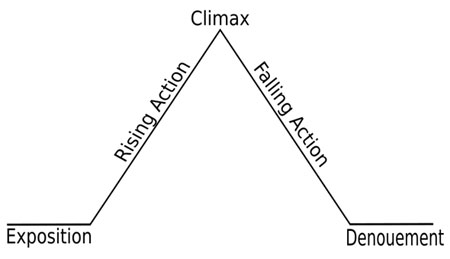
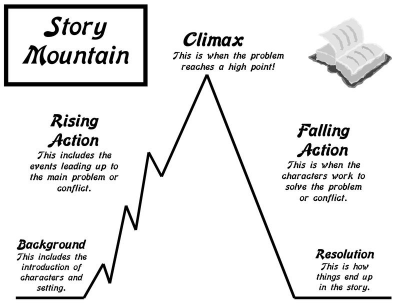
    And what the heck is this chart? Do writers really use this? (Not many that I know.)

    Story Diagram plot-mountain-pic

    And does anyone think changing the diagram to look like Aspen, Colorado actually helps?

    Story Diagram Aspen 

    Hey, students—please make your story look like Aspen, Colorado!  (Yeah, that’s going to be effective.)

    And yet it’s not as difficult as it appears. Nellie and I have seen a lot of kids really get into writing stories. We’ve seen kids WILLINGLY going way beyond the assignment to write stories that are eight, twelve, twenty-five plus pages. And as they’re writing, they’re practicing grammar, spelling, structure, vocabulary, etc. without knowing it and having a great time. I know that if you enable your students, many of them will write, write, write. Especially in grade school. But also in the higher grades.

    Stories can be a blast. The assignments can connect to many students. And the results can be wonderful. I’ve laughed out loud at some of the stories coming out of Nellie’s class. Others have been enjoyable on other levels.

    But for this to work in your class, you need to know some key things. You need to understand the core of story and the story development process. You need a lesson plan that details everything step-by-step so your students don’t flounder. And you need to know some fundamental tips (secrets?) about teaching this content.

    So I’m going to hold this day-long class for you. A full eight hours. And share everything Nellie and I have learned. This class will be for teachers at ALL levels (I’ll show you some ways to scale the complexity of what you’re doing). There will be NO cost. The only thing you have to bring is a pencil, paper, whatever program materials you have, and a willingness to have a good time.

    When we finish, you will know how to write a simple story like the ones your students will write because, ta-dum, you will write one! AND you’ll have a step-by-step lesson plan that builds on whatever materials you have—an official program or one of your own. AND you’ll understand story better than 99% of the population. AND you’ll have a bundle of techniques to help your students. AND you’ll solve both world peace and maybe the lost sock conundrum.

    Truly, I think that instead of feeling stress, you’ll actually be looking forward to teaching and writing stories with your students. If not, you may bring tomatoes and huck them at me, but please be aware that I will not stand still; to find satisfaction, you will have to be able to hit a moving target.

    If you’re interested, just click the Contact John link under my photo in the left sidebar and send me an email letting me know.

    Hope to see you in class!

    GET READY FOR A FUN DAY OF LEARNING!

    Topic: Teaching writing (narrative & the common core)

    Who: Teachers (and writers at least 18 years old), seats are limited

    When: Monday, July 29th, 8:15 AM – 5:00 PM

    Where: Rich Middle School, 54 E 100 S  Laketown, UT 84038

    Materials you need to bring:

    • Pencil
    • Paper
    • The writing program you’ll be using this year
    • Kooky socks, for those who cannot resist the urge
    • A lunch or a way to get one

    AGENDA

    8:15 AM Arrive

    8:30 AM – 9:20 AM

    • Can you create a redneck crapper?
    • The 1st secret to teaching writing: Attributes & techniques
    • The 5 parts of story
    • Thieves prosper – using existing patterns
    • A car, a beggar, and an idiot — basic pattern 1

    9:30 AM – 10:20 AM

    • The 2nd secret to teaching writing: Do it with them
    • Technique: Sketch then draft
    • Workshop 1: Zombies and kisses
    • Technique: Zing hunting
    • Workshop 2: Hunt zing

    10:30 – 11:20

    • What makes a story big or small
    • Workshop 3: Select a right-sized THOM and character
    • Workshop 4: Select a Goal
    • Workshop 5: Make character sympathetic
    • Workshop 6: 3 tries
    • Workshop 7: Resolution

    LUNCH

    12:00 – 12:50

    • The 3rd secret to teaching writing: Cognitive modeling and the 6-step process
    • The 4th secret to teaching writing: Our tiny brains
    • Writing is telling: Narrative & description
    • Technique: Yes, SiR
    • Technique: Broad-brush + 1
    • Technique: The Pause

    1:00 – 1:50

    • The 5th secret to teaching writing: Have fun
    • Workshop 8: Write your story

    2:00  – 2:50

    • How the pros revise—concept, line, & copy
    • Workshop 9: Content edit
    • The 6th secret to teaching writing: Our brains are still tiny
    • Workshop 10: Line edit

    3:00 – 3:50

    • The 7th secret to teaching writing: The 3 grunts (responding to a story and grading)
    • Share stories
    • What the heck did we just do?

    4:00 – 4:50

    • How to adjust for grade level
    • Common core
    • Your program and lesson plan
    • Identify black holes
    • Wrap up & next steps
    Share
  • | |

    Speculative Fiction, Gateway Drugs, and Literacy

    You can read the transcript of my remarks at the American Librarian Association (ALA) conference in Chicago on July 11 below as well as the supporting information.

    IS SF/Fantasy Key to Teen Literacy?

    Intro

    I am so happy to be here. And I’m happy share some good news. David McCollough, the Pulitzer prize winning historian shared this fact in his commencement speech at the University of Utah this spring. “There are yet “more public libraries in America than there are McDonalds.” [Cheering]

    We have not yet been assimilated!

    Of course, this is due in a large part to you, the librarians who care for the collections and take care of the patrons. Which is why I think you deserve a big round of applause. Give yourselves a hand. [Applause]

    Fiction is a literal drug

    I want to start my remarks with two quotes.

    Ray Bradbury was recently interviewed in a NY Times article  He said, “I don’t believe in colleges and universities.” This is what he said, “I don’t believe in colleges and universities. I believe in libraries.” He said this because when he graduated from High School he didn’t have enough money to go to college. So he went to the library three days a week for ten years.

    The next quote is from the great poet Dylan Thomas–“Do not go gentle into that good night, rage, rage against the dying of the light”–that guy. He said,  “My education was the liberty I had to read indiscriminately and all the time, with my eyes hanging out.”

    If you look at Bradbury and Thomas, they read, not because there was some grade involved, not because someone went after them with a stick—they read from hunger. From thirst. They read with wild abandon because they found in reading something they couldn’t find elsewhere.

    I want to suggest one thing they found was a drug. [Laughter] I’m not speaking in metaphor. I’m talking about real physical response. As real and physical as the response you get when you or I take aspirin, brandy, or crack. Well, I hope we’re not taking crack. [Laughter] 

    When we think about drugs we think about pills, smoke, injections. But those are simply one set of delivery mechanisms for chemicals that trigger a physical response. There are other delivery mechanisms. Other triggers. One of them is fiction.

    Now I don’t have time today to detail how this works. But I will write it up on my website for those who are interested. The key thing to remember is that fiction, the kind of fiction we love, the kind that keeps us up at night sitting on the edge of the tub or locked in a closet with a light, the kind of fiction goes beyond cognition, beyond data and facts. We find it so pleasurable precisely because it triggers and guides a physical response.

    So how does all of this apply to science fiction and fantasy? Here’s the deal. And here’s where we come to our topic. Science fiction and fantasy is, for our youth, one of the most powerful gateways drugs into the fictive experience. Of course, there are ideas in science fiction and fantasy that ripple out to the society. But even if there weren’t, the happy side-effect of an addiction to this drug is improved literacy. And we all know how much that impacts.

    Numbas

    Now I know those of you who work with young adult circulation have seen this. But I thought it might be interesting to get some actual numbers so we can start to gauge the scope of the science fiction and  fantasy effect.

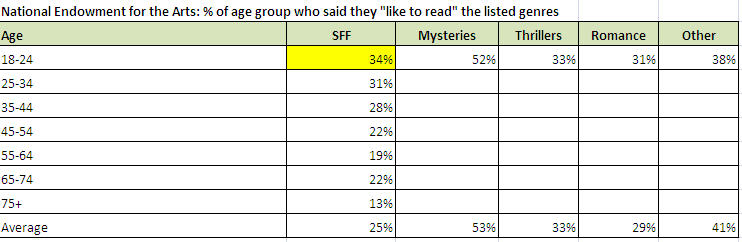
    My interest in this began when I saw the results of the latest NEA survey. They have this graph showing reading rates in all age groups dropping horribly since 1982. By 2002 the graph is taking a nose dive.  Then in 2008 everything turns around. And among the young adults (18-24), we see the biggest increase—9%.

    I saw they had a genre preference question in this survey. Of course, I wondered about science fiction and fantasy. So I contacted the NEA and dug into the details. It appears that 34% of the 18-24 group say they like to read science fiction and fantasy. That’s a big number. That’s 1 in 3.

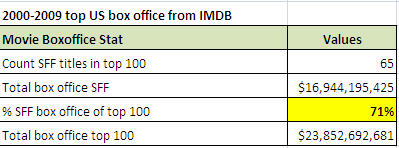
    Of course, I wanted another data pont, so I went to BookScan and asked for data on book sales. Because the wonderful people there love librarians and Tor Books, they said of course. We looked at juvenile fiction sales from 2004-2008. What we saw was that science fiction and fantasy grew 144% during that period. All the other genres only grew 23%. We also saw that science fiction and fantasy currently make up almost 30% of the juvenile fiction market. So about 1/3.

    Now there are some problems with the BookScan data. Yes, it only cover 60-70% of the market. It’s not in Wal-mart, grocery stories, and a few other places. But what’s more problematic for this issue is that they don’t break up the juvenile sales by age. It includes everything for folks one month old to age eighteen. So I’ve got books like Go Dog, Go in the dataset along with Twilight and Go Dog, Go isn’t categorized as fantasy. [Laughter] My suspicion is that if we narrow it down to the middle grade and YA group, we’ll see more science fiction and fantasy.

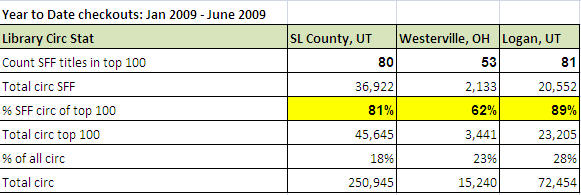
    So I needed someone who did break it up by age. Well, who does that? You do. Libraries do. Besides, a lot of youth don’t have the $ to buy lots of books. So I went to some libraries in Utah and Ohio and got their YA fiction circulation stats. Here’s what I found: 60-80% of the YA fiction circulation is science fiction and fantasy. This does not include graphic novels or magna. It’s text fiction.

    Folks, this is a big drug. I don’t know what part science fiction and fantasy played in the rise in reading rates, that would require a larger and more rigorous study. But I can tell you this: We want to see the impact of science fiction and fantasy on our society? We’re seeing it right now.

    My Story

    This large effect makes sense because science fiction and fantasy deliver experiences that are intersting to and matter to youth. It’s chock full of and encounter with the strange, weird, and wonderful; adventure and danger; doing something meaningful; being someone special, someone desireable, someone wanted in the group. All that coming of age stuff. So no wonder it’s a huge gateway drug.

    I know that it was in my case. I wasn’t a reader. I don’t think I read more than twenty or twenty-four book from kindergater to sixth grade. I look at the little fellows in my local school today and they read that many titles in the first six months of the first grade. But I didn’t. I wasn’t a reader. I do remember loving the look and feel of these small chubby books. [Laughter]

    I would take them them up to the librarian to check them out. She’d look down at me. “Are you going to read all that?” she’d ask. “Yes,” I’d say. Of course, it was lie. [Laughter] It was a huge lie because I would take them home and put them up on my dresser and just look at them.  Just loving the look and feel. And then when it was time to check them in, I’d take them back and give them to the librarian. “Did you read all that?”

    “Yes,” I’d say. And that’s how I became an author–lying to librarians. [Laughter] 

    Now in sixth grade my sister, we were in the car, I had four sisters and we had one TV, and so you had to reserve the time for your programs. So my sister says, “I have to watch The Hobbit for school.” Now I don’t know anything about The Hobbit. It sounded like a romance. [Laughter] I protested. No, way–we’re not going to watch some dumb kissing thing.

    “No,” she said. “It’s got dragons.”

    “You’re lying,” I said.

    I was convinced I was doomed. But it didn’t matter. We watched it. It had dragons. And I loved the experience so much I wanted another hit. Shortly thereafter my mother and father went on a business trip. I went over to my buddy’s house. So the first day we come up out of the basement to go to school and I said, “Oh, I’m feeling sick.” So my buddy went off to school and I went back down into the basement and played hookie for two days and read The Hobbit.

    It was amazing. More amazing than the movie. I had to have that experience again. And so I read Ursula LeGuin, Patricia McKillip, Donaldson, Terry Brooks. I kept reading because it delivered a cognitive-physical experience I loved. Of course, I didn’t put it that way back then. It was more along the lines of, duuuude. [Laughter]

    Now I got a BA in English and a Masters in Accounting. Those degress required a lot of reading. But I didn’t develop the requisite literacy skills in school. I developed them in science fiction and fantasy.

    And so when I started to write I was naturally drawn to fantasy. Having experienced this wonderful thing, I wanted to produce that and share it with others. So this novel that’s coming out has the gosh-wow I still love. It’s set in a world were humans are ranched by beings of immense power. There’s a young man and young woman in terrible trouble. So it has monsters, magic, and mayhem. But I also found fantasy big enough to let me explore other things that have become more important to me as I’ve aged. Like family, sacrifice, and redemption. And I hope people enjoy all that. But ultimately, I hope this book does for someone else what The Hobbit did for me and opens a door to a wonderful addiction. And, of course, as a powerful side-effect, improves the literacy of some rascal or rascaless. [Laughter]

    Conclusion

    I want to end where we began with that Thomas quote.

    “My education was the liberty I had to read indiscriminately and all the time, with my eyes hanging out.”

    That kind of wild abandon will happen when the drug takes effect. And for many of our youth, probably at least one in three, that’s going to be when they ingest a few ounces of SF & Fantasy.

    Thank you.

    [Applause]

    Supporting Numbers

    How fiction is a drug

    Emotion is not a cognition, although cognition plays a part. It’s not just in your brain. It involves a physical response, which means it involves chemicals. 

    We sometimes forget that our bodies produce a staggering number of chemicals. Sometimes they produce in response to external stimuli—the sun triggers the creation of vitamin D, ingested sugar triggers the production of insulin, the sight of a ravening lion standing not five feet away with nothing between him and me produces, among other things, adrenaline.

    Lots of these reactions, we don’t notice. But there’s a whole group of these physical responses that we do. We lump them together and call them emotions.

    Jenefer Robinson in her wonderful book Deeper Than Reason, explains, “Emotions are our way of responding to events in the environment (either external or internal)” that matter to us. They are “physiological changes that register the event in a bodily way and get us ready to respond appropriately.” Fight, flight, pursue, woo, investigate. They focus our attention, get us ready to take action, and communicate all this to others.

    So while I might not feel the production of vitamin D, I do feel the fear of the lion. Fear is a wonderful thing—it keeps us alive. It raises our heart rate, pumps us full of drugs that prepare us to flee or fight. The emotion writes itself on our faces in order to, among other things, communicate the situation to those around us, warning others and calling for help. It is a physical response. Yes, there are cognitions involved, but there are also chemicals.

    The latest research on emotion shows that emotion is a process that involves three things. (1) An affective appraisal of our environment that signals something important to us—a threat or opportunity. (2) This triggers an immediate physical response (chemicals, galvanic skin response, accelerated heart rates, facial expressions, etc.). (3) At this point cognitive (conscious thought) appraisals kick in and help us monitor the situation and moderate the physical response.

    For example, I go out to the yard and step on this thing that slithers through the grass. The sensory signals immediately trigger a physical response to get me ready to flee or fight–heart rate, adrenaline, etc. Then I notice the snake is far too long. I look closer. It’s the garden hose. My physical response changes. I laugh, feel relief. Research has shown that when we read text, the same process occurs. We do indeed have the same types of physical responses. In some cases they’re more intense.

    Now here’s the thing. This physical response is triggered not just by threats and opportunities we perceive with our senses, things out there. It is also triggered by thought. Thoughts deliver a physical response just as surely as crack does. We have the research to prove it. In fact, sometimes thought delivers a more powerful physical response. Here’s but one example. Did you know that people with a phobia of snakes have a stronger reaction to reading a passage about snakes than they do to the actual critter?

    This is where fiction comes in. As I stated in my speech, fiction, the kind of fiction we love, the kind that keeps us up at night sitting on the edge of the tub or locked in a closet with a light, the kind that lingers in the fabric of our clothes and our hair long after we close the book, that kind of fiction goes beyond cognition, beyond data and facts. That kind of fiction triggers a physical response.

    It does this, and this is one difference from emotion triggered by our own thoughts or the sensory data we pick up from the world, because fiction, by its very nature, its very structure, is actually guiding our emotional response. Our physical response. This management of the response is in fact one of the things that we find so pleasurable about it.

    To find out more, please read:

    • The Science of Emotion by Randolph R. Cornelius
    • Deeper Than Reason: Emotion and its Role in Literature, Music, and Art by Jenefer Robinson

    You may then want to search out texts by Dolf Zillmann, Jennings Bryant, and Peter Vorderer.

    Share