Sector Five Radio’s “Super Writers of the Universe” book signing

I’ll be signing September 25 with a whole bunch of other SFF authors. Come by and say hello.

Saturday, September 25, 11 am – 1 pm Book Signing West Jordan, UT Super Writers of the Universe and Friends from Sector Five Radio, AM 630 K-talk. 10 SFF authors, including me, Tracy Hickman, Dave Farland, Howard Tayler, Larry Correia, and Eric James Stone.

Barnes & Noble – Jordan Landing 

7157 Plaza Center Drive

West Jordan, UT 84084

801-282-1324

Saturday, September 25, 3 pm – 5 pm Book Signing Murray, UT Super Writers of the Universe and Friends Same 10 authors, but this time at Borders

Borders – Murray

132 East Winchester

Murray, UT 84107

Share

Similar Posts

  • |

    The 3 Things You Must Learn to Write Killer Stories: Feb 20 @ BYU

    Mark your calendars!!

    The free, 2009 Life, the Universe, and Everything symposium at BYU will run Thursday – Saturday, February 19 – 21.

    The speical guests are Tracy & Laura Hickman (Dragonlance authors) and James C. Christensen (yes, the amazing fantasy artist). But there will be more than a dozen other authors there, including: L.E. Modesitt, Brandon Mull, James Dashner, Brandon Sanderson, David Farland, Mette Ivie Harrison, Eric James Stone, Howard Tayler, and a number of others.
     
    Here’s what I’ll be doing:

    1. Panel: The Principles of Suspense. Fri, Feb 20, 1:00 PM – 2:00 PM
    2. Workshop: The 3 Things You Must Learn to Write Killer Stories. Fri, Feb 20, 6:00 PM – 8:00 PM
    3. Panel: Myth and Mythology in SF&F. Sat, Feb 21, 1:00 PM – 2:00 PM
    4. Reading: from the forthcoming novel and a few of my other published works, Sat, Feb 21, 3:00 PM – 4:00 PM

    If you want to write fiction, you’ll want to attend the workshop. And if you’ve attended the workshop before, know that I’ve made some significant updates to the workshop content for 2009. I’m always learning, and so each time I teach this I’m able to provide more insight.

    You’ll also want to carefully review the whole schedule. There are tons of panels with professional authors on them that are going to be both useful and interesting to writers.

    My workshop focuses on three incredibly important things.  In the beginning, I didn’t know these key things, and that ignorance stymied all my writing efforts for years. Once I learned them, the way was opened. There was still a lot of work involved. But these principles increased my output of quality material 1000% (literally). The principles allowed me to write the story that got me my current three-book contract from Tor.

    I’ve taught it now more than a dozen times to all sorts of fiction writers and they’re telling me they’re finding it very useful. You’re going to love this stuff, and I always enjoy sharing what I’ve learned with other writers. The three things are:

    1. What a story really is. We’re not talking narrative taxonomy, although that’s included. It’s focused on the story effect upon the reader. And why this is one of the most important things you need to understand when writing fiction.
    2. Parts & principles. Key principles of character, problem, plot, setting, and text as they relate to #1.
    3. The creative process. The simple but powerful principles of how to get ideas. How to develop them into story. Why writer’s block is a gift and how to use it to produce MORE. Plus a number of other creative principles I wished I’d known.

    It’s a highly interactive workshop. Again, the whole symposium, including the workshop, is free. I don’t know another place where you can learn from so many professionals for such a great price.

    Hope to see you there!!

    Share
  • Calendar updates

    I’ve added a number of entries to the calendar, including three conferences I plan on attending.

    I know I’ll be presenting at the first two. The title and description of the League of Utah Writers presentation are:

    TITLE: The Secret to Getting Story Ideas

    DESCRIPTION: How to stop generating great story ideas by accident and start generating them on purpose, whenever you need them.

    I don’t know what I’ll do for LTUE. I might do a repeat of the “The Secret to Getting Story Ideas,” or I might do something on how to write scenes or how genre is the key to plot. Stay tuned!

    Date & Time Event Location Notes
    Right now Writing Office It’s all for you, Dear Reader
    2015, Summer Release of Awful Intent, a Frank Shaw novel All major online retail venues The date is not firm.
    2015, Aug 28-29 League of Utah Writers Fall Conference Logan, UT League of Utah Writers
    2016, Winter Release of Hard Target, a Frank Shaw novel All major online retail venues The date is not firm.
    2016, Feb 11-13 Life, the Universe & Everything Provo, UT LTUE website
    2016, May LDStorymakers Conference Provo, UT LDStorymakers website
    2016, Summer Release of Glory: The Dark God Book 4 All major online retail venues The date is not firm.
    Share
  • Yo, John and Larry do Colorado this Saturday!

    Larry and I will be in Lone Tree (South Denver) and Loveland Saturday, December 5th. Drop by and say hello, buy one of our books as a gift, or just show up with your Klingon outfit and gun.

    John Brown events at Barnes & Noble

    Saturday,
    December 5
    1 pm – 3 pm
    Meet public, discuss book, signing–Brown & Correia Loveland, CO Barnes & Noble
    The Promenade Shops at Centerra
    5835 Sky Pond Drive
    Loveland, CO 80537
    (970) 663-9473
    Saturday,
    December 5
    5 pm – 7 pm
    Meet public, discuss book, signing–Brown & Correia Denver (Lone Tree), CO  Barnes & Noble
    Barnes & Noble Booksellers
    8374 South Willow Street
    Lone Tree, CO   80124
    (303) 706-9660
    Share
  • | |

    Teachers (and writers)! Free Class Next Monday on How to Teach Narrative for the Common Core

    If you feel a bit lost or anxious about how to teach narrative for the new core, especially stories, I think I can help.

    I’m an educator in the private sector and an award-winning novelist and short story writer. I’ve been teaching authors in various venues how to write for the last five years. I’ve been on writing podcasts with thousands of listeners, taught at a number of writers conventions, and had a series of articles published by the national Science Fiction and Fantasy Writers of America organization, an organization for professional authors. I’ve also been helping Nellie, my wonderful wife, teach her 7th and 8th grade language arts students the unit on short stories during that same period. We’ve taught it to twenty different classes and picked up a number of important insights along the way.

    This last year I couldn’t help but examine all the materials Nellie brought home during the district’s writing program adoption investigations. Some programs looked very promising; others not so much. Some got some things about writing flat out wrong. Most of the programs had gaps.

    Furthermore, because I work with so many people wanting to write, I know that it’s difficult to teach if you really don’t understand what stories really are and how they work. For lots of people, the subject matter can seem impenetrable. And yet writing stories is such a wonderful way to teach writing, especially because so many kids love it. You won’t find a kid who will spend extra hours writing a business letter or poem analysis, but you will find quite a few who will go crazy writing stories. And the whole time they’re practicing their writing skills.

    The question is how DO you write a story?

    What is a story?

    How can you tell if it’s good?

    How do you come up with ideas?

    Where do you start?

    And what the heck is this chart? Do writers really use this? (Not many that I know.)
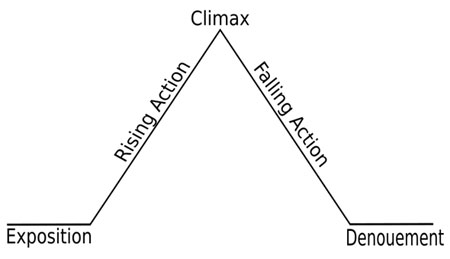
    Story Diagram plot-mountain-pic

    And does anyone think changing the diagram to look like Aspen, Colorado actually helps?
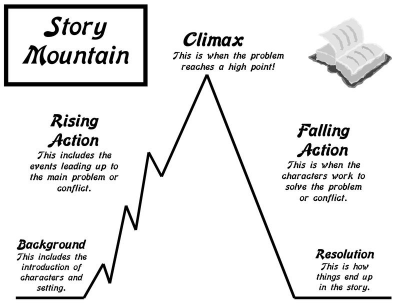
    Story Diagram Aspen 

    Hey, students—please make your story look like Aspen, Colorado!  (Yeah, that’s going to be effective.)

    And yet it’s not as difficult as it appears. Nellie and I have seen a lot of kids really get into writing stories. We’ve seen kids WILLINGLY going way beyond the assignment to write stories that are eight, twelve, twenty-five plus pages. And as they’re writing, they’re practicing grammar, spelling, structure, vocabulary, etc. without knowing it and having a great time. I know that if you enable your students, many of them will write, write, write. Especially in grade school. But also in the higher grades.

    Stories can be a blast. The assignments can connect to many students. And the results can be wonderful. I’ve laughed out loud at some of the stories coming out of Nellie’s class. Others have been enjoyable on other levels.

    But for this to work in your class, you need to know some key things. You need to understand the core of story and the story development process. You need a lesson plan that details everything step-by-step so your students don’t flounder. And you need to know some fundamental tips (secrets?) about teaching this content.

    So I’m going to hold this day-long class for you. A full eight hours. And share everything Nellie and I have learned. This class will be for teachers at ALL levels (I’ll show you some ways to scale the complexity of what you’re doing). There will be NO cost. The only thing you have to bring is a pencil, paper, whatever program materials you have, and a willingness to have a good time.

    When we finish, you will know how to write a simple story like the ones your students will write because, ta-dum, you will write one! AND you’ll have a step-by-step lesson plan that builds on whatever materials you have—an official program or one of your own. AND you’ll understand story better than 99% of the population. AND you’ll have a bundle of techniques to help your students. AND you’ll solve both world peace and maybe the lost sock conundrum.

    Truly, I think that instead of feeling stress, you’ll actually be looking forward to teaching and writing stories with your students. If not, you may bring tomatoes and huck them at me, but please be aware that I will not stand still; to find satisfaction, you will have to be able to hit a moving target.

    If you’re interested, just click the Contact John link under my photo in the left sidebar and send me an email letting me know.

    Hope to see you in class!

    GET READY FOR A FUN DAY OF LEARNING!

    Topic: Teaching writing (narrative & the common core)

    Who: Teachers (and writers at least 18 years old), seats are limited

    When: Monday, July 29th, 8:15 AM – 5:00 PM

    Where: Rich Middle School, 54 E 100 S  Laketown, UT 84038

    Materials you need to bring:

    • Pencil
    • Paper
    • The writing program you’ll be using this year
    • Kooky socks, for those who cannot resist the urge
    • A lunch or a way to get one

    AGENDA

    8:15 AM Arrive

    8:30 AM – 9:20 AM

    • Can you create a redneck crapper?
    • The 1st secret to teaching writing: Attributes & techniques
    • The 5 parts of story
    • Thieves prosper – using existing patterns
    • A car, a beggar, and an idiot — basic pattern 1

    9:30 AM – 10:20 AM

    • The 2nd secret to teaching writing: Do it with them
    • Technique: Sketch then draft
    • Workshop 1: Zombies and kisses
    • Technique: Zing hunting
    • Workshop 2: Hunt zing

    10:30 – 11:20

    • What makes a story big or small
    • Workshop 3: Select a right-sized THOM and character
    • Workshop 4: Select a Goal
    • Workshop 5: Make character sympathetic
    • Workshop 6: 3 tries
    • Workshop 7: Resolution

    LUNCH

    12:00 – 12:50

    • The 3rd secret to teaching writing: Cognitive modeling and the 6-step process
    • The 4th secret to teaching writing: Our tiny brains
    • Writing is telling: Narrative & description
    • Technique: Yes, SiR
    • Technique: Broad-brush + 1
    • Technique: The Pause

    1:00 – 1:50

    • The 5th secret to teaching writing: Have fun
    • Workshop 8: Write your story

    2:00  – 2:50

    • How the pros revise—concept, line, & copy
    • Workshop 9: Content edit
    • The 6th secret to teaching writing: Our brains are still tiny
    • Workshop 10: Line edit

    3:00 – 3:50

    • The 7th secret to teaching writing: The 3 grunts (responding to a story and grading)
    • Share stories
    • What the heck did we just do?

    4:00 – 4:50

    • How to adjust for grade level
    • Common core
    • Your program and lesson plan
    • Identify black holes
    • Wrap up & next steps
    Share
  • New series on writing coming next week

    I believe that there are three things you need to know to write stories. The better you know them, the better and more stories you’ll be able to write. Those three things are:

    1. What stories do, i.e. what you’re trying to do as an author.

    2. The principles of how character, setting, problem, plot, and text work to do those things.

    3. The principles of coming up with and developing stories.

    About this time last year I wrote my series on the key conditions for creating reader suspense, which went into depth on things 1 and 2. And I’ve written a bunch of other blogs on those topics. This year I’m going to be doing one on the key principles of getting and developing killer story ideas. I’ll be presenting it in a shortened form at this year’s League of Utah Writer’s roundup on Saturday (see my calendar for more details). One neat thing about this series is that I will have a number of other authors illustrate the principles with their own work. When learning this type of stuff, I don’t think we can’t get enough concrete examples. Keep your eyes open. I think it’s going to be a good one.

    Share
  • |

    All you need is a little beating and robbery

    Mrs. Brown, my wife, teaches language arts for the 7th and 8th grades as well as reading comprehension. She’s big on reading. She wants to provide every opportunity for kids to not only get good at it, but also learn to love it.

    And so her walls are lined with bookshelves full of awesome books teens love. She reads the first chapters of books to her classes to let them sample various stories. She features their book reports. She has them paste the covers of the books they’ve read on pages displayed around the classroom. And the school’s awesome librarian supports with her own programs.

    The 7th and 8th grade students at Rich Middle School are marinated in a big celebration of reading.

    In Mrs. Brown’s class, it’s fairly straight forward to get an A on reading, which is a huge part of your grade—all you’ve got to do is read.

    But how much reading do they need to do? How do you track it? And what books should they read?

    Check this out.

    First, she tests each student to see what his or her reading speed is.

    Next, she takes the number of hours they’re supposed to be reading each week for homework (I think it’s 2 or 2.5), then does the math to get a feasible reading word count for the trimester for each student. She may adjust it a bit, depending on the student’s ability.

    Third, she presents that number to the student, and the two of them set a word count goal for the trimester. Talk about an individualized goal.

    If you want to get an A in reading, all you have to do is reach that word count goal.

    How do you know how many words a book has?

    The Accelerated Reader program provides that information.

    But how does she know that they’ve read the books?

    She uses the Accelerated Reader tests. And if there isn’t one, the student can write a report.

    And what books do the students read?

    Any dang book they like.

    I love this. The kids get to select their own books and just read, read, read.

    Another part of this is that she pings each student once a week to ask them what book they’re reading, what page they’re on, and what they think of the book. This weekly check-in provides the more frequent accountability students of that age need.

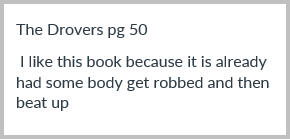
    Yesterday, she received this report from one of her 8th grade boys who is reading Prey, the first book in The Drovers series.

    Oh, yeah.

    I’ll take that any day (grin).

    Rock on, budding reader.

    Share