Uncanny cool

I just had the most uncanny, coolest experience. It’s 6 PM. I’m out on a walk along a road that runs by a swampy river called Birch Creek to a fork in the road. The sky is this glorious blue with brilliant white and gray clouds. I stop and pick some ripe black currents off a little spindly bush growing down off the shoulder in the rocks and continue on.

I take the left fork, south along the hill and enjoy the sight of the mown fields, a scattering of green ton bales standing on the short meadow grass, and the storm clouds gathering over the hills to the west.

A few rabbits spook and run across the road. I reach the mile mark and turn back. I’d already done 30 minutes worth of shred before the walk and needed to get back to practice basketball with my oldest. The whole time I’m listening to Lois McMaster Bujold’s HALLOWED HUNT read by Marguerite Gavin. It’s warm, sunny, lovely. The story is good.

I come back by the fork and hear this sound over the audio. It’s like a single prop airplane in the distance. I continue on another hundred yards. That distant, thin drone grows, but I can’t figure out what it is, so I put the audio book on hold and take off the ear phones.

The air is perfectly still. That muggy stillness that precedes a storm. But all around me is this sound. This thin drone, filling up road. It’s coming from all sides.

Insects?

I look down off the side of the road at the sloughs and cattails and willows and see nothing. I look back up. Look around. And then I notice a small black body speed past. And another. And another.

Flies? It can’t be flies. When have you ever seen a fly pursue a straight line?

Three more. Half a dozen. Another, another, and they’re everywhere. But they’re not flying thickly. Not mobbing. Not massed in some cartoon clump. They’re all spread out. I strain to see them in this odd light.

Bees. They’re dark. Almost black in their flight, but it has to be bees!

And they’re all around, thirty feet to either side of me. Zooming past. There, there, and there. It’s like dozens and dozens of refugees in flight with single purpose. There’s no looping around. No dalliance. No crazy panic. They’re serious, focused. All of them going the same way. Straight ahead on some urgent goal.

There’s a big fat blue dragonfly in the willows that keeps zipping after individual bees as they fly past, trying to get a meal, but each time, just at the moment when it would attack, it spooks and darts back for cover. Dragonflies are voracious buggers. But these aren’t single bees. It must be thinking the other bees are coming for it. Still it can’t resist and darts out again.

And all around is the humming. It grows. The bees directly in front of me see me as they approach and make course corrections. I keep walking. A half a mile and the thin droning still surrounds me. The bees keep coming, but they’re thinning.

Thunder cracks behind me. The wind begins to pick up. The sky behind me is darkening.

The sound of the drone grows thinner, is almost gone. But there are bees still out there, following. I can hear them. See them. Individuals trailing the others, flying past me toward the storm that’s still about a mile off. And I think they’re too far behind.

Maybe their hive was wrecked. Maybe it’s just time to swarm and there’s a queen up front leading them. And somehow her scent is on the wind. Somehow they know to follow.

I don’t know if they’ll find a new place. They’re going to have to cross a mile of mown meadow before they get to anything that might serve as any type of shelter. I don’t know if the wind will ground them, or the main group will find safety but the stragglers will be blown to their deaths. All I know is that I’m sitting here in awe, electric with life.

Share

Similar Posts

  • A happy friend is worth about $20,000

    This is based on research, folks.

    But we didn’t need scientists to tell us this. The old Frank Kapra films like IT’S A WONDERFUL LIFE that have been demonstrating this for years.  I think we need a new government measurement. We’d call it the GDH, the gross domestic happiness index. And then we can see who really is rich, e.g. my five bunko buddies cancel out your Lexus any day.

    Joking aside, this shows how much social interaction is built into our genes. And why we tend to tire of congenital whiners, complainers, and sadsacks. Not to say that people who are sad shouldn’t be. But that a happy friend or family member, who listens with kindness, can be a great boon to someone who is suffering.

    People with the most social connections — friends, spouses, neighbors, relatives — were also the happiest, the data showed. “Each additional happy person makes you happier,” Christakis said.

    “Imagine that I am connected to you and you are connected to others and others are connected to still others. It is this fabric of humanity, like an American patch quilt.”

    Each person sits on a different-colored patch. “Imagine that these patches are happy and unhappy patches. Your happiness depends on what is going on in the patch around you,” Christakis said.

    “It is not just happy people connecting with happy people, which they do. Above and beyond, there is this contagious process going on.”

    And happiness is more contagious than unhappiness, they discovered.

    “If a social contact is happy, it increases the likelihood that you are happy by 15 percent,” Fowler said. “A friend of a friend, or the friend of a spouse or a sibling, if they are happy, increases your chances by 10 percent,” he added.

    A happy third-degree friend — the friend or a friend of a friend — increases a person’s chances of being happy by 6 percent.

    “But every extra unhappy friend increases the likelihood that you’ll be unhappy by 7 percent,” Fowler said.

    The finding is interesting but it is useful, too Fowler said.

    “Among other benefits, happiness has been shown to have an important effect on reduced mortality, pain reduction, and improved cardiac function. So better understanding of how happiness spreads can help us learn how to promote a healthier society,” he said.

    The study also fits in with other data that suggested — in 1984 — that having $5,000 extra increased a person’s chances of becoming happier by about 2 percent.

    “A happy friend is worth about $20,000,” Christakis said.

    Here’s the full article.

    Share
  • |

    Story zing method: fiddling with knobs

    One of the most basic way of coming up with story ideas is to take a familiar story or thing, list out what’s commonly associated with it, then start changing some of those elements.

    For example, you list out all the normal things for vampires–the coffins, black, bats, sucking blood, etc.–then you begin to twist. What if the vampire wears, instead of black, some styling plaid? What if it isn’t a person but a rabbit (whoops, that one’s been done)? What if instead of gothic places like catherals you find him in a trailer park? What if instead of being dangerously suave, he’s a drunk?

    Do you see? You can do this with anything.

    In this interview, Matthew Sturges talks about how he did just that with the movie The Dirty Dozen and ended up with with Midwinter, a novel about prisoners given another chance. According to Sturges, “In the case of Midwinter, the beginning of the story was, ‘What is prison like in Faery?'”

    Read the whole interview. I think you’ll find it enlightening.

    Share
  • The church of dead chickens

    For about two hours each Sunday I get to teach a bunch of wonderful six and seven year olds at our church. 5 boys. 2 girls. One of the boys likes to rip the buttons off his shirts with his teeth. So I’m thinking, hey, this is my kind of crowd.

    I teach with a man named Jed. Poor mountaineer barely keeps his family fed. One day he was shooting up some food when up from the ground came a bubbling crude.

    Okay, so Jed isn’t a poor, bare-foot fellow with starving kids. He’s an eligible bachelor who helps his father run one of the biggest cattle ranches up here. Nevertheless, his name IS Jed. And we do live in the mountains.

    So anyway, we have a great time with these kids. I mean, with adults, they all sit there polite in their chairs. But with these kids, well, every once in a while there’s one boy who gets up and jigs like Lords of the Flame. We appreciate his art and then get on with the lesson. You also get to say things like, “Hey, do you need to blow that schnoz,” and “get your hand out of your pants” right in the middle of class and nobody bats an eye. During the prayer one of them likes to sit Indian style, hands out, thumbs to the birdie finger (what’s the real name of that finger anyway, Tallman?), and say “oohm.” Trying to break him of that habit. That’s not quite the civilized style of prayer in these parts. But at least he closes his eyes and figures prayer is fun.

    So at the beginning of each class we go around and tell one cool or interesting thing that happened that week. I think their stuff is cool. They think my stuff is cool. We have a cool chat and then move on to professionally prepared lessons. Lots of interaction. I’m a private sector teacher, right? (Look, I’d say “trainer,” but then all them snooty types would say, “So what do you want? Sex TRAINING or sex EDUCATION?” Then they’d look down on me. And I’d say, well, education can sometimes be boring. Let’s try the training part. Then I’d get kicked out of my church job. So I’m keeping my job, okay?)

    Jed and I, we facilitate some good lessons.  Thing is you never know what gets through. Until, of course, the parents give you some feedback.

    I had a party with the kids over at my house. We couldn’t find an official slip-n-slide, so we pulled out some plastic, folded it up, and then set it up on our hill. One benefit of coming to my house for slip n slide fun is that we have a hot water tap outside. Nice for washing cars. Nice for mixing with the cold water so you’re sliding in a warm sploosh. Not some ice fest because you want to be loosey-goosey when you’re careening over grass.

    It was all good until one boy zoomed down the slide at 80 mph while another was trying to straighten our redneck slip-n-slide. The first smacked the other I don’t know where with his head.  All I know is that there was a nice watermelon sound and a delayed wail of extreme pain. We all admired the sound echoing around the hill we live on then moved onto some buddy tag (you call it missionary tag out here in Mormonland). Then to flying paper airplanes off our deck, after which we cooked s’mores over a fire. We ended up with hooligan fireworks on the driveway–smoke bombs and tanks. Everyone loved it. Kids didn’t want to leave. Who would?

    That Sunday we had another fine lesson at the church. So what do you think this kids are going to remember?

    I’ll tell you what they’ll remember. One little gal just told her mom that they needed to get some dead chickens and turkeys and put them on their porch.  This is what they learned in primary from Brother John and Brother Jed. And she’s not the only one talking like that.

    I deny teaching any voodoo.

    Or taxidermy.

    Of course, I will admit that when we were flying airplanes off the deck I told them I wanted to put up a few platforms maybe two feet square down by our garden. Put them up on 7 foot poles and throw some dead animals on them during the winter, maybe a chicken from the store, and watch the bald eagles and hawks gather. I mean, come one. Forget those weiner sparrows. Who wouldn’t want a few bald eagle badboys in the garden, looking down and scaring the cats? We all agreed that was cool then went on flying our multi-colored airplanes.

    So that’s what I’ll admit to. But the parents can’t be mad because being nice to others, especially those with razor sharp beaks and talons that like to rip and tear raw flesh, hey, that’s the second great commandment. I was just teaching the gospel truth.

    Share
  • |

    Animals in Translation by Temple Grandin + Interview

    I have read few books more interesting than Temple Grandin’s Animals in Translation: Using the Mysteries of Autism to Decode Animal Behavior.

    In it she describes her world of autism and how it helped her a perspective into animals unlike any other expert in the field. She can literally see what we block out. It’s part of what helped her make a huge impact on the meat packing industry.

    And it’s had an impact on her. When she was visiting her grandparents once in Arizona, she saw a squeeze chute in operation on a ranch. She saw the cattle calm, for the most part, in the chute. “Watching those cattle calm down,” she says, “I knew I needed a squeeze chute of my own.” So when she got back home she built a human-sized one with the help of her teacher. “I got through my teenage years thanks to my squeeze machine and my horses.”

    Grandin is not a vegetarian activitst (she eats meat herself) or a brutal slayer. She has taken the middle ground between the fantatics that want to prevent the consumption of all meat, on one hand, or totally disregard the life of animals on the other. She writes, she says, “because I wish animals could have more than just a low-stress life and a quick, painless death. I wish animals could have a good life, too, with something useful to do. I think we owe them that.”

    Temple has dozens and dozens of insights into animals, which she shares here. You’ll learn about rapist roosters and the problem of one-trait breeding, whether prediators find it “fun to kill a groundhog” (yes, she says, they do), whether animals have true cognition, and so many other things it’s impossible to list them here. I was fascinated on every page. If you have anything to do with animals, you’re going to LOVE this book.

    Get the book. Read it. In the meantime, watch a 27 minute interview of Temple by Doug Fabrizio on Utah NOW. I caught this on TV flipping through the channels and couldn’t look away. This is a fascinating interview of a fascinating woman.

    Source:Temple Grandin on Utah NOW

    Share
  • Hornswoggle & Happiness

    Since we now know that happiness is contagious and that a happy friend is worth $20,000, I figured I’d provide a practical means of infecting you with some mild levels of joy so you could increase your value. Hey, who needs stinking bionics to become the million-dollar man?

    Have you ever noticed that using some words elevates your mood?

    No?

    Trust me. Words do have power. And I am sure researchers could prove that if you used a certain number of words like “schlub,” “smithereens,” and “diddly” each day, you could raise your happiness level by some statistically significant amount.  And even if they couldn’t demonstrate this, that would only prove that some scientists are made of styrofoam. But we knew that already. The point is that there are some words that are so delicious, goofy, or beautiful they must be preserved at all costs. If only for their happy-making ability. And in that light, I present to you “hornswoggle.”

    (HORN-swog-uhl)
    MEANING: verb tr.: To cheat, hoax, or deceive someone.

    Hornswoggle.

    USAGE: “Now, however, some special interests are out to hornswoggle residents, and they’re stooping low to do it.” Lauren Ritchie; But Doctor, Your Name is on the Mailer; The Orlando Sentinel (Florida); Oct 4, 2006.

    Aaaah, I’m feeling better already.

    You can use this too. See: “Son, don’t try to hornswoggle me,” “That dude’s a hornswoggler,” “Joe’s auto-body is a hornswoggling den of mechanical iniquity.”

    Now add to that skedaddle, discombobulate, and flummadiddle. (If you want definitions, just visit this list from wordsmith.org.)

    Take them home with you. Use them. Spread the happiness around.

    Share
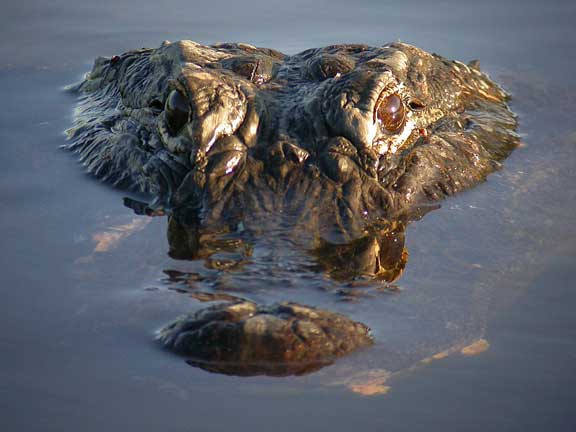
  • Gator Blood

    Crocodiles scare the crap out of me. In fact, I think they’re the scariest things on the planet. Gators make a close second. But they aren’t just monsters to humans. It appears gators have got blood that’s an infection’s worst nightmare.

    Gator blood kills

    So I predict right here that in the not too distant future we’re going to have a product called “Gator Cream” and it will rival the wonderful Neosporin.

    Share

6 Comments

  1. That sounds very cool, but also terrifying! I think once I realized that the bees weren’t interested in me I might have been OK.

    Once when I was working on the flightline, some bees were swarming over near Hotel Flight. I was outside of Kilo Flight, so I was a safe distance away. Some of the guys got badly stung and they had to shut down the flightline for a while.

  2. Thankfully, I’d read up on bees many years ago, and one of the things that stuck out in my mind was that when they were swarming to find a new hive they were quite docile. In fact, some bee farmers could walk up to a branch covered in them and they would remain calm. So I didn’t have any fear. Just to joy and surprise at the good fortune of being in the middle of it all.

    http://en.wikipedia.org/wiki/Swarming_(honey_bee)

  3. And from Christine Mehring, someone who actually owns bees. I asked her to confirm this was a relocation swarming.

    —-

    Hi, John.

    Sounds like a lovely day. Yes, what you described was a colony on the move. Up where you are there aren’t any Africanized bees, and European bees generally only throw one swarm a year in the spring, so what you saw was probably an absconding hive. For reasons unknown, the queen decided to up-stakes. Could have been disturbed by a predator, or discovered disease starting, or they became honey-bound (meaning the workers brought in too much honey and there was no longer space for the queen to lay), or they didn’t have enough nectar sources, or she just didn’t like the color of the wallpaper. At this point in the year, where you are, I’d guess honey-bound. The fact that they were on the move at all indicates a feral colony or a backyard hobbyist’s. Most beekeepers clip the queen’s wing to keep her at home. You’re right that they posed you no threat whatsoever. It is a fine thing to stand in the middle of a calm, peaceful swarm going about their business. Once, I was out hanging laundry when a swarm decided to move into a stack of empty hive boxes in the corner of the yard. It was very beautiful.
    Christine

  4. That reminds me: two weeks ago I was on a road trip through southeast Utah and southwest Colorado. While driving from Mesa Verde to Monument Valley, we passed through Bluff. We were speeding along at 65 beneath the red-rock cliffs, approaching bluff, when I realize that all around there are thousands of butterflies. I check my rear-view to make sure no one else is following me, and slam on the brakes.

    That woke the wife up. The kids looked up from their movie.

    We just sat there for a few seconds, surrounded by thousands of little yellow butterflies. They covered the cut field to our left. Just flitting around, being butterflies. Reminded me of my 7-year-old. I wish that I’d pulled over and gotten out with the kids.

    Later, someone commented that the butterflies migrate down through that area each year. Cool stuff.

  5. Ooh, that would have been lovely. When I was a kid I had something similar with a Monarch butterfly migration. It was incredible. Never saw anything like it again and have always wanted to.

Comments are closed.