Mrs. Brown, my wife, teaches language arts for the 7th and 8th grades as well as reading comprehension. She’s big on reading. She wants to provide every opportunity for kids to not only get good at it, but also learn to love it.
And so her walls are lined with bookshelves full of awesome books teens love. She reads the first chapters of books to her classes to let them sample various stories. She features their book reports. She has them paste the covers of the books they’ve read on pages displayed around the classroom. And the school’s awesome librarian supports with her own programs.
The 7th and 8th grade students at Rich Middle School are marinated in a big celebration of reading.
In Mrs. Brown’s class, it’s fairly straight forward to get an A on reading, which is a huge part of your grade—all you’ve got to do is read.
But how much reading do they need to do? How do you track it? And what books should they read?
Check this out.
First, she tests each student to see what his or her reading speed is.
Next, she takes the number of hours they’re supposed to be reading each week for homework (I think it’s 2 or 2.5), then does the math to get a feasible reading word count for the trimester for each student. She may adjust it a bit, depending on the student’s ability.
Third, she presents that number to the student, and the two of them set a word count goal for the trimester. Talk about an individualized goal.
If you want to get an A in reading, all you have to do is reach that word count goal.
How do you know how many words a book has?
The Accelerated Reader program provides that information.
But how does she know that they’ve read the books?
She uses the Accelerated Reader tests. And if there isn’t one, the student can write a report.
And what books do the students read?
Any dang book they like.
I love this. The kids get to select their own books and just read, read, read.
Another part of this is that she pings each student once a week to ask them what book they’re reading, what page they’re on, and what they think of the book. This weekly check-in provides the more frequent accountability students of that age need.
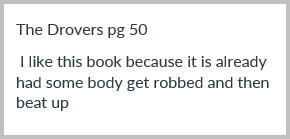
Yesterday, she received this report from one of her 8th grade boys who is reading Prey, the first book in The Drovers series.
If you’re a writer, you’ll find Life, The Universe, & Everything (LTUE)an excellent convention. Yes, it’s focused on science fiction and fantasy, but the principles of writing discussed apply generally and there are a lot of authors who will be there that write in different genres–YA, romance, etc. In fact, there will be a LOT of published authors there, period–including two that have recently been on the NY Times best seller list and others who have just broken in.
If I were an aspiring author, I’d be making sure I had arrangements to attend at least part of the convention. Follow the link above and look at the list of panel topics. And remember: it’s open to all and FREE of charge.
Dates: Feb 11-13, 2010
Wilkinson Center
Brigham Young University
Provo, UT 84602
(801) 422-4636 (BYU information line)
I’ll be doing the following. Hope to see you there!
BTW, Stephen Nelson has graciously offered to film the workshop. If the recording and class pass muster, we’ll post it for your viewing enjoyment!
Thursday, Feb 11
5 – 7 PM: Writing workshop: “How to Write a Story That Rocks” (John Brown, Larry Correia)
Friday, Feb 12
9 AM: Panel: “Paths to publishing: When is traditional best and when should you try an alternative” (Stacy Whitman, John Brown, Dan Willis, Eric Swedin, Sandra Tayler)
1 PM: Panel: “Killer Openings – How to write a gripping, engaging and interesting opening paragraph” (Dr. Steven C. Walker, John Brown, Mette Harrison, Heather Horrocks)
Saturday, Feb 13
9 AM: Panel: “A Guys Take on Writing Romance (Male Panelists)” (L. E. Modesitt, Jr., Clint Johnson, Aleta Clegg, Dan Willis, John Brown)
Noon: Panel: “Building different cultures….” (L. E. Modesitt, Jr., Roger White, John Brown, Brandon Mull, Marty Brenneis)
1 PM: Signing. (Wish very much I could go to Eric James Stone’s reading at the same time. I’ve gone to 2 or 3 of his and have never been disappointed)
I want to thank all of you who emailed and posted comments on the website expressing your anticipation for this book. I really hope you enjoy the story as much as I have.
Happy reading!
John
PS To get the free ebook with your purchase of the big paperback, purchase the paperback, then go to the Kindle store and click on “Kindle MatchBook” in the left sidebar. That will take you to your personal list of books you can get with the MatchBook program. Curse will appear there AFTER you make the purchase.
Just finished chapter 20. It’s been a rough month for writing, but I believe life has settled down a bit, and I should be able to get the time in that I need. I hate giving targets publicly because the last time I did that I just missed and missed and missed. So we’ll stay with the progress gauge. Although I have to say that I might go over thirty chapters. I normally write chapters about 2,500 words long. But these are averaging 2,000. We’ll see. The outline always changes during the first draft.
Homicide rates are down in America, but school shootings are up. What’s going on? What’s driving this?
Some say it’s guns.
I have an hunch that I think deserves some study.
Back in the 1970s we had 30 school shootings with a population of about 216 million.
Today we have a population of 320 million. If we had the same ratio of shootings to population today, we’d have 44 shootings total in the decade between 2010 and 2020. But from 2000 – 2010, we had 60. And since 2010 (if my data is correct, and it appears that’s a big if–see Edit 2 at bottom) we’ve had 146. That’s a 300% increase!
If we want to solve the school shooting problem in the long term, we need to figure out what’s fueling it. One way to get at this is to ask what’s changed since the 1970s and 80s when the rates were lower.
Are we killing at a higher rate in general? Is that what’s changed?
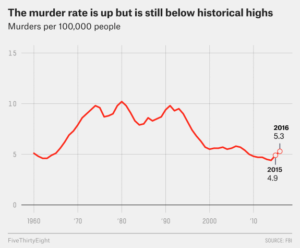
No. FiveThirtyEight reports homicide rates have dropped. Here’s their chart.
We’re down.
But school shootings are up. Way up!
Clearly, what’s driving school shootings doesn’t seem to be the same thing that’s driving general homicide rates. Otherwise, the rates would be moving in the same direction, but they’re not.
Is it gun ownership rates?
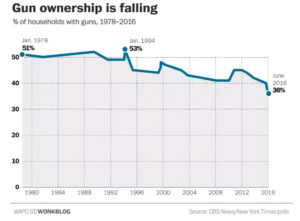
According to the Washington Post, ownership rates are at their lowest in quite some time. Here’s their chart.
This means that if general gun ownership rates were a major factor, then we’d be seeing school shooting rates fall. We’re not.
Furthermore, some of the US states with the highest gun ownership rates have the lowest murder and school shooting rates. (For those wanting to know more about guns, magazines, the definition of an assault rifle, gun control, etc. see Larry Correia’s informational post below.)
Now, it could be that while overall gun ownership rates have fallen, ownership in certain population segments has risen. That’s something to look at. But when looking at the overall ownership rate, we don’t find an answer.
Is there anything else to study? Anything else that might be different now?
Here’s my hunch–it’s the internet. My hunch is that an unintended consequence of social media and the ease of finding certain types of content have facilitated the development of the mindset and ability of certain youth to commit these crimes.
We do things when we are prompted to take a specific action and we have both the ability and desire necessary to take that action. So action requires three things:
A prompt
The ability
The desire
If the rates are going up, then one or more of those things have changed. Either more kids are being prompted to take this specific action, we’ve made it easier for them to do it, or we’ve increased their desire to do it. Or some combination of those three.
Let’s see if the internet might be a factor.
First, from what I’ve read, it seems a lot of these kids feel like outcasts and seem to be seeking some kind of revenge. Does social media foster and facilitate more bullying and isolation and, therefore, more resentment? Has it increased the desire to conduct such attacks?
Second, it is dramatically easier for kids to learn how to do all sorts of stuff now. Back in the 70s and 80s, it was hard to learn about the methods and tactics of crime, firearms, etc. Now, if you want to learn how to shoot, scope a place out, plan an attack, do all sorts of things, you can watch YouTube videos on it. Has the easy accessibility of how-to instruction facilitated the ability to plan and carry out these attacks?
Third, back in the 70s and 80s you had limited programming. Gilligan’s Island, Brady Bunch, The Love Boat, The Donny and Marie Show, Lawrence Welk, etc. They all fostered good-citizen values. Today, kids have easy access to all sorts of crap. Violent rape porn. Evil games like Blue Whale that give challenges to the player, and the last is to kill yourself. Are there certain types of programming on the internet that foster a violent mindset? That prompt these very actions and makes them seem like a good alternative?
Fourth, look at how well political conversations go on Facebook. Chat rooms, blogs, etc.–we all know they foster more incivility than when you talk in person. Does our social media, by its very structure, anonymity, etc. foster a more anger-filled approach to disagreements? Has it prompted, even trained, more kids to behave this way?
Is one of the unintended consequences of the internet and social media a rise in school shootings?
I’m not saying it’s the only part of the puzzle. But I do think it’s worth studying. We need a long-term solution.
At the same time, we need something now while that long-term solution is being researched and implemented. One of the best ideas I’ve seen so far to stop the killings is the one mentioned here.
Such people are screened, trained, and on-site. They can respond immediately. Plus it’s voluntary. If you’re a teacher that doesn’t want to do this, you don’t have to. Plus this doesn’t add security guards to schools. Nothing changes at the school until the shooter shows up, and suddenly there are half a dozen, dozen, two dozen deputies immediately there.
I think at our tiny 1A middle school, there are probably 6-8 people who would do this, including my wife. The teachers know the kids, know where other teachers are likely to be, know the place like the back of their hands. We know security deters threats. I can’t see anything but positives.
I don’t like the fact that we have to contemplate this. I want to go back to my youth in Bountiful, Utah where this never happened. Maybe we can get back to that type of a society. Until then we need an immediate, practical, and effective solution. This seems like a good part of a multi-approach solution.
But what’s the long-term solution?
I wonder if has to do with the internet.
Is any organization seriously studying this?
Do you see anything else that might have increased the prompts for this specific action, the ability to plan and conduct attacks, or the motivation to do so?
Edit 1 – gun retention
On Facebook today, a former deputy sheriff I know and respect was asked “Should teachers carry guns?” His answer: “No. Weapon retention is never even considered when politicians and others come up with that. Imagine some big, unfriendly student disarming a teacher during some classroom issue. Instant problem.”
This is a good point to raise.
I didn’t think of it. It’s clear none of the teacher defense plans are complete without it.
But is it a show stopper?
First of all, how big a risk is this? How many student-teacher scuffles do we have in grades 1-6 where the teacher is overpowered by a third-grader? How about in middle school? I’m sure the risk is higher in high school.
But just because there’s a risk doesn’t always mean you shouldn’t do something. Male and female agents and officers are trained in retention. My question is whether such retention training is ineffective? Should officers not carry guns because of this?
If it is effective, then it seems to me that if you’re trained, you’re trained. A big senior boy has just as much chance to disarm a trained cop as a trained non-cop of the same size and strength.
This is another reason I like the suggestion of the sheriff above. It’s not just any teacher that would do this. They need to be screened and trained. They’re deputized. I could see them doing training on a frequent basis. Something goes down at at school, and you immediately have 6-8 trained deputies on site. Maybe a dozen or more. Is that not a game changer?
It’s good to identify risks. But what would reduce the risks identified? Could we reduce them to acceptable levels? It’s a question that needs answering.
Edit 2 – is the “rise” due to bad data?
Just saw this. Is the “rise in school shootings” even real? Or is it bad data? Here’s an opinion on USA Today, suggesting it might not be as bad as we think. One of the things that’s maddening about all of this is what seems to be a lack of good data!
Wikipedia on murder rates by country–however, it appears how the data is reported by country and what’s counted, even between countries like the UK and USA, make is almost impossible to get apples to apples.
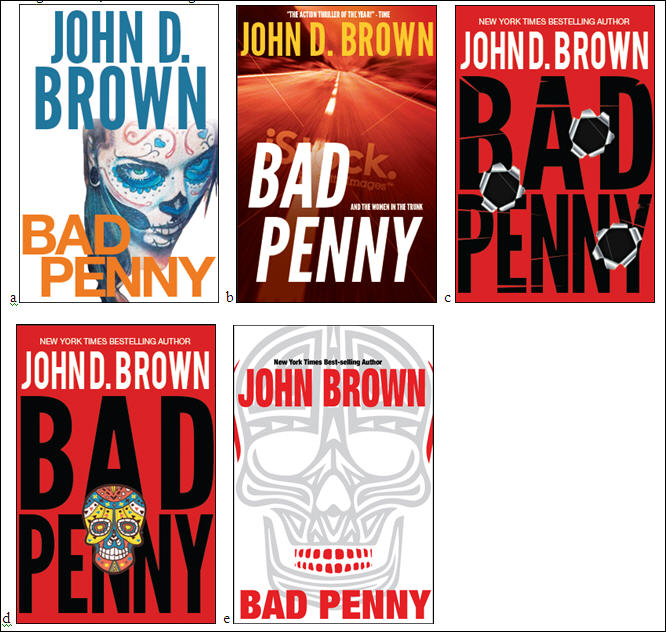
For those of you who are thriller readers, which two of the following would you be most interested in?
Before you make your choice, please note that they’re mockups. Unfinished. We’re just getting the idea.
Note as well that BAD PENNY is not a thriller of the spy, mystery, or intrigue type. It’s not military, cop, or FBI. It’s not fearful woman-in-jeopardy suspense. It’s not serial killer. It’s Lone Ranger Kicks Butt–a guy outside the law saves some folks and metes out justice. It’s action. And when thinking about tone, if you have the lighter KNIGHT AND DAY on one side and the very serious Jason Bourne or John LeCarre on the other, this one leans towards KNIGHT AND DAY.
Okay, let me know your choice. As dictator I may disregard all your votes, but at least I will feel like an enlightened dictator.
James Maxey is a writer I admire. For his work ethic. For the quality of his prose. For his imagination. His story “To Know All Things That Are In The Earth” is one of my favorites. So you can be sure I was pleased to find and read this today.
I will say, in utter candor, that Servant of a Dark God is a work that truly stands out from other fantasy books on the market. What makes this book work so well is that it’s a story about family first, and a fantasy adventure second. Full review.


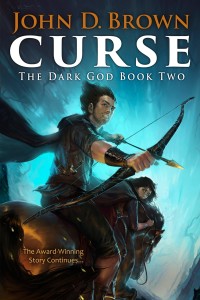 Curse’s long and crooked path to publication is now over!