

Similar Posts
The Weaponization of Insects

This idea.
Oh, my, heck.
One of my first novelettes was about using insects as military grade spies. Just a bit of wetware to get control of their brains. Then mount a nano recording and transmitting device…
How are you going to stop that?
But wait–insects can be far more sinister.
Jeffrey A. Lockwood has written Six-Legged Soldiers: Using Insects as Weapons of War. I can’t wait to read this. I hope it’s not a fluff book. Can’t wait to report my findings to you. Read more about it.
Oh, and did I mention that I’ve got weaponized insects in the novel I’m currently working on? Crown of a Dark God is turning into such a blast to write.
Move over X-ray glasses; here come the T-rays
Humans are blind. Really, think about all the things we cannot hear, see, smell, feel. Our world is so small. So when a device comes along that reveals a new part of the sensory spectrums we use, then I say, “cool!”
Of course, when I was a kid, you’d see ads for the X-ray glasses in all the boy magazines along with ads for Sea Monkeys and whoopee-cushions.

Well, now they’re not just gimmicks. You’ve heard of x-rays, gamma rays, ultraviolet rays, infrared–well, here are t-rays.
T-rays are emitted by all the objects around you, but they cannot be seen by humans. T-rays can go through just about anything except metal and water. People who spend serious time thinking about T-rays say this ability, the result of their short wavelengths, make them ideal candidates for certain types of medical imaging.
Among other potential uses imagined are: safer versions of X-rays; scanning baggage at airports; identifying large biological molecules such as proteins, viruses and bacteria; and even measuring the effectiveness of facial moisturizers. Read article here.
Here’s where t-rays fit on the electromagnetic spectrum.

And here’s the article that sparked it all today: Britain makes camera that “sees” under clothes. I guess one of those egg-head boys grew up and decided to make his dream come true, all in the name of science, medicine, and the Queen, of course.
Maya, a character for a thriller?
 Maya lives in a yurt.
She has glorious garbage floors.
And chickens that run around and lay pastel eggs in odd places like buckets–Easter every day.
Here’s a list of her most popular blogs.
So, folks. Maya has a fascinating life (as do most people when you start to get the details). So fascinating that you can’t help but want to write about someone like her to see where the story goes. Go read her blog and tell me you don’t agree. It doesn’t get any better than this.
In fact, what would happen if I took a Maya and put her in that thriller I’ve got incubating?
Oh, baby. Zing.
Bees Sniff Out Land Mines
 The bee. We slather its delicious vomit on bread and muffins. We send colonies out to pollinate our crops. Now Colin Henderson and his University of Montana colleagues have partnered up with bees to “locate buried land mines” and do it more quickly and thorougly than any dog.
“We can survey in one day what takes more than a week with dogs,” he says, “and humans stand 300 yards away.”
Bees can find not only land mines, but also drugs and decomposing bodies. Oh, and they are smart enough to recognize a sugar daddy when they see one.
Here’s the full article. Read it. Enjoy. Things like this are part of the wonderfulness of life.
Story zing method: fiddling with knobs
 One of the most basic way of coming up with story ideas is to take a familiar story or thing, list out what’s commonly associated with it, then start changing some of those elements.
For example, you list out all the normal things for vampires–the coffins, black, bats, sucking blood, etc.–then you begin to twist. What if the vampire wears, instead of black, some styling plaid? What if it isn’t a person but a rabbit (whoops, that one’s been done)? What if instead of gothic places like catherals you find him in a trailer park? What if instead of being dangerously suave, he’s a drunk?
Do you see? You can do this with anything.
In this interview, Matthew Sturges talks about how he did just that with the movie The Dirty Dozen and ended up with with Midwinter, a novel about prisoners given another chance. According to Sturges, “In the case of Midwinter, the beginning of the story was, ‘What is prison like in Faery?'”
Read the whole interview. I think you’ll find it enlightening.
Wolves in my backyard
National Geographic ran an article in the March issue titled “Wolf Wars.” It has a great interactive map. You’ll want to read the whole article, but I want you to look at something.
First, here’s a picture of a wolf in Yellowstone licking his or her chops over a recent elk kill. Looks real friendly, doesn’t it. Here, poochie, poochie, poochie.
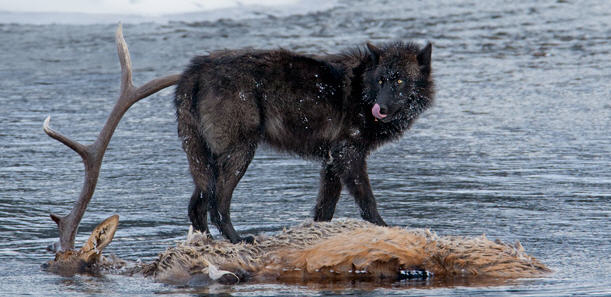
A few facts. Wolves can grow up to six feet long (tip of nose to tip of tail) and three feet tall. They weigh on average about 80 pounds but can be as heavy as 150-190 pounds. Wolves can reach 40 mph when chasing, but the use their stamina more than speed. Regardless of how they catch you, their jaws are strong enough to crush bones. You want more facts? Go to this wiki article on canis lupis. The point is that they are large, smart predators. At the top of the food chain. These aren’t little doggies. They’re killers. And they are mighty hard to socialize with humans (read the wiki article).
Of course, it can be done. Not far away in Heber City, Utah lives Doug and Lynne Seus (yes, that’s the name–gotta love it!) who train wild animals for movies. The company is called Rocky Mountain Wasatch Wildlife. I know you’ve seen one of their animal “actors,” Bart the bear, in many movies. The Seuses also happen to train wolves. A friend of mine grew up in Heber with the daughter of Doug and Lynne. She visits from time to time. Last summer she went down and saw the wolves. My friend was told that she had to carry any children she might bring.
Why?
Because the children are food. That’s why. And when she went out there, the wolves were tracking those children every minute with their eyes. Freaked her out. In fact, another friend got so freaked she took her kid back to the main house and didn’t come out again. Folks, these are wolves that work with humans ALL THE TIME.
I know the nature programs often make it seem like wolves are harmless, but they’re predators. Just like grizzlies, tigers, or crocodiles. Wolves are dangerous. A pack kills up to two elk a week. That’s a lot of eating. But they’re all up in Yellowstone, right?
Um, no.
Exhibit 1: Documented wolf packs, i.e. two or more wolves, in 1992 (click on image to see it full size)
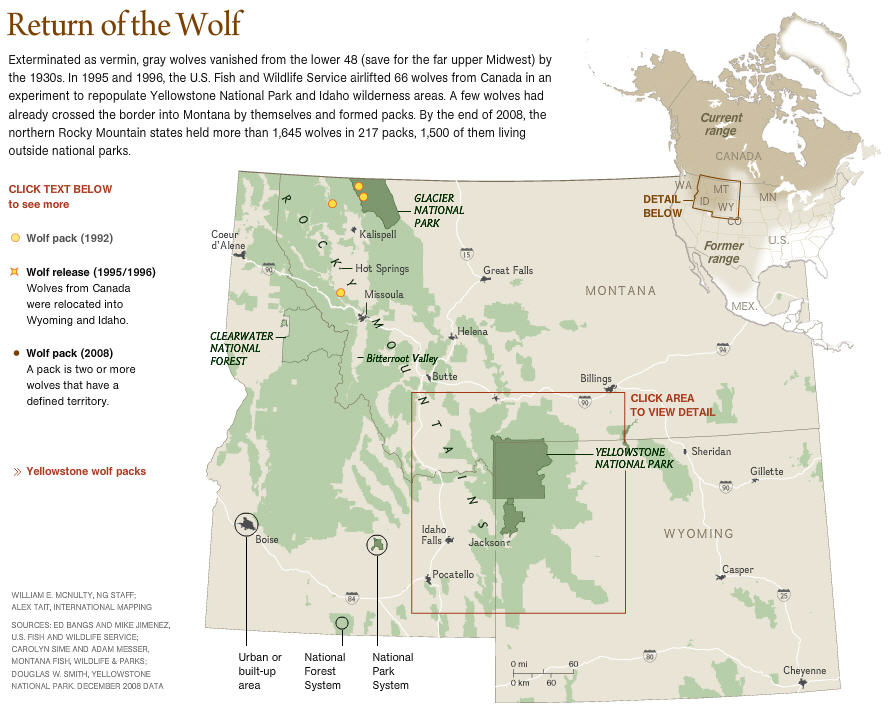
Exhibit 2: packs released in 1995
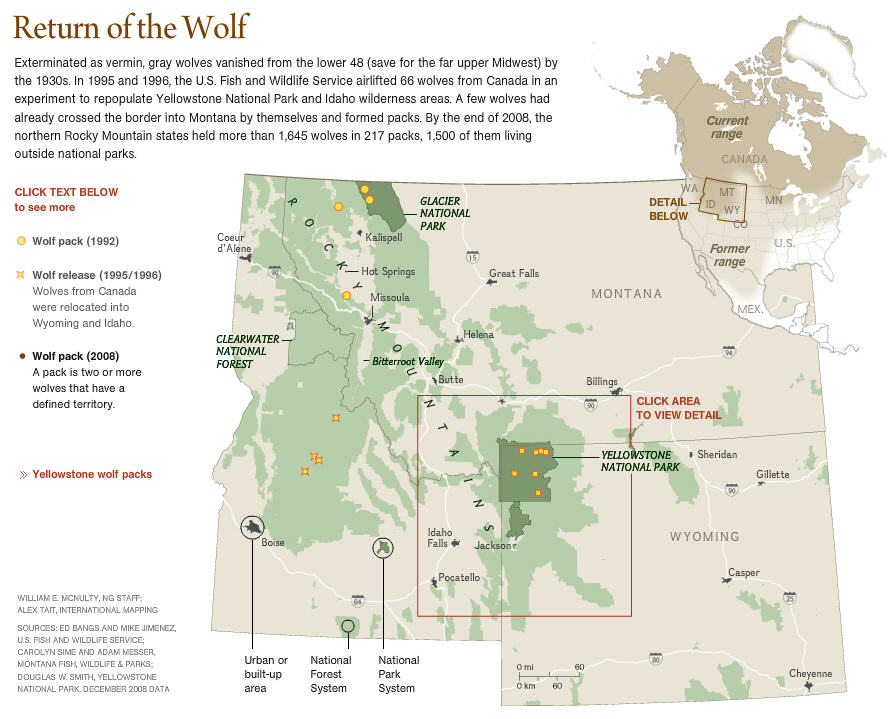
Exhibit 3: wolf packs as of 2008 (2 years ago)

Holy schnitzel!
If you didn’t read it above, they’re estimating about 1,645 wolves in 217 packs. And that’s just the ones that have been officially documented. You know there are more out there that haven’t been seen. Look at the one all the way out by Casper, WY. Those bad boys can travel. In fact, the NG article says that wolves stake out a territory of about 200 to 500 square miles (a circle of that size has a radius of 8 to 13 miles). They travel on average (AVERAGE!) 60 miles from their pack when seeking a mate or new pack. Although one was recorded traveling 500 miles.
Okay, so given the maps and sightings above, how is the John Brown family doing down in Laketown?
Exhibit 4: I need a gun!
The map below marks Laketown, UT with an A. I marked over that the packs shown in NG in red and others reported in pink. I also show orange rings 20 miles apart.
The “unofficial” sighting just inside the 80 mile ring was by my brother-in-law. The wolves were killing a bunch of his neighbor’s ewes he was taking care of. I didn’t say “eating” because they were killing far too many to eat. Wolves looked up at brother-in-law on four-wheeler. Assessed him. No whimpering, no cowering, no doggie wagging of tails. Just a frank assessment–human, danger or lunch? Said wolves sent a herd of the willies galloping up brother-in-law’s back. Freaked him out. He high-tailed it out of there and called the Feds who found that pack and killed them about fifteen miles away. But that sighting was before 2003. The sighting just outside the 100 mile mark was by some neighbors around 2007. The sighting down by Manila, UT was reported in a news report by KSL news in 2008, just two years ago.
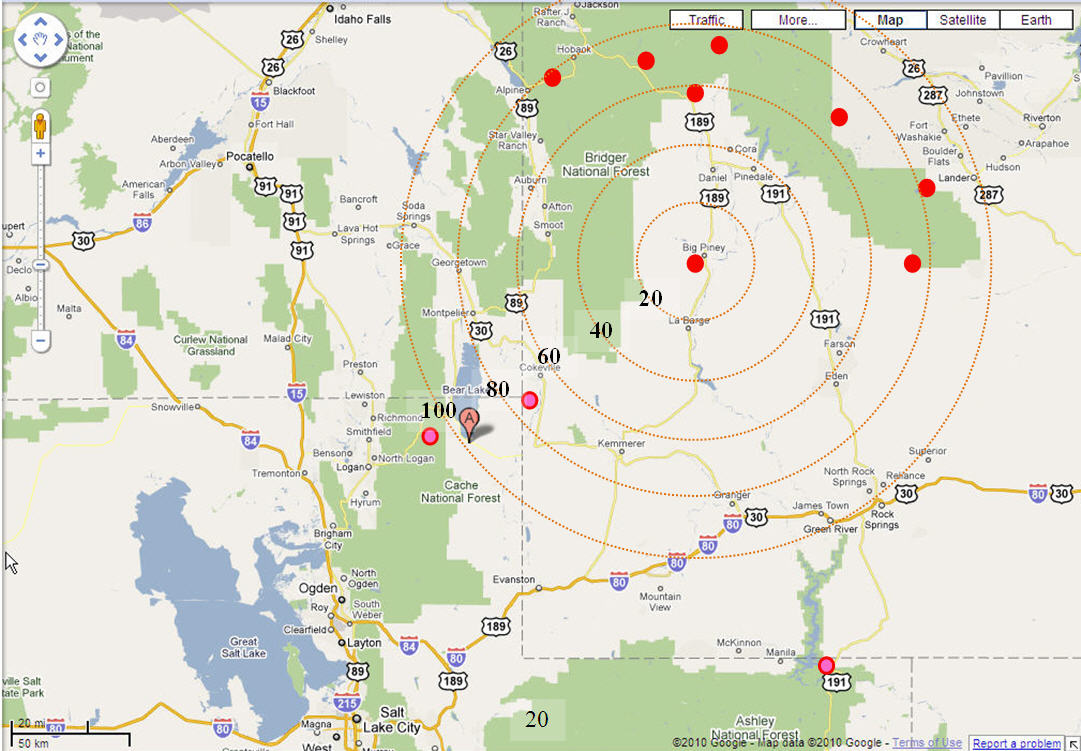
Okay, so I think it’s pretty safe to say that we probably have wolves in our backyard. And if we don’t, they’ll be here in a year or three.
Go read “Wolf Wars” in the the National Geographic. It’s free. Then tell me how you’d feel with a few packs in your backyard. Are you all warm and comfy? Here, little doggie . . .
So I’m thinking that when the girls or I go hiking, which we do all the time, we need to carry more than a walking stick. More than a paintball gun used to scare the deer out of our garden. I know that even with all the packs shown above, I haven’t heard about wolves attacking humans, but is it wise to assume they just freak out when they see humans and all run away–“that’s a eight-year-old human girl, she will make me wear the cone of shame. I do not like the cone of shame.”
Or will it be, “Hum, possible lunch over there, let’s check it out. Ooh, look at the fat one. I bet he’s tasty.”
What do you think?

2 Comments
Comments are closed.
This is really interesting. I’m a bit surprised English isn’t a little more common, considering the country’s founding and all. But kind of interesting how Utah ends up one of the only England states–perhaps goes back to how most of the pioneers that settled there were converts from Britain.
I’m curious though what the ancestry marked “American” refers to exactly (which fills in a lot of counties in Kentucky, Tennessee, etc).
Yeah, it doesn’t show the diversity of any given area. And it’s self-reported, hence the “American” ancestry. But it’s still interesting to see the groupings.