Nameless Thriller Started

Those who check the progress bars, will notice that I’ve started the first draft of the thriller, which remains nameless.  Poor thing. You’ll also notice I haven’t finished the working outline. That’s because sometimes–well, often–I need to do some drafting to get the feel of the story and characters before I finish that working document. And also because story development has never been a linear thing for me. 

I did a lot of work on the premise (the story setup) these last few weeks. Ran into a lot of dead ends.  However, it was all good. I got snippets of scenes throughout the process. Did a lot of useful research. Developed characters. I wrote a few drafts of another beginning that I realized didn’t feel right. It was telling the wrong story, had the wrong angle. A few days later, I figured out the right angle on the premise.  And it is so delicious to me.  Then during another work session–letting my mind run while I showered–I got the outline of the first chapter. I give you the first 300 words below. I’m sure they’ll change, but it’s a taste of what’s to come.

CHAPTER 1: Cowboy Donut 

Trying to get a straight job as an ex-con was a lovely experience.  Kind of like being dragged behind a bus.

No matter how tidy you looked or how sharp your resume was, it all came down to one question: “And what were you in for?”  Frank knew it would be stupid to lie about that.  First of all, he was trying to go straight.  Second, any employer who didn’t have a carrot for a brain was going to run a background check.  So there was no use trying to hide. 

Frank was now sitting in the back office of Cowboy Donut in Rock Springs, Wyoming across from Mary Rogers, the sun-wrinkled owner.  She was probably in her fifties and had two-tone hair that seemed to take its inspiration from a skunk or badger: all bleached up on top and dark underneath.

Ms. Mary had just asked the question.  Frank had just dropped his bomb—voluntary manslaughter, a security job gone bad.  He’d been protecting the wrong kind of noun for the wrong kind of people.

Ms. Mary narrowed her eyes.  “What else am I going to find on your RAP sheet?”

“That’s it,” Frank said.  “Just the one unfortunate incident.”

“Murder is a pretty big incident.”

“Manslaughter,” he corrected.  “Not murder.”

She made a noncommittal sound and looked down to study his resume a bit more.  Like maybe something new would pop up there. 

This was always the fun part, waiting for the reply.  First interviews were like first dates.  And Frank had basically told his date he had an Ebola monkey virus that would make her eyes bleed, and would she now like to kiss?  He’d done this now a couple dozen times and knew the best thing was just to be quiet. 

Poor Frank. And in just a few pages things are going to get so much worse when he finds two old associates waiting for him at his house.

Share

Similar Posts

  • Need your Dark God T-shirt input

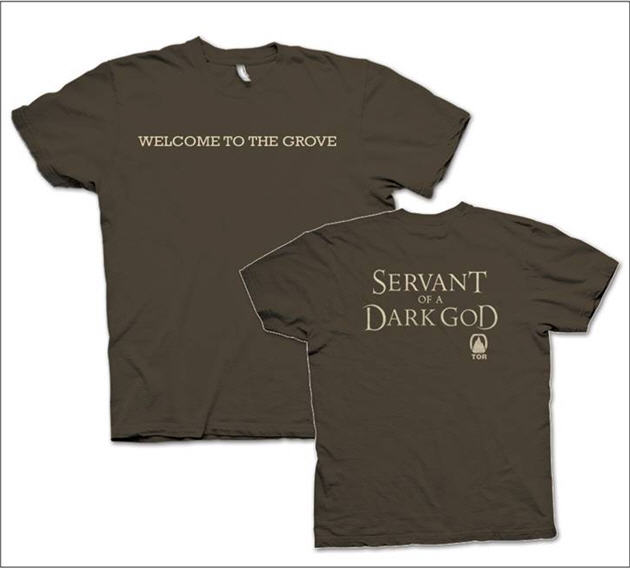
    I’ve got a deal to make t-shirts for my book available, and I have to make some decisions. The problem is that I am terrible at making these kinds of decisions. So I’m asking for your help. Any input would be appreciated.

    Mind-boggling question number 1

    So we’ve decided on the design. It will say “Servant of a Dark God” on the font as shown. We might put “Welcome to the Grove” or “Beware, the Mother is Watching” on the back. It will NOT have the Tor logo indicating it’s a book. Who knows what that is anyway? Instead, the question is whether to put my name on the shirt in some fashion.

    Option 1

    Some suggest that it’s better to just have a shirt that has the crazy label, suggesting the wearer is a servant of a dark god. It’s provocative, and if someone asks, the person wearing it can talk about the book. With this option we would NOT put my name on the t-shirt, just a small open book icon under the title. The idea behind this is that those who would buy the shirt would already be fans and the provocative statement will do more to spread the word than my name because going this route will make the shirt more fun to wear.

    Option 2

    Others think that you should have your name on the shirt to advertise. So we’d put “by John Brown” underneath the title. Or we’d put it on the back of the shirt. But some say it would make the shirt less fun.

    What would you prefer and why?

    Mind-boggling question number 2

    Because of the way we’re going about this, the color of the letters must be fixed. So the question is do we simply let people choose their own shirt colors that they thing will work with the color of the lettering or fix both the color of the lettering AND the shirt?

    Option 1

    Fix the shirt colors. Brown for guys and plum for women. Make the lettering a fantasy green or cream.

    Option 2

    Give people as much choice as possible and choose a font color that will work with the bulk of the shirt colors here: http://gildan.com/distributors/colorpalette/.

    But what would color would do that and still say fantasy, or would it matter?

    So which option to you think would work best? If you chose option 1, which colors?

    Mind-boggling question number 3

    Why is John worrying about this? Shouldn’t he be spending his time tracing his ancestry back to old grandpa lemur?

    The answer to that is that John’s mind works in mysterious ways, dear Reader. You must bear with him. And you must now face your greatest fashionista test ever: which colors would say fantasy and still be something people would want to wear? I will be making shirts up for the book store employees to wear before I come to signings.  So I have to decide. Someone suggested plum is all the rage this year for women. Make the letters a nice new willow green. We could have another color for men. Any ideas of what would appeal broadly?

    I await your ideas.

    (Ha, look at this. It appears one of my greats did indeed live his life out in the Prague menagerie. Hum.)

    Share
  • First draft done!!!

    Holy schmoly, has this been a ride. I projected the CURSE OF A DARK GOD to be 140,000 words. When I blew by that, I projected it would be 170,000. Today I just typed the last word of the first draft. It’s 230,000 words. For reference SERVANT OF A DARK GOD is 170,000 words.

    The bad news is that while I’m really happy with this draft, it IS a first draft and needs some editing. I’m also behind schedule. I hit 140k words just a few weeks after my original deadline (in March), so I pride myself on knowing how fast I can write, but at that point I had, unknowingly, about a normal novel’s worth of material left to write. Obviously, I haven’t quite figured out yet how to estimate the size of these bigger works. The problem is that instead of getting a month or even two to revise, I’ve got two days. Then I have to turn it in to my editors.

    The good news is that my editors haven’t canned me, yet. 🙂 And that they have great insight into story. And that I should have plenty of time to fix and polish this thing to make it shine. I just don’t like turning in first drafts. My goal with book three is to get back on schedule.

    Having told you my scheduling woes, I am very excited about the characters and storylines and expect readers to enjoy this as much or more than the first in the series. However, I do wish I could get this process down so that I was 99% of the way there in one draft. There are some authors who can do that. Perhaps that will come with more experience. Until then, I get to enjoy revision.

    Here are my stats:

    • 550 hours to write, from pre-draft to the end, not including thinking thinking on walks and drives and discussion time with my wife who saved me thrice.
    • The bulk of the writing was done in a 24 week period. I averaged 17 hours per week during that time. This is on top of my day job.

     For those who don’t know, an average young adult book as from 40,000 to 80,000 words. An average adult novel is from 70,000 – 120,000 words. I’m very pleased I was able to finish this monster. I might not be the fastest writer, but what this tells me is that I should be able to finish two big novels a year if I should ever be so lucky as to go full time.

    Share
  • |

    New Workshop: How to Write a Story that Rocks

    Folks, the first tentative schedule for Life, The Universe, & Everything (LTUE) has been set. For the past few years I’ve been teaching a 2-3 hour workshop called “The 3 Things You Must Learn To Write Killer Stories.” I think I must have taught it over 15 times in different venues. Hundreds have attended and said they loved it.

    However, this year I’m going to be doing something different. I’m developing a new two-hour workshop called “How to Write a Story that Rocks.”

    I’ll be teaching it Thursday evening, February 11th from 5 PM – 7 PM at LTUE at BYU. It’s FREE and open to all.

    What I found was that a lot of new aspiring authors get lost in mountains of rules. But great storytelling isn’t about rules. They try to form stories with word counts, chapters, and weird plot diagrams. But stories aren’t about those things. They have a hard time knowing what to write next because they don’t understand how story works. In fact, some don’t know how to start at all. They just flounder in their piles of zing. Finally, even if they can get a bullet outline, they have a hard time turning that into a scene.

    So what we’re going to do in this workshop is this.

    1. I’m going to bring in some ideas for character, setting, and problem. We’re not going to generate from scratch as we’ve done in the past because I want to get to the next steps.
    2. Then I’m going to teach you how to go from idea to outline–we’re going to do it together, and you’re going to learn exactly how to know what comes next 
    3. Then we’ll go from outline step to scene sketch.
    4. Then from scene sketch to draft.
    5. At every step I’ll be pointing out key story development concepts and principles

    When we finish, you should be able to:

    1. Identify the essential story objectives and story development questions–get these right and the rest doesn’t really matter. This will include the HANDFUL of key things you need to worry about and develop with character and plot.
    2. Develop more likeable and interesting characters
    3. Develop more powerful story concepts (call it premise, problem, situation, whatever). Once you get this the story writes a lot of itself.
    4. Explain the real Story Cycle. Not Campbell’s mumbo-jumbo hero’s journey. Not the three, five, seven, nine acts. Not Freytag’s diagram. Story.
    5. Explain what it means to “move a story forward,” “increase the stakes and tension,” “complicate the plot,” “complicate the motive” and how that’s done using surprise, conflict, motive, and problem. Included in this are “turns,” “rugpulls,” and “reversals.”
    6. Use the Story Cycle concepts to generate a story bullet outline and take a bullet step idea and turn it into a scene.
    7. Explain the creative principles that help you generate stories more easily.

    Larry Correia will be there as well. So I’m expecting this to be a very helpful workshop. I’m going to do all I can to make it as good or better than the first.

    Share
  • | |

    Teachers (and writers)! Free Class Next Monday on How to Teach Narrative for the Common Core

    If you feel a bit lost or anxious about how to teach narrative for the new core, especially stories, I think I can help.

    I’m an educator in the private sector and an award-winning novelist and short story writer. I’ve been teaching authors in various venues how to write for the last five years. I’ve been on writing podcasts with thousands of listeners, taught at a number of writers conventions, and had a series of articles published by the national Science Fiction and Fantasy Writers of America organization, an organization for professional authors. I’ve also been helping Nellie, my wonderful wife, teach her 7th and 8th grade language arts students the unit on short stories during that same period. We’ve taught it to twenty different classes and picked up a number of important insights along the way.

    This last year I couldn’t help but examine all the materials Nellie brought home during the district’s writing program adoption investigations. Some programs looked very promising; others not so much. Some got some things about writing flat out wrong. Most of the programs had gaps.

    Furthermore, because I work with so many people wanting to write, I know that it’s difficult to teach if you really don’t understand what stories really are and how they work. For lots of people, the subject matter can seem impenetrable. And yet writing stories is such a wonderful way to teach writing, especially because so many kids love it. You won’t find a kid who will spend extra hours writing a business letter or poem analysis, but you will find quite a few who will go crazy writing stories. And the whole time they’re practicing their writing skills.

    The question is how DO you write a story?

    What is a story?

    How can you tell if it’s good?

    How do you come up with ideas?

    Where do you start?

    And what the heck is this chart? Do writers really use this? (Not many that I know.)
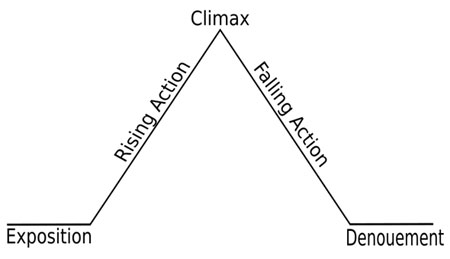
    Story Diagram plot-mountain-pic

    And does anyone think changing the diagram to look like Aspen, Colorado actually helps?
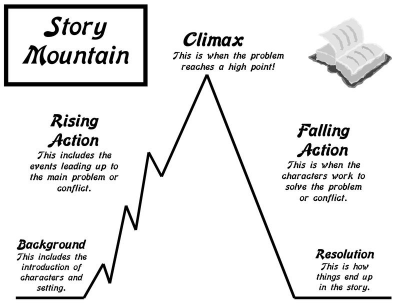
    Story Diagram Aspen 

    Hey, students—please make your story look like Aspen, Colorado!  (Yeah, that’s going to be effective.)

    And yet it’s not as difficult as it appears. Nellie and I have seen a lot of kids really get into writing stories. We’ve seen kids WILLINGLY going way beyond the assignment to write stories that are eight, twelve, twenty-five plus pages. And as they’re writing, they’re practicing grammar, spelling, structure, vocabulary, etc. without knowing it and having a great time. I know that if you enable your students, many of them will write, write, write. Especially in grade school. But also in the higher grades.

    Stories can be a blast. The assignments can connect to many students. And the results can be wonderful. I’ve laughed out loud at some of the stories coming out of Nellie’s class. Others have been enjoyable on other levels.

    But for this to work in your class, you need to know some key things. You need to understand the core of story and the story development process. You need a lesson plan that details everything step-by-step so your students don’t flounder. And you need to know some fundamental tips (secrets?) about teaching this content.

    So I’m going to hold this day-long class for you. A full eight hours. And share everything Nellie and I have learned. This class will be for teachers at ALL levels (I’ll show you some ways to scale the complexity of what you’re doing). There will be NO cost. The only thing you have to bring is a pencil, paper, whatever program materials you have, and a willingness to have a good time.

    When we finish, you will know how to write a simple story like the ones your students will write because, ta-dum, you will write one! AND you’ll have a step-by-step lesson plan that builds on whatever materials you have—an official program or one of your own. AND you’ll understand story better than 99% of the population. AND you’ll have a bundle of techniques to help your students. AND you’ll solve both world peace and maybe the lost sock conundrum.

    Truly, I think that instead of feeling stress, you’ll actually be looking forward to teaching and writing stories with your students. If not, you may bring tomatoes and huck them at me, but please be aware that I will not stand still; to find satisfaction, you will have to be able to hit a moving target.

    If you’re interested, just click the Contact John link under my photo in the left sidebar and send me an email letting me know.

    Hope to see you in class!

    GET READY FOR A FUN DAY OF LEARNING!

    Topic: Teaching writing (narrative & the common core)

    Who: Teachers (and writers at least 18 years old), seats are limited

    When: Monday, July 29th, 8:15 AM – 5:00 PM

    Where: Rich Middle School, 54 E 100 S  Laketown, UT 84038

    Materials you need to bring:

    • Pencil
    • Paper
    • The writing program you’ll be using this year
    • Kooky socks, for those who cannot resist the urge
    • A lunch or a way to get one

    AGENDA

    8:15 AM Arrive

    8:30 AM – 9:20 AM

    • Can you create a redneck crapper?
    • The 1st secret to teaching writing: Attributes & techniques
    • The 5 parts of story
    • Thieves prosper – using existing patterns
    • A car, a beggar, and an idiot — basic pattern 1

    9:30 AM – 10:20 AM

    • The 2nd secret to teaching writing: Do it with them
    • Technique: Sketch then draft
    • Workshop 1: Zombies and kisses
    • Technique: Zing hunting
    • Workshop 2: Hunt zing

    10:30 – 11:20

    • What makes a story big or small
    • Workshop 3: Select a right-sized THOM and character
    • Workshop 4: Select a Goal
    • Workshop 5: Make character sympathetic
    • Workshop 6: 3 tries
    • Workshop 7: Resolution

    LUNCH

    12:00 – 12:50

    • The 3rd secret to teaching writing: Cognitive modeling and the 6-step process
    • The 4th secret to teaching writing: Our tiny brains
    • Writing is telling: Narrative & description
    • Technique: Yes, SiR
    • Technique: Broad-brush + 1
    • Technique: The Pause

    1:00 – 1:50

    • The 5th secret to teaching writing: Have fun
    • Workshop 8: Write your story

    2:00  – 2:50

    • How the pros revise—concept, line, & copy
    • Workshop 9: Content edit
    • The 6th secret to teaching writing: Our brains are still tiny
    • Workshop 10: Line edit

    3:00 – 3:50

    • The 7th secret to teaching writing: The 3 grunts (responding to a story and grading)
    • Share stories
    • What the heck did we just do?

    4:00 – 4:50

    • How to adjust for grade level
    • Common core
    • Your program and lesson plan
    • Identify black holes
    • Wrap up & next steps
    Share
  • |

    LTUE schedule posted

    ltuelogoLTUE has posted its schedule for the upcoming conference Thursday – Saturady, Feb 12-14. I’m, of course, stoked to present and participate on the panels. But I’m also looking forward to attending some of the sessions.

    Look at this one: How a Military Unit Works in Real Life: Zachary Hill, Brook West, Robert J Defendi, C. R. Asay, Mike Kupari (m)

    Or this one: All about armor: Zachary Hill, J. D. Raisor, Kay Mildenhall, Charles B. Stanford (m)

    Or what about this one: Law Enforcement: James Ganiere, Zach Hill, Robin Ambrose (m), which conflicts with one of mine, dang it!

    Or this: Making Creatures Realistic to their Environment: Keliana Tayler, Brian Hailes, Jessica Douglas, Bryan Beus (m)

    This: Applied Biotechnology: Derrick William Dalton, Mikki Kells, Charlie Pulsipher, Chersti Nieveen, Ali Cross (m)

    This: How to Create a Language: Maxwell Alexander Drake, Dirk Elzinga, Valerie Mechling, Samuel Stubbs, Bryce Moore (m)

    And tons of others.

    Oh, and what about the keynote address on Saturday by Toni Weisskopf?

    It’s going to be a great conference. I’ll be giving these presentations.

    • How to Build an Action Plot. In this one, Larry Correia and I team up to share a model of plotting that should make developing your action story much easier. Attendees will be able to use the methods on a novel idea Larry, Joe (Larry’s son), and I came up with called Mech Runners. Basically, Larry turned to Joe and said, “What’s awesome?” Joe said, “Giant robots, bandits, and murderers.” We took it from there.
    • How to Build a Romance Subplot. In this one, I team up with romance author LL Muir to share a model of plotting that should make developing your romance plot or subplot much easier. Attendees will be able to use the methods on a story idea Lesli and I came up based on The Hobbit. It’s called My Precious.
    • Tapping into the Power of the Story Setup. The story setup is a fabulous tool that’s not only helped me drastically cut down the time it takes me to develop my ideas, but it has also helped me develop better ideas. In this presentation, I will explain what the story setup is and how you can use it to help you nail your novel.

    I’ll also be moderating or participating on these panels:

    • The Hero’s Journey & the Virgin’s Promise: Patterns and Archetypes for Better Characters:Michaelbrent Collings, Tracy Hickman, Blake Cassleman, Renee Collins, John D. Brown (m). Did I tell you I think the hero’s journey is stupid? This ought to be a fun one.
    • Action Sequences: John D. Brown, D. J. Butler, Peter Orullian, Adrienne Monson, M. Todd Gallowglas (m)
    • Self-Publishing Pros And Cons: Jared Abram Barneck, John D. Brown, Mikki Kells, Joe Vasicek (m)

    Hope to see you there!

    Share

7 Comments

  1. Good start! You have some great imagery there. Now I know what to call that kind of hair when I see it: badger hair.

  2. Nice opening! It gives me the warm fuzzies to see new words from The Man. I’m planning a re-read of Servant of a Dark God this year, and from the looks of it, I’ll be buying a copy from Amazon for a birthday gift (I can’t BELIEVE that they’re selling your hardback for just $6.61 right now! At that price, it’s probably two peoples’ birthdays 🙂 ). Keep up the great work, and hopefully we’ll be hearing some excellent news on Curse of a Dark God sometime soon! 😀

  3. I already want to read it. Nice hook. I know it has been a while now but thanks for opening up your comment thread without having to log in to WordPress.

  4. Wow! This is a powerful first page. I feel sympathy for Frank and have lots of questions about what will happen next. Good luck and have fun witing a thriller. 🙂

  5. Matt and Augusta, yea!

    Matt, you know I had no idea what I was doing when I first opened the WordPress account. Then I finally figured out I DIDN’T want people logging in–doh!–and reset it. Glad you’re happy with the change, cause I am 😀

Comments are closed.