Believe In Me, Cyber War

A Man and a Team of Girls
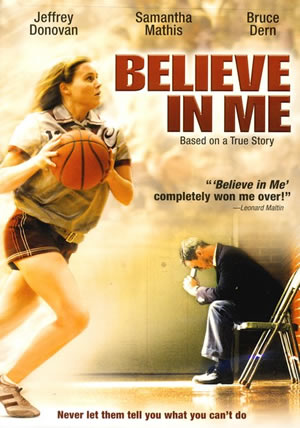
Back in 1964, Jim Keith took a job at an Oklahoma high school to coach boy’s basketball.  But when he arrived, the administrators changed their minds and gave his job to someone else.  Keith’s contract didn’t specify which gender he’d coach, just that he’d coach.  So they switched him to the girls.  Keith was extremely disappointed.  Who wanted to coach girls when it was the boys who played real ball?  Especially when Keith was supposed to be head coach.  Keith tried to get the promised position back, except the girls he coached had other things in store for him.  Harold Keith, Jim’s brother, wrote a novel based on what happened.  That novel was made into a movie in 2006 called Believe In Me.  

Now, we all know the plot line of sports movies: a losing underdog of a team rises up to win.  It’s predictable, right?  But we could say that of all crime shows as well—in this episode investigators discover a crime and figure out who did it!  Wow, what a shocker.  We could say it of all romantic comedies as well—in this movie a couple at odds gets together.  No way!  We could say it of lots of stories.  And yet we love these stories anyway.  Why?  

Because the characters suck us in.  Because the story tellers do such a good job with the particular details we forget we’re watching a movie or reading a book.  We forget to think about the ending.  Furthermore, the stories are often about more than just winning games.  And so we worry about these people who have become real to us and focus on their immediate situation.  At least, that’s what happens when the story tellers do a good job.

And Robert Collector, who both wrote and directed the film, did a great job with Believe In Me.  Now, I don’t know how accurate the film’s depiction of five-on-five play is; I believe the girl basketball teams of that era played six-on-six.  But that’s a niggling technical detail.  Besides, the movie isn’t about technique anyway.  It’s about a man and a group of country girls who have to face difficult obstacles, not so much on the court, but off it.  If you have girls or like sports at all, I think you’ll love this movie. 

Cyber War
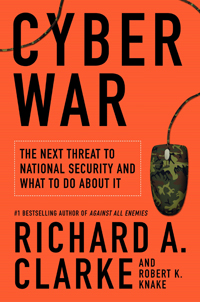
I recently reviewed America The Vulnerable which explained how exposed we are as individuals, corporations, and a country to cyber crime, cyber espionage (both state and corporate), and cyber attacks.  Of all the cyber threats we face as individuals and a nation, the least likely is an all out cyber war.  But just because it’s less likely that doesn’t mean the threat isn’t real.  Especially since cyber warfare has been in use since the 1990’s.  We used cyber weapons openly in the gulf war in 2003, knocking out Iraqi air defenses.  Israel used them to own Syria’s air defenses when bombing their clandestine nuclear site in 2007.  Russia used them against Estonia in 2008 and Georgia in 2009 on a variety of targets, bringing many critical systems to a halt.  In 2010, somebody, most likely the US or Israel, developed the Stuxnet worm to sabotage the uranium enrichment facility at Natanz in Iran.  China has already conducted trial runs of cyber attacks on the US and has planted logic bombs and trap doors to activate in the future.

In Cyber War, Richard Clarke shares his insights into what cyber war is, how cyber weapons work, and how vulnerable we are as a nation.  He discusses the cyber warriors (hackers) we now employ in the US military, and how a cyber war is like and unlike other wars.  In the second half of the book, he discusses the factors that have created our current vulnerability, how to set up a defense, and what we need to think about when conducting a cyber war. 

And Clarke knows his stuff.  He worked for the State Department during the presidency of Ronald Reagan.  In 1992, President George H.W. Bush appointed him to chair the Counter-terrorism Security Group and to a seat on the United States National Security Council.  President Bill Clinton retained Clarke and in 1998 promoted him to be the national coordinator for security, infrastructure protection, and counterterrorism, the chief counterterrorism adviser on the National Security Council.  President George W. Bush kept him in the same position and later made him special adviser to the president on cyber security.    

The thing I liked most about the book is that in addition to describing cool cyber war weapons, threats, and incidents, Clarke examines answers to many critical questions.  For example, how can we set up a defense without the government becoming a 1984 nightmare?  Would arms agreements work in cyber space?  (No.)  How do you prevent a cyber war from turning into a kinetic (guns and troops) war?  How do you attack your enemy when it’s sometimes hard to know who launched the attack in the first place?  He discusses these and many more questions.

The book does have one fault.  Clarke has an obvious axe to grind with the Bush administration, and can’t help but make snide and irritating comments whenever he brings them up.  The good news is that those spots are few and far between.  If you want an excellent introduction into how cyber weapons are used and will likely be used in the future, you’ll want to read this book.

Share

Similar Posts

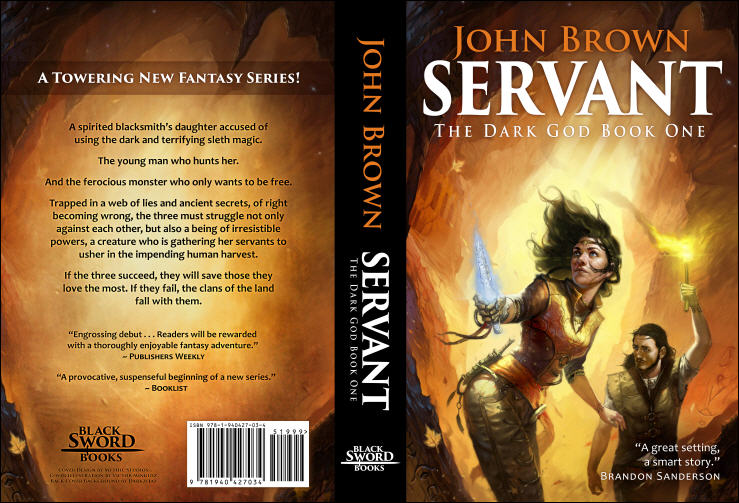
  • Servant Now in Paperback!

    The Stocking Stuffer for LORD of the RINGS readers

    Make someone happy with 624 AWARD-WINNING pages of thrilling ACTION, cool MONSTERS, & wicked MAGICS.


    • ~ Best Novel of the Year Whitney Awards, speculative fiction
    • ~ Engrossing Publishers Weekly
    • ~ Provocative Booklist
    • ~ Starred Review! Library Journal
    • ~ A great setting, a smart story Brandon Sanderson

    This book makes crowds cheer*. Only $7.99. Read the first chapter.

     ORDER NOW FROM

    *tested on a statistically valid sample of gerbils, hamsters, and various other intelligent rodents who all cheered with wild delight at the reading and then asked for more peanuts and crackers

    Share
  • Servant is here!

    ServantSpeadForWebsite

    Folks,

    Servant is now officially released! And for those who have stuck with me I’ve put it on a super sale this Tuesday and Wednesday: 99 cents for the ebook, $12.99 for the trade paper, which is almost right at cost (this is a nice fat book, clocking in at over 500 pages).

    eBook (Amazon)
    Trade paperback (Amazon)

    I love the ebook, but I must say the trade paperback version is gorgeous. The color and illustration at that size by Victor Minguez is just awesome.

    Enjoy!

    And Merry Christmas.

    P.S. Bad Penny is right around the corner.

    Share
  • If you liked “From the Clay of His Heart” you can nominate for Hugo

    You may nominate works for the 2009 Hugo award if you either:

    • were an attending or supporting member of Denvention 3 (the 2008 World Science Fiction Convention); OR
    • are an attending or supporting member of Anticipation (the 2009 World Science Fiction Convention) before January 31, 2009

    If you liked “From the Clay of His Heart” and want to nominate it in the novelette category, all you need to do is go here and fill out this form before Saturday, February 28, 2009. You can nominate up to 5 stories in each category.

    If you want to read it, you can do so online if you have an IGMS vol 8 subscription ($2.50). If you don’t plan on subscribing to that issue, post a comment, and I’ll make sure you get a copy.

    Here are nomination numbers for last year’s awards. What this shows is that 40 nominations puts a novel on the final ballot. 17 nominations put a short story there.

    Best Novel (382 nominating ballots cast):
    65 – Brasyl by Ian McDonald
    58 – The Yiddish Policemen’s Union by Michael Chabon
    58 – Rollback by Robert J. Sawyer
    41 – The Last Colony by John Scalzi
    40 – Halting State by Charles Stross

    Best Novella (220 nominating ballots cast):
    52 – “Memorare” by Gene Wolfe
    50 – “Recovering Apollo 8” by Kristine Kathryn Rusch
    49 – “All Seated on the Ground” by Connie Willis
    39 – “The Fountain of Age” by Nancy Kress
    34 – “Stars Seen Through Stone” by Lucius Shepard

    Best Novelette (243 nominating ballots cast):
    69 – “The Merchant and the Alchemist’s Gate” by Ted Chiang
    45 – “Dark Integers” by Greg Egan
    24 – “Finisterra” by David Moles
    22 – “The Cambist and Lord Iron” Daniel Abraham

    Best Short Story (270 nominating ballots cast):
    46 – “Tideline” by Elizabeth Bear
    29 – “Last Contact” by Stephen Baster
    28 – “Distant Replay” by Mike Resnick
    25 – “A Small Room in Koboldtown” by Michael Swanwick
    17 – “Who’s Afraid of Wolf 359?” by Ken MacLeod

    Share
  • Black Hawk Down, Pete Blaber, Not Waving But Drowning

    A Ferocious Battle

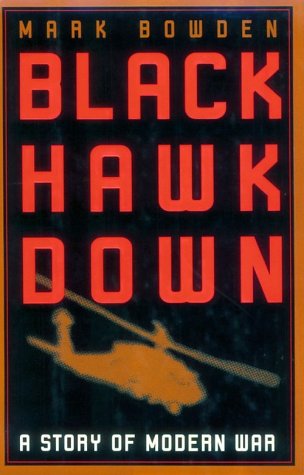
     I just finished reading Black Hawk Down by Mark Bowden. It is the most gripping account of any battle I have ever read.

    In 1992 a Somali warlord attacked and killed U.N. peacekeeping forces. As a result, the US put a $25,000 bounty on his head and attempted to arrest and try him for war crimes. On October 3, 1993, by the order of President Bill Clinton, a force of United States Army Rangers and Delta Force operators, the Army’s most elite warriors, set out to capture several lieutenants of the warlord’s militia in an area of the Somali capital city of Mogadishu that was controlled by the warlord.

    The force of about a hundred U.S. soldiers helicoptered in during broad daylight. They roped down to the streets surrounding the target building. It was supposed to take them no more than an hour. They would bag the warlord’s lieutenants, put them on a convoy of Army trucks that had barreled into the city and were waiting right around the corner, and get out.

    But the citizenry, loyal to the warlord, weren’t going to take it lying down. They began to swarm with guns and rocket propelled grenades. They attacked, almost heedless of the danger. One Somali with an AK-47 rode a cow out in a strange charge, a number of other Somali’s taking cover behind (yeah, he and the cow died). But the Americans were overconfident of their Black Hawk helicopters. They didn’t think the types of weapons the Somalis had could bring them down.

    One chopper was hit and crashed. Then another. A third and then a fourth were damaged and barely made it back to safety before they crash landed. As for the Rangers and D-boys, they were in for the fight of their life.

    The book tells the story of their courage, but it also brings in the point of view of a number of actual Somalis who fought and were injured. In the process, we get a view of the battle that is both thrilling and poignant.

    Bowden did an excellent job researching and writing this. I could not put it down. It does include some military grade profanity, but it wasn’t there to titillate or shock. I’ve talked to those who saw the movie based on this book, and I could tell the book is, per usual, better than the movie. If you’re at all interested in the military and the military operations we conduct overseas, let me recommend that you read this book. 

    Delta Force Commander Shares Insights

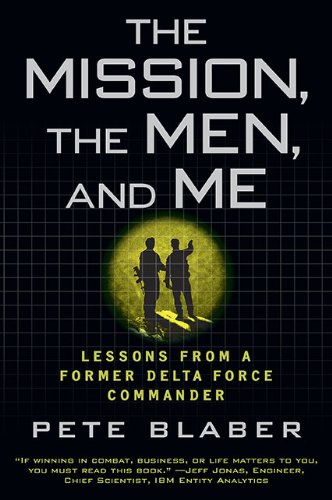
    Delta Force is the world’s most elite counterterrorist fighting force. Pete Blaber was a Delta Force operator that worked his way up to become a Delta Force commander and took part in some of the most dangerous, controversial, and significant military and political events of our time.

    During his time in uniform, he learned a number of lessons about life, about how we make decisions and act on them. In The Mission, The Men, and Me, Blaber writes about a number of the missions he conducted and the lessons he learned from them.

    The missions were conducted in Montana, Iraq, Bosnia, and Afghanistan. One featured a commander stupidly ordering Blaber to take his men into sure destruction. Another featured some of the first plans to capture Osama Bin Laden, before 9/11. Another included a man in a gorilla suit.

    The lessons Blaber draws from these experiences are fascinating and apply to more than military operations. For example, the lesson he drew from the operation featuring the gorilla suit is something I use every day with my writing. Anyone who leads or manages or works in groups will find other critical lessons. This was another book I couldn’t put down. Anyone interested in special forces will love this book.

    Not Waving But Drowning

    “Not Waving but Drowning” is a poem by female British poet Stevie Smith. It was published in 1957 as part of a collection with the same title. The work is her most famous poem and describes a man whose distressed thrashing in the sea causes onlookers to believe that he is waving to them, not drowning

    I hadn’t thought about this poem since I was a student at BYU. Then a local poet read it as part of his remarks at a conference I recently attended. The image and message lingered with me for hours. I thought about it off and on over the following weeks. This is, for me, an incredibly powerful poem. It needs to be read aloud, I think, to be appreciated. Not in some silly way, but with the appropriate feeling. I’m going to record a reading for my website, but you can read it aloud for yourself. Or have someone else do it for you. Then read it again.

    Nobody heard him, the dead man,
    But still he lay moaning:
    I was much further out than you thought
    And not waving but drowning.

    Poor chap, he always loved larking
    And now he’s dead
    It must have been too cold for him his heart gave way,
    They said.

    Oh, no no no, it was too cold always
    (Still the dead one lay moaning)
    I was much too far out all my life
    And not waving but drowning.

    How often does this happen? Those onlookers, caring only superficially, thinking it was too cold, thinking he was funning. But it wasn’t too cold. And his heart didn’t give out. He was struggling for his life, and they were too preoccupied to see it.

    Too preoccupied to really see. 

    I wonder. Is there someone around me, that if I just looked, just paused from my rush, I’d see they were much too far out, and not waving, but drowning.

    Share
  • |

    Maya Lassiter interviews The Man

    Maya has one of the most quirky goat-loving blogs around. I dare you to read just one of her blogs. You can’t do it.  You’ll find yourself going back to read another. And another. Anyway, she’s been doing a series called “How Writers Do What They Do” where she interviews authors on the creative process. Mine’s the latest, but there are a lot of other interviews in the series you will want to read. Enjoy!

    http://mayalassiter.com/2011/05/how-writers-do-what-they-do-john-brown/

    Share
  • The Veggie from Outer Space & The Mentalist

    I’ve been trying to increase my intake of vegetables and fruits because you are what you eat, and I think I’d like to look like a broccoli—long, sturdy, and with a lot of bushiness on top. So we’ve enjoyed our weekly box of fruits and veggies from the Bountiful Baskets co-op that we pick up in Garden City each Saturday.

    And we’ve enjoyed the surprises. Because someone else orders the produce, we never know quite what we’re going to get. Of course, this also means we sometimes get things we don’t normally seek out. Take cauliflower, for instance. We received a number of heads three or four weeks in a row back in October.

    Cauliflower?

    Who eats cauliflower? You ever hear anyone say: “Cauliflower’s on—let’s make a run to Brigham City to get some,” or “LaVern, I believe I’m going to knock back another floret,” or “It’s a party! You bring the chips and soda, I’ll bring the cauliflower?”

    No. We don’t hear those things because cauliflower is just weird. It’s the stuff that nobody eats on the vegetable tray. It looks like some growth spore from the planet Xenon. In fact, I want to know who started the rumor that aliens had big eyes and spindly limbs. That’s all propaganda. The aliens are already living among us, and cauliflower is their freaky pupal metamorphosis growth stage!

    Or, at least, that’s what I thought. Then I ate a serving of creamy mashed cauliflower at Ruby Tuesday’s and gained a testimony of both Ruby Tuesday’s and the weird white cousin of cabbage.  

    So when we received our surprise veggie, did I despair or use it for target practice on the idiot orange tom cat that comes around our house? No. I went to search for that Ruby Tuesday’s recipe. And through the miracle of the internets, I found it. Or something close enough for government work.

    Here it is. Enjoy.

    CREAMY MASHED CAULIFLOWER

    • 1 head cauliflower
    • ¾ C water
    • 1 T corn starch
    • 1/3 C heavy cream
    • 1 t granulated sugar
    • ¾ t salt
    • Pepper to taste
    • 1/8 t garlic powder
    • 1/8 t onion powder
    1. Divide the head of cauliflower into florets that are all roughly the same size. Steam or microwave until cauliflower is tender (we pressure cook it). Drain and toss it into a bowl of ice water to bring the cooking process to a screeching halt.
    2. Put florets into a food processor along with ½ C water. Puree on high speed until smooth, but with some small bits for texture. Or you can simply mash it like you do potatoes.
    3. Pour all the puree into a medium sauce pan. Dissolve the corn starch in the remaining ¼ cup of water and add to the puree.
    4. Add the cream, salt, pepper, garlic powder, and onion powder to the mixture and stir. Set the saucepan over medium heat and cook, stirring often, for 5-10 minutes, or until thick.

     You can experiment and switch the water for milk if you’d like, or if you don’t have cream. Leftovers are delicious. Of course, if I end up lumpy and round, you know it’s the cauliflower’s fault, or the alien’s that has set up shop in my chest cavity, whichever’s the truth. 

    For those who haven’t tried Bountiful Baskets, go to bountifulbaskets.org for more info. For those who wonder if cauliflower has any nutritional value at all, here’s the wikipedia on its goodness:

    “Cauliflower is low in fat, high in dietary fiber, folate, water and vitamin C, possessing a very high nutritional density. As a member of the brassica family, cauliflower shares with broccoli and cabbage several phytochemicals which are beneficial to human health, including sulforaphane, an anti-cancer compound released when cauliflower is chopped or chewed. Boiling reduces the levels of anti-cancer compounds, with losses of 20–30% after five minutes, 40–50% after ten minutes, and 75% after thirty minutes. However, other preparation methods such as steaming, microwaving, and stir frying had no significant effect on the compounds.

    Along with other brassica vegetables, cauliflower is a source of indole-3-carbinol, a chemical which boosts DNA repair in cells and appears to block the growth of cancer cells. The compound also appears to work as an anti-estrogen, appearing to slow or prevent the growth of tumors of the breast and prostate. Cauliflower also contains other glucosinolates besides sulfurophane, substances which may improve the liver’s ability to detoxify carcinogenic substances. A high intake of cauliflower has been found to reduce the risk of aggressive prostate cancer. Cauliflower is also a good source of carotenoids.”

    I guess the short version of all that is blah blah blah science says it’s good.

    ***

    Nellie and I have been enjoying The Mentalist for two years now. It’s a CBS crime thriller mystery series about a “mentalist,” a guy named Patrick Jane, played wonderfully by Simon Baker, who used to be a professional mind-reader and psychic, and a very good one at that, but gave it up and came clean. All psychics, he says in the pilot episode, are either fakes or deluded.

    But he was so good at it and made so much money–why would he give it up?

    Because a serial killer named Red John murdered his wife and daughter. So Jane has dedicated his life to hunting down and killing the murderer. To do that, he becomes a consultant to the California Bureau of Investigation (CBI) and works with a team of investigators.

    Some of the episodes are about the hunt for Red John. Many more are about other cases the team has to solve.

    Patrick Jane is the main attraction of the series. His outrageous behavior, acute observation skills, and keen wit all fascinate and delight. As the series progresses, the other characters take on their own interesting personalities as well. Agent Cho, for example, provides many moments of laugh-out-loud deadpan humor.

    The series is into its third season, but with the miracle of Netflix you can start at the beginning and watch them all commercial free at your own leisure.

    Share

4 Comments

  1. Wow! Thank you. You have put an incredible amount of time into analyzing and teaching about writing. It’s been so helpful. I really appreciate your willingness to share.

    Over the past few months I’ve been reading and collecting books from your lists of most helpful and useful. Every one is packed with good info. I wish I’d seen the list before I started buying books on writing–I could have saved some money.:)

    Thanks again!

Comments are closed.