|

Indie Thoughts: Publishers know profit, but haven’t tapped best seller lists

In The Business Rusch: Generational Divide Kris Rusch points out that the new on-demand and long-tail market for books has changed the duration of the opportunity a book has to be successful, but that it seems the industry still isn’t recognizing this in how they measure success.

The problems come from the fact that those of us who run things—people in our forties, fifties, and sixties—use metrics that were developed by our parents for their world, that tightly controlled Mad Men world where everyone was expected to be the same, not just in what they wore or bought but in what they listened to or watched or read as well.

The bestseller list?

It measures velocity. (A good essay on this topic, “The Meaningless Metrics of Fame,”  came from Mike Briggs, husband of Patricia Briggs, earlier this week. I’ve also dealt with it.)

Reviews?

They only want new books, and then only at the time of release.

Brick and mortar bookstores?

They only have room for the latest releases, and then only the ones that are the most popular with their customers (whoever those folks might be).

Books have come late to this fight. Books have been available on demand for only about four years now, in the U.S. In other countries, there’s been even less time.

And we’re all still fighting over meaningless metrics, to use Mike Briggs’ term, because those metrics only measure things that were important around the water cooler, not things which are important now.

What’s important now?

She goes on to say:

The publishing industry isn’t even talking about new metrics. That idea hasn’t occurred to traditional publishing, and indie (or self) published writers are constantly seeking validation from the old system—trying to figure out ways to game the bestseller lists or to get a fantastic review from somewhere that has old-world prestige . . . But at some point, traditional publishers are going to have to develop new ways to figure out which products sell well and which ones don’t. All of their systems—from sales figures (which measure books shipped not books sold) to bestseller lists to critical acclaim—are based on the old models.

Kris is a very experienced with publishing, but her last point conflates internal accounting with marketing. Publishers DO know which products sell.

The primary measure of success in a financial enterprise s not new. It’s been around for 100’s of years. And on demand and long-tail markets don’t change it.

The measure is how much a product or service contributes in profit to the bottom line. You take revenues, minus expenses, and that’s the contribution that product (a book in this instance) makes to your total profit. Or to covering your fixed costs.

Booksellers have measured the success of their books with actual or estimated profits for quite some time. Publishers already know which books sell well and which don’t. No accountant in the world is going to report books shipped as the measure of success. And they don’t. The very fact that publishers have a profit and loss statement and show returns on royalty statements demonstrate that. They look very closely at actual and estimated profits. And to they do this by channel, which is reflected in a small way when they break out ebooks on royalty reports. This is all basic accounting.

Here’s an example. Until Ender’s Game the movie, Ender’s Game the book hadn’t appeared on any best seller list since it was first released. And its release was 30 years ago! Yet over the years Tom Doherty touted its sales numbers many times. Tom knew that book was gold. Of course, he did. Because he doesn’t use best seller lists to tell him what’s selling well. He knows those lists are marketing devices. He has the real data in house. Why would he need a list to tell him anything?

And Tom isn’t going to use books shipped either. Tor may report those numbers to Publishers Weekly for marketing purposes, but he will always multiply that number by an expected return rate to estimate sales. He wants to do that. Because books shipped is meaningless to the bottom line and everyone knows it, including the auditors.

Publishers are well aware of the long tail. They see it with books that have been rotated out of the brick and mortar channels but are still selling in the online ones. They report it in their annual statements. They know the online channels work differently from the brick & mortar ones.

The measure of success is still the same as it ever was—how much profit is this property contributing to our bottom line?

Marketing, however, is a whole other ball of wax.

What the long tail and on-demand allow are marketing campaigns that are impossible in the brick & mortar channel. In brick & mortar you have a limited time to advertise (roughly 8-15 weeks). After that period, most books are rotated out of the store. This means that any marketing for those brick & mortar buyers MUST coincide with the period when the books are in the stores.

But the online channels open up all sorts of other opportunities. You can market forever. And the contribution margin is always positive. The online and POD costs are easily recouped with each sale. (Publishers are well aware of this profit potential; this is why we have so many making grabs for backlists.)

And I see publishers taking advantage of these new marketing methods. This last week I saw publisher books not currently stocked by brick & mortar retailers on BookBub, BargainBooksy, and Book Sends. And the industry isn’t totally focused on new books for reviews. I just had a large newspaper agree to look at my book that was published four months ago. Still, Rusch is right when she says that the publishers haven’t adapted one of their biggest marketing tools to take advantage of the new opportunities–they haven’t done anything with the best seller lists.

Amazon has lead the way in creating new ways of marketing books to different types of readers with their best seller lists. These lists create the excitement of discovery.

But every one else is still reporting weekly sales on the big lists.

If I were a publisher, I’d be asking USA Today to provide more than just the weekly view of the top 150 books. And USA Today is THE list to watch because their numbers are not based on units shipped to a sample of stores, but actual sales. Here are some lists that readers would be interested in.

  1. Most anticipated this week: based on pre-order totals
  2. Most anticipated this month: based on pre-order totals
  3. Hot new releases: based on weekly numbers
  4. Hot new releases for the month: based on monthly numbers
  5. Books with legs: last 3 months; I know it needs a different name (grin)
  6. Best sellers of the last 12 months: annual total of units sold
  7. Best sellers of the last 18 months: total units
  8. Contenders: for each of the lists above show the next 150 books (I always want to see the next 100 books after the top 100 on Amazon’s lists; why not show readers the top 300?)
  9. Movers: for each of the lists above show those that have the biggest rise in percentage sales and meet some unit minimum (you don’t want to feature books with 2,000% increase because they went from selling 1 unit to 20), even if they don’t break the best seller lists
  10. Genre: allow all of this to be sliced by genre.

Let the reader select the view they want to see!

Avid readers will gravitate towards the shorter time periods. Those that read fewer books will gravitate towards the longer periods. Everyone who wants to discover something new will go to the contender and mover lists.

This is about marketing. Not publishers measuring success.

And then armed with those numbers guess what the publishers will do? They will go back to the brick & mortar venues and pitch to have some of these same books carried in the stores for the first time (some publisher books are printed digital first) or carried again.

Share

Similar Posts

  • |

    My First Year as an Indie Author

    On November 24th last year, a little over 13 months ago, I released my first indie title—Servant: The Dark God Book 1. That release was the official rise from the sideways swamp crash I had with Tor Books.

    BTW, sideways swamp crashes in publishing, which can be caused by all sorts of reasons, are not uncommon. Most writers will take a hit or three in their career. That’s just part of the writing business. The question is what happens after the swamp crash?

    In my case, I got to work. And, boy, was it a lot of work.

    The results have been positive. It was not a phoenixian rise from ashes to glory; it was more like a damp crew patching the ship in the jungle with whatever they had at hand and then launching with nothing but a few birds making any noise. We are by no means past the many perils and obstacles on the path–right now a solid hit from just about anything could knock us out of the sky.

    But we are airborne.

    We are flying.

    And by that I mean the business is delighting readers and generating income.

    I’ll probably hit close to 23,000 paid sales since that launch. The large majority of them were for Bad Penny. To give you some perspective, a single title will make the official Publishers Weekly bestsellers lists (of traditionally published authors) hardback and paperback categories when the title has sold around 100,000 copies in the year. The top dogs report sales of a few million.

    It’s clear the John D. Brown crew has got a ways to go.

    But we don’t have to reach that lofty level to be viable. It would be awesome. At the same time, it’s helpful to be realistic. There are somewhere between 300-400 titles on the adult hardback and paperback list combined. The same on the children’s lists. So I estimate there are around 700 traditionally published books, fiction and non-fiction, that sell at those bestseller levels. That’s out of the millions of trade titles available on Amazon.

    The good news is that the majority of writers making a living don’t appear there. The fact is that you don’t have to sell 100,000+ copies of a single title in a year to make a living. In the indie world, you can do just fine with what Russell Blake calls base hits and doubles.

    So are we making a living?

    Those sales have generated enough net profit to purchase us a nice used vehicle and a few other things. Better than a poke in the eye with a sharp stick (as my neighbor Mike Carr used to say), but making $10-20k can’t replace the day job. Not even close. Still, it’s a beginning.

    Will our crew make it?

    Can they survive the ferocious flying monkeys?

    Stay tuned.

    In the meantime, I want to summarize a few things I’ve learned about indie publishing and give a few shout-outs.

    First, I want to thank all the readers who decided to give one of my books a shot. From the reviews and sales, it appears the majority found just what they were looking for (and there was much rejoicing).

    Second, a big thanks goes to Larry Correia. Not only is he generous and enthusiastic, but his audience is as well. The Monster Hunter Nation made a definite difference for me this year.

    I want to thank LL Muir and Diane Darcy, two romance writers who have been incredibly generous in sharing their indie insights and support.

    Devon Dorrity and Dixon Leavitt spent hours, HOURS, of their time helping me with covers. I can’t thank them enough.

    I also need to thank the Codex Writers. There’s a small group of us indies there, and they’ve all be very helpful in sharing insights about what’s worked for them and what hasn’t.

    I’ve found other resources helpful as well. The Passive Voice kept me current on the industry. Russell Blake’s blogs gave me a clear-eyed opinion of what it takes to succeed. The Calibre ebook editor has saved me many times. And Anne-Marie Concepcion’s online course on using InDesign to publish ebooks was a very good introduction, as were Dean Wesley Smith’s online courses on interior and cover formatting.  I list other resources I found useful in my Resources for Indie Writers post.

    Okay, so what have I learned?

    1. Nothing happens without visibility

    This is retail. If your product is not somewhere that people can see it, they won’t buy it.

    I was in Wal-Mart the other day. My sister calls it the Evil Empire, but she’s a Tarzjay snob. I myself am a value shopper. I want what I want, and I want to pay as little for it as possible. At the same time, I’m not going to go out of my way to get it because searching around costs time and money. So if I’m looking for something in Wal-Mart and I don’t see it on the shelves, guess what? I buy something similar that will do the job.

    Wal-Mart used to stock Marzetti’s Ranch Dip. The best vegetable dip EVAR. But then sometime this year, they stopped stocking it.

    Why?! Why do they stop stocking stuff the moment I find it?!

    (Hey, maybe that’s why they’re the Evil Empire . . .)

    I mourned for a few seconds. And then I purchased the Lighthouse dip. It’s good. If they put Marzetti’s back on the shelves, I’ll switch back immediately. But the point is that if it’s not in front of my eyeballs when I go shopping, I ain’t gonna buy it.

    And I’m finding retail is the same with ebooks as it is with everything else. You can have the best product in the world, but you aren’t going anywhere with it until you are visible to your buyers.

    2. There are a couple of ways that I was able to make my stuff visible

    The way to make my stuff visible was not by publishing on Amazon, Nook, and the rest.

    Publishing means nothing.

    Think about it. There are, right now, 3,079,561 books in the Kindle bookstore.

    Yes, three million!

    If those were physical books, and we lined them up spine-out like we do on a bookshelf, and we assumed the spines average about an inch in width, they would make a line 48.6 miles long.

    For us Utahans, that’s a line of books that stretches from the Mormon temple in downtown Salt Lake City, past Provo, and ends in Springville! (Look up your own local distances to get an idea.)

    That’s the kind of visibility you get by publishing your book, which is nada.

    So if getting it in the store that’s 50 miles long didn’t help, what did?

    Getting on a bestseller list.

    I sold thousands of copies of Bad Penny on Nook when I was on the Nook’s top 100 list. I rose to #3, in the entire Nook store, then hung out around #50 for about a month. And when that burst of sales that made me #3 fell out of the algorithm (30 days later), I fell off the list. My sales dropped like a stone. Not to nothing. But they were a fraction of what they had been.

    How did I get that #3 slot to begin with? The same way I rose to #30 for a few hours in the Kindle store, then slowly dropped to the 1,200s for a few days. I got it by placing an ad with the king of book advertising services, aka BookBub.

    How did I get onto BookBub? Here’s their requirements and tips. Please note that the reviews of Bad Penny were part of what made the book appealing to BookBub.

    How did I get reviews? By using other ad services to make my book visible and getting mentions on blogs like Larry Correia’s and a few others. And by following recommendations in the book Let’s Get Visible and Your First 1,000 Copies and the suggestions of others who are selling well. And that’s a key thing too–looking to see what folks who are selling well are doing, not those who aren’t.

    Of course, readers also liked the books enough create word of mouth. And I can track some of my sales spikes to specific posts or people. The ultimate goal is to have so much word of mouth that everyone’s talking about you. But until that time, I ain’t going to rely on word of mouth alone.

    Why not?

    Because I’d like to increase my odds of success. I’d like to accelerate them. And thinking that word of mouth alone is going to do that flies in the face of everything I’ve learned about retail. Read what I had to say about books and lemonade and tending your garden for more. Consistent efforts with methods that actually have some track record of success seem to have helped a great deal.

    BTW, Bad Penny is currently in the top 10 of three of Amazon’s thriller lists. I guaran-dang-tee you that being on those lists is a big factor in me selling somewhere around 60 copies a day. I saw that with Nook. Being visible starts a virtuous cycle–more people give you a try; if they like the book, they spread the word, which leads to more sales, which keeps you visible, which prompts more new readers to give you a try. Yeah, you’ve got to be good. But you’ve got to be visible first.

    3. In most cases, books in a specific genre are substitutes

    When readers purchase a book, they are looking for a certain type of experience. And my book’s experience isn’t so singular that readers can’t get something roughly similar from another book.

    I love Lee Child. But Robert Crais provides an experience that’s basically inside the same ballpark. So does Nelson Demille and a whole host of others, including me.

    If Lee Child stops writing or slows down his production to one book every four years, I’m not going to stop reading thrillers. There are plenty of other authors that give me the general adrenaline, surprise, action experience I’m looking for. I’ll be sad, but there are a lot of good authors out there. And I’m sure a few will become my new Lee Child.

    Of course, we aren’t all exactly the same. I provide a noticeably different tale than Lee Child does even though we’re in the same Lone-Ranger-vigilante-justice action genre. And so, if I produce the best tale I can, I will find some readers will come to prefer me to Child because I line up more with their tastes than he does.

    In addition to continue to work on visibility and craft, this means I’ve got to up my production. I’m going to try for 2.5 brand new books in 2015. That’s nothing for some folks. But that’s a good stretch goal for me.

    4. There is no one sure-fire way to success

    Even though visibility and studying your craft helps, nobody I know who is doing well has a replicable step-by-step program that guarantees success. There are some activities that seem to make the odds better, but there is no guarantee.

    For example, from what I wrote above about BookBub, you’d think that’s the brass ring. Nope. I know other authors who have run promos with them and didn’t have near the success Bad Penny did.

    Russell Blake’s advice on this seems to square best with my experience. See the links to his blogs here to see what I’m talking about.

    5. Figuring out how to make a living with this has a lot in common with Lean Startup principles

    The basic concept behind lean startup is that when you’re in a market without a lot of info on what works, the company that wins is the one that learns what works the fastest. And you do that by conducting experiments.

    You experiment to see if you’re offering any value to the intended audience. You experiment to see if you’re promo methods are actually feeding your engine of growth. You experiment to see if your audience really is big enough.

    The experimental approach taught in the lean startup stuff has freed me from a lot of anxiety. Success or failure is not about me personally. It’s about my techniques. It’s about my craft and business skills. It’s about me learning how to learn quicker.

    I’m approaching my thriller and epic fantasy properties as experiments. I’m approaching various visibility methods as experiments. My current state of craft is an experiment. If what I’m doing with my current properties doesn’t work, I can pivot and experiment with something new.

    The question is whether I can learn what works–to find an opportunity to add value and provide that value–before I run out of runway.

    If you’re interested in these ideas, let me recommend The Lean Startup by Eric Ries, which explains the general principles, and Running Lean: Iterate From Plan A to a Plan That Works by Ash Mayura, which shows you how to start to implement them. These two books have changed how I approach the writing business.

    Bottom Line

    The bottom line is that I love developing stories and sharing them with readers.

    I knew this already, of course. But having the ship up and flying again made it hit home in a big way. I enjoy the process of developing a story. I love the research, the story generation, the surprises that come along the way. And I love the emails I get and the discussions I have with readers who have read my books and enjoyed the heck out of them.

    So that’s the big summary.

    Year two stands before us. Let’s hope John D. Brown and company can learn and produce at higher levels than we ever have before.

    Have a wonderful 2015!

    Edit 1/14/2015: Here’s John Ellsworth, another indie author, with a similar tale. Although I’m jealous of his seven books in a year. I need to get cracking!

    Share
  • Can you write for love AND money?

    Many artists think you can’t. And not simply because they envy those who are selling hundreds of thousands of copies.

    The reason they think this is for the simple fact that the creative process is fueled by following the zing. It’s ruled by passion. You have to care about AND believe in what you’re writing. You have to because if you think it’s boring or unbelivable, then it’s likely everyone else will as well. 

    For example, let’s say you are deeply bored by vampires, but see that vampire love stories are making piles of cash and decide to write about one with smoldering eyes and a bad habit of chewing tobacco even though it leads to dental problems with the fangs (hey, why would her man-toy care?), then you’re substituting passion (that which springs up from within) for graphs and plots about marektability (stuff that’s imposed from without).

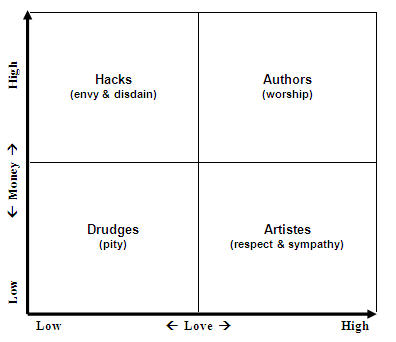
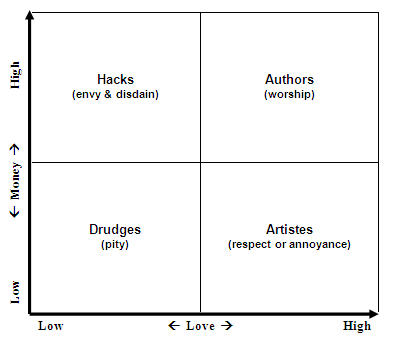
    And so many folks think that there’s a continuum. On one end is writing for passion. On the other is writing for money. And the two don’t cross. But this is a false dichotomy. The truth is that money and passion are independent factors.

    Lon Prater, a writer friend, recently expressed it this way.

    Not a dichotomy, but rather an X and Y axis, the way I see it.

    There’s:

    low love, low money (SEO writing?)

    low love, high money (For me, this would be tech writing, or media tie-in to a universe I didn’t care about)

    high love, low money (unfortunately too much of my writing!)

    high love, high money. (Loftiest of goals) 🙂

    You can find datapoints for every quadrant, and of course “love” is highly subjective and individualized, as are what counts as low and high for each writer.

    If we put labels to the quadrants, we get something like this, along with common emotions they tend to evoke in other writers. (Although I will say that envy seems to want to run amok in the author quadrant as well.) 

    writer-love-and-money-quadrants2

    Share
  • |

    Awful Intent Update: The power of having the electric ladies read to you

    Everyone says you cannot copyedit your own work.

    You’re an idiot if you try.

    Because you’re mind auto-corrects eorrs, and fills in missing punctuation or words like “of” “the” and “a”.  And often doesn’t care or know the house rules for capitalization. Etc.

    (Did you catch all the errors in that paragraph?)

    Except the brains of copy editors play this trick as well. That’s why some read the manuscript backward and others use arcane WordText code to suss out issues. And some change the font face. And some make multiple passes over a section, looking for dialogue issues the first time through, capitalization the next, and something else the third time. And despite all their work, you still find errors in the text.

    I’m not saying editors aren’t any good. I’m just saying that our brains, for the most part, don’t care about the details. They just care about the communication, and they’re very good at ignoring the rubbish. And when it’s just the brain and the eye working together, the brain makes sense of the text, even when something’s wrong or missing.

    So one trick to force the brain to see what’s actually on the page is to read your text out loud to yourself. It’s an excellent practice, except a human brain is still involved, and it sometimes still plays tricks. And sometimes we get lazy and start to read too quickly, and the next thing you know we’re subvocalizing and whipping along, missing all sorts of stuff.

    So what can you do?

    Well, a few book releases ago, I stumbled onto something. I invited an electric lady to help. And she was dynamite. (You can invite a man if you prefer the sound of those voices.)

    I’m talking about inviting your computer to read aloud every word of your manuscript to you. And highlight the words as it goes.

    I can tell you I’m never going back. These ladies have simply helped me see too many errors that were invisible to me and my beta readers who had editorial chops.

    I use WordTalk, a free plugin for Microsoft Word for this kind of reading. The University of Edinburgh created it to help kids learn how to read. It allows you to select from the text-to-speech voices you have on your computer, set the reading rate, and it highlights the word it’s reading so you immediately see where the error is.

    I set it at a slightly faster reading speed so my mind cannot wander during the reading and use the quick keys so I can start and stop and make my edits easily. And I always, always, always have my electric friend re-read any fixes I make because I can’t tell you how many times I’ve adjusted a sentence or paragraph and introduced more errors that I didn’t see, even though they were staring me in the face.

    I must admit that the electric ladies can’t do everything. Having them read to you cannot help you spot errors you don’t know are errors in the first place. If you don’t know, for example, the conventions for capitalization of personal titles or the conventions for numbers (is it a “.44mm” gun or “forty-four millimeter”?) If you don’t have your own house rules for the many areas where you have a choice like in an epic fantasy (do you use “Dreadman” or “dreadman”?) If you don’t know any of that, you’ll blithely skip over a host of errors and only see the issues you know like the misuses of “rise” and “raise” or “lie” and “lay.”

    So you have to learn the conventions or find someone who does (an editor). Or both.

    Also, doing this type of reading will not help you see if what you’ve written is actually translating the scene in your head clearly and vividly to the page for someone new to your story. Only a fresh set of eyes can tell you where your story isn’t clear, believable, or interesting (at least to that one reader).

    But for helping you spot the issues you do know, I haven’t found anything better. Give it a try.

    Oh, and the update on Awful Intent–Zira and I are almost finished with the copy edit! Which means the release is only days away.

    Share
  • |

    Amazon vs Macmillan = Big River Fighting to be Big Banana

    Here’s what this brouhaha is all about

    Amazon wants to try to replicate with digital books what Apple has done with digital music. So what has Apple done?

    According to Cnet’s “iTunes reps 1 in every 4 songs“:

    “iTunes-purchased songs now account for 25 percent of the overall music market–both physical and digital–in the U.S., says an NPD Group report released Tuesday.”

    That may not seem like a market leader position, but in the comments one person pointed out the following.

    “35% of the music sales are digital (there’s some conversion where 1 CD = 11 or 12 individual digital downloads). Apple owns 70% of the digital market. 70% of the 35% ~ 25%. So Apple has a 25% share of all music sales.”

    Whoa, Nellie. That there’s what we call a cash cow. Moo-la, Baby, Moo-LA! And this becomes even more significant when you consider the fact that many think the digital part of music sales is only going to grow and grow.

    According to the same set of data, TheStreet.com’s  “iTunes, Wal-Mart Dominate Music Sales” reports:

    Amazon accounts for only 8% of that market .

    How did Apple get the head lock on such a huge portion of the digital market? It appears it has to do with the fact that Apple was first to market with a good MP3 player solution, linked that to its iTunes store, and then bundled the software in such a way as to drive and then keep people coming back to iTunes. Here are a couple of articles. I’m sure we could google dozens more.

    Amazon (and many others) are forecasting digital books to become a very large part of book sales. Amazon wants to be the big banana in that space. Well, it can’t be (drum roll) the big Apple now can it?

    But what does this have to do with publishers?

    Big Banana’s Problem

    Amazon cannot become the big banana if nobody buys its stuff because consumers feel it’s priced too high.

    So why don’t they just price it low?

    Ah, there’s the peel.

    In this new proposed arrangement, Amazon cedes a huge portion of its pricing control to the publisher.

    But Apple’s doing that with its iPad.

    It is. However, Apple already has a model and ability to sell. I think Amazon wants to make sure it keeps the low-price position because this is one of the key reasons people go to Amazon. Amazon pulls online book customers in because (listed in what I estimate is importance):

    1. The new books are usually cheaper and if you really want a low price you can buy them used
    2. Amazon provide long tail stock (what book can’t you get out there?)
    3. It’s easy to type in a title and find out more info about the book (first chapters, user ratings, etc.)
    4. Completing the sales transaction is a snap 

    I’m assuming Amazon is worried that if it allows publishers to price their ebooks higher, then they lose one of their MAIN draws. And therefore their ability to become Big Banana.

    The Existing Supply Chain Model

    Right now you have these distribution or supply chains:

    • Publisher  –> Wholesaler  –> Retailer –> Consumer
    • Publisher  –> Retailer –> Consumer
    • Publisher  –> Consumer

    All of them exist side-by-side. For example, Scholastic will sell books via a Barnes & Noble retailer, but they’ll also sell direct via their school book program. You can get SERVANT at Barnes & Noble or you can get it directly from Macmillan here.

    Why have the middlemen?

    Because middlemen bring the cost of purchasing a book WAY down. Some people don’t think that. All they see is that the retailer buys the book wholesale and then jacks up the price.

    But imagine there were no Wal-Marts, Smith’s grocery, or any other kinds of stores. As a consumer you would have to go to farmer Bill for milk, travel 10 miles to farmer Jane for corn, travel another 10 miles to farmer gill for eggs, and on and on and on for the hundreds and thousands of different products we buy. Furthermore, because middlemen bring the products all together each producer has more incentive to compete on quality, value, and price.

    Middlemen SAVE consumers huge amounts of time and money. That’s why we’ll always have them with us even though producers may still sell direct at the same time.  And that’s why we’re willing to pay the little bit they ask for what they do.

    Price/Volume/Profit Control

    There are two keys to making all of this middlemen business work.

    First, usually only the two parties involved in any transaction control the terms of that transaction. So the publisher and wholesaler agree on a price for their transaction. The wholesaler than makes a separate agreement with the retailer. Finally, the retailer is free to make a separate agreement with the consumer. In each transaction the seller gets to control price, cut deals for high volume purchases, and, therefore control its profit.

    In all cases you negotiate a price/volume mix that’s good for both parties. Sometimes this includes a flat price. Sometimes it includes price deductions for larger volumes.  But in all cases it gives the producer something to count on. If a customer wants a lot of product, great, we’ll sell it to you for X price and make Z profit. If you want less, fine, we’ll sell it for Y and make Q profit.

    Second, wholesalers and retailers want to control costs. They need to be able to turn around and sell your product for some profit. If you sell your stuff to someone else for a humongous discount, then that allows their competitor to charge less and potentially shift volume to them. So buyers will often try to get commitments that you aren’t going to screw them somewhere else. And sellers who value long-term relationships are willing to make such commitments.

    So here’s business as it is today. A retail bookseller (Amazon, B&N, etc.) pays a fixed wholesale price for the book to the publisher. The bookseller might negotiate wholesale price breaks at different quantity levels with the publisher, but that’s a wholesale price/volume agreement that ensures certain profit levels for the publisher. As for the retailer, they maintain a different price/volume/profit control on their end with the consumers, fiddling with volume/price mixes that make sense to them. In this situation BOTH the publisher and the retailer maintain price/volume/profit control.

    What do you want to be–the Marketplace or the Seller?

    But this new percent-of-retail scheme decouples price from volume and forces the publisher or retailer to lose control of profit. Either Amazon or the publisher has to GIVE UP price/volume/profit control with their set of buyers.

    If Amazon gets control, then it can set the retail price however it wants REGARDLESS of volume. In this situation, because wholesale price is pegged to retail price via the %, this means Amazon would dictate the wholesale price to the publisher without any regard to volume. This takes price/volume/profit control away from the publishers, putting them at the mercy of the retailer’s whims.

    Scary, a total shift in the way they’re doing business. Publishers would have to budget for the worst case scenario–the lowest the retailer might charge.

    However, that’s NOT what happened. In this current deal Amazon ceded its control to Macmillan, saying, okay publisher YOU set the price for my customers. This isn’t foreign to Amazon. They do this right now with used book sellers. Those folks set their own price and Amazon acts as the market place. And once Amazon says “we’re the marketplace, not the seller” then they step right out of the “hey, you’re charging too much” equation. So nobody would yell at Amazon for this move. Well, some folks would, but they’d soon figure it out. For example, nobody yells at Amazon now when used book vendors want to charge $99 for a trashy paperback. Everyone gets that Amazon is just the marketplace just as they get that Ebay is the market place.

    However, in this case Amazon did want to retain some control. They said, let’s set a range of prices that are acceptable. You can charge $5.99 to $9.99 but no more or less. This would allow the publisher to sell a book for more money when it’s initially released and gradually drop the price as time goes on until we get the bargain basement price of the remainder tables. The articles I linked to in the original blog discuss this common selling practice.

    Macmillan said, the miminum is great, but we actually want to start higher–$14.99.

    Amazon said, no way, Dude. And the battle was on.

    Magic $9.99?

    But why? Why did Amazon insist on that maximum? Why not just do what they already do with used book sellers and step away completely from controlling price? Wouldn’t they WANT to make more money with higher prices anyway?

    Again, price directly affects volume sold which affects profit. But in this case, it’s not as much about profit but volume and market share.

    The only reason that makes sense to me is what I discussed at the beginning of the article–Amazon wants to dominate the digital book space as Apples does iTunes, and they feel the must keep prices low to continue to get people coming to their Kindle store and growing their customer base.  They’re hoping to spank the competition in this segment by being big first and getting all the volume–it’s the old five yards and a cloud of dust.

    Big Banana. Kind of like Wal-Mart is in its segment. Kind of like Microsoft is in theirs. Kind of like Apple is with digital music.

    And they obviously think $9.99 is the magic number to keep the customers pouring into their Kindle e-book world.

    ebooks cost nothing and my grandma plays in the NBA

    Isn’t $9.99 a good price for the publisher? I mean, heck, ebooks don’t use any paper, so they cost next to nothing to make, right?

    Um, no.

    The answer’s “no” because paper is only a part of the cost. And I’m not talking about the cost of the person who takes the Word document and converts it into PDF or Kindle or whatever the ebook format is. My kid could do that for twenty bucks.

    Every product is a mix of fixed costs that don’t change with the volume you produce and variable costs which do vary. Rent, electricity, buildings, equipment, editorial, art, design, author advances, marketing, etc.–all these things can be fixed costs. It doesn’t matter if you make one book or one million. You still have the same rent, same fixed cost for artwork, same cost for editors.  

    So how big are those fixed costs? Based on the blogs I linked to in the original article (and if I read them correctly), the fixed costs are estimated somewhere between $7,000 and $20,000 per book. But those numbers aren’t hard numbers. For example, books that have bigger author royalities and bigger marketing budgets are going to cost more. Furthermore, because those numbers don’t have any details backing them up, I’m leery of trusting them.

    But we can look at something that is public knowledge to see how this works. For example, Stephenie Meyer got $750,000 for Twilight. Most authors do NOT get that. Most get a $5,000 – $7,000 advance per book. Still it shows the fixed costs can be quite large. Meyer’s advance was a huge fixed cost that needed to be covered by each book her publisher sold.

    If they sold only one book, they’d have to have charged $750,000 for it just to cover that one cost. Do you know anyone willing to pay that for a book? No. So they priced it, hoping to sell thousands. If they were to sell 750,000 copies, then that advance only cost $1 per copy. If they were to sell 1.5 million copies, then it would be .50 cents per book. The more books they sell, the smaller the fixed cost per book. Of course, that’s just one fixed  cost! You need to add all the others in (marketing must have been very large as well). Furthermore, Meyer is THE best seller. The vast majority of authors don’t sell anything that comes close. Yes, they have smaller advances and marketing budgets. But you get the idea–fixed costs matter!

    So all these people saying that since no paper is involved ebooks should cost nothing are ignoring fixed costs. In fact, according to some sources, printing, paper, and shipping only account for 10-20% of the cost of most books. I don’t know if that’s an average at all volume levels. Again, there was nothing to back up those claims. But if it’s accurate, you can see the arguments demanding ebooks be sold for next to nothing become silly at best.

    The fact is that the publisher needs to cover those fixed costs. If you were the publisher, how would you do it? Would you price hardbacks to cover fixed + variable + profit? And then price paperbacks and ebooks at variable + profit? Probably not. Hardbacks are already pushing the price limits for consumers. I think you’d want to spread those fixed costs around. If anything, you might try to cover a higher portion of the fixed costs with the paperback and ebooks.

    My inner accountant is screaming for real data to crunch and display in a spreadsheet, but I don’t have any actual actual price/volume/profit matrices. What I can say is that paper has NEVER been the only cost. For midlist authors I suspect it’s probably the smaller portion of the cost of each indivudal book. Publishers must price the books and move the necessary volume to cover fixed costs + variable costs + some profit. And so it’s only reasonable to expect that ebooks be priced to do that.

    What’s the best for you, dear reader?

    I don’t know which specific potential leader will end up providing better prices, reading devices, services, etc. in the long run. Is that Amazon, Apple, Barnes & Noble? A whole bunch of retailers? Who knows?

    What I do know is that it’s good to have a number of companies competing for the customer’s dollars. My vote is with having lots of retailers. If Amazon can sell a significantly larger number of ebooks with their pricing, then publishers, authors, and readers all win. If they can’t, then it becomes a win-lose.  And the publishers and authors will be on the lookout for a way to improve the situation by seeking out other distribution channels.

    Edit for Macmillan Announcement

    2/4/2010 4:05 PM

    It appears Macmillan and Amazon have come to an agreement.

    Notice Macmillan CEO claims this new agreement will result in them making LESS money than they do with ebooks currently. But it provides a reliable and rational market. I think what he’s saying is that this allows publishers more predictability, even if it comes at a price.

    From what I understand Amazon currently pays 50% of suggested retail price for an ebook. The publisher sets the SRP (you see it on the book often), but Amazon has full control to charge whatever it wants to the customer. Here are the numbers for SERVANT.

    • SRP = $25.99
    • Amazon pays the publisher 50% of $25.99 = $13 for each copy of SERVANT they sell
    • If they sell it for $9.99 they lose $9.99 – $13 = $(3.01) per book
    • If they sell for $14 (about what they’ve been listing it for, the make $14 – $13 = $1 per book

    Under the new deal the publiser sets the SRP and the consumer price. On each sale Amazon gets 30%, the publisher 70%. Here are the number for SERVANT under this scenario.

    • SRP = $25.99
    • Publisher sells ebook for $14
    • Amazon pays the publisher nothing until the sale.
    • Amazon earns $14 x 30% = $4.2. This is MORE than they are making under the current system.
    • Publisher earns $14 x 70% = $9.8. This means the publisher earns $(3.20) less, just as claimed, under the system they WANTED versus the existing method

    So why earn less? As Macmillan says in the announcement above, they’re willing to take less to have a more rational and stable market for ebooks

    Over the last few years we have been deeply concerned about the pricing of electronic books. That pricing, combined with the traditional business model we were using, was creating a market that we believe was fundamentally unbalanced. In the last three weeks, from a standing start we have moved to a new business model. We will make less money on the sale of e books, but we will have a stable and rational market. To repeat myself from last Sunday’ s letter, we will now have a business model that will ensure our intellectual property will be available digitally through many channels, at a price that is both fair to the consumer and that allows those who create and publish it to be fairly compensated.

    We have also started discussions with all our other partners in the digital book world. While there is still lots of work to be done, they have all agreed to move to the agency model.

    So this is how all ebooks will work with Macmillan going forward. I’m betting most or all the other publishers will follow suit.

    I think this is good news for readers, publishers, and retailers. Readers get it for less than hardcover. It will be at the higher end of the range settled with Amazon (I think it was $5.99 – $14.99) unless the publisher decides to run discounts as they do with many blockbusters now in hardback. But the price will drop as time goes on. I imagine when they release the paperback for a book, they’ll have to drop it for certain. And when books go to the remainder tables, they’ll drop again. I can see old ebooks or promotions costing $5.99 – $9.99, new ones $14.00.

    BTW, the standard now for many authors is to be paid 15% royalty of the SRP on ebooks up to a maximum of 40-50% of the net amount publishers get from the retailer (btw, contracts stipulate different royalty rates for ebooks, hardback, mass market, etc.). Something the industry is considering, as mentioned in Sargent’s letter, is setting a % rate of the amount received by Macmillan from Amazon. So instead of paying authors 15% royalty on the SRP, new contracts will likely pay authors 20 -25% of the 70% the publisher receives as royalty. You can do the math. It’s very clear this new deal doesn’t earn the author more per book. 

    Hopefully, then, we’ll simply sell a heck of a lot more copies. One glitch in all this is the fact that publishers haven’t really been setting prices with consumers. That’s been the retailer’s job. And so they’ll probably have a learning curve trying to get the prices right in the beginning. Or maybe not. We’ll have to see.

    Edit to answer Jason_Young @ 2

    2/5/2010

    Your point is, hey, if they have three products (hardback, paperback, and ebook) to spread the fixed costs across, then should that allow them to drop the price of all three products? $100 / 2 = $50. $100 / 3 = $33.3. Have I got the question right?

    FIXED COSTS AND VOLUME

    If so, then the answer is it all depends on the relationship between volume and fixed costs. It always depends on that relationship. In fact, that 20% figure may or may not be accurate because . . . it all depends on volume and fixed costs. Both of which can change.

    Let’s take a totally FABRICATED and SIMPLIFIED situation to see how it works.

    Fixed costs: $10,000
    Variable costs hardback (paper, printing, binding, etc.): $3

    Cost per book by volume printed.
    Printed / Cost per Book / Variable as %
    1 / $10,003 / 0.03%
    1,000 / $1,003 / 0.3%
    5,000 / $5 / 60%
    10,000 / $4 / 75%
    20,000 / $3.50 / 86%
    50,000 / $3.20 / 94%

    Now remember: printing has fixed and variable costs as well. But I’m going to say the printing’s all variable to keep this manageable. And that you sell every book you print (something that never happens). The thing to see here is that when you keep fixed costs constant and increase the volume printed, then the fixed cost amount and % per book goes down. Conversely, variable costs become a larger and larger portion of each unit’s cost. Remember, however, that often fixed costs go up when you plan on printing significatly more books (Twilight etc.) But given a set budget for a book, you want to sell as much as you can.

    VARIABLES CHANGE

    So your argument is that when ebooks come along, the fixed costs have already been covered by the hardbacks and papers, cause they’re all still priced the same and the variable and fixed costs haven’t gone up that much since two or three years ago.

    Here’s some of the assumptions you’ve made that might be false:

    1. Fixed and variable costs haven’t gone up
    2. Publishers are selling the same number of copies per book as they were in the past
    3. Ebooks aren’t cannibalizing sales of hardcopies

    The truth may be that costs have gone up and that books aren’t selling as many copies in their various formats as they used to. But even if both of things have not happened, why should we suppose that ebooks don’t cannibalize hardcopy sales, dropping the volumes and, therefore, increasing the cost per hardcopy? Or that they won’t cannibalize even more in the future as ebook readers become better and better.

    On the revenue end, you’re also assuming publishers are selling books for the same prices they were in the past. SRP may be high, but have you noticed the prices on new books on Amazon and other outlets? My $25.99 SRP book came out and sold for $17. It sold for $15 and change before release! And I’m not a big name they’re trying to drive volume to. This is newbie no-name they’re having to discount.

    What I expect has happened over the last five years is this. Costs have risen. Hardbacks are already pushing the limits on price. Furthermore, sellers and consumers are asking for more and more discounts. Paperbacks still haven’t crossed the $9.99, but there’s still pressure to keep them low. Ebooks are adding revenue, but a significant portion of that comes at the expense of hardcopies. So it changes the mix of products sold. It doesn’t simply open up a whole new stream of untapped cash. Because of this, ebooks allow the publisher another method to earn profit that’s getting squeezed away.

    PRODUCT MIXES AND CONTRIBUTION MARGINS

    The best way to look at this is to look at the cost in two ways. One way is to allocate fixed costs and get a price per unit. But if you look at it only that way, you can make a number of bad judgments on the value or price of a product. This happens because of that relationship between fixed costs and volume. So you also want to look at the contribution margin of each product. And, in fact, this is a better way of judging the profitability of an item.

    In this method you lump all the fixed costs together and then examine each unit of the different products (hard, soft, ebook) only by its variable cost versus revenue to see if each unit sold is contributing something above its variable cost towards the fixed costs. Then you estimate the volume you expect (hope) to sell at given prices and try to price them all in a way that will move enough volume of each type of product to cover fixed costs and provide some profit.

    So you don’t consider each product type individually. You look at the MIX of product and the MIX of contribution margins. And you work it so that together the MIX of products covers costs and earns you a profit. And gets enough volume to keep your author a going concern, growing his numbers so he becomes more profitable as time goes on.

    Edit for Modesitt’s insight

    2/6/2010

    Please check out this blog by L.E. Modesitt, Jr. “Why Amazon and Some Readers are Wrong”

    Second, what’s been overlooked is the fact that a tremendous number of book titles actually lose money. Depending on the publisher and the year, that can range from as little as 30% of all titles published to more than 60%. That means that successful books not only have to cover their own production costs but the losses from unsuccessful books if the publisher is to remain in business.

    Third, hardcover sales of successful books effectively subsidize paperbacks or less successful books. Ten-dollar Kindle books would have created price pressures that would either reduce the sales of hardcovers or replace them with e-books, and as more adaptable e-book reading devices become available, that would reduce overall revenues even more than would $15 e-books. This, in turn, would reduce the ability of publishers to try “new” authors and approaches, and would likely result in more “mass” entertainment and less diversity in a field that is already having trouble publishing books for limited audiences.

    Just in case you didn’t connect it to the discussion above. A HUGE cost that needs to be covered by the contribution margins of the successful books are the fixed AND variable costs of each book that fails to contribute enough segment margin (the contribution margin of a segment of your business, in this case a book in its various formats) to pay for itself.  Look at Modesitt’s percentages of books that lose the publisher money. Think about that. For the publisher to continue to bring in new authors who might not sell well in the beginning but have great potential in the long run to sell well, they have to cover the “start up” costs of those authors.

    He makes a lot of other important points. It’s a good read.  And it all plugs into the fixed costs, volume, price, contribution margin equations.

    Share
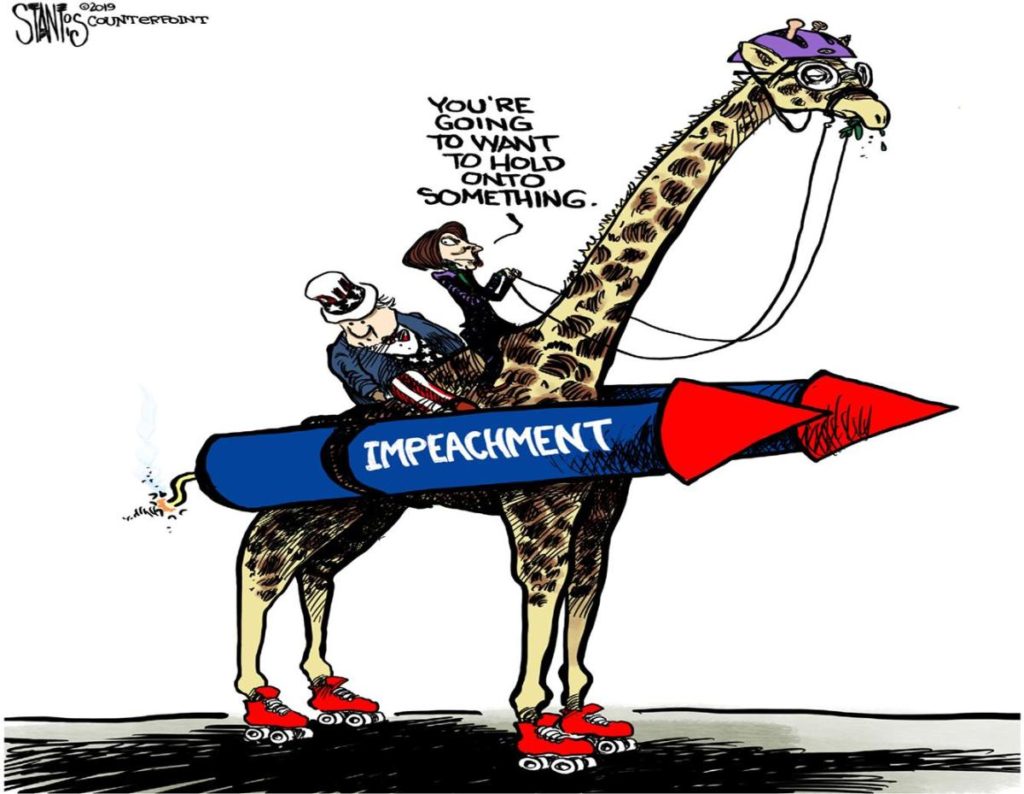
  • Impeachment might not be what you think it is

    I’ve come to realize I didn’t understand the process of impeachment and the standards by which it is conducted. Here are a few key things I’m betting most of us didn’t know. Some of them will surprise you.  

    First, the process has three steps:

    1. The Congress starts an investigation, which can be conducted by any part of that body—the House, Senate, a special counsel, etc.
    2. The House leadership decides on whether to vote on “articles of impeachment.” The articles need only a simple majority to pass. If they do pass, the person is impeached. However, the articles of impeachment are not a conviction; they are a formal allegation of wrongdoing. The analog to this in the criminal justice system is an indictment.
    3. The Senate then holds a trial to decide if the allegations are true with both sides bringing witnesses, evidence, cross-examination, etc. The chief justice presides when the president is impeached. If two-thirds of the senators deem the allegations true, then the person is convicted and removed from office and may be barred from holding future positions. If the super majority isn’t reached, the person is acquitted of the charges.

    There are two big questions in all of this. First, what standard of proof is used for passing the articles and then convicting the person of the allegations?

    It appears that the standard of proof required for impeachment and conviction is left to the discretion of each individual representative and senator. There is no standard defined. So while some may use the standard of beyond a reasonable doubt, others may not.

    Second, what can someone be impeached for?

    According to the constitution they can be impeached for “Treason, Bribery, or other high Crimes and Misdemeanors.” However, the phrase “high Crimes and Misdemeanors” is not defined in the Constitution itself. 

    The most authoritative explanation of what “high crimes and misdemeanors” are appears to be a document written by the staff of the House Judiciary Committee. The latest version of this was written in 2015 and is called “Impeachment and Removal.”

    According to the Wikipedia article on impeachment, “While this document is only staff recommendation, as a practical matter, today it is probably the single most influential definition of “high Crimes and Misdemeanors.””

    A key take away from that house committee report is that not all crimes are impeachable offenses and not all impeachable offenses are crimes. So what are grounds for impeachment? Well, it’s a bit vague.

    In 1788, Alexander Hamilton argued in the Federalist Paper 65 that impeachment was for “the misconduct of public men, or in other words from the abuse or violation of some public trust.” The House Committee report expounds on that, including the following general grounds:

    • “Constitutional wrongs that subvert the structure of government, or undermine the integrity of office and even the Constitution itself”
    • “Abuse of the particular powers of government office or a violation of the “public trust””

    The report goes on to say the following.

    “Congressional materials have cautioned that the grounds for impeachment “do not all fit neatly and logically into categories” because the remedy of impeachment is intended to “reach a broad variety of conduct by officers that is both serious and incompatible with the duties of the office.” Nonetheless, congressional precedents reflect three broad types of conduct thought to constitute grounds for impeachment, although they should not be understood as exhaustive or binding: (1) improperly exceeding or abusing the powers of the office; (2) behavior incompatible with the function and purpose of the office; and (3) misusing the office for an improper purpose or for personal gain.”

    But the report doesn’t give much definition beyond this, just a few examples of what individuals have been impeached for since the founding of the country. What does all of this mean?

    I think the Wikipedia article sums it up well.

    “Several commentators have suggested that Congress alone may decide for itself what constitutes a “high Crime or Misdemeanor”, especially since the Supreme Court decided in Nixon v. United States that it did not have the authority to determine whether the Senate properly “tried” a defendant. In 1970, then-House Minority Leader Gerald R. Ford defined the criterion as he saw it: “An impeachable offense is whatever a majority of the House of Representatives considers it to be at a given moment in history.””

    Impeachment is a political remedy, not a criminal justice or civil justice one. And given the vague definition of grounds for impeachment and the lack of any required standard of proof, what this all means, unfortunately, is that the process, especially in our current climate, is going to be rife, not with objectivity, but partisan politics. On both sides. 

    Here’s more for the curious.

    Share
  • | |

    Teachers (and writers)! Free Class Next Monday on How to Teach Narrative for the Common Core

    If you feel a bit lost or anxious about how to teach narrative for the new core, especially stories, I think I can help.

    I’m an educator in the private sector and an award-winning novelist and short story writer. I’ve been teaching authors in various venues how to write for the last five years. I’ve been on writing podcasts with thousands of listeners, taught at a number of writers conventions, and had a series of articles published by the national Science Fiction and Fantasy Writers of America organization, an organization for professional authors. I’ve also been helping Nellie, my wonderful wife, teach her 7th and 8th grade language arts students the unit on short stories during that same period. We’ve taught it to twenty different classes and picked up a number of important insights along the way.

    This last year I couldn’t help but examine all the materials Nellie brought home during the district’s writing program adoption investigations. Some programs looked very promising; others not so much. Some got some things about writing flat out wrong. Most of the programs had gaps.

    Furthermore, because I work with so many people wanting to write, I know that it’s difficult to teach if you really don’t understand what stories really are and how they work. For lots of people, the subject matter can seem impenetrable. And yet writing stories is such a wonderful way to teach writing, especially because so many kids love it. You won’t find a kid who will spend extra hours writing a business letter or poem analysis, but you will find quite a few who will go crazy writing stories. And the whole time they’re practicing their writing skills.

    The question is how DO you write a story?

    What is a story?

    How can you tell if it’s good?

    How do you come up with ideas?

    Where do you start?

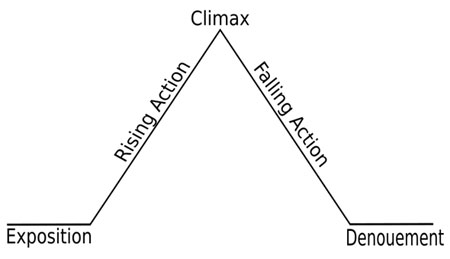
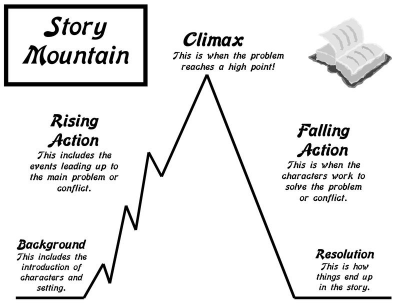
    And what the heck is this chart? Do writers really use this? (Not many that I know.)

    Story Diagram plot-mountain-pic

    And does anyone think changing the diagram to look like Aspen, Colorado actually helps?

    Story Diagram Aspen 

    Hey, students—please make your story look like Aspen, Colorado!  (Yeah, that’s going to be effective.)

    And yet it’s not as difficult as it appears. Nellie and I have seen a lot of kids really get into writing stories. We’ve seen kids WILLINGLY going way beyond the assignment to write stories that are eight, twelve, twenty-five plus pages. And as they’re writing, they’re practicing grammar, spelling, structure, vocabulary, etc. without knowing it and having a great time. I know that if you enable your students, many of them will write, write, write. Especially in grade school. But also in the higher grades.

    Stories can be a blast. The assignments can connect to many students. And the results can be wonderful. I’ve laughed out loud at some of the stories coming out of Nellie’s class. Others have been enjoyable on other levels.

    But for this to work in your class, you need to know some key things. You need to understand the core of story and the story development process. You need a lesson plan that details everything step-by-step so your students don’t flounder. And you need to know some fundamental tips (secrets?) about teaching this content.

    So I’m going to hold this day-long class for you. A full eight hours. And share everything Nellie and I have learned. This class will be for teachers at ALL levels (I’ll show you some ways to scale the complexity of what you’re doing). There will be NO cost. The only thing you have to bring is a pencil, paper, whatever program materials you have, and a willingness to have a good time.

    When we finish, you will know how to write a simple story like the ones your students will write because, ta-dum, you will write one! AND you’ll have a step-by-step lesson plan that builds on whatever materials you have—an official program or one of your own. AND you’ll understand story better than 99% of the population. AND you’ll have a bundle of techniques to help your students. AND you’ll solve both world peace and maybe the lost sock conundrum.

    Truly, I think that instead of feeling stress, you’ll actually be looking forward to teaching and writing stories with your students. If not, you may bring tomatoes and huck them at me, but please be aware that I will not stand still; to find satisfaction, you will have to be able to hit a moving target.

    If you’re interested, just click the Contact John link under my photo in the left sidebar and send me an email letting me know.

    Hope to see you in class!

    GET READY FOR A FUN DAY OF LEARNING!

    Topic: Teaching writing (narrative & the common core)

    Who: Teachers (and writers at least 18 years old), seats are limited

    When: Monday, July 29th, 8:15 AM – 5:00 PM

    Where: Rich Middle School, 54 E 100 S  Laketown, UT 84038

    Materials you need to bring:

    • Pencil
    • Paper
    • The writing program you’ll be using this year
    • Kooky socks, for those who cannot resist the urge
    • A lunch or a way to get one

    AGENDA

    8:15 AM Arrive

    8:30 AM – 9:20 AM

    • Can you create a redneck crapper?
    • The 1st secret to teaching writing: Attributes & techniques
    • The 5 parts of story
    • Thieves prosper – using existing patterns
    • A car, a beggar, and an idiot — basic pattern 1

    9:30 AM – 10:20 AM

    • The 2nd secret to teaching writing: Do it with them
    • Technique: Sketch then draft
    • Workshop 1: Zombies and kisses
    • Technique: Zing hunting
    • Workshop 2: Hunt zing

    10:30 – 11:20

    • What makes a story big or small
    • Workshop 3: Select a right-sized THOM and character
    • Workshop 4: Select a Goal
    • Workshop 5: Make character sympathetic
    • Workshop 6: 3 tries
    • Workshop 7: Resolution

    LUNCH

    12:00 – 12:50

    • The 3rd secret to teaching writing: Cognitive modeling and the 6-step process
    • The 4th secret to teaching writing: Our tiny brains
    • Writing is telling: Narrative & description
    • Technique: Yes, SiR
    • Technique: Broad-brush + 1
    • Technique: The Pause

    1:00 – 1:50

    • The 5th secret to teaching writing: Have fun
    • Workshop 8: Write your story

    2:00  – 2:50

    • How the pros revise—concept, line, & copy
    • Workshop 9: Content edit
    • The 6th secret to teaching writing: Our brains are still tiny
    • Workshop 10: Line edit

    3:00 – 3:50

    • The 7th secret to teaching writing: The 3 grunts (responding to a story and grading)
    • Share stories
    • What the heck did we just do?

    4:00 – 4:50

    • How to adjust for grade level
    • Common core
    • Your program and lesson plan
    • Identify black holes
    • Wrap up & next steps
    Share

3 Comments

  1. I would love to see lists like this! The most-anticipated would be an especially cool one, as well as the books with staying power.

  2. I wonder what readers would care about such lists.

    I’m a reader who does not care about any of those lists (or the current NYT ones).

    A list I’d be interested in would be forthcoming books, sorted by date of release, broken down by genre, and searchable by author name. That would make it easy for me to plan what books to buy and read. I actually maintain my own list with some of that information (NOT broken down by genre), but it would be much easier if I did not have to maintain the list manually.

Comments are closed.