Indie Thoughts: How much does it cost to publish a book independently?

Is The Guardian right?

Does it really cost $6,000 to publish a book independently?

Is that the price to become Hemmingway these days?

Lots of commenters at The Passive Voice said the numbers were rubbish. Far too high. They said this was yet another thinly-veiled bit of  flimflam The Guardian cooked up to depress indies and send aspiring authors into the arms of the zombie traditionalists.

I actually thought the piece was good.

Why?

Because I like numbers. I did get a Master’s degree in accounting, after all.

But is it just that numbers are sexy?

It’s true the shape of the number 3 can be glorious. 9 is a stunner as well. But the slopes and curves of these digits is not why I like them. Numbers, even if they’re bad numbers, allow you to start thinking about costs. They allow you to question whether they could be reduced. Or whether you’re getting any bang for your buck in a certain category. Heck, numbers allow you to discover whether you’re allocating way too much in one area and far too little in another.

I thought The Guardian did a great job breaking the costs out into categories and starting an examination. The question is: are the categories and amounts political fictions or real?

Comparing My Numbers

One way numbers do all the things I mentioned above is by letting you do comparisons. So I figured I’d compare The Guardian’s numbers with a set of my own. I’ve published four books independently. How do my costs stack up?

Here are the costs for the latest.

Cover: $500

  • $500 for illustration
  • $0 for cover design (I have a friend who is so incredibly generous with his time)
  • Cover for some genres can cost less. Some folks do it themselves. Most of those do-it-yourself covers look awful.
  • The zombie traditionalists can sometimes spend a few thousand. And when they do it right, they get some amazing, AMAZING, work.
  • Verdict: The Guardian’s number seems reasonable, but I’m thinking the range is a few hundred up to a few thousand for something that doesn’t give the average reader worms.

Editing: $0

  • My wife, former technical writer, current language arts teacher, is my editor. There are some other folks I’ve tapped as well.
  • If I didn’t have her, I’d need someone. My experience is that if you yourself are not an editor, and you try to do this, you’re going to end up with a poorly edited book. Even with her experience, we’re still finding it hard, and are working to get the process down. We might outsource this in the future.
  • I’ve gotten reasonable quotes, and they’re all around $600-900. And that’s just for a copy edit. You want other kind of editing, you’re going to pay more.
  • Verdict: The Guardian’s number is high, but not if you tap into a bunch of pros for multiple edits.

Formatting for POD and ebook: $120

  • I do the interiors myself, so the labor is free. If I had to pay, it could run anywhere from $100-$300 or more.
  • I pay a subscription fee for InDesign. If I release two books a year, it comes out to roughly $120/book.
  • I spent $300 taking a class on basic interior design principles. But that was just the beginning. I must have spent 50-70 hours, maybe more, last October and November, banging my head against the wall as I learned this. Luckily, all that thrashing about didn’t result in any medical bills. I’ve had to spend maybe 10-20 more since then learning advanced techniques and keeping the basics fresh.
  • Verdict: The Guardian didn’t even include this.

ISBN: $0

  • I owe my friend; without him, this would definitely be a cost. I’m such a free loader.
  • Verdict: The Guardian’s number is good.

Copyright Registration: $55

  • $20 bucks to mail 2 copies to the Copyright Registration Office
  • $35 processing fee
  • Yes, you do want to do this. For detail on why, see The Copyright Handbook by Stephen Fishman.
  • Verdict: Another miss

Print-on-demand fees: $0

  • I go with CreateSpace instead of Lightning Source
  • Verdict: Another miss

Notice what’s NOT up there that was in The Guardian article: reviews and review copies.

Why don’t I include them?

First, I would never pay for a Kirkus review. I wouldn’t because it appears such reviews mean little to readers. They don’t seem to generate much notice or desire to sample. Here’s what readers report matter to them. Such pre-publication reviews DO matter to store and library book buyers. But, as an indie, I’m not focusing on those channels.  Those channels are in the hands of the zombie traditionalists.

What about review copies?

You don’t need them to publish. All this review business is marketing. And you don’t need marketing to publish.

So what are my totals? I’ve included The Guardian numbers so you can see the differences.

Category My Costs Guardian Estimates
Cover $500 $750
Editing and proofing $0 $4,000
Ebook and POD Formatting $100 ?
ISBN $0 $125
Copyright Registration $55 ?
POD setup fees $0 ?
Reviews – $825
Review Copies – $300
TOTAL $655 $6,000

Whoa! The Guardian estimated a cost that’s ten times what it costs me. But I don’t think that’s a sign of some plot. If I’d paid an editor and cover designer and formatter and didn’t mooch my ISBNs, that could have added as much as $1,000-$2,000 to my total. I have friends who have paid more.

Furthermore, that’s just for the ebook and hard copy. Depending on if you publish an audio edition and how you do it, you could spend another $2,000-$3,000.

What does this tell you? It tells me that the reporter made a good start, but needed to do a bit more digging. It also tells me there’s a huge variability in the costs depending on the skills you and your friends possess. It also shows that this is a business. I doesn’t cost a gazillion dollars to publish. It’s not like the $200,000-500,000 you need to start some food franchises, but you’d better be prepared to fork over some cash and/or a lot of hard work.

In fact, when you consider that last point of sweat equity, the $655 is completely misleading because it does not capture the hours I spent, at least 20-60, doing my part of the cover, editing, and formatting. Nor the time spent by my wife or friends. There’s a huge opportunity cost there.

What’s the value of what I could have done with that time?

It’s for dang sure not reflected in the $655.

Marketing

I didn’t include marketing in those costs above because marketing is its own beast. You can publish and do zero marketing. You can publish and do gobs. And just as with the publishing costs, marketing costs will vary based on what you can do in-house and what your situation is. It costs JK Rowling nothing to get covered in  every news outlet in the land. She sneezes, and we get a report about her. You and I are probably going to have to work harder to get noticed.

There are all sorts of marketing costs. Whatever those costs, marketing has a job to do. It’s got to pay for itself. It’s got to help pay for the cost of publishing. And it’s got to help me meet my goal of winning new readers and compensating me for my time.

There are lots of cost categories depending on what you decide to do:

  • Hard copies you sell at events
  • Travel and lodging required to attend events
  • Hard copies and postage for reviewers
  • Time writing blog posts
  • Promotions with folks like BookBub and BookSends
  • Giveaways
  • Etc.

The bottom line is that I think it’s good to separate these costs from publishing so you can measure their effectiveness against sales. Marketing is about revenue generation. These costs really have nothing to do with producing a book.

Books and Lemonade

I’m going to go off an a tangent here for a second. Some folks suggest that indie authors shouldn’t do much marketing. Especially if they only have one or two books out.

I find no evidence to support the idea that just writing the next book is all you need to do for readers to hear about you and beat a path to your door. It’s true you’ve got to write the next book. You must get new product out the door. Hey, I learned that when book 2 from the publisher fell into a black hole. But that doesn’t mean marketing and promotion are inappropriate,  wrong-headed, or a waste of time or money.

Let me ask you a question.

Let’s say Juanito is a no-name in the lemonade business. He’s just starting from scratch with dreams of becoming a big time lemonader. Who thinks it’s a good idea for him to open a lemonade stand in his back yard? Or better yet, in a closet in his basement? And when folks suggest that the stand might get more business if he lets the neighbors know about it or puts the stand in a place with a lot of foot traffic, who says, no, that’s a waste of time and money–the key to selling more lemonade is whipping more batches up in the kitchen?

In retail, you must get folks to notice your product and then persuade them to try it. Now, maybe you’ve got something going that’s generating all the notice and sampling you can handle.  Maybe you lucked out.

What percentage of indies are in that situation? Raise your hands, please.

What? We’re not all inundated with hordes of readers? We’re not  all swimming in gold? Imagine that.

The fact is that it’s tough to get notice. It’s tough to get people to try. But there are some things we can do to increase our odds. Selling books is a retail business. Retail lives and dies by visibility. Yeah, you need word of mouth. But you need to be noticed and sampled in large enough amounts to keep that word of mouth going.

What would you rather have? 100,000 people all over the country in many social networks (I’m not talking about Facebook) noticing and sampling and talking about your product, or would you rather have five?

In the brick and mortar world, there are lots of ways to get visibility without doing much TV or internet advertising. Ways to get notice include things as simple as signage and a store’s location. For example, you get a ton of eyeballs just situating your restaurant in the parking lot of a big destination shopping mall. You get eyeballs putting a sign on top of a 100 foot pole next to the freeway exit saying “Gas & Eats.” Online retailers get noticed in other ways.

Without blathering on about that (this was a post on publishing costs), let me just say that until customers begin to line up and start throwing hundred dollar bills at me, it appears I’m going to have to do what every other retail business has done for hundreds of years–get my lemonade stand out of the basement and into the park with lots of thirsty kids and moms.

EDIT 8/30/2014

While a number of folks are assuming the article was written as part of some vast conspiracy to undermine indie authors, David Gaughran posted some criticism in the article’s comment section that actually make sense.

DavidGaughran

The reason I’m so annoyed by the inaccuracies in this article is that this kind of misinformation is creates an information gap which allows shady operators to flourish.

Vanity press operators thrive because inexperienced authors think that self-publishing is either difficult or expensive. It’s neither of those things, and articles like this only serve to reinforce this false notion. That’s why I think this piece is irresponsible as well as inaccurate.

Companies like Author Solutions specifically target the most inexperience authors, the ones who know least about self-publishing and the industry in general, the ones who have fallen under the spell of various myths (like that self-publishing costs $6,000).

As a commenter said below, saying self-publishing costs $6,000 is like saying houses cost $10m. You can spend that much, but you don’t need to.

It costs me less than a third of that to publish a book, and I use a Big 5 cover designer as well as an editor with over ten years experience working for traditional publishers. Anyone can look at my books and immediately see that they are produced to professional standards.

You don’t even have to spend as much as I do to get a quality product. If authors are on a tighter budget, they can purchase a pre-made cover design. There are some wonderful pre-mades out there for as little as $40. You will have to invest a fair bit of time combing through the sites to find something suitable, but if you are on a shoestring budget it’s an option.

Same goes for content editing/developmental editing. All manuscripts will need a thorough copy edit, but you can get by without a specific content edit with successive round of beta readers. Again, this will require a time investment – writers usually trade beta reads of each other’s work. But if you’re on a tighter budget, it’s another way you can save money.

This is why this piece is so off. Even going the “deluxe” route shouldn’t cost more than $2,000. And if you don’t have $2,000, there are plenty of options where you can achieve a quality product, spending far less, if you are willing to put in a little time.

There are ways you can save money in other areas too. It’s a waste of money for an author (especially a new author) to buy a NetGalley membership for themselves. Authors can (and do) form collectives to buy a membership between them – often spending just $20 per person. I got a NetGalley spot for a month, for free, by bartering with another author. (I didn’t think it was quite worth $20, by the way, let alone $400).

If you need reviews, there are much better and cheaper ways. Submitting to book bloggers costs nothing (we usually send e-book copies or PDFs, rather than hard copies). Doing an e-book giveaway on LibraryThing costs nothing. Giving out electronic ARCs in advance of your release costs nothing. And all of these are much more effective than giving any kind of money to Kirkus, let alone $425.

But I guess it doesn’t matter how many experienced self-publishers (and editors who work with same) tell you that your figures are off, or that you don’t need ISBNs to self-publish, you are going to stick to your guns.

Share

Similar Posts

  • New presentation materials

    Super Author Kristan Higgins
    Super Author Kristan Higgins

    The RWA conference was a blast. It was a wonderful time to hook up with writing friends, to make new ones, and to listen to insights and advice from folks who are selling tons of books.

    Brenda Novak, whose latest book hit #48 on the USA Today list,  gave a great presentation on generating emotion in the reader.

    RaeAnne Thayne, whose book is currently the #5 best selling book in the USA this week, shared lots of helpful tips on ways to make this your most productive year ever.

    Kristan Higgins, whose latest book hit #20 on the USA Today list, gave a presentation on the role and delights of secondary characters and how to use them. She also gave a humorous and insightful keynote speech about one of the most satisfying reasons to tell stories–to help others.

    Lynn Kurland’s presentation on world building was short, but sometimes short is more powerful. I came away remembering that one key to great world building is remembering that nobody will care much about the world if they don’t care for the characters!

    There were others presenting, but I wasn’t able to attend. I’m sure they were equally good. I had a great time.

    I promised those that attended my presentations that I would post the PDFs here. Enjoy!

    Make Them Beg for More — Triggers and Delay

    The Story Setup

    Share
  • What Robinson Wells Learned Last Year

    Look, this is just an excellent post by Robinson Wells: Five Things I’ve Learned In The Last Year About Writing.

    I kept finding myself saying yes, yes, yes!

    Yes! I hate “networking” too. Icky, icky, icky. Like squishy underwear. Like buddying up to someone to get them into your network marketing downline. Like flies in soup. I love how Robinson replaces that with the real deal. I think I’m going to summarize him every time anyone asks me about networking. 

    One point. I do think he might be overstating the you-need-to-know someone deal. It’s easier, sure. But Larry Correia didn’t know anybody. He just wrote a book a lot of people in a certain demographic loved. I didn’t know my agent from Adam. Didn’t know my editor, but did have an endorsement from one of his authors. But that didn’t get me any deal. It probably got me, at most, a fair consideration. I can name others who didn’t know a soul. In fact, go to the facts and figures page in the On Writing section. Look at the author polls there. A lot of authors didn’t know a soul. Of course, knowing someone can help.

    Yes! Be cheerfully flexible. Oh, my gosh. This is such a good approach. And I’m living it right now, although there have been a few moments when I’ve had to regroup for a moment to capture the cheerful.

    Yes! Sometimes the thing you love doesn’t work for the project. Sometimes it does. I would advocate making sure you get to the root of the issue. But we’re artists. If the thing we don’t love doesn’t work, we can create a new thing to love. That’s what it means to be creative.

    Work! Yes! It’s amazing what happens when you work.

    Good stuff.  

    I’m so bullish on this, I say Robinson for President.

    Of what, I don’t know. But he should be President, of something.

    Share
  • Generating Story 11: Creative Q&A with Author Janci Patterson

    I was introduced to Janci Patterson at a local convention by author Sandra Tayler (some may know Sandra because of her husband Howard who does the online Schlock Mercenary comic).  Janci told me she’d just signed with a YA publisher. That was exciting. I asked her what her novel was about. She told me, and I immediately hated her because it sounded like such a fun idea, and I wanted to not only read it, but also write the story myself. Luckily I have a few scruples and did not pay the local Klingons to off her and drop her body in the Great Salt Lake for the brine shrimp to feast upon.

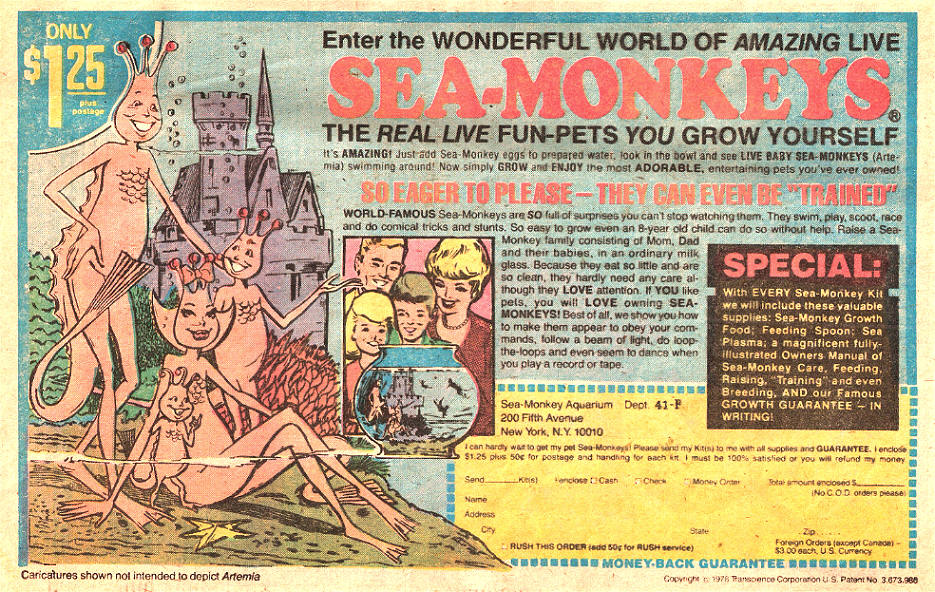
    BTW, did you know that back in the day hucksters placed this ad in Boy’s Life magazine?

    Look at that cute sea-monkey family. Look at the picture of the human family watching the sea-monkey family swim around a castle in a bowl. Click on it. See it large.

    As a young lad, I, as every good Boy Scout should, subscribed to the magazine. I saw that ad over and over.  Who wouldn’t want a sea-monkey? So I saved up my money, earned by watering plants and trees at a nursery in the hot Utah summer sun, and ordered me a family to put on my own shelf.

    The aquarium came. It was not a bowl and did not have a castle. But, hey, there were real live sea-monkey eggs right there in the packet. They weren’t just fantasy creatures! I mixed in the water and salt and dropped the eggs in. I can’t tell you how excited I was. Days later the eggs hatched. And what did I have?

    Brine shrimp.

    BRINE SHRIMP!

    I could have had my mom drive me to the lake where I could have scooped up a million of them. For free. That was, I believe, my first great disillusionment. The first great step from child to adult.

    Alas, sea-monkeys . . .

    Anyway, back to story. Janci was one of those Codex Writers who shared how she used Q&A to develop her killer story idea. She agreed to share it with you. Here’s Janci.

    ***

    The idea for CHASING THE SKIP started with a game of existential questions.  That’s like Twenty Questions, only with no question limit and much more confusing subject matter–like the Pythagorean theorem, or gas prices.  My husband and I like to play the game on long road trips, since a really good round can take two or three hours to play out. 
    On this occasion, I chose a bounty hunter.  It took Drew about five minutes to guess that one–not my finest subject ever.  But after he guessed it, we started talking.  I knew that bounty hunters still existed, but I had no idea how chasing down a fugitive could be a part of our contemporary justice system.  Just what is it that bounty hunters did, anyway?  How did it all work?

    After our road trip, that question stuck with me, so I began to do some research.  What I discovered fascinated me.  A bounty hunter could legally chase down his mark because of the bail bond process.  In order to be released from jail before a pending trial, an arrestee had to put up bail money as collateral, to ensure they returned for their trial.  Since most people can’t afford to post the full bail amount, a bondsman will post it for them, in exchange for a smaller fee.  When the arrestee skips bail, the bondsman is out the money–unless he can get bring the arrestee back.  In fact, he’ll have that person sign away their constitutional rights to privacy in addition to paying the fee.  He’s allowed to go find them if they don’t show up in court.  He can even break and enter to do so–dragging them out against their will.  But the bondsman is a busy man, so he signs those rights over to a bounty hunter, and off the bounty hunter goes, chasing down the skip.  If a person is good at it, bounty hunter can be a legitimate career.

    As I researched, I knew I had the beginnings of a story.  This had all the elements–reality with a touch of danger, crime with a touch of justice.  I wanted to make it work. 

    But I write YA novels, and no bondsman would sign on a teenager to go after his skips.  That would have all kinds of negative legal ramifications, and even if it didn’t, no reader would believe it. Enter my Creative Q&A, the question I always ask when I’m doing idea development for a novel: where can I put a teenager in this?

    Answer: she couldn’t be the bounty hunter, but she could be the bounty hunter’s daughter.

    That posed its own problems, of course.  No dad in his right mind is going to haul his daughter along on the road with him as he tracks down skips.  (Or, in question form, what would make a dad in his right mind bring his daughter into such a dangerous situation?)  I needed a crisis, so he had to bring her along, had to track down the skip, had to keep going with all of it, even when things got rough.  And if I could work in some interpersonal drama, all the better.

    And so it was that Ricki became abandoned by her mother, forced to ride along with her bounty hunter father, a man she barely knows, as he chases down a skip who is more dangerous than his usual mark.  Why would he take this particular job with Ricki along? 

    Ricki would like to know that, too.

    ***

    John Sez: ins’t that a great idea?  I hate Janci.

    While we’re hating her, did you notice that she got some random bit of zing playing 20 questions with her hubby? She followed it up by doing some research.  After doing that, she had a lot more zing. She also knew she had a general topic for a story.  She knew she had the beginnings of a story because her zing meter was going wild. 

    But she didn’t have a story yet.  She had a vocation, which is nothing more than a bit of setting.

    To have a story you need character, problem, plot, AND setting.  So she whipped out her Creative Q&A tool to help her find a character.  And the question she asked was one she’s found is very productive for her. It’s a basic question. But it’s an excellent question. And from that Q&A she started to develop the rest of the story parts.

    The take away isn’t that playing 20 questions on road trips is the key to story ideas.

    It isn’t that one question Janci asked, as fundamental and productive as it is.

    It’s that the principles we’ve been discussing in these posts work. Develop the 6 Core Parts. Think about objectives. Start anywhere. Hunt zing. Generate your own zing. Use Creative Q&A. Work on the various parts using whatever tools you have until you have developed enough that the story comes alive in your mind.

    I hope she sells a million.

    For more in this series, see How to Get and Develop Story Ideas

    Share
  • |

    Presentation for Brandon Sanderson’s writing course

    PDF of the slides

    Brandon asked me to substitute for him on March 1st and teach the students about indie publishing. For those of you who were there, here are the slides.

    2018 Sanderson Class – Indie Publishing Final PDF

    “If I Were Published”

    To start the presentation, I regaled the students with a surprise: my epic-fantasy-BYU-newbie-author version of the classic Fiddler on the Roof song which I called “If I Were Published.” Dylan Rowe, a student in the class with some serious violin chops, practiced with me in secret, then accompanied me during the performance. He was great. And the performance went well. We all had a great time. There’s a recording. Once I get it, I’ll post it here.

    Here’s how it went.

    Isaac introduced me. I said how happy I was to be there. I then asked for a show of hands: who was hoping to be published. Not all did, BTW. Some were taking the course for other reasons. I then said that the sight of such a vast assemblage of unpublished writers made me think of someone else. I displayed the slide of Tevye dancing. They all laughed, and I knew this was going to be a good crowd.

    And then Dylan, who was hiding off to the side, played the phrase for “If I were a rich man” and I put on my own black Tevye hat. There was more laughter and surprise, and I began.

    Dear Lord, you made many, many unpublished writers.
    I realize, of course, that it’s no shame to be unpublished
    But it’s no great honor, either.
    So what would have been so terrible if I had one small best-selling series?

    [Dylan began to play and I began to sing]

    If I were published,
    Yaba dibba dibba dibba digguh deedle daidle dum.
    All day long I’d biddy-biddy-bum
    If I were a published man

    Wouldn’t have to work hard,
    Yaba dibba dibba dibba digguh deedle daidle dum.
    If I were a biddy biddy pub
    digguh deedle daidle published man

    I’d write a big long epic–hundreds of characters!
    Swords and dragons and a lot of gore
    A snot-nosed lad who was prophesied for the fight

    There’d be a quest to one far side of the map
    And one to find a lovely ancient lore
    And one more leading out into the blight

    [I paused here, to think, then sang the tune to the last line again with the first four of these]

    To meet a sprite,
    and a dark knight,
    with an old birth right,
    read by moon light,
    that … cures snake bite.

    [Dylan produced a big scratch. I covered my eyes in shame.]

    Oy! Bad story development.

    I’d see my wife, my Nellie,
    Looking like a rich man’s wife,
    with a proper golden skin,
    rolling out the yoga mats to her heart’s delight.

    I’d see her driving the kids
    in something other than a minivan
    Oy! What a happy mood she’s in!
    Posting perfect selfies to day and night.

    Hordes of bright-eyed zoobie writers will come to fawn on me.
    They will ask me to advise them,
    like Sanderson the Wise.
    “If you please, Mister Brown?”
    “Pardon me, Mister Brown?”
    Posing problems that would cross a Shakespeare’s eyes
    Ya da dee da dum, ya dah da dum

    And it won’t make one bit of difference
    if I answer right or wrong.
    When you’re published they think you really know.

    If I were published, I’d have the time that I lack
    to go to the temple and to pray,
    seated in a corner of the celestial room.
    And I would serve on projects building Enoch’s Zion
    from here to Africa and beyond.
    And that would be the sweetest thing of all

    Oy!

    If I were pub-lished.
    Yaba dibba dibba dibba digguh deedle daidle dum.
    All day long I’d biddy-biddy-bum
    if I were a published man.

    Wouldn’t have to work hard.
    Yaba dibba dibba dibba digguh deedle daidle dum.
    Lord who made the lion and the lamb,
    You decreed I should be what I am.
    Would it spoil some vast, eternal plan,
    if I were a pub-lished man?

    Limericks

    I took a bunch of copies as my books as gifts to support the good cause of entertaining hard-working students. But there was a twist. To get a book, they had to pay me one limerick. It could be about anything and of any quality. But it needed to be a limerick. They had, like, 5 minutes to write one at the end. Thirty-three souls came up with the payment. Here they are for your enjoyment.

    1.
    A writer, a publisher, and a poet,
    And now, wouldn’t you know it,
    They’re debating a comma,
    and imagine the drama,
    When they’re divided on just how to cull it

    2.
    There once was a class of fiction
    Which had a stranger take up his position
    He was quite amusing
    He kept them from snoozing
    For he had quite a talent for diction.

    3.
    John Brown’s book could be greatness
    I hope it’ll be a hit, not a miss
    Your lecture was great,
    It did not stagnate
    I hope you will great me my wish! (to get your book)

    4.
    I want to write a book that is fun
    where an evil something kills someone
    And the people will fail
    ‘Til the heroes prevail
    But I fear I will never be done.

    5.
    I’m trying to write my own book.
    But, if you now went to look
    I fear you will find
    It’s all in my mind
    But, oh – all the effort it took!

    6.
    There once was a poodle named Paddle
    whose fur was cut into a saddle
    until in the park
    he ate too much bark
    And now his tight fur is a battle.

    7.
    There was a young woman whose head
    Had eyes that looked dead
    As boys approached her,
    Her sharp tongue they started to stir
    Filling others with dread

    8.
    A poet sat twiddling his thumbs
    He felt his ideas were dumb.
    He was lacking in time
    But just couldn’t rhyme
    So he loosened his thoughts with some rum.

    9.
    “In honor of your song”
    “You know I’d really love to be published
    Oh, the glam and the glory I would relish
    The hordes of fans my mind’s eye can see-
    Sanderson with John Brown bowing to me –
    And don’t (?) tell me my dreams are embellished”

    10.
    Homework I do not much like, you see
    But for your book a lim’rick it be
    and so i must do,
    with great thanks to you,
    this my small bit of lame poetry

    11.
    There once was a boy named John
    Who needed to mow the lawn.
    He pulled on the rope
    But oh, what a dope!
    Alas, the gas was all gone!

    12.
    Guardian Angel Limerick
    I’ve struggled to write since the phone call,
    when the maybe’s, the what-if’s turned actual
    and the grieving stretched on
    till the morn she was gone
    and the world lost, but I gained, an angel.

    The note with that one: “I was the girl who asked if the limericks had to be funny. Thank you for coming to class and giving us the books. I’ve included my limerick below. My mother passed away a couple weeks ago. This is my tribute to my loudest cheerleader and my harshest critic.” Boy, I’m definitely honored to have this one.

    13.
    There was a young man from Pocatello
    Who thought that he was a brave fellow
    But one dark, dark night
    He took quite a fright,
    And found that he was quite, quite yellow.

    14.
    There once was a sorcerer bloke
    Who traveled outside for a smoke
    He yawned, “curse this day”
    And that is to say
    The incantation now was spoke

    15.
    There once was a ship fresh-moored
    With my favorite couple on board
    But despite the large fanon
    It was destroyed by the canon
    And my ship, sunk quick, sailed no more

    16.
    There once was a sad unicorn
    Who had tragically lost his gold horn
    And thus ran away
    and still to this day,
    He stands but a horse all forlorn

    17.
    There once was a grandma so old
    on her birthday she had a bad cold
    as she blew out her candles
    her kids yelled, “Mad scandal!”
    as her dentures flew into the mould

    18.
    There once was a cat named caterer
    who keeps running into the mirror
    we got her some glasses
    form the shopping masses
    and now she sees everything clearer

    19.
    There once was a dust speck named Mike
    Who lived on the edge of a spike.
    He was bumped off that edge,
    then snagged on some sedge,
    ending up on the wheel of a bike

    20.
    I am a cat who is hip.
    Who likes to shoot from the lip.
    My songs are all crude.
    My stories are lewd.
    I like to make reality flip.

    21.
    There once was a bunny named Mopey
    Who had friends that were silly and dopey.
    They hopped on a train
    That took them to Maine
    Where someone threw them in a bath that was soapy

    22.
    I want something to teach me to cook
    but this sure and that kind of a book
    but bore shadiz tes (yeah, couldn’t read it, dang it)
    and this sure seems fair
    So now I guess I should take a look

    23.
    There once was a man named John
    Who put his books out to pawn
    Some students one day,
    Wrote limericks to say,
    “We love your free books–give us one.”

    24.
    My mother wanted to get a book,
    And she gave me that terrible look.
    A limerick the price,
    I wrote one down twice,
    So please give me that sought after book.

    25.
    There once was a man named Lam
    Who like to eat lots of Spam.
    When the aliens came
    He cooked them a meal
    And so his soul they did not steal

    26.
    There once was a tiger named Ted
    He went to town in a bed.
    Jeep in the rustle
    He spotted a tussle
    And now he has bumps on his head.

    27.
    Once I tried writing haiku;
    it seemed like a fun thing to do.
    But I fumbled the timing,
    and couldn’t stop rhyming,
    and now this haiku is just poo.

    28.
    Once I was writing a sonnet
    But my paper hand not a word on it.
    I sat there confused,
    My talents unused,
    Because nothing else rhymes except “bonnet”.

    29.
    I love me a good paper book
    But the digital have a nice look
    Shopped for a kindle all day,
    Tried to buy on eBay,
    But, somehow I just have a Nook.

    30.
    There once was a man with pink hair
    And all he ever got were rude stares.
    He said, “I know that I’m hot.
    There’s no need to gawk.
    Goodbye.” And left with great flair.

    31.
    There once was a lobster named Clyde
    Who was inexplicably snide.
    But he had some bad luck,
    from the sea he was plucked
    and now he’s been battered and fried.

    32.
    I was once walking home on the street
    When a woman, I happened to meet
    I said to her, “Hey.”
    She said to me, “Nay.”
    So I went out and bought me a treat.

    33.
    Tetris is the very best game
    My playing will put you to shame
    See… I am the best
    Put it to the test
    One day it may lead me to fame.

    Share
  • |

    JB Speculates: eBooks, Book Contracts, Agents, and Libraries

    I’ve looked in the crystal ball I hide under my desk and caught a glimpse of what ebooks will change in the next few years. Specifically I saw what will happen to:

    • Book Contracts
    • Literary Agents
    • eBook Aggregators and Libraries

    After showing me the vision, the ball thanked me for shopping at Walmart. Weird.

    PRINT ONLY CONTRACTS

    The only reason to have a print publisher is to get distribution you cannot obtain on your own, or to get it more cheaply than it would cost you if you tried to get it on your own. That’s it. Now, it’s true publishers have excellent art departments and story editors. But you can contract out cover art, copy editing, formatting, and even story editing yourself.

    Distribution is the main thing publishers offer that you can’t get anywhere else.

    BTW, when I’m talking about distribution, I’m talking mostly about getting the books out to places people can see and purchase them. For example, publishers can get your book into hundreds or thousands of books stores all at the same time–Barnes & Noble, Hastings, Walmart, Costco, indie book stores, airport book stores, grocery stores, drug stores, etc. Publishers can get you display in those stores so consumers see your book. One form of that are the racks and new book displays. Another is one that Scholastic does so well, i.e. displaying and selling titles in tens of thousands of classrooms with its book catalogs. A single author just can’t do that. 

    It’s also true publishers can convince some platform venues, that would never look at a self-pubbed author, to spotlight your book.  For example, it’s unlikely a self-published author will be able to convince Booklist, Publishers Weekly, and Library Journal, which have huge platform for library book purchasers, to review a book.  But publishers have no problem getting their stuff in there. Likewise, it’s often much easier for publishers to get endorsements from other authors or people with platform than it is for a single author.  Of course, there are so many places that have some kind of platform, that publishers don’t have a lock on them all, e.g. Goodreads and Amazon reader reviews.  But for the sake of simplicity, let’s just look at the distribution end.  

    Because 90% of book sales are still hardcopy, the only way to have HUGE sales numbers, right now, is through a print publisher. I’m talking about the numbers you see in the Publishers Weekly top selling books, where you have to sell at least 100k copies in hard back, 500k copies in mass market, to even make the list.

    Publisher’s lock on this ability will erode. We can see signs of this in the USA Today Top 150 already. I consider this to be the most accurate picture of what truly is selling the most. Here’s why. And ebooks are starting to be the best selling format for a number of books. On that list, they add up sales of a title in all formats and then list the best-selling format. So when you see an (E) at the end of the listing, you know it’s selling more ebooks than any other format. E’s are starting to pop up all over and we’re still in the early adopter stage for ebooks and ereaders.

    So what does this mean?

    If I put on my author business slacks (why does it always have to be hats we change?), I’d be crazy to turn down a publisher that wanted to offer me monster distribution. A bird in the hand is worth two in the bush. You offer me $500k now, I’m taking the money and running all the way to the bank and then the $6.99 Indian all-you-can-eat buffet.

    Of course, I’m not likely to get that kind of an offer. We new writers are more likely to get an offer for, what were Hines’ numbers? $6k – $12k? And for that the publisher will want all our ebook rights and will tie them up for years and years and years. And then they’ll try to give us a fraction of what we could get selling directly. Furthermore, they don’t provide such books the same push to garner platform spotlight. They don’t spend the money to give them the prime display in bookstores. This means the difference between what they bring to the table for us smaller authors and what we can do on our own is much less. And the ebook has narrowed that even further.

    How much further? Well, how many books would you have to sell to make that advance of $6k – $12k? If you’re selling your books for $2.99 for the Kindle, you get about $2.00 a book. That means you’d have to sell 3k-6k copies of an ebook to earn as much as that average advance. 

    Do you think you can sell 3k – 6k copies of an ebook at $2.99?

    Some authors will be able to do this. Some won’t. If you wanted to do that in three years, you’d have to sell about 150-350 books per month. For a more in depth comparison between traditional publishing and self-publshing ebooks, see Dean Smith’s blog on cash flow.  

    Maybe you don’t think you can make those numbers. But maybe you can. The point is that if you think you can, then you can make as much on your own as you can with a publisher. This means there is absolutely no financial reason on earth to take the publisher’s deal. None. Now, if you have non-financial reasons, that’s another thing, but when looking at dollars and cents, it’s fairly clear the publisher’s ability to put you into their distribution channels isn’t worth what it will cost you. Especially since the ebook is forever and may keep selling for years to come AND because the market for ebooks is still in the early adopter phase–it’s only going to grow massively over these next years.

    But this doesn’t mean paper publishing is dead. It’s not. Nor will it be for some time. Just because SOME authors can make as much in the ebook market on their own as they can with a publisher through their distribution channels doesn’t mean all of them can. Furthermore, publishers with distribution have something to offer even those who successfully publish ebooks themselves.

    Let’s say you have an ebook series that starts to sell well for you, 1,000 per month. That’s $2k per month, $24k per year. If a publisher wanted to buy the rights to that from me, they would have to pay me MORE than $70k as an advance. MORE. Because I can make that on my own in three years selling it myself. In fact, since ebooks are forever, I have to look at the present value of all of those years of sales. That income stream is going to be a LOT MORE than $70k, even if we think sales will taper off after five or six years.

    How many big publishers are going to want to pay that?

    Probably none. Or, at least, I suspect those deals will be few and far between. But there is money to be made in paper, even if that market is shrinking. There will be some smaller publishers who, for the right price, will offer paper distribution. And if they can get me distribution that I couldn’t get myself for paper, or do it at a lower cost, then I’d want to sell them paper rights. Why not?

    And so what I see in the crystal ball are some authors, the ones who do well selling ebooks, being able to sign contracts with publishers that sell paper rights only. I know the big publishers probably won’t go for that in the near term, but smaller publishers will see the value and step up to the plate.

    AGENTS

    What about agents? Are they going to die?

    I think if we remember that literary agents are SALES agents, then their future becomes clear. The only reason to get a sales agent is because doing so makes my property worth more (same reason for getting a publisher, btw). If, by letting them focus on sales and letting me focus on getting more product out the door, I make more money than I would if I tried to do BOTH the selling and the producing, then I want an agent.

    I want to sell as many rights as I can to as many people as possible–gaming, film, audio, foreign, merchandise, etc. I’d be a fool to say, well, no, I’ve got this little ebook gig going. I’m not going to sell any of these many other rights to anybody. No, I’m just going to let them sit in my basket and earn me nothing. Let them go to waste.

    !?

    A good agent should be able to sell more than I could on my own because they have a better ability to reach AND close editors AND other people that are in the market for purchasing rights to my property. They’ll also allow me to sell more because all the time I would have spent selling, I can now use to create more product. So not only do I have more books, and therefore rights, to sell, I can hopefully sell them for a better price and terms than I could on my own.

    I’d be a fool not to increase my revenue. I’d be a fool not to have a good agent.

    So as long as there are people who want to purchase these non-ebook rights, and an agent can make a sale I couldn’t or can make it for less than what it would cost me to do it on my own, then agents will be useful. Because of this, because we’ll always have more than ebook rights to sell, I don’t see a role for good agents ever going away.

    EBOOK AGGREGATORS & LIBRARIES

    When more and more people begin reading ebooks what happens to the libraries?

    Ebooks cost less. So a lower price per book would simply allow libraries to purchase more books and expand the collection. But wait, they don’t need rooms and rooms to hold all the paper. You can store the world’s library in one computer room. Shoot, this means that housing the collection on a server instead of on the shelves would cost less. This would allow for an even bigger collection. But why maintain a server and manage your own collection if you can network to the collection down the road?

    In fact, what if there were a mega service with millions of titles you could subscribe to? That would be even cheaper. Then you wouldn’t have to pay book purchasing agents or IT folks to keep your server running.

    Enter the ebook aggregators–the Netflixes of ebooks (I know somebody somewhere is working on this business plan; is it you?)

    I’m betting the whole library system goes national. I’m betting you’ll have some government aggregators, but they’ll probably be dwarfed by the private companies. You’d subscribe to the aggregator’s service just as you do Netflix today and many university libraries currently subscribe to electronic periodical collections.

    The aggregators will probably charge users as Netflix does for a certain number of books checked out at the same time. If a large entity like a library wanted to subscribe, I bet the aggregator would charge access to the collection based on number of users at the library. The library would pass some of that fee onto patrons. The rest of the fee would be paid by the community’s tax dollars, just as those tax dollars pay for the current collections. You might even have device manufacturers coupling subscriptions with purchase of the product as incentives to buy their devices.

    When the aggregators step in, we suddenly end up with a different mix of distribution channels that will coexist:

    1. Author –> ebook retailer (Amazon Kindle, B&N Nook, etc.) –> reader
    2. Author –> subscription aggregator –> reader
    3. Author –> subscription aggregator –> public and school libraries –> reader
    4. Author –> publisher –> subscription aggregator –> then option 2 or 3 above
    5. Author –> publisher –> current distribution channels

    Surprised by #5? Well, the current distribution channels are not going away until every book can be read on an ereader and everyone who reads has and wants to read on such a device. That’s going to take some time, if it happens at all.

    Why would readers buy individual titles ala distribution channel 1 above? Some people just want to own. Other readers will be happy to purchase the books because they don’t want to wait for a checkout slot to open up, e.g. I already have my allotted number of books checked out and I really want this one on hand all the time because it’s Suzie’s favorite. Other readers will want to customize a book with highlights, margin notes, links, etc. just as many of us like to mark up paper texts. We’ll need our own copy for that. Still, I think the bulk of reading will move to the subscriptions. For example, right now I purchase DVDs I love, even though I can get them from Netflix. But the number of DVD’s I own are a fraction of those I watch. Most TV and film I watch once and it goes back to Netflix until I want to see it again. And this checking out becomes even easier where there’s nothing physical to send through the mail.

    Please note: there will probably be some form of gatekeeping with the aggregators. I doubt they will carry every scrap of anything ever written. They’ll carry a lot of stuff, but not every written word. Furthermore, when you have hundreds of thousands of titles, you’ll need mechanisms for helping your subscribers find great content suited to their tastes. A lot of “people who read this read that,” review services, etc.–the next generation of Netflix recommendations, Goodreads reviews, and Pandora like tools. 

    Aggregators won’t be the only gatekeepers, however. The key is in getting notice. And there will be many places with platform that will be able to shine a spotlight on a book. Think about all the places you find out about movies today—radio movie programs, TV movie reviews, Rotten Tomatoes, Newspaper Reviews, Yahoo viewer and critic review summaries, Kids-in-mind, and on and on. Look at all the ways you find music. There will be just as many ways to find books.

    As far as paying authors, I suspect aggregators will pay authors each time a book is checked out, or, if it’s a must-have name author, they will pay to list the title plus a per use payment.

    So that’s the future I saw in my strange little ball. Feel free to comment or add your own thoughts.

    Share
  • Indie Thoughts: Resources for Indie Writers

    About this time last year I got the last of my rights back to the Dark God properties. I thought it would take twenty or thirty hours to figure out the whole indie publishing thing. And then the awesome John Brown story machine would kick in gear.

    Reality promptly woke me up and slapped me around a bit. This last year has been quite the learning curve. Here’s what I’ve had to pick up:

    • Designing book covers
    • Finding artists
    • Working with artists in a way that actually works
    • Copy editing
    • Formatting book interiors
    • Fonts, fonts, fonts
    • Using ISBNs
    • Using InDesign to create files for both POD books and epubs
    • eBook structure
    • Editing ebooks (okay, just get Calibre ebook editor right now. We luvs it, Precious)
    • Validating ebooks (http://validator.idpf.org/)
    • Converting epubs to Amazon’s mobi format
    • Uploading ebooks to the various ebook retailers: Amazon, NookPress, Kobo, iTunes (I upload via Draft2Digital), Smashwords
    • The pros and cons of CreateSpace vs Lightning Source
    • Using CreateSpace to publish POD books
    • Registering books with the US Copyright Office
    • Writing better book descriptions
    • Using keywords and categories on Amazon
    • Setting prices in the indie market
    • Creating an email list (I love MailChimp. They make me happy every time I go to their site)
    • Advertising and promoting as an indie

    One of the things I love about this business is that there is always more to learn. But I’m happy to be over that curve. For folks just starting out, let me share some of the resources I found super helpful with a number of the things listed above.

    Posts by a mega indie-seller Russell Blake to give you the right perspective about indie publishing. I’ve read a lot of posts the last few years about being an indie author. These are the best I’ve come across.

    Online courses to help you on the publishing side.

    • Designing Book Covers and Designing Book Interiors with Dean Wesley Smith (look for “Online Workshops”). I don’t agree with Dean on all his ideas about pricing and promotion, but these two courses helped a great deal.
    • InDesign CS6 to EPUB, Kindle, and iPad with Anne-Marie Concepción at Lynda.com. Awesome.

    The most practical and clear-headed books about indie promotion I’ve read. For other clear-headed advice, see the Russell Blake posts above.

    The most helpful book on copyright.

    The most helpful book on copy editing as well as info to put into front and back matter.

    Helpful threads on Kindle boards

    Other great resources

    Good luck!

    Share