Awful Intent Update: Chapter 23

You’ll notice that the progress meter for Awful Intent is slowly rising. I just finished the first draft of chapter 23. The meter says I’m almost 75% of the way done. But I’m thinking I might need an extra six chapters to finish this tale. We’ll see. The number of chapters I estimate I’ll have is always, well, an estimate. But we are moving forward.  The next chapter is where we get the next step in the mystery which leads to the big twist in the chapter after that which ratchets up the stakes.

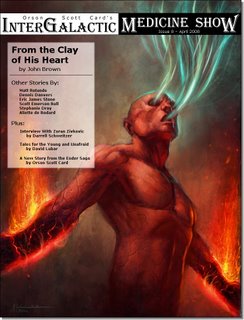
And for those of you wondering about the Far-Fetched Fables production of “From The Clay of His Heart,” they usually do two stories in an episode. But my story was too big to be paired with another big story, so they have moved the story “to the June 2nd (the first available spot on our schedule).”

Share

Similar Posts

  • NEWS: Cover Artist Selected for SERVANT and CURSE

    After reviewing almost 100 applications, we have selected an artist to do the covers for SERVANT and CURSE. His name is Giorgio Grecu Shards, and he lives in the UK. You can see his gallery here: http://shards.cghub.com/images/.

    Some of my favorite pieces of his include these. 

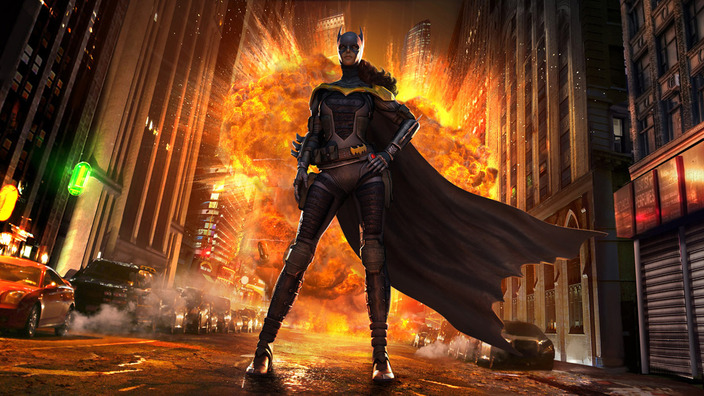
    BatGirl by Shards
    BatGirl by Shards

     And this

    Dancer by Shards
    Dancer by Shards

    There were quite a number of others who we gave serious consideration, including Shen Fei, ThuyNgan, Nusha Amini, and Nick Greenwood. In the end, we felt Giorgio could pull off the feel the best. We’re very excited to have made the selection and come to the agreement. Right now we’re targeting October-November for the release of both books. I’ll keep you posted as the cover art shapes up.

    Share
  • | |

    Speculative Fiction, Gateway Drugs, and Literacy

    You can read the transcript of my remarks at the American Librarian Association (ALA) conference in Chicago on July 11 below as well as the supporting information.

    IS SF/Fantasy Key to Teen Literacy?

    Intro

    I am so happy to be here. And I’m happy share some good news. David McCollough, the Pulitzer prize winning historian shared this fact in his commencement speech at the University of Utah this spring. “There are yet “more public libraries in America than there are McDonalds.” [Cheering]

    We have not yet been assimilated!

    Of course, this is due in a large part to you, the librarians who care for the collections and take care of the patrons. Which is why I think you deserve a big round of applause. Give yourselves a hand. [Applause]

    Fiction is a literal drug

    I want to start my remarks with two quotes.

    Ray Bradbury was recently interviewed in a NY Times article  He said, “I don’t believe in colleges and universities.” This is what he said, “I don’t believe in colleges and universities. I believe in libraries.” He said this because when he graduated from High School he didn’t have enough money to go to college. So he went to the library three days a week for ten years.

    The next quote is from the great poet Dylan Thomas–“Do not go gentle into that good night, rage, rage against the dying of the light”–that guy. He said,  “My education was the liberty I had to read indiscriminately and all the time, with my eyes hanging out.”

    If you look at Bradbury and Thomas, they read, not because there was some grade involved, not because someone went after them with a stick—they read from hunger. From thirst. They read with wild abandon because they found in reading something they couldn’t find elsewhere.

    I want to suggest one thing they found was a drug. [Laughter] I’m not speaking in metaphor. I’m talking about real physical response. As real and physical as the response you get when you or I take aspirin, brandy, or crack. Well, I hope we’re not taking crack. [Laughter] 

    When we think about drugs we think about pills, smoke, injections. But those are simply one set of delivery mechanisms for chemicals that trigger a physical response. There are other delivery mechanisms. Other triggers. One of them is fiction.

    Now I don’t have time today to detail how this works. But I will write it up on my website for those who are interested. The key thing to remember is that fiction, the kind of fiction we love, the kind that keeps us up at night sitting on the edge of the tub or locked in a closet with a light, the kind of fiction goes beyond cognition, beyond data and facts. We find it so pleasurable precisely because it triggers and guides a physical response.

    So how does all of this apply to science fiction and fantasy? Here’s the deal. And here’s where we come to our topic. Science fiction and fantasy is, for our youth, one of the most powerful gateways drugs into the fictive experience. Of course, there are ideas in science fiction and fantasy that ripple out to the society. But even if there weren’t, the happy side-effect of an addiction to this drug is improved literacy. And we all know how much that impacts.

    Numbas

    Now I know those of you who work with young adult circulation have seen this. But I thought it might be interesting to get some actual numbers so we can start to gauge the scope of the science fiction and  fantasy effect.

    My interest in this began when I saw the results of the latest NEA survey. They have this graph showing reading rates in all age groups dropping horribly since 1982. By 2002 the graph is taking a nose dive.  Then in 2008 everything turns around. And among the young adults (18-24), we see the biggest increase—9%.

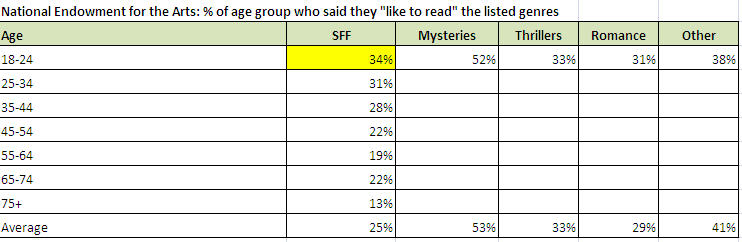
    I saw they had a genre preference question in this survey. Of course, I wondered about science fiction and fantasy. So I contacted the NEA and dug into the details. It appears that 34% of the 18-24 group say they like to read science fiction and fantasy. That’s a big number. That’s 1 in 3.

    Of course, I wanted another data pont, so I went to BookScan and asked for data on book sales. Because the wonderful people there love librarians and Tor Books, they said of course. We looked at juvenile fiction sales from 2004-2008. What we saw was that science fiction and fantasy grew 144% during that period. All the other genres only grew 23%. We also saw that science fiction and fantasy currently make up almost 30% of the juvenile fiction market. So about 1/3.

    Now there are some problems with the BookScan data. Yes, it only cover 60-70% of the market. It’s not in Wal-mart, grocery stories, and a few other places. But what’s more problematic for this issue is that they don’t break up the juvenile sales by age. It includes everything for folks one month old to age eighteen. So I’ve got books like Go Dog, Go in the dataset along with Twilight and Go Dog, Go isn’t categorized as fantasy. [Laughter] My suspicion is that if we narrow it down to the middle grade and YA group, we’ll see more science fiction and fantasy.

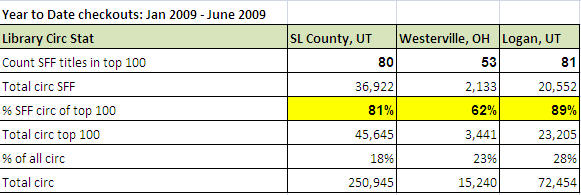
    So I needed someone who did break it up by age. Well, who does that? You do. Libraries do. Besides, a lot of youth don’t have the $ to buy lots of books. So I went to some libraries in Utah and Ohio and got their YA fiction circulation stats. Here’s what I found: 60-80% of the YA fiction circulation is science fiction and fantasy. This does not include graphic novels or magna. It’s text fiction.

    Folks, this is a big drug. I don’t know what part science fiction and fantasy played in the rise in reading rates, that would require a larger and more rigorous study. But I can tell you this: We want to see the impact of science fiction and fantasy on our society? We’re seeing it right now.

    My Story

    This large effect makes sense because science fiction and fantasy deliver experiences that are intersting to and matter to youth. It’s chock full of and encounter with the strange, weird, and wonderful; adventure and danger; doing something meaningful; being someone special, someone desireable, someone wanted in the group. All that coming of age stuff. So no wonder it’s a huge gateway drug.

    I know that it was in my case. I wasn’t a reader. I don’t think I read more than twenty or twenty-four book from kindergater to sixth grade. I look at the little fellows in my local school today and they read that many titles in the first six months of the first grade. But I didn’t. I wasn’t a reader. I do remember loving the look and feel of these small chubby books. [Laughter]

    I would take them them up to the librarian to check them out. She’d look down at me. “Are you going to read all that?” she’d ask. “Yes,” I’d say. Of course, it was lie. [Laughter] It was a huge lie because I would take them home and put them up on my dresser and just look at them.  Just loving the look and feel. And then when it was time to check them in, I’d take them back and give them to the librarian. “Did you read all that?”

    “Yes,” I’d say. And that’s how I became an author–lying to librarians. [Laughter] 

    Now in sixth grade my sister, we were in the car, I had four sisters and we had one TV, and so you had to reserve the time for your programs. So my sister says, “I have to watch The Hobbit for school.” Now I don’t know anything about The Hobbit. It sounded like a romance. [Laughter] I protested. No, way–we’re not going to watch some dumb kissing thing.

    “No,” she said. “It’s got dragons.”

    “You’re lying,” I said.

    I was convinced I was doomed. But it didn’t matter. We watched it. It had dragons. And I loved the experience so much I wanted another hit. Shortly thereafter my mother and father went on a business trip. I went over to my buddy’s house. So the first day we come up out of the basement to go to school and I said, “Oh, I’m feeling sick.” So my buddy went off to school and I went back down into the basement and played hookie for two days and read The Hobbit.

    It was amazing. More amazing than the movie. I had to have that experience again. And so I read Ursula LeGuin, Patricia McKillip, Donaldson, Terry Brooks. I kept reading because it delivered a cognitive-physical experience I loved. Of course, I didn’t put it that way back then. It was more along the lines of, duuuude. [Laughter]

    Now I got a BA in English and a Masters in Accounting. Those degress required a lot of reading. But I didn’t develop the requisite literacy skills in school. I developed them in science fiction and fantasy.

    And so when I started to write I was naturally drawn to fantasy. Having experienced this wonderful thing, I wanted to produce that and share it with others. So this novel that’s coming out has the gosh-wow I still love. It’s set in a world were humans are ranched by beings of immense power. There’s a young man and young woman in terrible trouble. So it has monsters, magic, and mayhem. But I also found fantasy big enough to let me explore other things that have become more important to me as I’ve aged. Like family, sacrifice, and redemption. And I hope people enjoy all that. But ultimately, I hope this book does for someone else what The Hobbit did for me and opens a door to a wonderful addiction. And, of course, as a powerful side-effect, improves the literacy of some rascal or rascaless. [Laughter]

    Conclusion

    I want to end where we began with that Thomas quote.

    “My education was the liberty I had to read indiscriminately and all the time, with my eyes hanging out.”

    That kind of wild abandon will happen when the drug takes effect. And for many of our youth, probably at least one in three, that’s going to be when they ingest a few ounces of SF & Fantasy.

    Thank you.

    [Applause]

    Supporting Numbers

    How fiction is a drug

    Emotion is not a cognition, although cognition plays a part. It’s not just in your brain. It involves a physical response, which means it involves chemicals. 

    We sometimes forget that our bodies produce a staggering number of chemicals. Sometimes they produce in response to external stimuli—the sun triggers the creation of vitamin D, ingested sugar triggers the production of insulin, the sight of a ravening lion standing not five feet away with nothing between him and me produces, among other things, adrenaline.

    Lots of these reactions, we don’t notice. But there’s a whole group of these physical responses that we do. We lump them together and call them emotions.

    Jenefer Robinson in her wonderful book Deeper Than Reason, explains, “Emotions are our way of responding to events in the environment (either external or internal)” that matter to us. They are “physiological changes that register the event in a bodily way and get us ready to respond appropriately.” Fight, flight, pursue, woo, investigate. They focus our attention, get us ready to take action, and communicate all this to others.

    So while I might not feel the production of vitamin D, I do feel the fear of the lion. Fear is a wonderful thing—it keeps us alive. It raises our heart rate, pumps us full of drugs that prepare us to flee or fight. The emotion writes itself on our faces in order to, among other things, communicate the situation to those around us, warning others and calling for help. It is a physical response. Yes, there are cognitions involved, but there are also chemicals.

    The latest research on emotion shows that emotion is a process that involves three things. (1) An affective appraisal of our environment that signals something important to us—a threat or opportunity. (2) This triggers an immediate physical response (chemicals, galvanic skin response, accelerated heart rates, facial expressions, etc.). (3) At this point cognitive (conscious thought) appraisals kick in and help us monitor the situation and moderate the physical response.

    For example, I go out to the yard and step on this thing that slithers through the grass. The sensory signals immediately trigger a physical response to get me ready to flee or fight–heart rate, adrenaline, etc. Then I notice the snake is far too long. I look closer. It’s the garden hose. My physical response changes. I laugh, feel relief. Research has shown that when we read text, the same process occurs. We do indeed have the same types of physical responses. In some cases they’re more intense.

    Now here’s the thing. This physical response is triggered not just by threats and opportunities we perceive with our senses, things out there. It is also triggered by thought. Thoughts deliver a physical response just as surely as crack does. We have the research to prove it. In fact, sometimes thought delivers a more powerful physical response. Here’s but one example. Did you know that people with a phobia of snakes have a stronger reaction to reading a passage about snakes than they do to the actual critter?

    This is where fiction comes in. As I stated in my speech, fiction, the kind of fiction we love, the kind that keeps us up at night sitting on the edge of the tub or locked in a closet with a light, the kind that lingers in the fabric of our clothes and our hair long after we close the book, that kind of fiction goes beyond cognition, beyond data and facts. That kind of fiction triggers a physical response.

    It does this, and this is one difference from emotion triggered by our own thoughts or the sensory data we pick up from the world, because fiction, by its very nature, its very structure, is actually guiding our emotional response. Our physical response. This management of the response is in fact one of the things that we find so pleasurable about it.

    To find out more, please read:

    • The Science of Emotion by Randolph R. Cornelius
    • Deeper Than Reason: Emotion and its Role in Literature, Music, and Art by Jenefer Robinson

    You may then want to search out texts by Dolf Zillmann, Jennings Bryant, and Peter Vorderer.

    Share
  • |

    My First Year as an Indie Author

    On November 24th last year, a little over 13 months ago, I released my first indie title—Servant: The Dark God Book 1. That release was the official rise from the sideways swamp crash I had with Tor Books.

    BTW, sideways swamp crashes in publishing, which can be caused by all sorts of reasons, are not uncommon. Most writers will take a hit or three in their career. That’s just part of the writing business. The question is what happens after the swamp crash?

    In my case, I got to work. And, boy, was it a lot of work.

    The results have been positive. It was not a phoenixian rise from ashes to glory; it was more like a damp crew patching the ship in the jungle with whatever they had at hand and then launching with nothing but a few birds making any noise. We are by no means past the many perils and obstacles on the path–right now a solid hit from just about anything could knock us out of the sky.

    But we are airborne.

    We are flying.

    And by that I mean the business is delighting readers and generating income.

    I’ll probably hit close to 23,000 paid sales since that launch. The large majority of them were for Bad Penny. To give you some perspective, a single title will make the official Publishers Weekly bestsellers lists (of traditionally published authors) hardback and paperback categories when the title has sold around 100,000 copies in the year. The top dogs report sales of a few million.

    It’s clear the John D. Brown crew has got a ways to go.

    But we don’t have to reach that lofty level to be viable. It would be awesome. At the same time, it’s helpful to be realistic. There are somewhere between 300-400 titles on the adult hardback and paperback list combined. The same on the children’s lists. So I estimate there are around 700 traditionally published books, fiction and non-fiction, that sell at those bestseller levels. That’s out of the millions of trade titles available on Amazon.

    The good news is that the majority of writers making a living don’t appear there. The fact is that you don’t have to sell 100,000+ copies of a single title in a year to make a living. In the indie world, you can do just fine with what Russell Blake calls base hits and doubles.

    So are we making a living?

    Those sales have generated enough net profit to purchase us a nice used vehicle and a few other things. Better than a poke in the eye with a sharp stick (as my neighbor Mike Carr used to say), but making $10-20k can’t replace the day job. Not even close. Still, it’s a beginning.

    Will our crew make it?

    Can they survive the ferocious flying monkeys?

    Stay tuned.

    In the meantime, I want to summarize a few things I’ve learned about indie publishing and give a few shout-outs.

    First, I want to thank all the readers who decided to give one of my books a shot. From the reviews and sales, it appears the majority found just what they were looking for (and there was much rejoicing).

    Second, a big thanks goes to Larry Correia. Not only is he generous and enthusiastic, but his audience is as well. The Monster Hunter Nation made a definite difference for me this year.

    I want to thank LL Muir and Diane Darcy, two romance writers who have been incredibly generous in sharing their indie insights and support.

    Devon Dorrity and Dixon Leavitt spent hours, HOURS, of their time helping me with covers. I can’t thank them enough.

    I also need to thank the Codex Writers. There’s a small group of us indies there, and they’ve all be very helpful in sharing insights about what’s worked for them and what hasn’t.

    I’ve found other resources helpful as well. The Passive Voice kept me current on the industry. Russell Blake’s blogs gave me a clear-eyed opinion of what it takes to succeed. The Calibre ebook editor has saved me many times. And Anne-Marie Concepcion’s online course on using InDesign to publish ebooks was a very good introduction, as were Dean Wesley Smith’s online courses on interior and cover formatting.  I list other resources I found useful in my Resources for Indie Writers post.

    Okay, so what have I learned?

    1. Nothing happens without visibility

    This is retail. If your product is not somewhere that people can see it, they won’t buy it.

    I was in Wal-Mart the other day. My sister calls it the Evil Empire, but she’s a Tarzjay snob. I myself am a value shopper. I want what I want, and I want to pay as little for it as possible. At the same time, I’m not going to go out of my way to get it because searching around costs time and money. So if I’m looking for something in Wal-Mart and I don’t see it on the shelves, guess what? I buy something similar that will do the job.

    Wal-Mart used to stock Marzetti’s Ranch Dip. The best vegetable dip EVAR. But then sometime this year, they stopped stocking it.

    Why?! Why do they stop stocking stuff the moment I find it?!

    (Hey, maybe that’s why they’re the Evil Empire . . .)

    I mourned for a few seconds. And then I purchased the Lighthouse dip. It’s good. If they put Marzetti’s back on the shelves, I’ll switch back immediately. But the point is that if it’s not in front of my eyeballs when I go shopping, I ain’t gonna buy it.

    And I’m finding retail is the same with ebooks as it is with everything else. You can have the best product in the world, but you aren’t going anywhere with it until you are visible to your buyers.

    2. There are a couple of ways that I was able to make my stuff visible

    The way to make my stuff visible was not by publishing on Amazon, Nook, and the rest.

    Publishing means nothing.

    Think about it. There are, right now, 3,079,561 books in the Kindle bookstore.

    Yes, three million!

    If those were physical books, and we lined them up spine-out like we do on a bookshelf, and we assumed the spines average about an inch in width, they would make a line 48.6 miles long.

    For us Utahans, that’s a line of books that stretches from the Mormon temple in downtown Salt Lake City, past Provo, and ends in Springville! (Look up your own local distances to get an idea.)

    That’s the kind of visibility you get by publishing your book, which is nada.

    So if getting it in the store that’s 50 miles long didn’t help, what did?

    Getting on a bestseller list.

    I sold thousands of copies of Bad Penny on Nook when I was on the Nook’s top 100 list. I rose to #3, in the entire Nook store, then hung out around #50 for about a month. And when that burst of sales that made me #3 fell out of the algorithm (30 days later), I fell off the list. My sales dropped like a stone. Not to nothing. But they were a fraction of what they had been.

    How did I get that #3 slot to begin with? The same way I rose to #30 for a few hours in the Kindle store, then slowly dropped to the 1,200s for a few days. I got it by placing an ad with the king of book advertising services, aka BookBub.

    How did I get onto BookBub? Here’s their requirements and tips. Please note that the reviews of Bad Penny were part of what made the book appealing to BookBub.

    How did I get reviews? By using other ad services to make my book visible and getting mentions on blogs like Larry Correia’s and a few others. And by following recommendations in the book Let’s Get Visible and Your First 1,000 Copies and the suggestions of others who are selling well. And that’s a key thing too–looking to see what folks who are selling well are doing, not those who aren’t.

    Of course, readers also liked the books enough create word of mouth. And I can track some of my sales spikes to specific posts or people. The ultimate goal is to have so much word of mouth that everyone’s talking about you. But until that time, I ain’t going to rely on word of mouth alone.

    Why not?

    Because I’d like to increase my odds of success. I’d like to accelerate them. And thinking that word of mouth alone is going to do that flies in the face of everything I’ve learned about retail. Read what I had to say about books and lemonade and tending your garden for more. Consistent efforts with methods that actually have some track record of success seem to have helped a great deal.

    BTW, Bad Penny is currently in the top 10 of three of Amazon’s thriller lists. I guaran-dang-tee you that being on those lists is a big factor in me selling somewhere around 60 copies a day. I saw that with Nook. Being visible starts a virtuous cycle–more people give you a try; if they like the book, they spread the word, which leads to more sales, which keeps you visible, which prompts more new readers to give you a try. Yeah, you’ve got to be good. But you’ve got to be visible first.

    3. In most cases, books in a specific genre are substitutes

    When readers purchase a book, they are looking for a certain type of experience. And my book’s experience isn’t so singular that readers can’t get something roughly similar from another book.

    I love Lee Child. But Robert Crais provides an experience that’s basically inside the same ballpark. So does Nelson Demille and a whole host of others, including me.

    If Lee Child stops writing or slows down his production to one book every four years, I’m not going to stop reading thrillers. There are plenty of other authors that give me the general adrenaline, surprise, action experience I’m looking for. I’ll be sad, but there are a lot of good authors out there. And I’m sure a few will become my new Lee Child.

    Of course, we aren’t all exactly the same. I provide a noticeably different tale than Lee Child does even though we’re in the same Lone-Ranger-vigilante-justice action genre. And so, if I produce the best tale I can, I will find some readers will come to prefer me to Child because I line up more with their tastes than he does.

    In addition to continue to work on visibility and craft, this means I’ve got to up my production. I’m going to try for 2.5 brand new books in 2015. That’s nothing for some folks. But that’s a good stretch goal for me.

    4. There is no one sure-fire way to success

    Even though visibility and studying your craft helps, nobody I know who is doing well has a replicable step-by-step program that guarantees success. There are some activities that seem to make the odds better, but there is no guarantee.

    For example, from what I wrote above about BookBub, you’d think that’s the brass ring. Nope. I know other authors who have run promos with them and didn’t have near the success Bad Penny did.

    Russell Blake’s advice on this seems to square best with my experience. See the links to his blogs here to see what I’m talking about.

    5. Figuring out how to make a living with this has a lot in common with Lean Startup principles

    The basic concept behind lean startup is that when you’re in a market without a lot of info on what works, the company that wins is the one that learns what works the fastest. And you do that by conducting experiments.

    You experiment to see if you’re offering any value to the intended audience. You experiment to see if you’re promo methods are actually feeding your engine of growth. You experiment to see if your audience really is big enough.

    The experimental approach taught in the lean startup stuff has freed me from a lot of anxiety. Success or failure is not about me personally. It’s about my techniques. It’s about my craft and business skills. It’s about me learning how to learn quicker.

    I’m approaching my thriller and epic fantasy properties as experiments. I’m approaching various visibility methods as experiments. My current state of craft is an experiment. If what I’m doing with my current properties doesn’t work, I can pivot and experiment with something new.

    The question is whether I can learn what works–to find an opportunity to add value and provide that value–before I run out of runway.

    If you’re interested in these ideas, let me recommend The Lean Startup by Eric Ries, which explains the general principles, and Running Lean: Iterate From Plan A to a Plan That Works by Ash Mayura, which shows you how to start to implement them. These two books have changed how I approach the writing business.

    Bottom Line

    The bottom line is that I love developing stories and sharing them with readers.

    I knew this already, of course. But having the ship up and flying again made it hit home in a big way. I enjoy the process of developing a story. I love the research, the story generation, the surprises that come along the way. And I love the emails I get and the discussions I have with readers who have read my books and enjoyed the heck out of them.

    So that’s the big summary.

    Year two stands before us. Let’s hope John D. Brown and company can learn and produce at higher levels than we ever have before.

    Have a wonderful 2015!

    Edit 1/14/2015: Here’s John Ellsworth, another indie author, with a similar tale. Although I’m jealous of his seven books in a year. I need to get cracking!
    Share
  • |

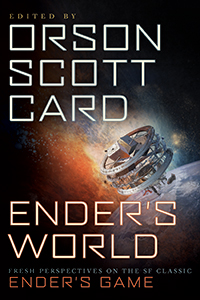
    Ender’s World: Fresh Perspectives on the SF Classic Ender’s Game

    Smart Pop publishes smart, fresh, and engaging articles on the best of pop culture TV, books, and film, with a particular focus on science fiction and fantasy television and literature.

    You want to hear what Scott Westerfield (Uglies, Pretties, etc.) has to say about Buffy?  Go to Smart Pop.

    What about Orson Card’s thoughts on Joss Whedon’s Firefly universe? Smart Pop.

    What about the venerable Lawrence Block on Robert B. Parker’s Spenser series? Um, Smart Pop.

    Strange.  Do you see a pattern emerging? 

    Whether it’s Mad Men, House, Hunger Games, George Martin’s epic fantasies, Halo, True Blood, or Alias, Smart Pop gathers together New York Times bestselling authors, television writers, psychologists, philosophers, and others–folks who love of pop culture and have something worth sharing about it–and asks them to share their insights.   

    Recently, they’ve been putting together just such a collection on Ender’s Game.  It’s called Ender’s World: Fresh Perspectives on the SF Classic Ender’s Game. It’s coming out February 2013.  You can read more about it here.

    I’m announcing this now because The Man was fortunate enough to be invited to contribute.  I love Ender’s Game.  LOVE IT.  How cool is it that I get to write about it in an anthology edited by the folks at Smart Pop and Card himself? And then get to read what everyone else has to say, including military strategists Colonel Tom Ruby and Captain John Schmitt.  As well as the little bits they’ll include on things like why the battle room is the shape it is and why they were recruiting kids.

    But I’m also announcing this because in addition to the essays all we Ender-lovers get to write, Smart Pop is also going to include a series of Q&As with Scott Card, and they are currently soliciting the question from readers. FROM YOU. Right now.

    You ever wonder about a character or part of the setting or event in Ender’s Game?  Ever wanted to know what inspired Card? Ever wanted to ask any question at all about Ender’s Game?  Now’s your chance. Just submit you question here: http://www.smartpopbooks.com/ask-orson-scott-card-a-question-about-enders-game/

    You can see questions already submitted at Smart Pop’s Tumblr.

    From a writer’s pov, I have to tell you that the folks at Smart Pop have been nothing but enjoyable and insightful to work with. I’m looking forward to this book!

    Share
  • “From the Clay of His Heart” makes Locus Magazine’s 2008 recommended reading list

    Locus Magazine, the trade publication for the science fiction and fantasy genre, has listed my novelette, “From the Clay of His Heart,” on their 2008 recommended reading list.

    Yea!

    Lots of other goodies out there as well.


    .

    Share