Good Stuff! Tiny Habits

We’re told we can change.

We’re told that a key is to write “SMART” goals. Make them specific, measurable, realistic, and focused on results. Give them a deadline. And, for heaven’s sake, put them to paper because “a goal that is not written down is just a wish.”

We’re told a key is to dream, that “whatever the mind can believe, it can achieve.”

We’re told that the key to changing our life is changing our habits, and that they way to change our habits is to stick with something for twenty-one days.

Except, well, how many habits have you been successful in establishing?

How many of those lofty goals have you achieved?

How many New Year’s resolutions have you really followed through with?

The problem is that all of the good advice on goals and habits seems to only work for other people. And I grant that there might be some AAA+++ personalities out there with megawatts of motivation who seem to be able to do whatever they set their mind to.

But that triple A plus personality passed me by. It passed a lot of us by.

So are we doomed?

B.J. Fogg, a Stanford researcher, says no. There’s hope for all of us. Because the key is not in having megawatts of motivation.

It’s not that we disregard the power of motivation. It’s just that motivation, Fogg has found, is never constant. It comes in waves. And while we certainly want to take advantage of it when it comes and do things that increase it, a much more effective way to grow habits and meet goals and change our lives is to focus on the other things that drive behavior.

Fogg has spent his career studying persuasion and habit. He works with companies to help them create products that are habit-forming. Think about Facebook, Twitter, or Candy Crush, and the habits those products form. These and similar companies have implemented the principles of habit so well that their products have become, for some, something of an addiction.

So what’s the secret?

Fogg has identified three things that must be present if we’re going to do something:

  1. The motivation to do it
  2. The ability to do it
  3. A trigger to remind us to do it

When those three things are present, we act. And we often do so without thinking. If one of those three elements is missing, we don’t act. So if we want to start a new habit, we need to focus on these three things.

But if motivation goes up and down, then we don’t want to rely on that part of the equation. Fogg’s insight is that it’s much easier and more effective to focus on the ability and the trigger parts.

When we focus on the ability, we make the habit we want to form so tiny and small that it’s super easy to do. Such tiny behaviors require only the smallest levels of motivation. And if we’ve planted them in good ground (at a time of day where they can expand and linked to a good trigger), those tiny habits eventually grow into the full blown big habit we wanted all along.

Does this work?

Well, I started Fogg’s Tiny Habits back at the beginning of December. And I’m happy to report that starting new habits using this approach has been easy.

Like falling off a log easy.

For example, because I work on the computer, I know that to increase my health, I need to get at least forty minutes of good, heart-pumping activity each day. But did I start there? No.

Did I start at twenty minutes?

No.

Ten minutes?

No.

Five? Surely, I started at five minutes.

No.

The Tiny Habits approach suggests starting much smaller. I started with doing one push up after I used the restroom. And it was an incline pushup on the stairs, which my daughter found hilarious.

Yes, that’s how tiny you start them. Something that takes less than 30 seconds.

That tiny habit grew. And I am now doing 60 regular floor pushups each day, plus 75 curls, 75 flies, 75 squats, and 75 bicycle crunches. It’s about 25 minutes of good activity. And it’s only going to grow. Come April, I’m pretty sure I’ll be around 100 pushups every day.

And there was no twenty-one day business. Fogg has found that’s not the secret. Habits can form in just a few days.

I started the delicious habit of kissing my wife for at least five seconds each day. Along with a five-second hug. And then a little more kissing, and little more hugging, and a little more kissing (when I can steal it). Did I mention it was delicious? This is a highly-recommend habit.

I started the habit of daily morning scripture reading. I have tried to be consistent for years and couldn’t do it. But with this new approach, I think I’ve missed three times in the last two months.

I started the habit of beginning the day with a positive thought, the habit of turning off my wireless mouse when I’m done at my desk, and I’ve also made great headway against the mother of all habits for me—going to bed by 10 PM.

I can easily stay up until one a.m. reading, “researching” on the internet, wasting time watching political videos, or Facebooking. Or a million other things. This bad habit is so ingrained it is almost like someone else is controlling me. All day long I say I’ll go to bed only to find myself, yet again well past dark, screwing up my life plans. It’s like some evil villain has me on remote. I can’t tell you how many times I’ve tried to “motivate” myself to change this. All to no avail.

But with the tiny habits approach, I finally figured out the triggers that were driving it. Then I engineered other triggers and tiny habits to replace them. And now my computer is off and behind a closed door most of the time in the evenings. I’m actually getting to bed. It’s huge progress. There are still some kinks to work out, but it’s only going to grow.

I found the Tiny Habits program through my insurance provider. They had an annual wellness check in November, and on their website they had a link to Tiny Habits. I clicked, signed up for their tiny program, and I’m so happy I did.

I’m hooked on tiny habits.

And the cool thing is that you can begin learning and developing your ability to plant and grow tiny habits too. For free.

If you want to change your life, I think you will love their free five-day, three-habit program. It’s there to teach you how to create tiny habits, triggers, and celebrate.

Let me also recommend a few videos. Here’s the best video I’ve found that explains Fogg’s model of behavior and why tiny habits work.

And here’s the best video that explains the pitfalls of relying mostly on motivation instead of bringing in the other two Musketeers.

Researchers say that between 40-70% of all we do each day is driven by habit and external triggers. We think we’re exercising our agency all day long, but it’s an illusion. We’re not. Most of the day we’re running on auto pilot and responding to triggers. But we can change those routines. That’s the promise of tiny habits. And so far, the results for me have been promising. Give it a try. I think you’ll be happy you did.

Notes

SMART stands for specific, measurable, achievable, results-focused, and time-bound. SMART goals are helpful. But the key, Fogg has found, is in not trying to eat the whole SMART whale in one bite. Instead, you start with the tiniest part of the very first step. And then watch as the habit grows.

I reviewed The Power of Habit by Charles Duhigg back in 2012. It provided great insight about habits, but not a tested program to actually change them. In fact, the author states himself that his book doesn’t provide a program, just a way of thinking about habits. Duhigg isn’t a behavioral scientist; he’s a reporter, trying to share what he’s found. The book was great. However, I tried to apply his insights, and, as expected, wasn’t very successful in changing things. But Fogg and his Tiny Habits fills that gap in a spectacular way. Fogg is a behavioral scientist and has taught thousands how to form habits. So read Duhigg for great stories and insights about habits in general. But go to Fogg for a tested program that will guide you step by step.


Share

Similar Posts

  • Good Stuff: Mexican Hummus

    I have been giving a new way of eating a go for the last few months. It’s high-fat, medium-protein, low-carb (HFLC).

    Zoinks!?

    High freaking fat, you exclaim. Has he gone mad!

    Well, possibly.

    One thing I do know is that I’ve lightened the load my godlike thighs have to carry by about twenty pounds, which is a nice thing. Oh, and by the way, I’ve paired this with intermittent fasting.

    Horrors!

    Yes, it is Halloween. Or was a few days ago.

    In a few more months, when I’ve given this method a good long test, I’ll explain exactly what this is all about. But I’ll tease you by saying that it seems the scientific community isn’t immune to bias and jumping the gun. Not even close. We’d like to think they are, all those men and women in their white lab coats, but they aren’t. In fact, there are a number of doctors and researchers right now demonstrating that the advice we’ve been getting about fat and carbohydrates since the late 1970s was wrong. Like 180 degrees wrong.

    Let me point you to some presentations you can watch about this right now.

    “The Two Big Lies of Type 2 Diabetes” by Jason Fung, MD

    “Reversing Type 2 diabetes starts with ignoring the guidelines” by Sarah Hallberg, MD

    “Therapeutic fasting” by Jason Fung, MD

    Okay, so with that lead up, who’s up for a delicious, high-fat meal? Here’s one of my favorites.

    I call it “Mexican Hummus.” I found it in Always Hungry? By David Ludwig, MD, PhD. He calls it “Cheesy Pinto Bean Dip.” Which isn’t a bad name, but isn’t inspiring. You might call it modern refried beans, but that sounds like something out of a can or glopped onto the side of your dish. But Mexican Hummus, that has some class. A little zip.

    Whatever you call it, it tastes great.

    Use as a dip for red, orange, or yellow bell peppers cut into strips. Or eat it as a side. I like it with baked chicken thighs. It’s also good with fajita veggies—sautéed peppers and onions cooked with lots of butter, salt, and a bit a chili powder—and some slices of avocado.

    MEXICAN HUMMUS

    1. Mix the following in food processor for 30 seconds or until smooth
      1. 1 C cooked pinto beans, drained and rinsed
      2. 4 tsp extra-virgin olive oil
      3. ¼ C water
      4. ½ tsp chili powder
      5. ¼ to ½ tsp salt
    2. Mix in ¾ C shredded cheddar cheese (you want cheddar cause it melts well)
    3. Heat in microwave or on stove until cheese just melts. Stir.

    HOMEMADE CHILI POWDER

    I don’t like the chili powder you get in the stores—it’s too strong, overwhelms everything I put it into, and gives me heartburn. So I found a recipe that’s awesome and make my own.

    Mix the following together. Choose the amounts in the ranges shown based on your tastes.

    • 2 tablespoon paprika
    • ¾  to 1½ teaspoon onion powder
    • 1½ to 2 teaspoon dried oregano
    • ½  to 1 teaspoon cumin
    • 1½ t garlic powder (optional)
    • ½ to 1½ teaspoon cayenne (optional, I put in barely a pinch; I do NOT like it spicy)

    HERB-ROASTED CHICKEN THIGHS

    This has got to be the easiest recipe on the planet for chicken.

    • 6 to 8 bone-in, skin-on chicken thighs (about 2 pounds)
    • 1 tablespoon extra-virgin olive oil
    • 1 to 2 teaspoons dried herb blend (Italian herb mix, poultry mix, lemon chicken mix, or chili powder above)
    • ½ to ¾ teaspoons of salt
    • ¼ teaspoon ground black pepper

    Instructions.

    1. Preheat oven to 350 degrees
    2. Grease a 9×9 inch baking dish with butter or some extra-virgin olive oil
    3. Put chicken skin side up in baking dish
    4. Brush with the olive oil
    5. Sprinkle on the herb blend, salt, and pepper
    6. Bake for 45 minutes.
    7. If you want, you can baste a couple of time through the cooking by spooning the juices in the baking dish over the thighs.

    Bon appetite.

    Share
  • Sing-Off, Reliable Contractors, Cruise & Valkyrie

    The Best Vocal Show Currently Running

    We are now two weeks into the third season of NBC’s The Sing-Off, and it’s going to be just as good as last year’s or better.  It airs for the next few weeks on Mondays from 7-9 p.m. Mountain. But you can catch the performances on the site http://www.nbc.com/sing-off/ if you miss them.

    According to the site, “The show scours the country in search of the best a cappella groups, ranging in various sizes and ages. This year, the competition has expanded to the 16 very best groups, who will perform popular songs in weekly competitions, which will culminate with a live finale revealing the grand-prize winner. The groups will be competing for America’s vote and a chance to walk away with the ultimate prize – a Sony Music recording contract and $200,000.”

    There are a lot of great groups this year, including Vocal Point from BYU and the University of Rochester Yellow Jackets, who both nailed their second songs this week–“The Way You Look Tonight” by Fred Astaire and “Can’t Take My Eyes Off You” by Frankie Valli. These guys were sooooo good. Delilah, an all-girl group, wowed with their week one performance of “Grenade” by Bruno Marks. A number of the other 16 groups are spectacular, but there’s not enough time to list all the wonderful performances.

    This is the best vocal show on TV right now. The judges and host, who are all successful singers themselves, give interesting feedback, even if they sprinkle it with too many mild expletives for my taste. Tune in and enjoy.

    3 Reliable Men

    For almost a year now I’ve been trying to find somebody, ANYBODY, to come and fix some issues with my house. We had a leak in the roof, a leak through a window, and an exterior French door that was never hung right and gaped open at the top, especially when we had a strong north wind blowing at us in the winter. Lovely Wife had to take to stuffing the gap with a towel.

    So I called a number of local construction guys. I called folks in Evanston, Wyoming and Logan, Utah, and it boggled my mind how many promised to drop by but never showed up, or came by but never followed through. I was happy to pay good money. But contractor after contractor after contractor shined me.

    Then I ran onto three guys who made promises they could keep, showed up, followed through, did an excellent job, and did it quickly.

    Ryan Hoth of Hoth Boys Construction in Logan, UT, recommended to me by Burton Lumber in Logan, does framing, concrete, and general contracting. Ryan personally fixed the troublesome French door with a very creative and simple solution that I wouldn’t have come up with in a million years. Hoth’s number is 435-994-0169.

    Todd Bohman of Valley Trades in Logan, UT, which does siding and windows, came up and assessed, then sent one of his crew to fix our window/siding issue. The crewman not only worked expertly and quickly, but he fixed a piece of siding another contractor had broken without being prompted. Bohman’s number is 435-752-7642.

    Keith Homer of Homer Roofing in Logan, UT, not only assessed our issue, but steered us towards a fix that cut the amount of money we would have to pay him. He gave up revenue we were willing to pay because it was the right thing to do. Homer’s number is 435-787-0910.

    If I ever need any construction, siding, window, or roofing services, you can be sure I’ll be calling these guys first. 

    Valkyrie

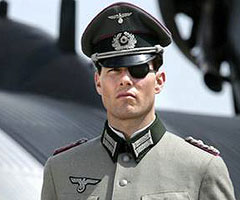
    I love a number of movies Tom Cruise stars in. The stories are usually strong, and Cruise is a great actor. Nellie and I recently watched and enjoyed Knight and Day, a hilarious romantic action comedy with Cameron Diaz. We enjoyed him in Collateral, a thriller where a cab driver gets shanghaied to drive for a contract killer, and fights to save himself and the last victim. I loved him in Minority Report, Last Samurai, and Far & Away. In Valkyrie, Cruise stars as Claus von Stauffenberg, a colonel in the German army who attempts to assassinate Hitler.

    The movie is based on a true story, and dramatizes just one of many attempts those who disagreed with Hitler made to remove the despot from power. It shows just how close they came. The story is full of suspense and, ultimately, heartache.

    This is a movie to make you think. It’s also a great introduction to the history of WW2 Germany that’s often missed. According to a number of top WW2 historians, the film is accurate.

    If you’re in the mood for a suspenseful serious film, I think you’ll love this one. And when you’re done, you’ll ponder on the meaning of courage.

    Share
  • Good Stuff! Simply Three

    The joy of music. Pure, unadulterated joy–this is what I recently stumbled across on YouTube.

    I was watching the The Piano Guys and thought I saw something new from them. I clicked, but it wasn’t The Piano Guys. It was Simply Three doing a cover version of the popular “Wake Me Up” by Avicii.

    For those unfamiliar with the term, a “cover” or “cover version” is a reworking, updating, or interpretation of an existing song. And this cover simply blew me away.

    SimplyThreeWakeMeUp

    Simply Three is an electrifying trio made up of cellist Zack Clark, bassist Nicholas Villalobos, and violinist Glen McDaniel, although they have switched in other violinists, including Alex Weill and Olivia Lemmelin. But don’t let the instruments fool you–this isn’t some stuffy classical music gig. And it’s not muzak in the elevator. Not even close.

    They are doing what Lindsey Stirling and The Piano Guys are doing: taking modern songs in wonderful new directions and, in the process, making these classical instruments cool again.

    I went on to watch a number of their other covers, and then I had to purchase the songs because I simply had to be able to listen to their great beats and interpretations on the road.

    Here’s their cover of “Wake Me Up.” The joy Zack Clark (the cellist) exhibits sells the whole thing for me.

    Here is their cover of “Demons” by Imagine Dragons.

    And finally their cover of “Counting Stars” by OneRepublic.

    If you like them, you can get each of these on Amazon for less than a buck with these links:

    Buying them not only supports the artists, but it lets them know there’s a demand for it and encourages them to make more. And I hope they make more.

    ***

    By the way, “Counting Stars” has some interesting lyrics. Ryan Tedder, the songwriter, is a professed Christian. He grew up in a Charismatic household and graduated from Oral Roberts University.

    However, you might look at some of the lyrics and think he’s given all that faith up.

    I feel something so right
    Doing the wrong thing
    I feel something so wrong
    Doing the right thing
    I could lie, could lie, could lie
    Everything that kills me makes me feel alive

    But you need to look at the lyrics in context of the rest of the song and the artist’s statements about the song to see he’s singing about something totally different.

    Some poets, and songwriters are poets (song is where poetry lives these days), think being obscure is cool. Tedder follows that more obscure approach in this song, which is unlike the immediate clarity he put into the lyrics of the fantastic “Halo,” performed by Beyonce, or his own OneRepublic’s “Apologize.”

    Sometimes the artist writing gnomic lyrics doesn’t want to pin down a message for the listener—they think it’s cool for each person to make up their own message (I prefer clarity). Other times they do have a message, but they want the listener to work for it, and so they try to be subtle. Or sometimes they simply goof and don’t realize their lyrics are being so vague.

    I have no idea which path Tedder was trying to take with these lyrics, but I do know that he’s made statements about the song. And these statements give us a guide.

    In an interview with 5280, the Denver magazine (Denver is where Tedder lives) we get the first glimpse.

    At 15, he began writing his own songs. “I obsessed over music and just loved it,” Tedder says. “But I never considered it as a career. Where I grew up you go to high school, you go to college, you find a wife in college, you get married, you have 2.3 kids, and if that hasn’t all happened by the time you’re 24, some people think there’s something wrong with you—or the assumption is that maybe you’re not into the opposite sex.”

    But he couldn’t keep away.

    Back in Oklahoma, at Oral Roberts University, the largest charismatic Christian university in the world, Tedder majored in public relations and advertising. At least that’s what his diploma says. Based on the time he put into sneaking into the Timko-Barton Performance Hall’s piano rooms, he probably could have been a double major. He spent hours on the piano and the guitar deconstructing his favorite albums—like Eric Clapton and B.B. King’s Riding with the King—figuring out the chords and then trying to write new songs using those same chords. He was skipping classes—even meals—to write songs.

    No one knew. Not friends. Not his roommate. He sang in secret. He was in the school choir, but his friends always thought it was odd that a person who didn’t seem overly musically inclined would be taking a singing class. When he was in one of the piano rooms he would tape a piece of notebook paper over the small window in the door so that no one could see him.

    Tedder says there were two reasons he hid his passion. The first was that he believed there were so many bad singers and bad songs in the world that he didn’t want to add to the noise. He wanted to be certain he would be successful before he revealed himself. The second reason was more deep-seated: Being raised in a religious home, Tedder had been taught that there was a purpose for his life, and that because God had ordained that purpose, he should live the life expected of him—one that was pious and humble. “Deciding you want to go into the music business is about the most narcissistic thing in the world,” Tedder says. “I had this constant battle—and to some degree I still do.”

    So Tedder felt “wrong” about songwriting. But he eventually began to see it as his gift to share.

    In an interview with Billboard magazine, we learn that he wants his OneRepublic to sing about different themes than the norm.

    Billboard: Given “Counting Stars”‘ uplifting, faith-based message, it must be gratifying to be connecting with such a meaningful song.

    Tedder: I think it’s our responsibility as a band, and what separates us from everyone else. I took that from being a fan of U2 for two decades now, since “Achtung Baby.” To this day, they might be the only band on that level who sings about things other than just boy-girl troubles or the kind of selfish, “I’m a badass” stuff. I’ve spoken with Bono about this when we toured with him, and he said the same thing. I felt a responsibility to actually write and sing about things that have a level of human gravity to them. If everybody else sings about sex and love and lust and money, then somebody’s gotta be singing about life and faith and hope and things of that nature.

    So if “Counting Stars” isn’t about sex, lust, and money, what’s it about?

    In another interview with Radio.com, he indicated that the whole counting stars bit was for anyone who loses sleep wondering how they’re going to be able to afford their rent or provide for their family. When he was first starting out, things were rough.

    “A lot of time I just lay in bed awake, stressing out,” Tedder said. “Everybody does it. And I just thought, I can’t wait until I’m counting stars and not counting dollars anymore. Things will be so much better.”

    To me, it’s clear that Tedder is singing about his story. And he’s singing for people like him who have a passion, but society says it’s not the practical thing to follow or dedicate your life to. Songwriting is what makes him feel alive. Furthermore, he had flashing signs indicating that if he sought, he would find—in other words, it was the thing God wanted him to do. And he just had to have hope, a four-letter word for those who are practical- and money-minded, and follow that passion.

    We can argue the merits of that follow-your-passion message, but I think we’re all happy Tedder followed his.

    ***

    And while we’re talking about the joy of music, how about this baritone saxophone and drum.

    Share
  • |

    Superstars Writing Seminar DVDs

    Aspiring authors, I wasn’t able to attend, but heard from a few who were that the Superstars Writing Seminar in Pasadena with Eric Flint, Brandon Sanderson, Dave Wolverton, Rebecca Moesta, and Kevin J. Andersen was EXCELLENT. 

    See clips of parts of the videos here (still a lot of good info): http://www.youtube.com/view_play_list?p=2F211054CBD822A8

    Purchase the full recordings on DVD or MP3 here: www.writerscanon.com

    Topics include:

    • Econ 201 for Writers: Economics of Commercial Publishing
    • Inside Editors: How editors look at manuscripts, novels & short fiction
    • Dirty Secrets: What you need to know about being a Professional Author
    • From Slushpile to #1 New York Times Bestseller in 4 Years
    • Intellectual Property: How to Exploit Yours
    • Balancing Acts: Writing World & Real World
    • Agents: the A Word
    • Networking for Writers
    • Self-Promotion for Authors
    • Novel Contracts
    • Self-Publishing: Realities & Pitfalls
    • Pitching the Big Proposal
    • Two Heads Are Better than One: Collaborative Writing
    • New Media: Using It to Get an Edge
    • E-Publishing
    • Movies, TV and Authors
    • Anatomy of a Major Book Release
    • Myths of Publishing
    • Eleven Tips to Increase Your Writing Productivity
    Share
  • |

    Brain Nazis and Feeling Good by David D. Burns, M.D.

    Have You Got a Brain Nazi?

    If you’re conscious, you’re monitoring your environment. You have to. It’s how you survive. This is not something you can turn off. It’s just one of those systems that runs automatically, like your liver. You’re always appraising the situation.

    And as soon as you encounter something that’s likely to be of importance to you or yours, your monitor kicks off a physical response to prepare you to deal with or take advantage of it.

    The problem is that sometimes a Nazi propagandist worms his way into the monitoring station. And like any good Nazi, he distorts reality.

    Sometimes those distortions lead to burning resentment, sometimes to unwarranted shame or anxiety, sometimes to eating disorders, sometimes to grave depression. When I heard of the tragic suicide that occurred in our community a few months ago, my heart went out in sympathy to the girl, her family, and friends.  I’m not a doctor. I don’t know the situation. But I’m positive she was dealing with one of these villains.

    I wished I’d been able to share something that’s been a literal life saver to me. Now, it might not have changed anything. But hopefully it can change things in the future for you and others you know who may have to deal with a Nazi in the brain.

    And you will have to deal with a brain Nazi at some time.

    This is not something that affects a miniscule portion of the population. In any given year you can expect more than 15% of a population to experience some form of this [1]. That’s roughly 238 of the estimated 1,592 people 18 years and older in the little county where I live [2]. Rates for teens are similar [3]. Besides, you don’t have to have a full-blown case of a depression for distortions to affect you. How many of us haven’t made faulty comparisons with others? “Oh, she’s so thin and has such great hair; I’m so dumpy.” “Oh, he’s doing so well, and I’m not. I’ll never be a success.”

    The question is not whether you or someone important to you will have to deal with it. The question is how prepared you’ll be when you do. Everyone deals with distortions now and again.  Which means everyone can find a little more enjoyment in life by showing their brain Nazis the door.

    So how does it all work? How do you show the villain out?

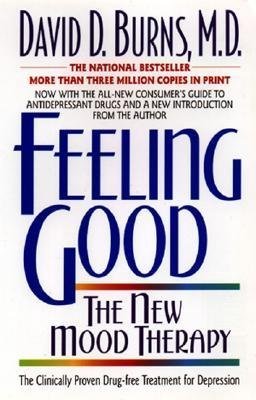
    I’m going to summarize it below, but I’ll tell you right now that the book that saved my life was Feeling Good by David D. Burns, MD. This isn’t positive mental attitude. It’s not neuro-linguistic programming. It’s not the mumbo jumbo of Freud and Jung. This is practical and proven. It is the most prescribed intervention for dealing with these issues in the current medical community. It’s prescribed because it works.

    Your Brilliant Appraisal-Emotion System

    To understand this, you have to understand how emotions work. As I said before, you’re always monitoring your situation. You hear a buzz and see a rattlesnake on the path two feet away. Your monitor immediately responds. Alarm, adrenaline, increased blood flow–all of that to get you ready to deal with the situation. Your monitor writes “alarm” on your face to communicate it to those around you–to warn and ask for help. This happens in less than a blink of an eye.

    But this doesn’t just happen with danger. It happens when we encounter unfamiliar things. When we encounter positive things. You see a great friend who makes you laugh all the time. Boom, your monitor responds. You smile. Feel. Focus. You do so because you not only want to avoid dangers, you also want to seek out the things that make you happy.

    Our emotions prepare us to fight, flee, seek, and pitch woo. Our little monitoring and physical response system is brilliant.

    But there’s more. We don’t rely on just the automatic subconscious monitoring. We also have a cognitive (conscious thinking) part. Let’s go back to the rattlesnake. You walk out into the garden, step on a slither, and immediately go into alarm mode. Then you look, consciously see the slithery thing is not a snake, but the garden hose. You relax. Laugh.

    The quick subconscious appraisals keep us alive, because with snakes and other things, if you’re slow, you’re dead. We don’t have time for thought. If you touch a hot stove, you want an immediate reflex. You don’t want to ponder it for a second or two. On the other hand, the cognitive appraisals help us further appraise a situation. They bring more of our resources to bear on the situation.

    How Does the Nazi Get In?

    So there are three parts of the appraisal-emotion system: the subconscious appraisal of the situation, the physical response, and the cognitive appraisal. Each of the three parts affects the other two. And when things are running smoothly, we don’t have problems. But sometimes we get a distortion mucking up the works. We make a faulty appraisal of the situation. And therefore have a faulty physical response.

    For example, you’re a mother. You’ve had a hard day. The kids make a huge mess with flour in the kitchen. You yell, freak out. When they’re cowering in their rooms and you’re cleaning up the flour, you think, “There I go again. I’m a total failure. I can’t stand it! I never do anything right! I’m a terrible mother.” These thoughts make you even sadder.

    And that’s the propaganda. That’s your brain Nazi with his all-or-nothing thinking, telling you that you either perform perfectly or you’re a failure.

    But is that true? No, it’s not. You might be a B+ mother, filling the lives of your kids with all sorts of goodness. You might have just had a great time reading with the kids not thirty minutes before. But the brain Nazi tells you to forget that. “Vatch dis film,” he says, “und see de horrors of vut you are!”    

    And the all-or-nothing thinking gambit is just one of ten common weapons he uses. Furthermore, this happens so quick that we often don’t notice it. In fact, we’ve often repeated some of these distortions so often than they’ve become almost automatic.

    Mr. Nazi, Meet Mr. Bazooka

    The good news is that you can pull the lid off the lies. You can open the door, spot the brain Nazi that slipped in, and take him out. You can do this because one of the three parts of the system is our cognitive appraisal. This means you can consciously stop the movie, pin the distortion on the wall, and uncover the truth. Once you do that, it’s like the rattlesnake scenario above—oh, it’s a hose, we realize, not a snake, and the appropriate emotions immediately follow.

    But you need to know how to stop the movie. You need to know how to spot the lies. David D. Burns, MD tells you exactly how to do this in his book Feeling Good. (By the way, DON’T get this book confused with his Feeling Good Handbook–you DON’T want the handbook; you want Feeling Good, the book.)  In the book, Burns talks about the theory, the results, and then gets right down to the practical techniques used to blow the brain Nazi to kingdom come.

    A few years ago I hit a bad patch with a brain Nazi that had taken up residence. A very bad patch. He’d been there for quite some time. This book and a good counselor saved me. I thank the Lord for that. By the time I went to see a medical doctor to assess whether chemical issues might be playing a role, I was stable. I wasn’t out of the woods yet, but I had opened the lid and found the villain at the controls. I used the techniques Burns gave me, and I’m happy to say that while the brain Nazi still comes round every once in a while, I can spot him. And I can take that sucker out.

    Go to the library and check out the book and take the assessment test. If you, or someone you know, scores in the mild range, maybe you’ve just experienced a very sad event. But maybe you’ve also got a villain in residence. Get the book. Read it. Be happy. Nobody needs to live with a Nazi at the controls.

    For Authors

    By the way, fiction authors should pay special attention to this stuff. Not because we’re more susceptible to brain Nazis than others, although we do have to deal with our fair share as we develop and share our stories. No, we should because the emotion process is exactly what we’re trying to tap into. Knowing the principles can be very useful indeed. Let me recommend you read the books on emotion listed on the Learning With Pros page.

    Sources

    1. 1. http://www.nimh.nih.gov/health/publications/the-numbers-count-mental-disorders-in-america/index.shtml
    2. 2. http://quickfacts.census.gov/qfd/states/49/49033.html (find your state and county and see how many folks are likely dealing with a brain Nazi in your area)
    3. 3. http://www.oas.samhsa.gov/2k5/youthDepression/youthDepression.htm
    Share
  • Good Stuff! Wonder, Darkest Hour, Sea Wolves

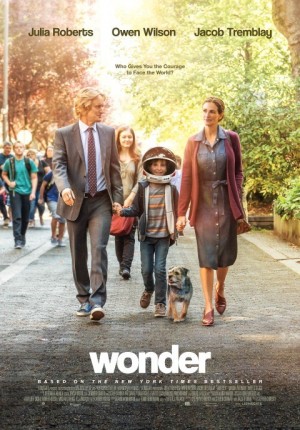
    I had seen a lot of good reviews of Wonder. My wife told me a lot of her students enjoyed the book. But I thought it was going to be a heavy topic, full of sadness and heart-wrenching drama. I’m happy to report that while Wonder does indeed have some difficult moments, it’s also full of humor. And triumph.

    It’s a story about Auggie, a boy with a rare medical deformity that has put him through multiple surgeries. His parents have homeschooled him, but now that he’s at the age where he could go to middle school, they feel it’s time for him to navigate the world. The perfect time, right?

    But it’s not just about Auggie. The film is also about Auggie’s sister, her former best friend, and Jack, Auggie’s classmate. We get to see their stories as well, and they are woven into a wonderful, poignant story.

    You’ll laugh and wince and cry and cheer. You’ll enjoy Julia Roberts and Owen Wilson, who do a wonderful job as Auggie’s parents. And you’ll enjoy the children and teens. Me, my wife, my married daughter, and my teen all loved this film. I will be watching it again. If you want a great movie to watch as a family, I think you’ll love this.

    *

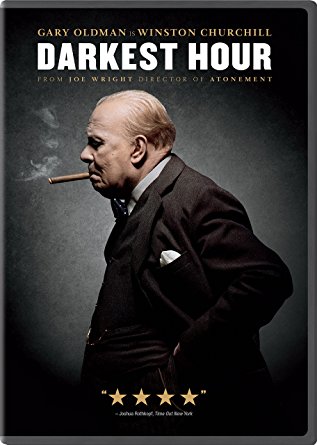
    As soon as I saw the preview for the Darkest Hour, I knew I had to see it. And, boy oh boy, this is yet another movie I can’t wait to watch again.

    The phrase “The Darkest Hour” is used in Britain to refer to the time when the United Kingdom appeared to be under direct threat of invasion from Germany at the beginning of World War 2. Germany had launched its attack on France, Belgium, and the Netherlands and had smashed their armies, sweeping all before them. The bulk of the British army was trapped at Dunkirk and looked like it would be annihilated.

    The British government was split between those who saw no path to victory and wanted to make a peace treaty with Hitler and those who wanted to resist him. The opposition party in parliament forced Neville Chamberlain to resign. And the only man they’d accept in his place is Winston Churchill. But Churchill was not the lion we think of him as today. He had a poor reputation among many of the leaders of his party and was not someone they wanted to elevate.

    So the film starts with the ouster of Chamberlain. We then get to watch how Churchill deals with the catastrophe of what’s happening just across the channel and all the voices pressuring him to make peace.

    There’s humor, suspense, and a number of one-liners that we all began repeating to each other immediately after the film ended. You get a feel for what it must have been like at the time and why so many wanted to sue for some peace treaty with the monster across the channel. You also get to see a slightly different picture of Churchill as a man. I particularly loved the exchanges between him and his wife.

    If you are interested in World War 2 or Britain in even the slightest degree, you simply must see this film.

    *

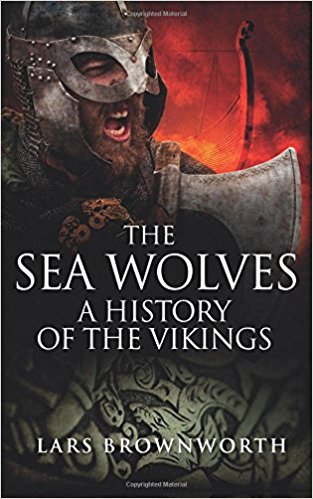
    I have now listed to the audio book of The Sea Wolves by Lars Brownworth twice.

    Yes, it’s that good.

    In this book, Brownworth tells the history of the Vikings. And he tells the history the way history should be told, bringing to life the old Norse world of epic poets, sea kings, and raiders, including Ivar the Boneless, Eric Bloodaxe, Harald Hardrada, Rollo the Walker—all the major figures.

    And Brownworth does it in a way that helps you understand how their dominance was possible and what their effect on the wider world was. Did you know, for example, that Russia comes from the word “Rus”, which was the name for the Swedish Vikings that started that nation?

    What? Russia was started by the Vikings?

    Yes.

    Read or listen to the book. You’ll learn that plus a whole bunch more that will make you look at that time in a different light.

    And if you want to get the other side of the tale, let me recommend reading Bernard Cornwell’s historical fiction series that starts with The Last Kingdom. The series tells the story of the invasion of the Danes during King Alfred’s rule from the point of view of Uhtred of Bebbanburg. It’s a terrific series.

    By the way, I do not recommend the TV series based on the books—too much sex for my tastes. But the books are fabulous. As are the audio versions. I’ve listened to six of them so far, and they have provided hours of enjoyment and interesting insights about the time and the events that took place.

    Share

2 Comments

  1. Another terrific post, John. Thank you.

    I am up well past your 10 pm bedtime -a problem I indeed need to work on. So a lot to digest in detail right now; bookmarked and I’ll be back later.

    2018 is all about me trying new adventures -so I’ll be checking this out. Among additional concepts, Fogg seems -at first glance- to incorporate some ideas I found in the following books/programs that have helped me a little (again, I am a work-in-progress):

    = StrengthFinders v2.0 (Tom Rath)
    = Getting Things Done (David Allen)
    = Habit Stacking (S. J. Scott)

    None of these actually have a program, per se. But they are good reads anyway, IMHO.

    While making some progress myself in fighting some of the demons you are slaying, I still have work to do. So I’ll be checking out Mr Fogg’s program.

    Again, as always, thanks for the “good stuff”, John.
    Regards,

Comments are closed.