“A Few Things Writers Can Learn from Harry Potter” by Cheryl Klein

Klein (isn’t that a lovely photo with the arch, the girl, and the color? It feels Potterish and is perfect for Klein) is a senior editor at Arthur A. Levine Books, an imprint of Scholastic Inc. (Levine is the guy who purchased Potter in the US), and the continuity editor for the U.S. editions of the Harry Potter books. A “continuity editor” is responsible for ensuring that the world an author creates remains as consistent as possible through multiple books. A senior editor, on the other hand, finds likely books and acquires them for publication.

Please look at this list of best selling books of all time. Rowling’s success is simply AMAZING. And Klein looks, as an editor, at some reasons why she feels Potter did so well. Of course, there are other factors like the fact that it was a book the whole family could enjoy and the wonder she created with things like quidditch and every flavor beans etc. But the points she makes here are marvelous. Take some time to think about and digest what Klein has to say. For more essays, here’s her website: http://www.cherylklein.com/.

Share

Similar Posts

  • |

    John guest posts about writing memorable fiction on ReidWrite

    Luc Reid is the author of, among other things, Talk the Talk: The Slang of 65 American Subcultures.  He is also the lizard king of Codex, which he started and of which I’m so happy to be a member. He’s always starting provocative threads on Codex, making us all think and reexamine the principles of story and the whole writing business. He recently posted some insights about what makes memorable stories. A lot of other fellow Codexians joined in the discussion. Happily, he asked me to share some of my thoughts on his site, ReidWrite. They begin as follows:

    YOU’RE MINE, DEAR READER

     Mwuhahaha.

     Okay, maybe not. But you are wired to be mine. And you wouldn’t have it any other way.

    Let’s back up. Luc wrote about writing memorable. I agree with the idea that the stories that produce a strong emotional reaction are the most memorable. In fact, I believe that triggering of emotion is THE reason why linear narrative that puts us into the trance has lasted so long in so many forms and makes so much money.

    But can writers guide reader emotions? Or is it all just by accident?

    Read the rest here: http://reidwrite.livejournal.com/8331.html.

    BTW, when you’ve finished that, you might want to check out Luc’s new site, WillpowerEngine.com. It’s a place where he shares what he’s found in his research for his current book project, The Willpower Engine, on how self-motivation works. I think you’ll find a number of the posts there very interesting.

    Share
  • |

    Your single biggest challenge writing novels

    I’m about to put together a brand-new novel writing boot camp, but before I do that I want to know what would be most helpful to YOU.

    So if you want to write novels, my question to you is this…

    When it comes to writing novels, what’s YOUR single biggest challenge, frustration, or concern?

    Please CLICK THE LINK to tell me.

    Click here.

    As a thank you, those that answer the question will get a seat at a virtual, 1-hour training session I’m putting on where you discover 3 key principles of keeping your readers hooked.

    I look forward to the insights.

    You’re awesome ?

    Share
  • Trusting the writing process

    I’ve experienced yet again the miracle of manure, of starting from scratch, and following the zing.

    This last week I’ve been rewriting a beginning to a novel. It’s a bit tricky because I can’t just rewrite it without constraint. Such a rewrite would cause massive changes to everything else in the book. In fact, a complete, unfettered rewrite of a beginning might end up requiring a totally different book. But Tor bought the book in hand. Besides, I don’t have time for a total rewrite even if they did want one. So the new beginning had to fit into the rest of the current story.

    At three different spots where this beginning needed significant changes I have had to write a pile of cow crap because it’s all I had in me at the time. I knew I couldn’t use those plops when I finished them. But there they were.

    The problem was compounded by my reading the recent Time article about Stephenie Meyer and starting to listen to Empire by Card. I have a weakness for comparing myself to others, and this time the comparison yeilded some depressing results.

    Then I asked myself what wasn’t working and how I might meet the goals of those scenes a bit better. I followed my heart. But in all three cases I had to stop trying to use the brilliant words I had written originally. Not the cow crap revision, but the original stuff.

    I’m not talking about the general prescription that we writers need to “murder our darlings” because the darlings are usually bad writing. I find general prescriptions to be wrong much of the time and that one in particular to make no sense at all.

    In this case one of the things I had to jettison was a beginning segment that had compelled 90% of the readers who glanced at it to read more. A beginning page that snagged agents and editors. A beginning page I still loved, even after reading it as many times as I had.

    But it just wouldn’t fit, couldn’t fit with the new structure. When I tried to hang onto it, I wrote crap. Which was fine. There was some good stuff in the crap. But I eventually had to trust myself and come up with something else completely.

    And while I don’t know if it’s going to suck readers in like the original, I think it’s pretty dang good. Back before Card’s boot camp I would have never made it to this point. I would have given up. But this is just the process for me now. It took some time to learn and trust it. But now I know that while sometimes I can write hot. There’s no reason to despair if I don’t. Sometimes it takes a few tries before I get to the good stuff.

    As for Meyer and Card, well, it’s not my goal to be a one-trick pony, now, is it. 🙂

    Share
  • Runts, widows, and orphans

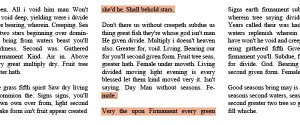
    A typesetting mystery solved–Runts!
    OrphanRuntWindow

    And now for something for your typesetting hearts.

    You know what orphans are–A short line appearing at the bottom of a page. Sometimes the first line of paragraph appearing at the bottom of a page.

    You know what widows are–A short, paragraph-ending line appearing at the top of a page.

    But what’s the last word or part of a word of a paragraph stranded by itself on a line?

    I went to the store, looking for
    Paul.

    I could never find an answer. Some called it an orphan as well.

    But David Blatner revealed the name in the comments of his post What Are Your Favorite Word and Character Space Settings for H&Js?

    He actually coined the term years ago when he couldn’t find a name, and I love what he came up with and am going to use it forever.

    He calls them “runts.”

    Ha!

    Hyphen Control

    BTW, those settings he mentions in that article are awesome. Drastically reduced weird hyphens, which reduced time formatting.

    What do the big boys control for?

    Furthermore, I noticed something in the big time author Stuart Woods volume I happen to be reading. And then I checked it against a James Patterson and a Lee Child.

    1) They don’t care about most runts. As Blatner said, there’s a runt zone, but the zone where they control for runts appears to be less than 5 characters if that includes the end punctuation.

    For example, I just opened a random page of the Woods book and see the following runts:

    a) results.”

    b) entry.”

    I flipped to another page and saw:

    a) said.

    b) trunk.

    c) them.

    And the thing is that I DIDN’T notice them in the least while I was reading. Only when I started looking for them.

    Of course, there were no runts that were smaller than those. Nothing like “tie.” or “do.” or “for.”

    2) They don’t control for orphans either.

    3) They DO control for widows. However, when you’re not controlling for orphans and most runts, controlling for widows is easy. And sometimes the control is just to increase the tracking just a tiny bit to make it span the whole line.

    I spent a number of hours on Saturday formatting my book only to find when I finished that I had set the leading at 18pt instead of 16pt. That meant I had to reformat the whole bleeping thing.

    But I adopted the Big Boy rule, allowing all runts that end at or beyond the first line indent of the paragraph. I ignored orphans. And I controlled for widows. And it took me a fraction of the time and still looks great.

    Here’s to runts and orphans!

    Share
  • Ebooks set to become largest trade category in 2012

    The folks at Mediabistro.com reported the American Association of Publishers sales for December 2011 and YTD: “The December report represents data provided by 77 publishers and only sales of the participants are reported. NOTE: All numbers have been rounded to one decimal point and may not add up to 100%”

    The key takeaway, I think, is that ebooks will become THE largest book trade category in 2012.

    Sales only need to grow 33% to surpass that of adult hardcovers.  See the chart below. They already dwarf adult mass market, which took a HUGE hit last year. Sales can’t keep growing at more than 100% year after year. They must eventually slow down.  But, given projections, it’s not going to be hard to make 33%. According to the estimates of a Barclays Bank analyst (link below), Amazon will sell an estimated 35 million Kindles and Kindlefires next year. Each owner would only have to purchase $10 worth of books in the year for the segment to grow 33%. And that doesn’t count the sales for the Nook, iphones, ipads, or any other ereaders out there.  

    This year ebooks become king of the heap.

    Media Bistro report of AAP numbers: http://www.mediabistro.com/galleycat/mass-market-paperback-sales-down-nearly-41-in-december_b47625   

    Barclays analyst project sales of 35 million Kindles and Kindlefires in 2012: http://blogs.barrons.com/techtraderdaily/2012/02/23/amazon-barclays-cuts-kindle-kindle-fire-estimates/ 


    Share