Generating Story 3: Develop The 6 Core Parts, Start Anywhere

If you’re going to build a house, you need to know what type of house you want and what you want it to do. A two-man tent is a house of sorts.  So are a suburban rambler, a New York high-rise, and a medieval fort.  Each is a bit different, even if they share elements.

Building a story is like building a house. You need to know what you’re after. You need to know how stories work in general and how the type of story you want to write works in particular.

For example, if you love suspense, and it’s going to factor heavily in your story, you’d better learn the principles of suspense. If you love intrigue and mystery, you’d better learn how to build that in a reader. If your current project is a crime story, you need to know how crimes work and how they’re solved. If it’s a love story, you need to know how falling in love works. All of those things you identified as your personal style—you want to know how they work.

Except sometimes, when you’re starting from scratch, you might not know exactly what kind of story you’re going to build.

So what do you do?

You get a list of development objectives. And you begin to work on them. Your mind needs a direction to run.

Despite the fact that stories are different, they share some common core things. These are the things you want to focus on developing. When I start a new project, I know my task is to develop six core story elements. This gives me a direction. All I have to do is start developing these six things, and sooner or later the story comes to life.

So what are these core elements?

  • Genre
  • Character
  • Setting
  • Problem
  • Plot
  • Text

You need to develop all six parts. That’s your job. There’s no particular order that you develop the elements in. You just start with what you have. As you develop all six parts, the story will come to life. Your characters will begin to breathe and speak. They’ll take on a voice and attitude. You’ll see the landscape. Scenes and plot turns will come to mind. If you’re more of an auditory thinker, you might not see anything, but will start hearing the rhythms of the prose. Visual or auditory, you’ll care about and believe in the tale. You’ll have something wonderful to write and share with readers.

Let’s look at each element to see what you’re trying to develop.

Genre

The genre tells you the overall effect you’re going for. It describes the salient aspects of the tale. Those aspects often focus on the emotional mix you’re delivering to the reader (horror, humor, thriller), but can also describe the setting (western, Regency romance), as well as the type of problem your characters will be facing (love story, political thriller), and the audience your writing to (young adult, middle grade, women’s fiction).

But why do you want to know your genre? Isn’t that just a marketing thing?

No, it’s not just some marketing thing. If I’m telling a story about a kidnapping, knowing it’s a tale of tale of horror–instead of a romantic comedy, fantasy, western, science fiction, or political thriller—makes a huge difference.

It gives me an objective. Parameters. Remember, creativity is problem solving. If there’s no objective, there’s no solution. The moment we have an objective, our mighty brains can kick into gear and start suggesting ideas. The more specific we make the objective, the easier it is to think up ideas.

Now, you might not know the genre when you start. You might simply have a cool bit of dialogue, an image, or newspaper clipping. That’s okay. You don’t need to start with genre, although it often helps. But you eventually want to peg that genre, even if it’s some blend of your own making, so you know the general effect you’re going for.

Character

You want to develop a couple of characters, usually at least a protagnoist and antagonist. They need to be interesting to you. If you want your readers to root for someone, that person had better also be sympathetic and likeable.

What makes a character interesting? What makes them sympathetic and likeable? You might want people to dislike your antagonist. You’ll at least want them to fear him or her. What produces that? Read what I wrote about character here: http://www.sfwa.org/2010/12/key-conditions-for-suspense/. Then start noticing what makes people and characters interesting, sympathetic, and likeable to you, as well as what makes you fear and dislike others.

There will be other characters you’ll need to develop—a mentor, lover, friend, henchmen, etc. Maybe you start with one of them. That’s fine. Just know you need to be on the lookout for your protagonist and antagonist. Almost every story has both. For the hero, you’ll usually want to develop someone that’s interesting and likeable. For the antagonist, you’ll want to develop someone who is interesting and powerful enough to make us fear for the hero.

Setting

Setting may play a huge role in your story as it does in epic fantasies, Westerns, historical pieces. Furthermore, a setting doesn’t have to be faraway place to play a big role. Your story may be set in a prison, rural town, or manufacturing plant, which may factor heavily into the story. Then again, setting may play less of a role. It all depends on what interests you and the type of story you’re writing.

They key, I’ve found, is to develop the setting with the goal of having it come alive in my mind by identifying things in the setting that are interesting or will affect the hero and plot. I need to transport the reader to a place. I can’t do it, if I myself don’t know what that place is like. And it’s nice for them to find it interesting when they get there.

Setting is also a great source of ideas for the other elements. When you develop setting, you’ll find characters, problems, and plot ideas galore.

Problem and Plot

I wrote a detailed explanation of problem and plot, which you can read here:  http://www.sfwa.org/2010/12/key-conditions-for-suspense/. Read it. I’m not going to rehash it now. But I will say that problem is the engine to your story. Your story is not going to go anywhere without it.

You want to identify the main problem your character is facing. One that is going to generate enough scenes for the size of story you’re going to write. Read what I wrote about conflicts, obstacles, etc. Ultimately, you’re aiming to develop a problem that you find compelling.

You might not develop the key aspects of the plot in the beginning. In fact, you’ll probably discover many of them only as you write. However, at this stage it does help to start looking at plot patterns for the type of problem you’re writing about because it helps generate ideas for scenes. For example, a romance about a gal who is a Minuteman or border agent and guy who is a coyote (smuggling folks across the border) will take a different course than one about a farmer trying to find his kidnapped wife.  

In the first story, we might start by introducing the characters: the border agent interdicting a group suspected of being drug mules; the coyote is leading that group. In the next scene they might meet, and not know what the other is. They’re attracted. They meet again, maybe have dinner or dance or go hunting. The romance deepens. Then one finds out about the other.  If she finds out, does she turn him in? Maybe he inadvertantly leads the drug cartel to her and puts her in jeopardy.

In the second story, we might start with the husband and wife in some funny situation. He leaves. Comes back. Finds her gone. Finds evidence of her kidnapping. Gets a call or a note. Is told they want him to pay them a ransom. Or maybe turn over title to something. Or maybe he works at a weapon manufacturer, and they want some piece of tech. Or maybe it’s something else.

The point is that they develop differently. The plot patterns of love stories are different from the patterns of heists, kidnappings, shipwrecks, bullies, etc.  because they’re all different problems and require the hero to take different types of steps to solve them. When first developing a story, I’ve found it’s helpful to think about patterns for presenting, complicating, and resolving those types of problems. I’ve found it helpful to ask, what would I do in this situation?

For more on plot patterns, see the link above. In addition to patterns, specific plot turns that really spark your interest will present themselves to you. Maybe I don’t have a pattern yet, but as I’m developing the character or setting a cool scene comes to mind. Or maybe it’s a cool plot turn–the border agent is captured by a drug cartel and the coyote goes in to save her. You want to be on the lookout for these.

So in the beginning, you want to focus on developing a compelling problem, a general plot pattern, and be on the lookout for some cool or fun scenes or turns.

Text

Text is the prose on the page. It’s how you translate the story in your head to something the reader can consume. It’s the specific scenes, the dialogue, and narration, which means you don’t stop developing the text until you write “the end.”  Sometimes, the story can come alive without drafting. Sometimes, especially with those writers who are more auditory, you need a rhythm, a voice for the narrator and character before the story clicks. Often it just takes some freewrites or a drew chapters to discover this.  What I’m after is a point of view voice.

Sum It Up

Take some time and think about the key elements, how they work, and the core of what you need for each. Make yourself a simple checklist. Here’s one such checklist.

  • A protagonist who is interesting, fascinating maybe, someone you yourself can get behind and want to follow. 
  • An interesting antagonist who raises your anxiety for the protagonist.
  • Asetting that’s alive in your mind as well, including parts of the setting that are interesting—the things and people that are scary, cool, lovely, dangerous, funny, etc.
  • A problem that’s compelling to you. One that’s big enough for the size of story you’re writing. One that suggests a juicy plot.
  • A plot pattern or two. Maybe some scenes or plot turns that really spark your interest.
  • A voice for the main character / narrator. 

Here’s another I recently shared with some younger writers:  

It doesn’t matter where you start when you invent a story, but you  need to end up with a character you think is fun, cool, or  interesting, who has a problem other people will find funny or  compelling–that’s the core of your story. The problem can be a mystery the character needs to solve (there are strange green lights in the sewer), a danger or threat to some aspect of the character’s happiness or someone they care about (holy smokes, that big alien that looks like a bug wants to eat my head), or an opportunity for something that will make them happy (I live in a cupboard and get to go to magic school!) You start there. The rest of the story is about how that character goes about trying to solve the problem, the characters who help them, and those who work against them (including tiny evil mice villains). You know you’re done when the mystery is solved, the threat removed, or the opportunity is won or lost.

Here’s another from Lou Anders that he offered on a Writing Excuses podcast that presents another way to sum up what you’re looking for with character and problem (BTW, I find no evidence that all satisfying stories need what he calls a relationship character; however I do think it’s a fantastic technique for stating theme and clarifying the internal problem in stories that revolve around a character making a change):

[Lou] The protagonist is usually the most obvious one. He or she is the star of the film. The protagonist is someone who wants something. It has to be something concrete [emphasis added]. It can’t be “I want to be happy” or “I want to be pretty” or “I want to be rich.” It has to be a definite, achievable goal associated with that. So I want him to fall in love with me so that I will be happy. I want to win the game show that I’m going to be on so that I will be rich. I want to rob a casino of the guy who’s dating my ex-girlfriend, that will make us happy.

[Dan] So I can be happy and rich.

[Lou] Yes. Exactly. So it has to be a concrete, achievable goal.

[Lou] The antagonist is the person who places obstacles to that goal in the path of the protagonist. This does not mean the bad guy. Now, we can talk about some very interesting examples. The antagonist is the one whose goals are diametrically opposed to the protagonist, and they’re the one who is blocking the protagonist’s journey.

These aren’t twenty page design documents. They’re simple checklists. There’s power in keeping your objectives simple. Too many details and you lose your focus.

I suggest you take some time to write a succient sumary of what you want to develop, one that gives you clear direction. It doesn’t need to be perfect. Just cobble something together. And keep it SHORT! Remember the 80/20 rule.

Let me suggest you not get bogged down by rules: Rules vs. Objectives. And that you include at least four of the six parts: The 4 Parts. The key is have a list of core things you know you need to develop for the current project. Knowing what you need to develop gives your mind a direction to work in so you’re not just flailing about.

You can’t know it all up front

It’s important to know that even though you have a development checklist, you will NOT develop the whole story up front before you begin to draft. You can’t. It’s impossible. It’s a mistake to think you must.

Even the folks who write detailed seventy-page outlines cannot imagine the exact words and turns of every scene before they actually write them. Furthermore, they are often surprised by ideas that come as they draft and find themselves adjusting their outlines.

Your goal is NOT to develop a super detailed set of writing instructions that a monkey could follow. Your goal is to get enough ideas in the six parts for the beginnings of the story to come alive in your mind. When the story is alive in your mind, writing is almost like transcribing.

You might develop your ideas by creating various types of sketches for the plot, problem, character, and setting before you begin to draft. This includes things like summaries, outlines, drawings, maps, character biographies, etc. On the other hand, it may take some drafting before those things begin to breathe.

Also, it’s rarely the case that you develop the parts sequentially. What usually happens is that you develop a little bits about each part in random order. Maybe you start with the bare bones of a problem, then develop a bit about a character, then setting, which leads you to more about the character, then you see something on TV that sparks your ideas about the problem, then you write a draft of something and get some more details, then your brother says something that sparks an idea that fits. Or maybe you start with a snippet about a character and move to the setting and back to character then to problem. Or maybe you begin with setting and discover a bit about a character.

It doesn’t matter where you start. The parts build by accretion, like a snowball—here a little, there a little. 

Selective Attention

Once you know what you’re trying to develop, ideas will literally jump out at you. It’s all part of the biology of selective attention (http://en.wikipedia.org/wiki/Attention).

For example, if I tell you to develop a sexy female antagonist, I’m betting some ideas or images immediately leap to mind. If I tell you to present me with three different choices for this antagonist next week, someone who will fit into my kidnapping story, someone who’s a little surprising, and every day you think about this objective, you’ll encounter all sorts of ideas over the next seven days that you might use.

Why? Because you’re primed to see them. You’re looking for solutions to a specific problem. You’re harnessesing your focus and working memory limitations. That’s selective attention.

The more specific I get in my objectives, up to a point, the easier it becomes. If I tell you the kidnapping is a comedy set in rural Utah with Mormons and Peruvian sheep herders who work for 9 months and then return to Peru, that will lead you down one path. If I tell you it’s a thriller set in the deep south with Mexican drug gangs and a local police force, that starts you thinking in another.

An Example

Let me give you an example of all this. A few years ago, I was on a business trip, and just before checking out of my hotel, I read an interview with Deborah Vetter who used to be the editor for Cicada. She said they loved traditional fantasy stories and that many of those she liked took a common theme and gave it an unexpected twist. Cicada was open to fantasy at the time, and so I asked myself: what’s a twist on a common fantasy element?

Boom, objective–my mind had a direction to run in.

I got my luggage together, checked out of the hotel, and drove over to a Lowe’s around the corner to pick up something for the house. All this time I’m running various fantasy elements through my mind—witches, ghosts, dragons, etc.—asking how I might twist them. Trolls? No, boring. Witches? Meh. Vampires? Ugh. I went through a whole bunch of ideas. I got out of the car, entered the store, continued. When I was walking down the trim isle, I finally got to golems.

Hum, that was interesting to me.

All the golem stories I had read were about the rabbi creating the golem and what happens. Kind of like Frankenstein’s monster. So I asked: what if it wasn’t about the guy who creates the golem? What’s a twist? What if it’s about someone who finds a golem?

I immediately saw the bank of a river, the Evanston, Wyoming river my girls and I had been playing on a few weeks earlier. I imagined the river in autumn, yellow leaves on the ground. I imagined a bald man of red clay, half exposed in the freshly shorn bank, the rune of power on his forehead and neck. The river was low, the mint growing on the exposed sand and gravel bars, the smell of leaf mold hanging low over the water.

My cool meters went wild. Some ideas carry such a delicious energy.

Did I have a story?

Of course, not. I only had the first whispers of a character (the golem), setting (a river somewhere), and genre (some kind of fantasy). Maybe a bit of a problem. This was one cool idea, not anything close to a story. I knew I needed to develop character, setting, and problem. That’s what forms the premise of the story. So I got to work on those elements.

I captured the image on a scrap of paper, and began asking questions. Who finds it? A woman, I thought. Where? I listed some options and liked the woods of North Carolina. And it was some Native American creature. What’s the problem? What’s at issue? Either the red golem has his own agenda, I thought, or it’s others forcing it on him, or he’s trapped. A trapped soul…and the woman and the golem love each other…

Did I have a story yet?

No. Not even close. I still didn’t have a clear problem. Or very much about the characters. No plot.

So what could the problem be? What was the situation?

I walked around Lowe’s, drove home, thought about it on the way, generating options. I took a few days and generated ideas about American Indians, pickups and rednecks. I researched golems. I asked myself–what would that girl do, if she found this thing?  What if she dug it out and took it home? So I had a girl who digs the golem out and transports it home in her pickup, modern day South Carolina. She takes it home, cleans it, becomes obsessed with it. Takes it into her room. One night she’s lying in the dark, the house is quiet.  And suddenly it takes in a breath. It’s trapped soul–they love one another, she has to say good-bye in the end, a bitter sweet ending.

Whoa. Cool! Now this thing is alive. But then the more I thought about it, the more I realized I didn’t want to write a story about a woman obsessed with a golem. Golem love? So I tossed it and went back to developing more ideas.

Here are some of my development notes so you can get a feel.

<quote>The deep-trench men were admirable monsters. They knew the clay, the feel and pattern of it, for it had long been heavy in their minds and muscles. They were big in three dimensions and their eyes were black and barbarous…</quote>[just a scrap I ran across and put into the folder]

Okay, this is going to be a hot writing, just letting the ideas flow to see where they take me and trying to simply let the ideas come.

Zing: what if he leaves, she finds him, does something, and then one day she goes back and he’s gone. And what’s she going to do? He could be hiding there and malevolent. Or he could be following her.

I like the idea of her falling in love with him.

The red man in the bank of the river. And I’m pulled to the historical setting, a historical fantasy. Not a contemporary, but one that’s serious about the guy. One that has villagers etc.

So she’s out there, collecting late berries (currants) or maybe mint, she’s out there and it’s a fine fall day and the water is tumbling, rushing by. And she’s in a dark blue skirt and a white blouse, and she’s got dirt on the skirt, carrying the mint, and she comes around one thicket of willow and there he is.

He’s not all visible, but she sees the skull and the shoulder and thinks skeleton, perhaps a burial ground, some ancient thing.

Goes to investigate. It’s not the bones of the dead. A statue? What is it? She digs a bit, dirt in its ear, digs and uncovers more of it. Sees the rune of power on his head. Steps back. He looks like someone struggling to get out of the rock, birthed from the rock. And now its very obvious to anyone coming by and she hides it. Struggling like a man from the womb.

And so what’s the danger from here?

She loses the cool thing.

    • He gets out and leaves–gone
    • The villagers or one guy, one big man, goes down to destroy it
      • Her fiancé
      • Her husband, she’s young, very young and he’s her husband?
    • Or she’s alone, very alone.
      • She takes the thing home, gives it a place, talks to it (like Wilson in Outcast)
      • And then one day it’s gone, he’s gone, this thing that’s taken her life, it’s gone and she realizes that it’s alive, the last image, last piece of information shows dirt, red clay dirt in the bottom of a bowl, the spoon laid to the side. Something that would signal that the thing was alive.
      • THIS IS A COOL STORY. Not a long one either. A cool one.
      • So she’s caring for it all the time. Cleaning, scrubbing
      • Does she at one time hear a gasp? Thinks, he’s coming alive. Has a place set for him, a plate etc. But that goes away, it goes long away, too long and she realizes she’s mad.
  • She digs it out? Digs it all out. Heavy as stone.

It’s all freewheeling sketching.

Now, I could have stuck with North Carolina and tried something else. But as you read, my interests were pulling me to a different setting. Where else might it be set?

I listed some locations, and Croatia drew me. I’d just read and seen some cool stuff about Croatia. But I didn’t know much. Was it going to be modern or historical? I began to read about Croatia. And the 1100’s fascinated me. There was all sorts of stuff going on. I decided to set it there.

Did I have a story?

No. I still didn’t know what the problem was. So I outlined some options, did some character sketches. Did more research. Looked up old Croatian names and magic. I got out a map. I was wanting it to come to life in my mind. But it wasn’t there yet.

I went searching for a problem. I didn’t really want that golem love story. I made the following entry in my pre-draft document. 

What’s at stake? The woman finds this thing, so what? She’s obsessed. But what’s the big issue here?

  • Danger, if she wakens maybe it will kill
  • Maybe if people find out they will want to use
  • Maybe she will be declared a witch
  • Maybe it will eat her out of home
  • Eat her children
  • Maybe it will force her to feed it, force her to bring people to him so he can kill them
  • Is it a thing of danger?
  • Maybe it will force love upon her? Breed with her and create a race of goblins or trolls.
  • It is a great thief–bringing her presents, presents for the master. And one day it brings a child.
  • A goblin with long hair and not dumb, not brutish, by hungry, a predator, one who will eat you, who loves hunt and chase, but can dress and act civilized.
  • Maybe that’s the thing–it draws you, draws your dreams or your mind, feeds on these things until it has strength to go on and takes a part of you with it, you’re longing, longing, longing for it to return.

I tried a few drafts, still focusing on it being a thing she wakens, but they all eventually lost energy. So I tried something new. Here’s what I wrote:

What if it IS about him stealing things? “The golem was a thief, and this made her believe it might not have been such a holy thing after all.”

Or

She’s looking. Can’t destroy it because of its holiness. But didn’t the wizards of the devil turn rods into snakes in the Pharaoh’s court? And didn’t men always take God’s gifts, like Adam, and throw them away?

This was a question.

That last line brought in a voice. I’d recently watched Fiddler on the Roof; I loved the characters and voices in that movie, and it was that yiddish voice. I decided to try that voice on for size and freewrite again. Here’s what I wrote.

The golem was a thief.

[That felt exactly right; I love it and continued]

Nothing in the village, nothing in the whole vale for that matter, was safe. The golem was forever stealing and bringing its thefts to Braslava’s door, laying them on her step like a cat lays down dead birds and mice.

One day it’s the Butcher’s blue and white Turkish stockings, the next it’s cranky Petar’s new pitchfork.

And then it would stand there, looking at her, and all she could say was, “You think you’re doing me favors? Take your inscrutable face and go sit.”

I went maybe two pages before I ran out of steam. At the end of the freewrite, the story was alive and bucking in my hands. I was full of excitement. At this stage in the game, I had three characters I’d sketched, a problem (the thief golem), a setting, a bit of plot. I had a maybe two scenes I knew I wanted to write. I had a narrative voice for the piece. I knew, because I’d been researching the political situation, that a Hungarian lord was going to get wind of what was happening in the little village of Plavca and want to use the golem for war. I didn’t know everything, but I knew enough to start.

You can read the story for free on my fiction page. It’s called “From The Clay of His Heart” and was the cover story for Orson Scott Card’s Intergalactic Medicine Show, Vol. 8, 2008 and reprinted in Year’s Best Fantasy #9, Ed. David G. Hartwell & Kathryn Cramer. Here’s a thumbnail of the illustration. Nice, eh?

The key is that I knew the things I needed to develop and kept at it until everything reached a critical mass and the story came to life.  This is how you develop on purpose instead of on accident.

Now What?

Take some time to think about the six parts of your current project as well as some general principles about how those parts work. Write out a couple of things you want to develop in those parts. Over the next few days notice how much more productive you become.

Of course, it helps to know how to go about developing the ideas. It helps to know some specific techniques. Because we can’t just wait for ideas to come along. Again, we want to create on purpose, not by chance.

And that will be the topic of the next few posts.

For more in this series, see How to Get and Develop Story Ideas

Share

Similar Posts

  • |

    Writing update: 5/16/11 – outlines & writing vividly

    Finished chapter 5 of CURSE last Saturday. Huzzah!

    The writing is a blast, even though it still requires work. Along those lines, I’ve been meaning for some time to write up the techniques and principles I use when drafting.  So I think I’m going to do a semi-regular post on a weekly basis where I share these tidbits as I run into them. It will be kind of like director commentary, although I’ll have to be careful not to toss out any spoilers.

    This week I’ll talk about using chapter outlines and writing vividly. 

    Bullet Outlines & Chapter Outlines

    Up to this draft, what I’ve done is work from a bullet outline.  Each bullet is a short statement of what needs to occur.  Sometimes it’s very general about the story arc–presentation of the problem, struggle, and resolution.  Sometimes it’s a very specific step.  Sometimes it includes cryptic notes.  For example, here are some bullets for SERVANT:

    1. Talen goes to village, they suspect him
    2. Talen runs, sabin catches him by his hair and pulls him back, field stone size of liver. Plant idea of him catching Hatchlings
    3. Woods back home, freaked
    4. Father is not as concerned, strange, sends him out to field–Talen starts to think about catching the Hatchlings himself

    As you can see, it gives me a roadmap (which often changes) so I’m not starting from nothing when I open up my chapter document.  But it’s very general.  When using this, I often have to use a number of takes to get the scene written because those first takes are me imagining the scene. In fact, my first take is usually a sketch of the scene with me blocking out my goals for the scene and how I expect the events to occur. However, in this last go at CURSE I wrote a chapter outline.  It took me about 25 hours, and the outline for CURSE ran 32 pages. I’ve pasted the first two chapters below.  You can see they’re still mostly in summary, but they represent the initial sketch of what’s going to happen.   

    1.               The Village of Plum – TALEN

    It’s past midnight, behind enemy lines. A thin moon hangs in the sky. Talen, Sugar, River, and five of Shim’s best soldiers crouch in the black shadows of the tree line running along the road to the village of Plum (Sugar’s former village), watching for soldiers or a village guard.

    Talen jokes with Sugar, telling her he wanted a dance tonight, not a sneak behind enemy lines, even if it was in the dark. He’s more than half serious. As they’ve worked together over the last three months since the battle in the cave, he’s become attracted to her.

    Also during those three months, the clans of the New Lands split into two factions. Five clans, led by the Fir-Noy, believed Shim, the leader of the Shoka clan, was being controlled by sleth. The remaining four clans followed Shim. The Fir-Noy faction immediately took up arms, initially to protect themselves, but they soon began talking about ridding the land of the sleth curse. Tensions rose, and in a series of altercations a number of people on both sides were killed. Now both factions have mobilized forces to establish pickets and patrols along a border between them.

    A few days ago, Argoth received word from his spies that something was afoot in the Fir-Noy clan, as if they were preparing for a strike. Futhermore, they’ve decided to excavate the grounds about Sugar’s old house. Argoth knows Purity had her own cache of weaves under the hearth of her old home, the location of which she revealed to Sugar just before she died. Argoth has begun to train up an army of dreadmen for Shim. But he’s stretched thin. He needs all the lore he can get. So he’s sent Sugar and the others to retrieve the items before they’re lost. They’ve come on the evening of the annual apple dance festival, hoping the Fir-Noy would be less vigilant. So far, they’ve been right. In fact, Talen begins to feel like it’s been a little too easy.

    As Talen and the others prepare to move forward, Sugar puts her hand on Talen’s arm. He can feel Sugar’s Fire and soul, and her touch only enflames his desire for both. He’s alarmed by this intensity, and finds it hard to focus, so he moves his arm away.

    “You’re going to give me a boost up,” she says.

    Up ahead in front of the Fir-Noy village stands a thick timber pole probably 11 feet high. Fastened to the top of that pole is what looks to be a skull.

    “You brought us round the wrong side,” Talen says. Their objective was the ash ruins of Sugar’s burned out house, not this pole. 

    “You can’t think we’d come all this way, and I’d leave without it.”

    It’s her father’s skull. The only thing of his that remains. Talen, not wanting contact, motions at one of the taller soldiers with them. “He’d be taller.”

    “Come on,” Sugar says and moves forward in a crouch. They move out of the shadows and into the moonlight, watching the village. Sugar climbs up on Talen’s shoulders and cuts loose the bonds holding her father’s skull. The whole time Talen’s desires make the experience uncomfortable.

    Once Sugar has the skull safely in her sack, the group keeps to the deeper night shadows of the tree line and moves around the edges of the village fields until they come to a ditch. Along the way, one of the soldiers touches Talen, and he feels that same overpowering desire. Something is not right inside of him. He knows it. But there’s nothing to do about it now as they follow the ditch to the ash ruins of Sugar’s house.

    Sugar and Talen sneak over to the hearth of the burned out home. River and the five Shoka soldiers take up watch. Soon Sugar finds the secret cache, but as she’s removing the items, they hear a sound come from one of the surrounding houses. Talen and the others stop and listen. Suddenly Fir-Noy soldiers burst out of the door. They overwhelm one of Shim’s soldiers and rush straight for the others.

    Talen and the others turn to run, but Fir-Noy soldiers begin to pour out of four other houses. Then a Fir-Noy dreadman emerges and shouts it’s the boy that’s wanted. They can slaughter all the rest. It’s clear these soldiers were waiting for them, but there’s no way they could have know Talen and the others were coming, unless they were betrayed. 

    2.               Hue & Cry – SUGAR

    Sugar stuffs the last item in the secret cache into her sack and rises. The Fir-Noy are shouting, but River charges a gap in the quickly forming mob. She fights ferociously. The others race after her, Sugar and another soldier bringing up the rear. Sugar and the others are multiplied, but they’re not fast enough to avoid the soldiers completely, and Sugar is forced to fight and kick to break her way through. When she finally does break past the men, she finds she and the last soldier have been separated from the others and there’s no way to immediately join back up.

    Sugar and the soldier run, but he’s wounded. He tells Sugar to run on without him. She refuses, then a company of Fir-Noy round the corner of a house. The soldier turns to face them and tells her once again to run. In her mind’s eye, Sugar sees the same situation unfolding before her as when the mob came after her mother and da. She ran then and regretted watching her father get butchered. She isn’t going to run now. Besides, she’s multiplied. So instead of running, she rushes over to the soldier and, with lore-given strength, picks him up, puts him over her shoulders, and, despite his protests, speeds away.

    Sugar knows she won’t be able to outdistance her pursuers like this, but she also knows the villager Stout keeps a horse in the barn just ahead. She turns the corner on the barn, puts the soldier down, and tells him to get the horse. Then she darts back out into view of the soldiers following and leads them away. She glances back and sees the soldier slip into the barn. It’s the best she could do for him. If he can get on Stout’s horse, he’ll have a chance to escape.

    Sugar looks to see how she might join back up with Talen and the others, but it’s impossible now. And while most of the Fir-Noy soldiers chased after Talen and the others, a good number are chasing her. Furthermore, others in the village are coming out of their homes. She speeds past them. All over the village dogs begin to bark, but she hears one cluster that sends fear down her spine. The villager Solem keeps a pack of prize-winning sight hounds. He emerges from a barn with his pack on a leash.

    “There!” a man shouts. The barking of Solem’s dogs rises in pitch.

    Sugar increases her speed then hears Solem. “Stu, boys! Take her. Get the wretch!”

    The dogs shoot out after her.

    So how has it worked?

    So far it’s worked very well. Having that initial sketch done means I take a lot less time finishing each chapter.  However, it doesn’t change the general drafting process for me:

    1. The chapters still change as I write. I find cooler ways to accomplish what I need. I also run into things I haven’t imagined yet and have to invent them. For example, on chapter 2 when Sugar is having issues, I realized I didn’t know exactly where the houses lay in the village, so I had to sketch that. It presented opportunities and images.  For example, I thought about the Fir-Noy bowmen being on the roofs. I hadn’t imagined that before, but it was so cool to me, I had to put it in.  Then I felt I wanted Talen and her to huddle together at first. I had to run through a few options about how that played out before I found one that felt right.  
    2. I still find I need to sketch out my goals for the chapters and an initial blocking of what happens. This is much shorter than it’s been on previous drafts, but I still find it helpful. Blocking scenes helps.  This is me just figuring out where everyone is and how they move. Sketching this first helps me write faster.
    3. I still have to do takes, although I move through them more quickly.  

     As you can see, I find the sketch/draft method incredibly helpful.  Just like a painter, I sketch out what I’m thinking of painting. That might require a few sketches where I add in more details.  Then I switch over and begin to paint.


    Writing Vividly

    On another note, I read “Stories are made out of scenes; Scenes are made out of nouns” by author James Maxey again. I really like this essay. Everyone is always talking about verbs, but nouns are such powerhouses.

    Speaking of which, here is the opening to Maxey’s “To The East, A Bright Star” which was published in Asimov’s.  It has one of my favorite beginnings. And part of the reason is what Maxey talks about with nouns.

    TO THE EAST, A BRIGHT STAR

    There was a shark in the kitchen. The shark wasn’t huge, maybe four feet long, gliding across the linoleum toward the refrigerator. Tony stood motionless in the knee-deep water of the dining room. The Wolfman said that the only sharks that came in this far were bull sharks, which were highly aggressive. Tony leaned forward cautiously and shut the door to the kitchen. He’d known the exact time and date of his death for most of his adult life. With only hours to go, he wasn’t about to let the shark do something ironic.  

    Tony waded back to the living room. Here in the coolest part of the house, always shaded, he kept his most valuable possession in an ice-chest stashed beneath the stairs. He pulled away the wooden panel and retrieved the red plastic cooler. Inside was his cigar box, wrapped in plastic bags. He took the box, grabbed one of the jugs of rainwater cooling in the corner, and headed up the stairs to the bathroom. He climbed out the window above the tub onto the low sloping roof over the back porch.

    This all reminds me of Swain’s thoughts on bringing the material to life, which I thought Maxey did so well in those paragraphs.

    Few of us read voluntarily about the primer-level doings of Dick and Jane.  Simplicity is a virtue in writing, true; but never the primary virtue.

    What is?

    Vividness.

    How about brevity?

    It’s important too.  Within reason.

    Within reason?

    Who, just learning this business, knows where or when or how to be brief? In the wrong place, brevity can destroy you.

    So?

    As in the case of simplicity, brevity is never the heart of the issue. Vividness is.

    How do you write vividly?

    You present the story in terms of things that can be verified by sensory perception. Sight, hearing, smell, taste, touch–these are the common denominators of human experience; these are the evidence that men believe.

    Describe them precisely, put them forth in terms of action and of movement, and you’re in business.

    Your two key tools are nouns and verbs.

    (p25 Techniques of the Selling Writer)

    Of course, there’s more–the telling detail, metaphor, working memory overload, details from the point of view. But it all plays into being vivid.

    Share
  • What does an author earn per book?

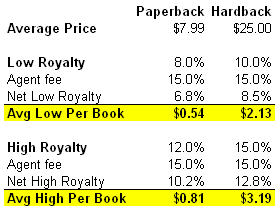
    People are always curious about this, so I thought I’d post it and refer to my previous post about what kind of sales numbers it takes to make a living as a fiction author in the US. Of course, the royalty rates depend on what’s in your contract. Many contracts have sales volume break points. For example, an 8% royalty on the first 50,000 paperbacks sold, 10% on anything above that. But this should give you a good feel.

    Earnings per book

    Share
  • |

    Become A Story Idea Machine

    Now’s your chance

    Apply to take the next Novel Writers Academy course: How to Create Story Ideas That Beg To Be Written.

    • Six-weeks
    • Starts: Jan 2, 2022
    • Ends: Feb 21, 2022
    • Gobs of hands on practice
    • One-on-one guidance from me

    At the end of the six weeks you will be a story idea machine.

    I will be working with only a small set of people. And so you need to apply to get in.

    The deadline for applications is midnight, December 11th. So contact me now to get the application instructions.


    A cracking good story idea requires five critical elements.

    Until you have all five, you’ll struggle to plot. You’ll write a few scenes and run out of gas. You’ll feel like the story just isn’t going anywhere.

    And that’s because it isn’t. It can’t. A story isn’t a story without all five elements.

    However, once you develop these five things, your story will suddenly roar to life. There are a few other elements that are important as well, but these five things form the core of the story setup. 

    In this course you’re not going to merely learn about all of those story elements. You’re going to go deep and learn what can only be learned by actually doing the work and developing story idea after story idea with personal one-on-one feedback from someone who knows what they’re doing.   

    When you finish, you won’t just know story theory. You will be a story idea machine. And you will be that because you have put in the work. The right work.  

    Again, this is not a course full of lectures and videos. This is a course where you’re going to work. And develop the insights and skills that only come from doing the work.

    You’re actually going to:

    • Come up with story setup after story setup after story setup
    • And improve them with one-on-one feedback. 

    It’s going to:

    • Eliminate years of you wandering about in the story wilderness trying to figure things out on your own. 
    • Put you miles ahead of other writers who have no idea what’s really at the core of story. 

    You are going to learn how to develop killer story ideas on purpose instead of on accident. Which means you’ll be able to do again and again. Reliably. Like clockwork. 

    Course details

    The focus of the class is not on learning about story, although you will do that. The majority of your time will be spent on developing stories. 

    You can’t become a carpenter by watching videos and reading books about it.

    You have to get out on the work site, cut wood, and pound nails. You have to make the mistakes all beginning carpenters make, get feedback, and improve.

    The same goes for writing.

    And you’re going to work in this class. You develop 21 story setups. In fact, you develop more because the 21 are just the ones you turn into me. And with each one your skills, insights, and abilities grow.  

    In the beginning, your setups will be bare bones. By the end, they’ll be fully developed setups that beg to be written. Setups you can use to immediately write the first draft  of your novel, whether that’s in outline or chapter form. 

    Here’s what you do each week. 

    Week 1.

    • Uncover the secrets of what’s really at the heart of story and how to generate ideas. 
    • Define your genre requirements
    • Create story setups 1-3

    Week 2.

    • Uncover the secrets to compelling characters 
    • Create character sketches
    • Create story setups 4-7 

    Week 3.

    • Uncover the secrets to formidable obstacles
    • Create story setups 8-11 

    Week 4.

    • Uncover the secrets to interesting casts
    • Create story setups 12-15

    Week 5.

    • Uncover the secrets to managing multiple storylines and series
    • Create story setups 16-19 

    Week 6.

    • Create story setups 20-21. These are your capstone projects where you apply everything you’ve learned and take it to the next level

    In this class you develop story idea after story idea after story idea. You are going to be marinated in the work of developing characters, THOMs, goals, obstacles, settings, casts, and more. And because of that, each week will not only bring an explosion of insights, but new skills and abilities.

    Every week you get two private, one-on-one, live sessions with me where you get encouragement and feedback on what you’ve developed. And you’ll have access to a private Facebook group where you can apply the principles to brainstorm even MORE ideas for each other’s stories. 

    At first you might feel a bit shy and worried about your ideas and abilities. But you’ll soon get over that. By the end of the course you’ll be one of those people that can generate terrific ideas easily. And you’ll be able to do that because you will have put in the work to become a different writer.  

    What’s the price?

    Hours of one-on-one instruction from a professional editor or author costs thousands of dollars. An MFA program can cost $25,000 to $30,000 or more!

    But this course won’t cost anywhere close to that.

    Plus you’re going to learn things here you’ll never get in an MFA program (I know. I was accepted into a top-ranked program).

    The cost of this course is $799. And I personally guarantee your results. You’ll be totally oh-my-gosh-I’m-so-happy-I-took-that-class satisfied, or I’ll give you your money back. No questions asked.

    Now’s your chance to stop spinning your wheels. I can’t tell you how much I wish I’d had something like this when I’d started:

    • The secrets about the true core of story.
    • The secrets about how to come up with ideas. 
    • Actual work with personal one-on-one feedback. 
    • Laser focused on what actually matters, not a bunch of ridiculous writing rules. 

    When you finish, you will be a story idea machine. 

    You won’t know plotting. That’s a different course and set of skills. You won’t know how to write chapters. But you’ll know how to create the engine that powers all the rest of that. You’ll know how to create the core that makes awesome plots and chapters possible. 

    If you want to take this course, click the button below and contact me. I will tell you exactly how to apply.

    I’m not going to be able to accept everyone who wants to take the class. I have a very strict limit on the number of students I can work with. So you need to get your application in before the deadline of midnight, December 11th.

    Don’t wait!

    Contact me now to get application instructions.

    Share
  • |

    I want to be Scott Westerfield

    Laura Miller at Salon.com has it all wrong when she says promoting books with movie-style trailers is a silly idea.

    Here, watch this book trailer for Scott Westerfield’s Leviathan.

    Yeah, I know you want to–go ahead, watch it again.

    Miller looks at book trailers, sees that the vast majority of them are lame, lame, lame (actually, this is the FIRST I’ve seen that’s any good). Sees that they reach no markets and then concludes that all trailers are silly. It’s true: lame trailers ARE a waste of time and money. But ANY advertisement (print, video, audio, whatever) that’s lame is a waste of time and money. Making killer trailers that nobody sees is an even bigger waste of time and money. But that’s true of ANY killer advertisement that nobody sees.  

    Look. I’ve never read Westerfield. Don’t know much about him or his books. But I saw that clip and now want to read that book. Hum, trailer worked for me. I AM a reptoid mutant, but I suspect there are others out there like me. I mean, come on. Good gravy, woman–“Do you oil your war machines? Or do you feed them?” Killer!

    Movie trailers, book trailers–any advertisement–isn’t about delivering what the person is going to experience on the spot. If that were the case, then you’d never show a print ad of a meal at Olive Garden because it doesn’t deliver the goods right there on page 10 of Woman’s Day. Nope, all you’d do is go around giving out samples in places with Italian mood.

    Miller’s error is not understanding the difference between making an offer and delivering on one. What an ad is supposed to do is make the offer. Let you know this thing is available. Because you’re not delivering the actual experience,  you can make the offer via all sorts of media. Now, if you can give them a taste, that’s great. But you don’t need to deliver the full deal right there.

    So what do you need in an offer? You need the offer to say, “Hey, I’ll deliver this type of experience.” It needs to call to some action, either directly or by implication–“buy this” or “be here.” You also need it to say, “You can trust this will be worth it” and make the consumer believe that’s likely to be true. It communicates this last bit by being a quality piece of work.

    Making an offer is exactly what book covers do–they make the offer and give the consumer a little taste. And book covers matter. This has been proven over and over. Just like most people, when I see a cool cover, I pick up the book and check it out. When I see a lame one, or one that offers something I’m not interested in, you’re going to have to threaten me to pick that book up. Or it better dang well have some righteous word of mouth. It’s that simple. We all judge books by their covers because the cover is making an offer. And lame offers don’t get very many takers.

    Book trailers are nothing more than deluxe book covers. The cool thing about them is the cool thing about movie trailers–you can make the offer by providing a little taste. You do that by giving the audience the story situation, the pitch. You do it by communicating the feel of the experience and raising curiosity. You do it by making it a pro job. The good  ones make you laugh, say cool!, or raise curiosity and expectation.

    And that Westerfield trailer does that.

    Dang, “Do you oil your machines? Or do you feed them?”

    Run that on TV. Run it on the radio. Put it up on sites where people are likely to see and click. Confirm it in print. Make the offer to real people. Get it infront of young readers. I’ll stake my eyebrows that ad can sell as many books as a good movie trailer can sell movie tickets.

    Crimeny, now I want to be Scott Westerfield.

    Edit, I lied

    I have seen another book trailer that’s as good as Westerfield’s. Do you remember this: http://thesecret.tv/movie/trailer.html ?

    Very effective advertising for the book. I think the content of the book is crap, but that trailer made me pick it up just to see what it was all about.

    Do you notice that this one and the Westerfield one combine extreme professionalism AND they make the pitch in a clear and grabbing way? The pitch for both was what the book was about. For fiction it’s the concept. For non-fiction how to it’s the promise.

    So many of the book trailers lack one or more of those things. For example, look at the book award finalist for THE FALLEN: http://www.youtube.com/watch?v=vsLE6bNaIrk. I don’t know what the heck the book is even about after a long 2 minutes. They’re trying to make a movie.

    Something else. On both of these you have a voice over PITCHING the book to you just as someone might do it in person or to an editor. It’s a powerful method, I think.

    Notice also how short the Westerfield one is. Just over a minute. Westerfield’s really is like a query pitch or cover copy–in just a few lines tell me what your story is about. We get genre, setting, character, and the story problem or concept.

    Share
  • Generating Story 10: Creative Q&A with Orson Card

    Back when Orson Card first started his online magazine Intergalactic Medicine Show, he wrote an essay in which he detailed how he developed the idea for one of the short stories he told in his Ender universe. Card’s essay is a valuable resource because he exposes his mental thought process, modeling how he approaches story development.  It’s not often that an expert takes the time to expose his mental thought process while working through something, and there’s always a lot to learn when they do.  Interestingly enough, it illustrates a number of the principles in the Story Development Framework.

    Please read How One Story Can Give Birth to Another by Orson Scott Card.

    While you are reading it, watch for:

    1. How often he uses questions as he develops the story.
    2. How story objectives influenced what he wrote.  For example, why didn’t he write from Peter’s point of view, and how did he want to portray the mother?
    3. How story principles guided his development.  For example, what were the three ways to get an audience’s interest and how did that affect the story development?
    4. What he did when his zing suggested he go another way.  Did he end up writing the story he set out to at first? (Card listens to his Spidey-sense, what he cares about and believes in, quite a bit.)
    5. What his first draft provided him.  What does this say about using drafts to help you develop the story? 
    6. How he used the four-scene “plan” he sketched of the story.  How did that outline help him?  When he had that, was he finished developing the story?
    7. How he uses improvising to continue the development as he drafts.  What did he need in order to improvise? And what was he actually doing?

    Did you notice the elements of the story–problem, character, plot, and setting?  Did you notice how his development continued while working on the text (drafting)?

    One thing I don’t think you should take away from this is that you must write exactly like Orson Card.  That you must not include much setting.  Or that your sketches of the plot, the “plan” of the story, needs to be just like his.  You may enjoy more setting than Card.  You may want more or less in your sketch.  That’s fine.  The goal here isn’t to suggest you follow his exact procedure and have his exact same objectives.  It’s to see how authors use creative Q&A to develop a story, to make it come to life.

    As a final side note, I would like to quibble with one thing Card says.  A lot of folks talk about showing and telling in writing.  The eleventh commandment is to “Show, don’t tell.”  But I would like to suggest that writers actually never show anything.  They can’t.  It’s all tell, tell, tell. 

    Showing requires the original sensory input.  So a movie can show.  A stage play can show.  Both can also provide raw auditory input.  But all an author can show are marks on a page.  Those marks guide a reader into imagining events, people, and things, but it’s telling–“imagine this, imagine that, now imagine this.”  The author can tell in scene or summary.  Both have their place.  But it’s important to realize that we’re helping the reader imagine.  I don’t have time to go into the implications of this right now, but try the idea on for a while and ask yourself what type of writing helps you imagine things more vividly.

    For more in this series, see How to Get and Develop Story Ideas
    Share
  • Generating Story 9: Creative Q&A with Author Ian Creasey

    So how do writers use questions in their story development? Let’s hear first from Ian Creasey, whose short fiction has appeared in magazines such as Asimov’s, Realms of Fantasy and Weird Tales, and has been reprinted in several Year’s Best SF anthologies.  His excellent collection Maps of the Edge was published last year. 

    Stories Are Made Of Scenes

     by Ian Creasey

    I’d like to begin by thanking John for the opportunity to write a guest post about the technique of using questions to help create stories.  This is not a “where do you get your ideas?” post.  Rather, it assumes that you already have a basic idea, which you want to develop into a complete story.

    I’ll use one of my own stories to illustrate how the question technique works in practice.  The questions themselves are sufficiently general that they can be applied across a whole range of stories.  What tends to change is the order in which they are asked.  I find that stories sometimes start from an idea for a specific detail, in which case the process involves working backwards to develop the appropriate context.  In other cases, the initial idea is rather abstract, and the task is to flesh out the premise with sufficient detail.

    My example story is “The Report of a Doubtful Creature”, which was published in Orson Scott Card’s InterGalactic Medicine Show (November 2009).  I mention the publication date, because this was actually the seed for the story.  The year 2009 marked the bicentenary of Charles Darwin’s birth, and also the 150th anniversary of the publication of Origin of Species.  I live near the Yorkshire town of Ilkley, which Charles Darwin visited just before the first edition of Origin was published.  I therefore decided to write a story about Darwin’s visit to Ilkley, with the aim of getting it published in November 2009, exactly 150 years after the first edition of Origin of Species in November 1859. 

    So I had a story I wanted to write, without any notion of what its plot might be.  The technique of asking questions helped me to shape the story, and I’ll list some of those questions here. 

    Who is the story about?

    For my particular story, the answer is already in the premise: it’s about Charles Darwin.  But other times, it’s not immediately obvious who a story might be about — for instance, if the initial idea is to explore a technological or social development, then there is a wide range of people who might be affected.  In this case the standard advice is to ask, “Who is the most hurt by this development?  Who has the most to lose?”  That person is often a suitable protagonist (or antagonist) for the story.

    What is the story about?

    In this example, it’s fairly obvious that the story has to be about evolution.  There’s not much point in writing a story targeted for the anniversary of the Origin of Species, if it’s not about evolution!

    What is the conflict?

    The Origin of Species is a famously controversial book, symbolising a clear conflict between science and faith.

    Wow… so far it looks easy, doesn’t it?  It may appear that I’ve cheated by starting with several questions to which I already know the answer.  But in fact I’m illustrating the point that if you have the germ of an idea for a story, then there are already some questions and answers implicit in your premise, no matter how vague it may initially seem to be.  It can be useful to state these answers explicitly, to help crystallise the starting position.

    What is the specific example?

    This is what John calls a “power question”, a key question that can be widely applied, and which cuts right through to the essentials.  The question “what is the specific example?” can be asked in many contexts (e.g. in considering how to show characterisation), but I find it particularly useful when framed as, “How does the conflict manifest itself?”

    This isn’t mathematics: there’s no right or wrong answer.  But you need some kind of answer.  It’s a classic beginner’s mistake to write a story entirely in abstract terms: telling the reader about the conflict, without showing it.  Stories are made of scenes.  There should be at least one scene which dramatises the overarching conflict by putting a specific example onstage.

    A short story will typically hinge upon a single scene that illustrates the core of the conflict.  A novella or novel may require more instances, e.g. a small-scale scene near the beginning, and a large-scale scene toward the end.  But the principle of needing specific examples still applies.

    If I say that I’m going to write a story about evolution, and the conflict between science and faith, I’m speaking in general terms.  I need a specific example.  The device I chose was to have Darwin encounter a strange creature, which might possibly be a fairy.

    What are the stakes?

    This is another “power question”.  It’s a way of saying, “Why does this story matter?  Why should the reader care?”

    There are different ways of addressing the question, depending on whether you develop the story on a top-down or bottom-up basis.  If you start from specific details, then you may need to establish that those details represent important issues.  Conversely, if you start from the big issues, then you need to establish that your illustrative details are sufficiently representative.

    For my story, the question of evolution (i.e. science vs. faith) is already a high-stakes issue.  So the crucial task was to establish that my specific example adequately represented the issue.  Basically, if fairies exist — so what?  Why would that affect evolution?

    Here is the answer from the story, in Darwin’s words:

    “My theory of natural selection requires that life proceeds by common descent.  All creatures are related, however distantly.  So any particular creature must possess living relatives, of some kind; and ancestral forms should be preserved as fossils.  Any beast, however unprecedented to man’s eyes, must fit somewhere within the Linnaean taxonomy.

    “If fairies exist as material creatures, what genus do they occupy?  Where are their fossils?  (The fossiliferous strata contain an imperfect sample of past organisms, yet surely we could hope for one example to be retained from the entire fairy lineage.)  If the traditional description be correct — like a small man with wings — it is clear that fairies cannot fit anywhere within the existing genera of Mammalia.  We could only accommodate them within Animalia by supposing an entirely separate line of descent, one which has left no close relatives, no intermediate forms, and no fossils.  The evidence does not support it.

    “It would be simpler, therefore, to suppose that fairies were a separate creation.  After all, why should we require all creatures to be related?

    “We indeed require it, for if we allow that any creature may be a separate creation, then we must allow the possibility to all creatures.  How could I argue that a wolf must have descended from canid predecessors, if I cannot argue likewise for a fairy?  Any opponent could simply say, ‘The wolf was independently created in its current form, just like a fairy.’  I would have no refutation for such a critique.  Even those who accepted the Wolf might balk at the descent of Man from simpler progenitors, if given the excuse of the Fairy.

    “My hypothesis must explain all creatures, or it explains none.  Everything, or nothing.  The thought burned in my mind: If this fairy truly exists, it will destroy my whole Theory.”

    What choice does the protagonist face?

    This is another “power question”.  A story tends to feel more meaningful if the protagonist faces a genuine choice — a difficult decision.  The nature of the choice obviously depends upon the overall conflict, but its onstage manifestation is determined by the specific example that illustrates the conflict.  So when deciding upon an example, it’s helpful to bear in mind the choice that the example implies.

    In my story, what choice did Darwin face when he encountered the fairy?

    “A thought struck me that it would be simple to let the creature escape, thus avoiding the revelation of what it might be, and what it might imply.  The temptation seemed to hang in the air before me, needing but a single step to reach out and grasp.”

    Where does the encounter happen?

    Once the specific example has been selected, and its importance has been established, our questions move to the realm of practicalities.  We must decide how the example is “staged”.

    Stories are made of scenes.  The scene begins when the protagonist encounters the situation, whatever the situation is.  So the author’s task is to decide where and when that encounter takes place.

    For my story, I needed Darwin to see a fairy.  How could that happen?  Maybe he goes out for a walk, and simply happens to see one.  But that feels rather coincidental: too obviously contrived by the author.  Also, at the time the story takes place, Darwin is ill: he’s in Ilkley to take the “water cure”.  So he’s not likely to be wandering very far.

    I decided to introduce a secondary character: a woman who had captured the fairy.  She knew that Darwin was a famous naturalist, so she asked him to come and see it.

    It’s important for a short story to remain focused, and not become cluttered with too many characters.  It’s dangerous to answer every question by introducing a new character.  But in this particular case, it was a useful solution.  I started off with only a protagonist, Darwin.  He didn’t have anyone to interact with.  By introducing a secondary character, I allowed myself scope for dialogue, interaction, and contrast.

    Conclusion

    I’ve deliberately ended this post on an anti-climactic note, because although stories conclude with a climax, this doesn’t mean that the climax is the last thing you work out when writing it.  Personally I find it easier to begin by shaping the overall structure of a story, including the ending, before I work out all the nitty-gritty staging details.

    The questions that I’ve listed here are, obviously, not exhaustive.  But I hope they give an indication of how an abstract idea can be turned into a detailed narrative.  In my opinion the most important thing to remember is this: Stories are made of scenes.  The most useful questions are those which help you envisage a particular scene.  Once you can imagine the scene in your head, half the task of writing it is already done.

    John sez . . .

    So are you curious about his story yet?  If so, “The Report of a Doubtful Creature” is available to IGMS subscribers at http://www.intergalacticmedicineshow.com/cgi-bin/mag.cgi?do=issue&vol=i15&article=_003 . You can also learn more about Ian and his work at www.iancreasey.com.

    I’d like to thank Ian for taking the time to write up his process on this story. I though he made a number of interesing points. Did you notice what he said about envisioning scenes? Did you see that at least one of his questions is particular to this story and might not be used on any other?

    Understand the core principles. Get a list of core questions. But then realize you’ll need to use creative Q&A as you go with all sorts of questions, large and small.

    For more in this series, see How to Get and Develop Story Ideas
    Share