|

Audio for my presentations

Folks. I have 2 mp3 files. One for Story Turns. One for Vivid & Clear. They are each about 48mb in size. But I don’t have the time to figure out how to make them available to you.

But I know someone out there does have the skillz to mash the slides with the audio in a short period of time and make it available. Maybe create something to upload to YouTube.

So if you have been waiting for this and would like to offer your services, I’d be happy to throw in a free copy of the ebook edition of Bad Penny and Servant for your efforts. It would in no way cover your time, but it’s better than a poke in the eye with a sharp stick. And the project will also give you all sorts of glowy goodness inside knowing that you’ve served a whole bunch of writers.

That’s my offer: glowy goodness and ebooks.

If you’re interested, click my picture in the left sidebar and and let me know 🙂

Share

Similar Posts

  • Warwick Castle

    This last June, I stood outside Warwick Castle next to a longbowman and stared up at the massive structure. The curtain walls rose forty to fifty feet high. The great tower soared even higher—one hundred and twenty feet. But it wasn’t just the walls. 

    The moat. Holy schnitzel, folks, the MOAT. 

    On one side of the castle, the River Avon provided a barrier. On the other, a dry moat stretched forty to sixty feet wide and twenty to thirty feet deep. Standing at the bottom, you’d be staring up at seventy feet of turf and stone. That’s like staring up at a six-story building—with armed soldiers waiting at the top. 

    My only thought was: good night, what kind of madman would assault these defenses? 

    The answer, of course, is almost no one. Medieval sieges were usually about starving the defenders out, not storming the gates in a blaze of glory. Unless you had a trebuchet—which I also saw demonstrated that day. 

    It was the kind of moment that makes a writer’s brain spark. Assassin, the fourth book in my Drovers series, is set in the capital city of Broniss, which bristles with towers and walls of its own. Standing there at Warwick, I realized: no sane army would attack such walls directly. Which is why the High King of Osson has other dark plans. 

    Of course, Warwick had more than just military lessons. There was a falconry show where hawks, vultures, eagles, and even a condor soared just above our heads. Here’s a tip. If you go, sit on the benches, not under the tree. The benches are where you get the most flyovers.  

    There was a dungeon tour that turned into a hilarious series of skits, complete with a plague doctor and a judge who convicted one of us.  

    And afterward, we went into the city to a Thai place called The Giggling Squid (yes, that’s really its name). The food was amazing. 

    It was a glorious day, and it reminded me that some of the best research often comes from first-hand experience. Although some things—like being pierced through with a sword—I’m happy to leave to my imagination. 

    I’m back at the desk now, hard at work on Assassin. It’s turning into a terrific ride, and I can’t wait to share more soon. 

    Here’s to Ferran, Sura, and Lagash—will they foil the traitor’s plot and stop the hashida’s creature, or will Ferran and the others fail and find all their dreams dashed to pieces?  

    You’ll soon be able to find out.  

    Sincerely, 

    John 

    Share
  • Yo, John and Larry do Colorado this Saturday!

    Larry and I will be in Lone Tree (South Denver) and Loveland Saturday, December 5th. Drop by and say hello, buy one of our books as a gift, or just show up with your Klingon outfit and gun.

    John Brown events at Barnes & Noble

    Saturday,
    December 5
    1 pm – 3 pm
    Meet public, discuss book, signing–Brown & Correia Loveland, CO Barnes & Noble
    The Promenade Shops at Centerra
    5835 Sky Pond Drive
    Loveland, CO 80537
    (970) 663-9473
    Saturday,
    December 5
    5 pm – 7 pm
    Meet public, discuss book, signing–Brown & Correia Denver (Lone Tree), CO  Barnes & Noble
    Barnes & Noble Booksellers
    8374 South Willow Street
    Lone Tree, CO   80124
    (303) 706-9660
    Share
  • |

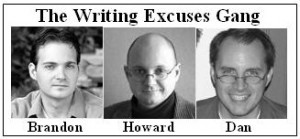
    John guests on Writing Excuses season 3 episode 19

    writing-excuses-the-guys2-300x139

    Here’s the third episode I recorded with the Writing Excuses guys.

    In the first podcast we talked about putting and not putting ourselves in our writing and making characters who don’t all sound like the author. In the second, we talked about how to not repeat yourself as an author. In this one, I shared some basics about generating emotion in readers and dealing with negative emotions writers face when they encounter rejection, compare their career with others, hit writer’s block, or hear someone didn’t like their story.

    As usual, the guys had some great insights. Check it out: Emotion in Fiction.

    Share
  • How to tell an author you don’t like their book

    Mette Harrison wrote a blog about how various authors respond when they read a book, don’t like it, and then the book’s author asks them directly what they thought of the book. 

    Here’s my response.

    As an author when I ask someone, especially another author, about their experience with my story, I’m looking for a data point to see how the book’s working or to get some insight. I realize others might be looking for validation. And, of course, I hope that everyone who reads my stuff finds nirvana even if I know that is not going to be the case. But I don’t ask unless I want data. And so I would hope they would report their experience accurately. I also hope they do it in friendly and helpful manner.

    So because that’s what I want, that’s what I try to do for others.  And the sandwich+ method has been one good way for me to do that.

    1. State something specific that works for me, e.g. “I love your character Bill because he’s so outrageous.”
     
    2. State the key thing that’s giving me trouble. For example, I might say, “I am having a hard time with the pacing.” But then I ALWAYS want to give the context of me as reader when it applies to my reaction, e.g. I’m a terribly impatient reader, I like to feel hope in what I read and know I don’t like as much despair as many other readers do, I can’t stand clowns (this is true: clowns are some of the scariest creatures out there, second only to crocodiles). The author should know these readerly things when they apply so the author can understand where the comments are coming from.

    If the book’s in pro shape and I think the issue is mostly my tastes, then it’s also useful to compare their work to another successful piece or author that had the same issue for me, e.g. “This reminds me of Twilight; I know people love it, but I just couldn’t get into that book either for the same reason.”

    I don’t think this is fluff. I think it’s part of being accurate. Our reality is what we focus on. And if I make a statement that leaves an author thinking I think the work is bad, then that’s not accurate because the truth is I think I’m not in the audience.

    If I think it’s a craft issue, then I highlight the main thing I think is causing the problem. A laundry list is usually useless. But thoughtful focus on the key issue can be very helpful. If I can’t tell whether it’s a taste issue or a craft issue, I admit it.

    3. State something else that’s working for me, e.g. “While I just couldn’t get past all those clowns freaking me out, I did think your chapter openers were compelling. I always wanted to read more, but then, alas, clowns.”

    4. The + is not just leaving statements hanging. Asking some sincere questions after demonstrates my genuine interest. And I am interested. If the book is unpublished, I might ask about their plans for the book, are they going to be doing another draft or shopping it, or if my reaction is common. If it’s published I might ask how it’s being received, what others are liking about it, and what’s next.  Maybe they tell me about another project they’re working on that sounds fascinating.

    This is what I’d want an author to do for me–be accurate, interested, and friendly. In such a context, someone having issues with a story is not such a big deal. It really isn’t.

    Share