Author: John Brown

  • |

    Update and Fage

    I passed the 90% mark today on SERVANT. It’s been wonderful going back through this story, remembering why I loved these characters so much. The cover too is coming along. I’m looking forward to revealing it in the near future. Right now everything looks like it will release on target, although that may change.

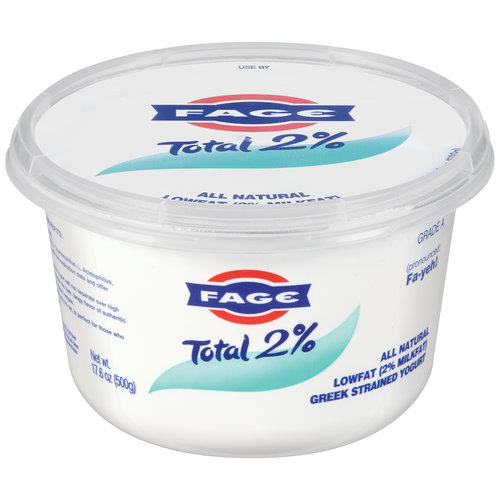
    While you’re here, you know I have been on a quest for delicious low-sugar yogurt for some time. I have found it at last. Behold.

    Fage 2 percent yogurt

    No Greek yogurt has a better taste or texture. And there’s no added sugar. Add some fruit and it’s heaven.

    It’s pronounced “fa-yeh.” Except, how do you pronounce that? Who comes up with product names nobody can pronounce? 

    But it doesn’t matter how you pronounce it. We luvs it, Precious.


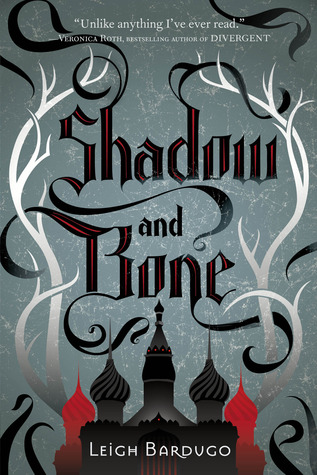
  • Shadow and Bone

    Last year someone recommended Shadow and Bone by Leigh Bardugo to me. I noted the recommendation and then promptly forgot it because my reading queue is two years long. But this last week my wife brought some books home from the library, and there, sitting on top, was Bardugo’s book.

    I opened it. Page one listed the orders of magic. I was immediately drawn to the names. They were Grisha, “soldiers of the second army, masters of the small science.” They had divisions of corporalki, etheralki, and materialki, who are the order of fabrikators.

    I don’t know what it is, but I love, not steampunk (well, I don’t know if I don’t love steampunk because I really haven’t read any, but I do think dirigibles are vastly overrated), but the mixture of machinists and engineers and magic set in the late 1800’s, the time period when Sherlock Holmes was running about. It’s something I can’t resist.

    And “fabrikators”? Russian? Oh, baby.

    Most epic fantasies are set in some kind of old German or English medieval setting. Nothing wrong with that. We luvs them, Precious. But something different is nice as well. Recently, Peter V. Brett and Saladin Ahmed have given us fantasies with a Middle Eastern flavor. But I haven’t read an epic fantasy with a Russian flair since C. J. Cherryh’s Rusalka series. And here on page one I’ve got magic and machinists and all these Russian sounding terms.

    Awesome.

    I turned the page. The opening paragraph of the prologue pulled me right in, and I was off and running, soaking up this little snippet about an orphaned boy and girl who, fast-forward in the next chapter, are now in the army. Not the second army that’s made up of Grisha, but the first army that’s made up of soldiers with rifles who have to slog through mud and march while a handful of Grisha of the second army roll by in a carriage.

    Alina, the girl who is now working with the army’s cartographers, and Mal, who is a tracker, are heading with the troops toward the Unsea, the Shadow Fold, this darkness that cuts the country in two and is full of these horrors called volcra. They enter the Shadow Fold, are attacked, and Alina unconsciously calls forth a powerful magic.

    Of course, she can’t reproduce it, but it’s a magic that might be used to banish the Fold forever. The rest of the book is about Alina avoiding assassination, trying to learn how to summon her magic, and being pulled into a surprising and terrible plot. It’s also about her and Mal. Yes, there’s a love story here, but this is NOT a romance where everything focuses on her feelings and his feelings and touches and sighs and unbounded quivering.

    This is an epic fantasy, remember? Those books that delight readers with dark lords and magic? Well, there’s plenty of that here, plus secrets and a number of delicious plot twists. There are escapes and chases and battles. And, yes, that love story that isn’t overblown but feels very real indeed.

    Epic fantasies come in lots of different sizes. This isn’t one of those huge doorstop epics with twenty sprawling plotlines. This focuses on one point of view and one storyline, which means you are able to enter the story very quickly, much like the epics by Hambly and McKinley and so many others.

    It’s a terrific read. Give it a go. If you enjoyed Vin in Brandon Sanderson’s Mistborn and Cinna and Katniss in Hunger Games, then I think you’re going to love Shadow and Bone. I’m certainly looking forward to the next volume.

  • Book Release Schedule

    The artists were the wild cards with my delivery schedule. Now that I’ve secured the artist for all three books I want to release this fall, I can finally give some target dates. Here’s the schedule:

    1. SERVANT (The Dark God book 1) — last week of September, 2013
    2. BAD PENNY (a Frank Shaw novel) — first week of October, 2013
    3. CURSE (The Dark God book 2) — first week of  November, 2013 (I’d like to make it Halloween for the fun of it, but we’ll see)
    4. AWFUL INTENT (a Frank Shaw novel) — June, 2014
    5. GLORY (The Dark God book 3) — March, 2015

    I want to get GLORY out sooner, but it’s going to be a big book, and I’m not going to rush the editing phase. I don’t want to release shoddy work. Furthermore, it’s almost the size of two normal 100,000k novels. I hope to significantly accelerate the schedules for both AWFUL INTENT and GLORY, but we’ll have to see if I can make the necessary arrangements.

    After GLORY, I will publish another Frank Shaw novel. And then I begin the LORD OF BONES epic fantasy series which is going to be structured differently that much of what’s out there. The concept excites me and allows me to take the story in all sorts of directions. It’s going to be a blast.

    Can’t wait to get these books out there and let them find their audience. Thanks to all of you who have hung with me, sending me emails or posting comments of support. It’s much appreciated!

    EDIT: I keep the release schedule up-to-date on the Calendar page.

  • NEWS: Cover Artist Selected for SERVANT and CURSE

    After reviewing almost 100 applications, we have selected an artist to do the covers for SERVANT and CURSE. His name is Giorgio Grecu Shards, and he lives in the UK. You can see his gallery here: http://shards.cghub.com/images/.

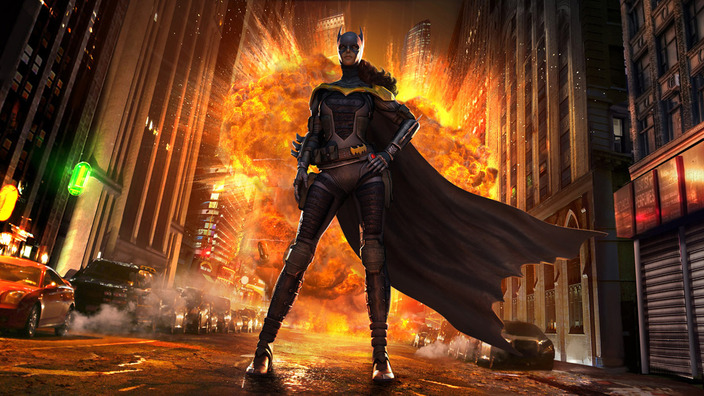
    Some of my favorite pieces of his include these. 

    BatGirl by Shards
    BatGirl by Shards

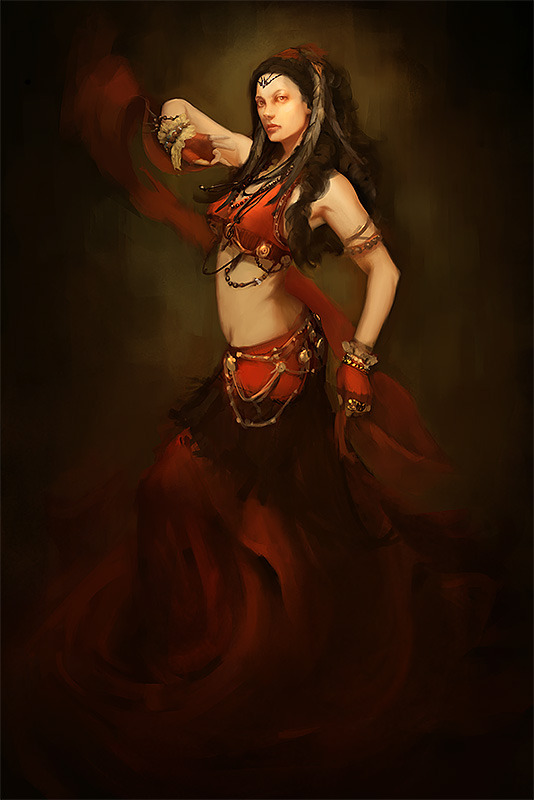
     And this

    Dancer by Shards
    Dancer by Shards

    There were quite a number of others who we gave serious consideration, including Shen Fei, ThuyNgan, Nusha Amini, and Nick Greenwood. In the end, we felt Giorgio could pull off the feel the best. We’re very excited to have made the selection and come to the agreement. Right now we’re targeting October-November for the release of both books. I’ll keep you posted as the cover art shapes up.

  • | |

    Teachers (and writers)! Free Class Next Monday on How to Teach Narrative for the Common Core

    If you feel a bit lost or anxious about how to teach narrative for the new core, especially stories, I think I can help.

    I’m an educator in the private sector and an award-winning novelist and short story writer. I’ve been teaching authors in various venues how to write for the last five years. I’ve been on writing podcasts with thousands of listeners, taught at a number of writers conventions, and had a series of articles published by the national Science Fiction and Fantasy Writers of America organization, an organization for professional authors. I’ve also been helping Nellie, my wonderful wife, teach her 7th and 8th grade language arts students the unit on short stories during that same period. We’ve taught it to twenty different classes and picked up a number of important insights along the way.

    This last year I couldn’t help but examine all the materials Nellie brought home during the district’s writing program adoption investigations. Some programs looked very promising; others not so much. Some got some things about writing flat out wrong. Most of the programs had gaps.

    Furthermore, because I work with so many people wanting to write, I know that it’s difficult to teach if you really don’t understand what stories really are and how they work. For lots of people, the subject matter can seem impenetrable. And yet writing stories is such a wonderful way to teach writing, especially because so many kids love it. You won’t find a kid who will spend extra hours writing a business letter or poem analysis, but you will find quite a few who will go crazy writing stories. And the whole time they’re practicing their writing skills.

    The question is how DO you write a story?

    What is a story?

    How can you tell if it’s good?

    How do you come up with ideas?

    Where do you start?

    And what the heck is this chart? Do writers really use this? (Not many that I know.)
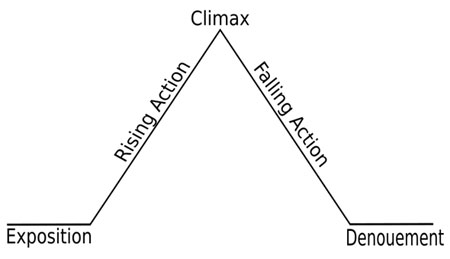
    Story Diagram plot-mountain-pic

    And does anyone think changing the diagram to look like Aspen, Colorado actually helps?
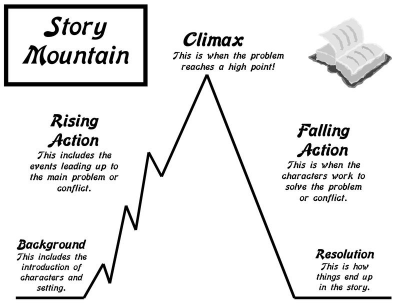
    Story Diagram Aspen 

    Hey, students—please make your story look like Aspen, Colorado!  (Yeah, that’s going to be effective.)

    And yet it’s not as difficult as it appears. Nellie and I have seen a lot of kids really get into writing stories. We’ve seen kids WILLINGLY going way beyond the assignment to write stories that are eight, twelve, twenty-five plus pages. And as they’re writing, they’re practicing grammar, spelling, structure, vocabulary, etc. without knowing it and having a great time. I know that if you enable your students, many of them will write, write, write. Especially in grade school. But also in the higher grades.

    Stories can be a blast. The assignments can connect to many students. And the results can be wonderful. I’ve laughed out loud at some of the stories coming out of Nellie’s class. Others have been enjoyable on other levels.

    But for this to work in your class, you need to know some key things. You need to understand the core of story and the story development process. You need a lesson plan that details everything step-by-step so your students don’t flounder. And you need to know some fundamental tips (secrets?) about teaching this content.

    So I’m going to hold this day-long class for you. A full eight hours. And share everything Nellie and I have learned. This class will be for teachers at ALL levels (I’ll show you some ways to scale the complexity of what you’re doing). There will be NO cost. The only thing you have to bring is a pencil, paper, whatever program materials you have, and a willingness to have a good time.

    When we finish, you will know how to write a simple story like the ones your students will write because, ta-dum, you will write one! AND you’ll have a step-by-step lesson plan that builds on whatever materials you have—an official program or one of your own. AND you’ll understand story better than 99% of the population. AND you’ll have a bundle of techniques to help your students. AND you’ll solve both world peace and maybe the lost sock conundrum.

    Truly, I think that instead of feeling stress, you’ll actually be looking forward to teaching and writing stories with your students. If not, you may bring tomatoes and huck them at me, but please be aware that I will not stand still; to find satisfaction, you will have to be able to hit a moving target.

    If you’re interested, just click the Contact John link under my photo in the left sidebar and send me an email letting me know.

    Hope to see you in class!

    GET READY FOR A FUN DAY OF LEARNING!

    Topic: Teaching writing (narrative & the common core)

    Who: Teachers (and writers at least 18 years old), seats are limited

    When: Monday, July 29th, 8:15 AM – 5:00 PM

    Where: Rich Middle School, 54 E 100 S  Laketown, UT 84038

    Materials you need to bring:

    • Pencil
    • Paper
    • The writing program you’ll be using this year
    • Kooky socks, for those who cannot resist the urge
    • A lunch or a way to get one

    AGENDA

    8:15 AM Arrive

    8:30 AM – 9:20 AM

    • Can you create a redneck crapper?
    • The 1st secret to teaching writing: Attributes & techniques
    • The 5 parts of story
    • Thieves prosper – using existing patterns
    • A car, a beggar, and an idiot — basic pattern 1

    9:30 AM – 10:20 AM

    • The 2nd secret to teaching writing: Do it with them
    • Technique: Sketch then draft
    • Workshop 1: Zombies and kisses
    • Technique: Zing hunting
    • Workshop 2: Hunt zing

    10:30 – 11:20

    • What makes a story big or small
    • Workshop 3: Select a right-sized THOM and character
    • Workshop 4: Select a Goal
    • Workshop 5: Make character sympathetic
    • Workshop 6: 3 tries
    • Workshop 7: Resolution

    LUNCH

    12:00 – 12:50

    • The 3rd secret to teaching writing: Cognitive modeling and the 6-step process
    • The 4th secret to teaching writing: Our tiny brains
    • Writing is telling: Narrative & description
    • Technique: Yes, SiR
    • Technique: Broad-brush + 1
    • Technique: The Pause

    1:00 – 1:50

    • The 5th secret to teaching writing: Have fun
    • Workshop 8: Write your story

    2:00  – 2:50

    • How the pros revise—concept, line, & copy
    • Workshop 9: Content edit
    • The 6th secret to teaching writing: Our brains are still tiny
    • Workshop 10: Line edit

    3:00 – 3:50

    • The 7th secret to teaching writing: The 3 grunts (responding to a story and grading)
    • Share stories
    • What the heck did we just do?

    4:00 – 4:50

    • How to adjust for grade level
    • Common core
    • Your program and lesson plan
    • Identify black holes
    • Wrap up & next steps