Author: John Brown

  • The Last Apprentice, Path Finder

    The Last Apprentice
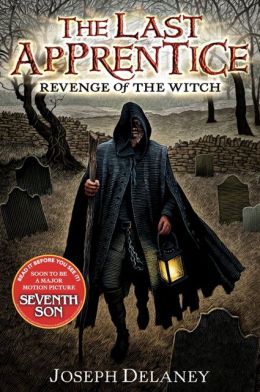
    Revenge of the Witch by Joseph DelaneyMy wife is always telling me I need to write a young adult or middle grade adventure series. One that’s directed at boys.

    Not because we have something against girls. We have four daughters, and my wife is adamantly pro-woman. But she finds very few books for her sixth-, seventh-, and eighth- grade male readers. I haven’t done a count, but I’m pretty sure that most YA is targeted at females. And this isn’t just me. I remember visiting a Barnes & Noble in Arizona with my voracious-reader nieces a few years ago and riding the escalator to the YA section. They told me that they called it the “girl-book section” because they figured that basically 90% of it was indeed for girls.

    Anyway, I think writing such an adventure would be a blast. I can already think of a number of near future or fantasy settings that would rock. But the time constraints I have right now just won’t allow me to start another series. Nevertheless, we sat down the other day and listed out all of the authors and books we knew that had a more male focus.

    For about the twentieth time she told me about Joseph Delaney’s The Last Apprentice series. It’s about a boy who apprenticed to the county Spook who is someone that takes care of witches, ghasts, ghosts, etc.  Her students love the stories. She loves them. She has bought the first ten volumes for her classroom. Why the heck wasn’t I reading them?

    Well, for starters, I just don’t like books about witches. And the first book in the series is called Revenge of the Witch. I don’t know what it is. Witches aren’t as bad a zombies–I am SO bored with zombies; I just don’t get the appeal. But even if they’re better than creatures that make no sense at all to me, I just don’t like spooky horror all that much. I loved to be scared, startled, and filled with dread. But not with witches.

    Witches? The gals with pointy hats?

    No.

    But this was, as I said, like the twentieth time she’d brought it up. We were driving over to Logan (that’s the big city for us), and stopped at the library, and we went over to the YA section. Unfortunately, they didn’t have volume one. But I did see many other volumes on the shelf and figured I needed to see what the competition was doing. So I perused. A few night later we went to her classroom, and there was volume one. The one about the witch.

    I sighed and opened it and began to read. And when I finished chapter one, I realized I kind of liked it. It was like the old Life cereal commercials—hey, Mikey!—and I wanted to read more. And so I took it home, read the whole book, and was delighted with the story. I liked it so much I promptly borrowed volume two, Curse of the Bane, from my wife’s classroom and read it as well. And I liked that one so much I checked out the third.

    The story is about Thomas Ward, the aforementioned apprentice. In book one, he is forced to face down some witches. But it’s Alice, the girl with pointy shoes, who made the story for me. Adding her as a character transformed it from a run-of-the-mill booger man story, into something special. No, I’m not going to give you a peek at the plot. Just know that this is the book where Thomas starts his apprentice, has to deal with that new life (and I thought Delaney captured that so well), and makes some apprentice mistakes that he then has to fix.

    In book two, we get to meet Alice and Thomas again, but this time they have to face down a different creature. And again, while the adventure is all cool, it’s the interactions with Alice that put it over the top.

    Having praised the books, I will say that I think Delaney has something against priests and religion in general because he paints it all with a negative broad brush. It’s too bad. Not only is such a view inaccurate, but showing the good and bad could add so many delicious dimensions to the tale. Maybe we’ll see that in later books. But even if we don’t, book two was still a great read.

    I’m looking forward to book three. If you’re in the mood to try something new, something about a young man and young girl that doesn’t revolve around romantic smoldering, something that a guy would like to read, let me recommend you join me in reading the volumes of The Last Apprentice.

    Pathfinder
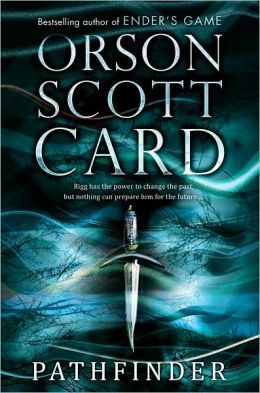
    Pathfinder by Orson Scott CardI was once in a discussion about religion with a friend who happens to be an atheist and fellow science fiction and fantasy writer. He’s a great guy. The blog posts he wrote about the passing of the woman he loved who was lost to cancer were poignant and wonderful–full of beauty. I read them and wanted to be a better man. Still, he and I disagree about God.

    I remember telling him that science fiction is the one genre that makes God more plausible than any other. At least, it makes my view of God more plausible.  Now, I do not want to talk religion in this essay. But it’s just hard for science fiction to leave the idea of creation and Adam and Eve alone. Witness the many stories over the years about these very things.

    Heck, even the recent movie Oblivion has references—are not Jack and Victoria much like Adam and Eve? Just think about it. Their paradise together as a team, the knowledge, the fall. The echoes are simply marvelous.

    Well, I just read another science fiction tale that provided a wonderful opportunity to think about these things. It’s Orson Scott Card’s novel Pathfinder. Now, the story isn’t about God. It’s not a biblical allegory. It’s not dressed-up doctrine. It’s a tale about a boy named Rigg with special abilities on a quest to find his real family and who he is. Along the way we meet some interesting people, especially one character named Loaf who leavened the whole tale. So there’s an interesting adventure and speculations about faster-than-light travel. But one of the chief delights for me was the questions and ideas this story raised in my mind about the creation of our own world—“Garden,” the name of the world, just begged for it.

    For example, a long-time staple of science fiction is the idea of terraforming—changing face of the flora, fauna, atmosphere, and climate of the planet to be hospitable to your species. If you believe in a God that is more a being of advanced technology than one of unknowable fantasy, doesn’t that present a new and interesting way of viewing the creation story? It does for me, and Pathfinder sparked ideas about this.

    The book also led me to think about life. First, Card has these characters called “Expendables.” They’re robots, but not really. They’re artificial intelligence. But not really. The way Card presents the expendables, you don’t think of silicon and steel and gears. You think of biology.

    You think of mosquitoes.

    You think about the fact that if we humans use intelligent machines, surely God must use intelligent machinery. So what kind of intelligent machinery does God employ? (Dude, that idea is just pregnant with stories!)

    Are viruses and bacteria machines? Are mosquitoes and beetles (please, let there be no mosquitoes in heaven)?

    The book prompts me to wonder. It prompts me to look at the life about me on our wonderful world with new eyes. It prompts me to think differently about some of my core definitions. In fact, there are some exchanges between a character and an expendable where they talk about the difference between humans and expendables and the definition of what it means to be human, especially given evolution.

    This is a book about an adventure, but also a book about ideas, which is as it should be. Science fiction is the one genre, more than any other, that marries character and plot with exploration of ideas. If you’re looking for an interesting tale that will make you think about our world differently, give Pathfinder a try.

  • NEWS: Finished line edit of Servant

    It took me 33 hours, but I just finished reading through SERVANT and marking the manuscript up with the line edits I need to make.

    Holy smokes, folks, but it’s going to be a bigger edit than I originally thought. I knew I wanted to resequence chapters 1-8 back to the way I originally intended them. I knew there were some typos. And I knew I needed to add some content surrounding Purity’s story. But as I read I found that I was making line edits on almost every page.  For those unfamiliar with the term, you have basically four edits.

    • Content or story edit
    • Line edit
    • Copy edit
    • Proof edit

    The story edit is just what it says: you’re looking at plot and character. In this edit, you might add or cut whole chapters or story lines.

    Once the story is good, you do a line edit. In this edit you’re looking for how well the actual words on the page flow. You’re looking for parts where what you’re trying to say isn’t clear, where sentences or paragraphs are awkward, or where you haven’t been consistent. In this edit, you rewrite sentences and paragraphs. 

    Next, there’s the copy edit. Back in the old days, you had essentially three versions of the work. You had the original manuscript, which might go through many edits for the story and flow. Once it was good, the manuscript would be given to an editor who created a “copy” that could be used by the typesetters.  Of course, before you handed that over to the folks setting the type, you wanted to make sure it was clean because making changes in type is a pain in the butt. So in this edit, you’d go over it one more time, looking for typos and grammar issues. At this level, you fix words within sentences, although many times this edit will be combined with a line edit.

    Finally, there’s the proof edit. A proof was a copy of the work that had been set into type and printed. The typesetters would look at the their typesetters copy and then physically take metal sorts and mount them in a press to match it. To print it, they would ink the sorts and make an impression onto blank paper. That’s how stuff was printed. 

    Nowadays, you don’t need to manually set the type–you just print directly from document on your computer.  So you don’t have to worry about errors introduced into the text because of the typesetting. However, as many writers will attest, you simply do not see things on the computer screen that are obvious on the printed page. And so you always want to print out a proof and then edit it one last time for any errors in formatting or for small copy or line edits.

    So this last read was more or less a line edit. I did make some content-sized changes. And I did mark it up for typos and grammar stuff. But the bulk of the changes were line-level stuff, and I have to say I’m amazed at how many there are. I guess this simply means I’ve grown as a writer. But it is going to take some time to finish. I’ll then give the manuscript to my wife who is great with copy editing. And do another revision.

    I have to say I enjoyed reading the stories of Talen, Sugar, Argoth, and Hunger again. Some of the events had dimmed with time, and I was delighted to read them again. Parts of this book just make me so happy. With a couple of them I was all, dang, this story is awesome!

    ***

    Still working on the cover design for the Dark God books. Hope to finalize the basic structure this week and commission an artist. I’ll post the process and get your feedback as we go.

  • NEWS: The Man is going all indie for the next little while

    After discussions with my agent and a few others, I’ve decided NOT to shop BAD PENNY to New York publishers. In fact, I’ve decided I’m not going to be shopping anything to NY for the next 12 – 18 months.

    My agent was certainly willing to take the property out, but given the average expected advance for thrillers ($15-20k per book; maybe up to $100k for three books) and the terms that NY currently wants, I thought that it might be worth it to try to build something on my own.

    I do not hold the illusions some do about indie publishing (I probably hold others). For example, I know quite a few authors who have published indie and are selling very low numbers each month–single digits and teens. Of course, I know others, a smaller portion, who are selling just fine.

    But then what’s the bar? How many copies do I have to sell on my own over a three to five year period to match what NY can do for me via brick and mortar?

    Let’s look at that from a revenue and a unit perspective.

    The average advance for a fantasy, according to Tobias Buckell’s survey, is about $7,000 for a new author. $12,000 for an established author. We saw the numbers I gathered for thrillers above.

    So lets see how many copies I’d have to sell indie style to earn as much as I’d get in an advance from New York.  Why not select a higher number? Well, my understanding is that most books don’t earn out their advance. That doesn’t mean the publisher doesn’t make money; just that a publisher’s profit isn’t dependent on an author earning out.

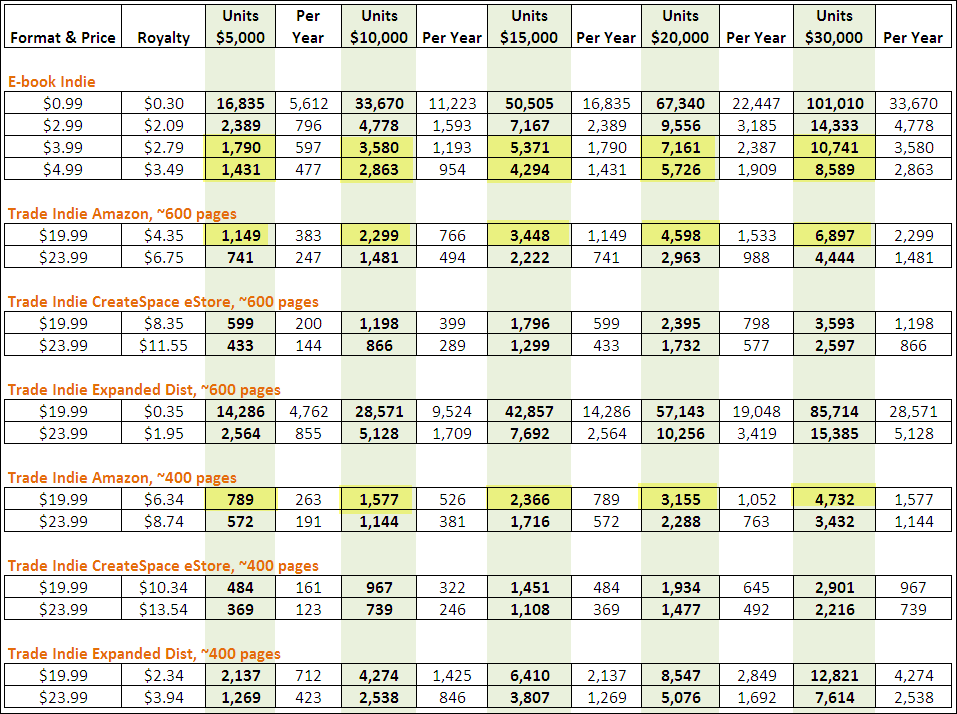
    So what are the numbers? Well, here are the numbers for NY. Down the first column you’ll see the different formats. Across the rows you’ll see how many units I’d have to sell to make the advance specified at the top. And how many units I’d have to sell if I wanted to spread the total over three years.

    IndieNYComparisonNYNumbers

    Okay, and here’s what I’d have to sell if I went indie to make the same numbers. I put in the trade paperback format for both 600 and 400 pages because that’s about how big SERVANT and BAD PENNY are going to be.

    IndieNYComparisonIndieNumbers


    What does this tell me?

    It tells me I have to sell a heck of a lot more units with NY at a much higher price than I do indie.  It tells me that a $5,000 advance is not even close to being worth the control I lose with NY.  And if it’s true that most books don’t earn out, then it tells me the units that are being sold by NY on the average book.

    Back in 2009 I shared this: How Many Copies Do Average Authors Sell? This was from an editor at Tor Books. Seems like my numbers are in the ball park.

    It’s true that NY could get me into brick and mortar stores. But if the book gets shelved spine out in the back, how many people will discover it?

    It’s true that NY produces some spectacular hits. I looked at the USA Today bestseller list yesterday and it appears only about 10% of the books there this week are indies. But I can’t bank on becoming a NY wonder. The vast majority of NY published books DON’T make the bestseller lists.

    Finally, even if I sold BAD PENNY today, it still wouldn’t hit shelves for probably 12-18 months from now. And then it would only stay on the shelves for 12-18 weeks. Going indie, I will have it up by September. And it will stay. For years and years and years.

    There’s no guarantee of success either way. But the indie numbers look good to me. We’ll see how it goes.

  • NEWS: Book Updates

    I finished draft three of BAD PENNY last week and have updated the progress bars.

    I’ve given the book to my agent, but because there are some contract terms that I’m unwilling to sign going forward, I need to make sure she’s comfortable representing me on it. I don’t want her doing a lot of work and bringing back what she thinks is a good deal only to have me refuse it. I’d rather discuss these up front and make sure we’re both on the same page. I hope to have her response back this week.

    I am now turning my focus to SERVANT and CURSE. I need to re-read both of them and then write up an outline of what I need to revise. I hope to finish SERVANT in June and CURSE in July. I’ll post my progress on the side bars as I go.

    The cover artist I’d hoped to use for both of these is unavailable at this time, dang it! So I’m currently reviewing candidates. If you know of an up-and-coming artist who you think would be good, click on the Contact Me link under my photo in the sidebar or post it in the comments.

  • Slides for my LDStorymakers Presentations

    I loved attending the LDStorymakers conference this year. It was awesome, fun. I chatted with old friends and met new ones.  Got (stole) a great story idea from Donald Carey, the Conference King. Enjoyed Provo–love the weather down there this time of year! Attended some great presentations on writing. Gave some that seemed to help a number of folks. It’s a special delight to deliver a presentation that both entertains and helps. Furthermore, my family came down with me. So I got to hang out with them in the evenings. My daughters sneaked into the mass booksigning and got autographs from some of their favorite authors.  They were giddy with delight.

    It was bliss.

    I also worked with Isaac Stewart on a mock up of the new cover for SERVANT, and dude. DUDE.  If we can swing it, the covers for the Blacksword Books version are going to rock.

    Anyway, I promised many people I would post my presentation slides here. Here they are in PDF format:

    Vivid and Clear

    Story Turns

    And for those of you in the Story Turns class wanting that fine car chase clip, here it is!