Blather

  • | |

    30 books you should read before you die

    An avid reader friend of mine began reading through the books in a list called “100 books you must read before you die.”

    She got to Jack Kerouac’s On The Road and went to Facebook and posted the following: “I don’t get the appeal. It’s about a group of boys/men who are irresponsible, drunks, whoring around taking advantage of others and being enabled by their women. Why is this a classic and why should I have wasted my time on it? Can some of my literary friends explain? I hated a brave new world and the handmaid’s tale too.”

    Is the book a classic?

    Should she read it before she dies?

    Is it really that important?

    Let me share an edited version of my response and then provide my list of 30 books you should read before you die.

    *

    Annette, the unfortunate truth is that these lists of “classics” are a sham because there is no objective criteria for determining literary excellence.

    Or maybe I should say that measuring quality in the arts isn’t like measuring the unambiguous, objective score of a baseball game. After books exhibit a certain level of proficiency, it becomes increasingly difficult to distinguish the quality of one book from another, especially because much of this depends on a reader’s interests and subjective experience of the story.

    When it becomes hard to rank performances, people rely on other measures. One of the most powerful is social networks.

    So if two readers find two different books that blow them away, one of the books might get all the attention because the one book gets picked up by a news service (The New York Times) or a platform (the Oprah Book Club effect) or some other social network of influence. A lot of the so-called literary classics only appear on various lists because they tapped into the academic network, which kept them alive far longer than they would have lasted otherwise.

    On The Road is simply a book that made a stir among some circles in the 1950s. That’s it.

    Was it more important or of higher quality than Exodus? The Chronicles of Narnia? Lord of the Rings? A Town Like Alice? All published in the 1950s as well.

    It depends.

    If you’re wanting to understand the 1950s beat culture, it would be an important book.

    But if you’re wanting to understand fantasy writing of the time, it wouldn’t.

    If you’re wanting to read a book that’s had a huge impact on popular culture, well, LOTR beats On The Road like a dog.

    Some people have the feeling that the so-called classics have some inherent medicinal value because someone put them on a list and called them classics.

    Nope. They’re just stories. Some of which can shed light on the issues and interests of a part of the culture in a given period. But if you’re not interested in that specific sub-culture, who cares?

    And if you’re reading to be entertained, moved, uplifted, or educated—which ones do that best for Annette is for you to decide.

    So all that to say I wouldn’t devalue your reaction to the book ?

    *

    I’m now going to give you my list.

    But it’s not going to be a list of titles. Nor will it focus on a book’s impact on some sub-culture of a given period.

    It’s going to be a real list. One that focuses on what so many of us go to stories for.
    1. The one that makes you weep.
    2. The one that makes you giggle and snort.
    3. The one that reminds you of what it’s like to fall in love.
    4. The one that gives you hope.
    5. The one that you begin to read more and more slowly because you don’t want it to end.
    6. The one that scares the soup out of you.
    7. The one that you can’t put down, even though you need to wake up early in the morning.
    8. The one that makes you wish you lived there.
    9. The one that’s so good that when you close it, you immediately start to read it a second time.
    10. The one that gives you and your child hours of pleasure together.
    11. The one that gives you a sacred, spiritual experience.
    12. The one that makes you reread some of the lines because the turns of phrase are just so delicious.
    13. The one that gives you courage.
    14. The one that takes you on an awesome adventure.
    15. The one that makes you want to be a better person.
    16. The one that bores you to tears (just so know you how good the others are).
    17. The one that introduces you to a different culture that delights you.
    18. The one that makes you think.
    19. The one that lingers with you for days.
    20. The one that gives you lovely insights.
    21. The one that inspires you to love your spouse more.
    22. The one that introduces you to the sorts of people you normally don’t like and makes you actually like them.
    23. The one that delights you with its characters.
    24. The one that whisks you away to a different historical period.
    25. The one that inspires you to give your children a hug.
    26. The one that gets your adrenaline pumping.
    27. The one that sparks all sorts of ideas in your head.
    28. The one that makes you wonder and start imagining what it would be like to be there.
    29. The one that blows your freaking mind.
    30. The one that makes you stand up in your living room and cheer.

    We could do more than 30, couldn’t we?

    Like the one that makes you think people from a different time period are just like us. And the one that makes you think people from that same period are completely alien.

    But I think we’ll stop. That there above is a list.

    Those are 30 books I think everyone will want to read before they die.
  • Gun Runner wins Dragon Award

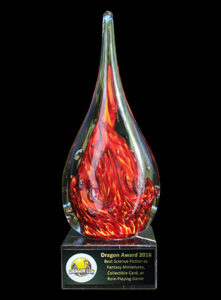
    I was very happy to receive news that GUN RUNNER, the novel Larry Correia and I wrote together, just won the 2021 Dragon Award for Best Military Science Fiction or Fantasy Novel.

    The Dragon Awards are a set of literary and media awards presented annually by Dragon Con in Atlanta, Georgia for excellence in various categories of science fiction, fantasy, and horror novels, movies, television, and games.

    And the cool thing is that these awards are voted on by fandom, meaning thousands and thousands of folks voted.

    Past winners have included authors such as Terry Pratchett, Brandon Sanderson, Rick Riordan, and Stephen King.

    As stated in earlier posts, the seed came from Larry’s eleven-year-old son, Joe.

    When Larry and I sat down to develop an idea for a workshop we were holding for Life, the Universe and Everything, a large annual writer’s conference in Provo, a number of years ago, Joe was listening in on the stairs.

    We settled on a genre, and then Correia asked, “Hey Joe, what’s cool?”

    Joe immediately popped up and said, “Giant robots, bandits, and murderers.”

    “We looked at each other and said, ‘Dang, that IS cool.’”

    Forty minutes later we had the key elements we needed for the story we’d use in the workshop. A number of years after that workshop, Baen Books wanted a collaboration from Larry, and that story was one of the first he thought of.

    Larry and I are both frequently asked to present at writers conferences. And one of the tips each of us shares to new authors is to loosen up and have fun. One of the keys to writing an entertaining story is to simply ask, “What’s cool?” And go from there.

    I’m thrilled and honored that those who voted selected Gun Runner for this award.

  • Gun Runner a finalist for the Dragon Award

    I’m happy to report that GUN RUNNER, the science fiction, action adventure novel that Larry Correia and I wrote, is a finalist for this year’s Dragon Award for Best Military Science Fiction or Fantasy Novel.

    The award is part of Dragon Con, the massive multimedia convention held annually in Atlanta, Georgia. The winners will be announced at the con which takes place over Labor Day weekend.

    Lots of great books on the list.

    You can see all the finalists here .

  • Good Stuff! Two fun family and party games

    There’s nothing quite like the laughter and fun a good family or party game creates. And we discovered two games this summer that have brought hours of pleasure.

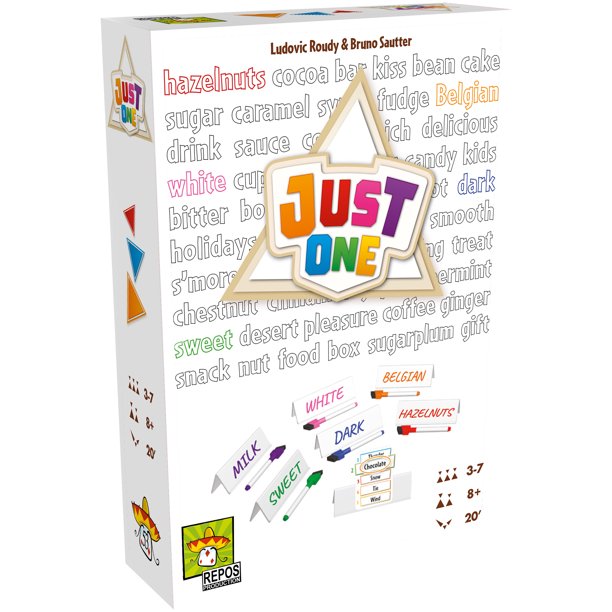
    The first is Just One. It’s for 3 to 7 players and takes about 20 minutes to finish.

    Now, I was skeptical of this game at first because it’s a cooperative party game.

    I mean, come on. Cooperation?

    No teams?

    No competition?

    What were we going to do—hold hands and sing Kumbaya?

    I was fully expecting to be bored out of my mind. Boy, was I wrong. There was suspense, laughter, and loads of fun.

    There are 13 rounds in each game. In each round, one player blindly selects the number of a word on one of the game cards. The other players each write a one word clue to help that player guess the word. However, if two or more players write down the same word, they have to remove that clue.

    So you’re trying to come up with one-word clues the others won’t that still help the guessing player. Some clues lead the guessing player off onto funny tangents. Others are just funny. And then there’s the suspense of whether someone else wrote your word and whether the player will be able to guess it from the clues that are left.

    Your goal is to guess all 13 words selected. And there’s a little score card that ranks what it means if you get 13, 12, 11, etc.

    As an aside, it’s crazy to me that the score card provided motivation. But it did. It was a delightful little brain hack.

    One Word is a quick, fun game. We’ve played it with a few as 3 and as many 8 players and had a ball each time. We are so happy to have it in the family game closet.

    The next is Fish Bowl. It’s for 4+ players. What this game does is take favorites like Taboo, One Word, and charades and mixes them together in a competitive game between two teams.

    Here’s how you play it. Each person writes up 5 to 7 different words or phrases on separate slips of paper, folds the papers, and puts them in a bowl. Then you do 3 rounds.

    Round 1 is like Taboo, where you can describe, but can’t say or act out the word or phrase on the paper. You select a team to go first. One person on the team selects the papers from the bowl and then tries to describe the word or phrase. The team has 30-45 seconds (you decide) to guess as many of the words as possible. When the time is up, it’s the other team’s turn. Back and forth you go, selecting a new team member each turn to give the clues, until there are no more slips of paper in the bowl. Then you count the number of slips each team got and move to round 2.

    In round two, you put all of the slips of paper back into the bowl. The team that went second in the first round starts this one. This time the person giving clues gets to share one word. That’s it. And the team has to guess it. Again, the team has 30-45 seconds to guess as many as they can.  Then it goes to the next team. And you switch back and forth just like you did in round 1, and when the slips of paper are gone, each team counts up their score.

    In round 3, you put all of the slips of paper back into the bowl. The time the person giving the clues has to act them out. No words allowed. You run this round just like you did the first two with  30-45  second turns, switching back and forth between the teams until all the papers are gone. At that point, the teams  total their scores for this round and then for all 3 rounds together to see which team won.

    If you don’t want to use paper, you can play a version online.

    Either way, it’s another fast, fun game. In fact, we played it last night. And laughed and laughed when one daughter was trying to get the other to guess “sling” and nailed her teammate in the head trying to act out a rock hitting Goliath.   Movies are great. But sometimes what you need is some delightful game fun. And I’m betting you’ll love these.

  • Good Stuff! Factfulness by Hans Rosling

    Are things really bad as they seem on the news?

    Are they getting worse?

    Do we actually have an accurate picture of what’s going on in the world?

    The answer is no. Not even close.

    The normal American’s view is completely skewed. And negative. And that’s because the news is prone to be overly dramatic.

    We think we’re learning what’s going on by watching the news, but we actually getting an incredibly skewed view. And that view is wrong.

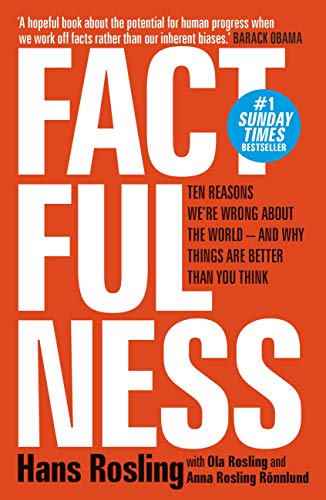
    In his book Factfulness: Ten Reasons We’re Wrong About the World and Why Things Are Better Than You Think, Hans Rosling identifies a number of things we get wrong, but also the 10 reasons why, and how to avoid our tendencies to skew the data.  

    It’s a fascinating book.

    For example, Rosling wanted to see how well we understand the scientific projections of how our population will grow. After all, a lot of people think we’re headed for an overpopulation nightmare.

    In 1950 there were fewer than one billion children (aged 0-14) in the world. By 2000 there were almost two billion. How many do UN experts think there will be in 2100?

    1. 4 billion
    2. 3 billion
    3. 2 billion

    What do you think the right answer is?

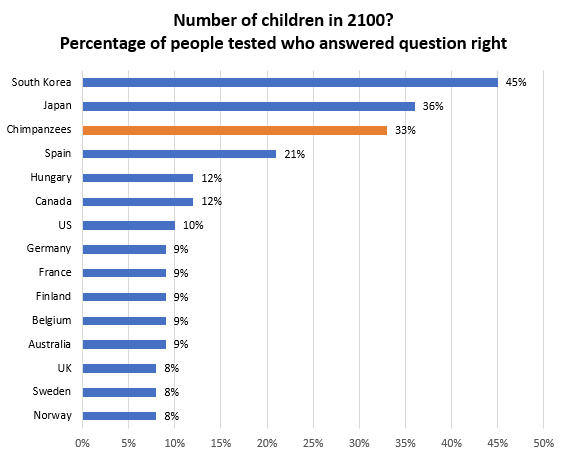
    If a bunch of chimpanzees had to answer the question above, each would choose an answer randomly. And 33% of them would get it right.

    But when you ask humans the question, most of them get it wrong. Most of them, in fact, do worse than the chimpanzees. It’s not even close.

    Rosling asked 12,000 people in 14 countries were asked this question, among others. Here’s how many got it right in various countries.

    To be clear, no chimps were tested. That bar is in there just for comparison. But if they were, that’s how they’d do.

    So how is it possible that humans do so spectacularly worse than the chimpanzees?

    It’s not because chimps are secretly studying world population stats and hatching schemes. It’s because we humans think we know something, but, in reality, what we think we know is wrong.

    And in this case, we think they know that the population is going to keep growing and growing and growing.

    But it’s not.

    The right answer above is C—there are 2 billion children now, and there will be 2 billion in 2100.

    The world has hit the peak number of children it will ever have at any time.

    There are around 6 billion people on the earth today. As those 2 billion children get older, the UN experts project the total population to fill out and grow to 11 billion in 2100 and then level off.

     That means there is no overpopulation nightmare on the horizon.

    Can this be true?

    Read Rosling’s book.

    Well, what about literacy levels? Poverty? Racism? Wars?

    And what about the news—don’t we see the world going to pieces every night?

    If you want an eye-opening experience, read Rosling’s book. He delivers all the insights with clarity, expertise, and humor.

    Best of all, when you’re done, you’ll have a set of tools to help you correct the picture.

    And while you’re waiting for the book, why not watch Rosling in action in this TED talk where he shows the data on population.