I’m happy to report that GUN RUNNER, the science fiction, action adventure novel that Larry Correia and I wrote, is a finalist for this year’s Dragon Award for Best Military Science Fiction or Fantasy Novel.
The award is part of Dragon Con, the massive multimedia convention held annually in Atlanta, Georgia. The winners will be announced at the con which takes place over Labor Day weekend.
In The Business Rusch: Generational Divide Kris Rusch points out that the new on-demand and long-tail market for books has changed the duration of the opportunity a book has to be successful, but that it seems the industry still isn’t recognizing this in how they measure success.
The problems come from the fact that those of us who run things—people in our forties, fifties, and sixties—use metrics that were developed by our parents for their world, that tightly controlled Mad Men world where everyone was expected to be the same, not just in what they wore or bought but in what they listened to or watched or read as well.
They only want new books, and then only at the time of release.
Brick and mortar bookstores?
They only have room for the latest releases, and then only the ones that are the most popular with their customers (whoever those folks might be).
Books have come late to this fight. Books have been available on demand for only about four years now, in the U.S. In other countries, there’s been even less time.
And we’re all still fighting over meaningless metrics, to use Mike Briggs’ term, because those metrics only measure things that were important around the water cooler, not things which are important now.
What’s important now?
She goes on to say:
The publishing industry isn’t even talking about new metrics. That idea hasn’t occurred to traditional publishing, and indie (or self) published writers are constantly seeking validation from the old system—trying to figure out ways to game the bestseller lists or to get a fantastic review from somewhere that has old-world prestige . . . But at some point, traditional publishers are going to have to develop new ways to figure out which products sell well and which ones don’t. All of their systems—from sales figures (which measure books shipped not books sold) to bestseller lists to critical acclaim—are based on the old models.
Kris is a very experienced with publishing, but her last point conflates internal accounting with marketing. Publishers DO know which products sell.
The primary measure of success in a financial enterprise s not new. It’s been around for 100’s of years. And on demand and long-tail markets don’t change it.
The measure is how much a product or service contributes in profit to the bottom line. You take revenues, minus expenses, and that’s the contribution that product (a book in this instance) makes to your total profit. Or to covering your fixed costs.
Booksellers have measured the success of their books with actual or estimated profits for quite some time. Publishers already know which books sell well and which don’t. No accountant in the world is going to report books shipped as the measure of success. And they don’t. The very fact that publishers have a profit and loss statement and show returns on royalty statements demonstrate that. They look very closely at actual and estimated profits. And to they do this by channel, which is reflected in a small way when they break out ebooks on royalty reports. This is all basic accounting.
Here’s an example. Until Ender’s Game the movie, Ender’s Game the book hadn’t appeared on any best seller list since it was first released. And its release was 30 years ago! Yet over the years Tom Doherty touted its sales numbers many times. Tom knew that book was gold. Of course, he did. Because he doesn’t use best seller lists to tell him what’s selling well. He knows those lists are marketing devices. He has the real data in house. Why would he need a list to tell him anything?
And Tom isn’t going to use books shipped either. Tor may report those numbers to Publishers Weekly for marketing purposes, but he will always multiply that number by an expected return rate to estimate sales. He wants to do that. Because books shipped is meaningless to the bottom line and everyone knows it, including the auditors.
Publishers are well aware of the long tail. They see it with books that have been rotated out of the brick and mortar channels but are still selling in the online ones. They report it in their annual statements. They know the online channels work differently from the brick & mortar ones.
The measure of success is still the same as it ever was—how much profit is this property contributing to our bottom line?
Marketing, however, is a whole other ball of wax.
What the long tail and on-demand allow are marketing campaigns that are impossible in the brick & mortar channel. In brick & mortar you have a limited time to advertise (roughly 8-15 weeks). After that period, most books are rotated out of the store. This means that any marketing for those brick & mortar buyers MUST coincide with the period when the books are in the stores.
But the online channels open up all sorts of other opportunities. You can market forever. And the contribution margin is always positive. The online and POD costs are easily recouped with each sale. (Publishers are well aware of this profit potential; this is why we have so many making grabs for backlists.)
And I see publishers taking advantage of these new marketing methods. This last week I saw publisher books not currently stocked by brick & mortar retailers on BookBub, BargainBooksy, and Book Sends. And the industry isn’t totally focused on new books for reviews. I just had a large newspaper agree to look at my book that was published four months ago. Still, Rusch is right when she says that the publishers haven’t adapted one of their biggest marketing tools to take advantage of the new opportunities–they haven’t done anything with the best seller lists.
Amazon has lead the way in creating new ways of marketing books to different types of readers with their best seller lists. These lists create the excitement of discovery.
But every one else is still reporting weekly sales on the big lists.
If I were a publisher, I’d be asking USA Today to provide more than just the weekly view of the top 150 books. And USA Today is THE list to watch because their numbers are not based on units shipped to a sample of stores, but actual sales. Here are some lists that readers would be interested in.
Most anticipated this week: based on pre-order totals
Most anticipated this month: based on pre-order totals
Hot new releases: based on weekly numbers
Hot new releases for the month: based on monthly numbers
Books with legs: last 3 months; I know it needs a different name (grin)
Best sellers of the last 12 months: annual total of units sold
Best sellers of the last 18 months: total units
Contenders: for each of the lists above show the next 150 books (I always want to see the next 100 books after the top 100 on Amazon’s lists; why not show readers the top 300?)
Movers: for each of the lists above show those that have the biggest rise in percentage sales and meet some unit minimum (you don’t want to feature books with 2,000% increase because they went from selling 1 unit to 20), even if they don’t break the best seller lists
Genre: allow all of this to be sliced by genre.
Let the reader select the view they want to see!
Avid readers will gravitate towards the shorter time periods. Those that read fewer books will gravitate towards the longer periods. Everyone who wants to discover something new will go to the contender and mover lists.
This is about marketing. Not publishers measuring success.
And then armed with those numbers guess what the publishers will do? They will go back to the brick & mortar venues and pitch to have some of these same books carried in the stores for the first time (some publisher books are printed digital first) or carried again.
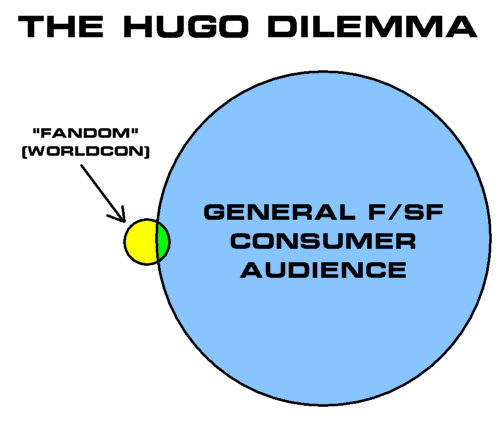
There are a number of great science fiction and fantasy authors who feel that the Hugo awards have become irrelevant because the folks voting–only those who are members of Worldcon–do not represent science fiction and fantasy fandom.
But this is not only about the fact that the voting block is not a statistically valid sample of fandom. It’s also a campaign against what Larry, Brad, and many others see as a politically correct shibboleth in parts of the publishing community that they feel short shrifts authors who do not toe the liberal political line.
Two years ago, Larry Correia decided to give this issue a lot of attention. He did this by asking his fans to purchase a Worldcon membership and then consider a list of authors he thought were very good but didn’t necessarily reflect the prevailing values of the traditional Worldcon audience. Last year he repeated the effort and created a shirt-storm (I like that image so much better than the one that includes flying poops). This year, Brad is carrying the banner. Read Larry’s post Sad Puppies 3: The Slatening? to see this year’s slate of alternative folks and a summary of why these guys are doing this.
I’m friends with Larry and Brad. And I do not like the Should Police coming out and telling me I should or must include more X in my stories and less of Y, whatever that X and Y may be.
But, I’m wondering if storming the Hugos is the right way to do this.
Yes, the Hugo award has a lot of brand equity. But must the Hugo represent fandom?
Is Sad Puppies attempting to storm the castle and force upon Worldcon something Worldcon members don’t care for?
Let’s go back to the original issue that Sad Puppies is trying to shine a light on.
Reader Kim wants more of X and less of Y in his or her books.
But instead of saying, “Geez, where in the crap do I find books with more of X and less of Y?”
Instead of trying to get with a bunch of folks and saying to suppliers, “Hey if someone would write more of X and less of Y, we’d buy it! Look at this market that’s dying for product!”
Instead of developing the More X and Less Y website dedicated to helping readers who like that find their books.
Instead of that, Kim says, “Gosh darn it! All books should have more X and less of Y. And if they don’t, they’re, they’re, they’re bad, and bad for you, and probably make kids smoke! And we should make all stories conform.”
And the mandated “should” is where things get all tangled up. That should is what Sad Puppies is speaking out against.
So instead of trying to stomp out differing opinions or requiring all authors to write stories with some allotted amount of XY content, would it not be more productive to simply work with our wonderful free market to try to create a new silk road (or pave the existing one fit only for camels) that connects readers who like XY stories with authors who are happy to write them?
I think it would.
At the same time, this same argument could be applied to the Hugos. Instead of trying to force Worldcon members to change their ways, why not let them like the stories they like, but create a fresh new award that seeks a broader base? It would require work to build its brand equity, but maybe that’s a more effective long-term strategy.
It’s kind of like the New York Times best seller list. There are many problems with that list, including, but not limited to, the fact that it can be gamed. But instead of trying to change it, USA Today came up with something much better. Yes, “NY Times Best Seller!” still has huge brand equity. But USA Today is gaining on it. And as the market learns more and more about the difference between the lists, USA Today’s will only grow in luster.
I suppose it’s true that you sometimes do indeed need to storm the castle. And maybe this one needed some barbarians to show up and sack it. But I wonder if it’s time to pivot. I’m wondering if in this case the best long-term strategy wouldn’t be to simply build an armored division of M1-Abrams with air and sea support and make the castle irrelevant. Maybe this is something to think about for next year.
I think this was taken when someone stole the ILOH’s Cheetoes
Seven days.
San Diego, Phoenix, and a wild trip through Wyoming, around Denver, and back to Utah.
Seven days.
Five nights.
In Arizona, I was told by a wild-eyed denizen of the Barnes & Noble we were signing at that my epic fantasy book was true–we are ruled by lizard people!
Imagine how shocking it was to learn that. I mean it doesn’t have anything to do with my book, but lizard people? A hollow earth? Is the CIA in on it? I don’t think I’ve recovered yet.
In San Diego, we rode around with Dave Farland in his old four-door sedan. A Lincoln? All I remember is that it was big and floated like a dream. After some narrow misses, Dave asked me to drive. Two big guys up front. One older, rough-looking guy being chauffeured in the back. At one point we walked to a restaurant during the day like some made man and his two goons. The restaurant was empty except for three rough characters sitting around a table on the far side. They looked at us, sized us up, then looked away. We sat at a table on our side.
In Wyoming we drove in high winds that sent streams of snow across the highway like multitudes of slithering snakes. At one point we passed one semi that was on fire, winds howling about. About an hour later, we passed a truck driver out in the median, thigh-deep in snow, a huge knife in his hand. He was trying to saw off the frozen antlers of an elk that had been hit. I looked up at his rig as we passed and did not see anyone behind the wheel. I swear the thing was rolling slowly down the highway, unmanned.
On the way back from Denver, we rode along a wintery, icy highway with trucks and cars littering the sides. Larry white-knuckled the steering wheel, but we made it. Two big guys, one 6’4″ the other 6’2″, in a tiny Ford Focus.
Did the very road fear the Lord of Hate? I cannot tell.
On this trip, Larry, that man of hate, brought a bag of Walmart beef jerky that smelled like, well, a particular kind of flatulence. What kind of person does that to beef? But we ate it. Because you do such things on epic journeys.
Now, here’s the thing. If you spend any amount of time with me, you will eventually tell me your life story.
You will.
Not because I’m a prier. But because I’m simply and sincerely interested. In people. If you work for the sanitation department, I’m going to want to know about garbage trucks. If you bowl, I’m going to want to know about bowling. If you’re some kind of wackadoo, I’m going to want to hear your wackadooness. Sooner or later, you’re going to talk. And, yes, there will be things along the way that I just might put in my zing file. That’s not why I’m talking to you. But sometimes the slices of life are too good not to capture.
So you put Larry Correia, International Lord of Hate, into a car with me, and he’s going to spill his guts.
Let me tell you what I found. Oh yeah, wait until you hear this.
Larry loves Bridget, his wife. No, do not turn away in horror. You must hear the rest of the tale.
He doesn’t like taxes, which is outrageous. Simply beyond the pale.
He’s a strong advocate of the right to bear arms. He figures people are safer with guns than without. And he was loaded. I remember getting to the hotel in Denver and seeing he draw his guns and put them on the table. A Kimber/Bul Poly .45 from his waist and a little Kahr MK9 on the ankle. Frightening. Of course, I never worried about going anywhere with him, but the guns had nothing to do with that.
He doesn’t like the idea of a small group of people in Washington telling folks what they need to do. He’s not anti-government. He just likes a minimal amount of government. This too is outrageous. Government is the source of all good in the world.
He doesn’t like a lot of what Franklin Delano Roosevelt did. One of those things he doesn’t like is the rounding up of Japanese Americans and putting them in war camps. Another was Roosevelt’s attempt to pack the Supreme Court with justices who would rule his way, essentially eliminating that branch’s check on the presidency. Nor does he like Roosevelt for being the first president to explicitly embrace deficit spending. The list with Roosevelt could go on. Of course, we all know that wise people everywhere thought Roosevelt made the right choice on these things.
Larry honors the folks who serve in our military and law enforcement. Big time. Guys and gals who put their lives on the line or support those who do. I roll my eyes.
Larry’s a big believer in pulling yourself up by your boot straps and getting to work. He worked on his father’s dairy farm milking cows early in life. Busted his chops in school. Busted his chops at work. Busted his chops writing novel after novel. And now he lives on Yard Moose Mountain. A supposed example of can-do economic mobility, which all smart people know is a farce.
I mean, work? Come on. Do you see how unreasonable the man is?
He’s an accountant and pretty good with numbers. Ergo he doesn’t like a lot of bureaucratic waste. It stinks to his accountant soul. And he saw a lot of that as a military contractor. I’m really for a lot of waste of taxpayer dollars, but I let him have his say.
Larry was once a bouncer.
He’s a big guy, but got his trash kicked in some early amateur MMA. But he still loved it.
The International Lord of Hate in multiple colors
In a friendly wrestling match, he broke his roommate’s toe, and said roommate responded by breaking the International Lord of Hate’s nose. Yes, the nose, Ladies and Gentlemen.
Larry is funny.
Larry has a lot of friends because, shocker, he’s a friendly guy.
There’s more. But let me tell you what I never heard. I never heard him make a racist remark. Not even when he told me about growing up in California’s Central Valley, or when some idiot kids who had been tasked with beating someone up to to join a Hispanic gang targeted him. Never heard him make a misogynistic remark.
I did hear how he loved to argue with folks on the internets. And then saw that later when I started reading his blog. It’s clear Larry likes a good fight. He’s a barbarian with big boots. But, in truth, he’s a friendly barbarian.
That’s the expose. I know. Shocking, isn’t it.
Now he’s gone and done this Hugo thing and calls people names and uses four-letter words on his blog posts.
I’ve found that Larry in person is not quite the same as Larry online when you disagree with him. In person he’s usually very conversational when you disagree.
Some might say he needs to be more polite online. Use more class.
They might have a point. Sometimes I think he steps over the line. Then again, they might not. He does get people to listen. And some of the things he has to say are insightful and worthwhile. Others are just plain funny.
Whatever your opinion, all I know is that if you’re wanting Abraham Lincoln, you’re going to have to look elsewhere. If you come out swinging, he’s not going to regale you with Kumbaya.
The International Lord of Hate radiating fearsome hate
And because he fights the way he does as Internet Larry, his posts seem to push some folks buttons to the point that they actually miss his intent.
For example, when Larry responded to Alex MacFarlane’s call for “an end to the default of binary gender in science fiction stories,” he never once suggested that we should discriminate against the folks MacFarlane wants to read stories about. He never suggested there shouldn’t be any such stories. Nor did he ever suggest folks who are discriminated against never have a case. His point was that the best way to write an entertaining story was to put the entertainment first, not some political agenda. His point was also that he’s sick of folks trying to foist their interests on him and everyone else. If you want to write about certain types of characters, do it. But don’t tell everyone else they must.
That was lost on some people. All they saw was someone who disagreed “rudely,” and they saw red. I’d be seeing red too if I felt ruded upon. At the same time, they still missed his point. A lot have missed his point about the Hugos as well.
But whatever happens with this latest kerfluffle, I had to tell my tale. Because I spent seven days with Larry Correia, International Lord of Hate. It was nip and tuck the whole time, but I survived his horrible onslaught. And then we enjoyed some ice creams and tropical trail mix, which I can happily report smelled a lot better than the beef jerky.
During LTUE this year I sat down with John Goodwin, who manages the Writers and Illustrators of the Future contest, to chat about the contest, my win, and other writerly topics. I had a great time with John.
If you’re a new writer or illustrator working in the science fiction or fantasy genres, I strongly recommend you submit each quarter. There is no fee and the prize is generous. Best of all, it comes with a week long workshop with pros.
As a thank you, those that answer the question will get a seat at a virtual, 1-hour training session I’m putting on where you discover 3 key principles of keeping your readers hooked.
James Dawson, YA author, feels it’s somehow wrong to hold back on cussing in his fiction. He wrote an article about this in the UK Guardian called “Why Teens in Books Can’t Swear.” He thinks it’s unrealistic. He thinks it’s about gate-keeper censorship. You know, parents wanting to steer their children towards certain experiences and away from others.
People.
Dawson’s approach to the whole problem is wrong-headed. This isn’t about the virtues and vices of fiction. Or about gatekeepers, especially in today’s ebook world. Or what experiences parents want to provide their children. And it’s not about art reflecting reality. Reality includes trips to the toilet, and yet we somehow fail to include realistic bum wiping in so many of our tales. Good heavens, have we betrayed our artistic integrity? No. We’ve just naturally chosen to include things that appeal to us and leave out others that don’t. Every book is an exercise in hundreds of such choices.
The fact is that Dawson’s forgetting that a fundamental aspect of the book trade is the trade. The buyer trades his or her money for a product (the book) that provides a service (the entertainment, thrills, chills, etc. of the reading experience) he or she values. A customer preferring one kind of experience over another isn’t censorship (the horror, the horror). It’s choice.
As an author, you make your offer. If folks like it, they buy it. If not, they don’t. Nobody owes you a purchase.
This means that in any business, and selling fiction is a business, the most sensible way forward is to offer your intended buyers something they are likely to value. Something they’re going to like. Something they want. If your buyer is thirsty and wants water, offer him a cold glass of water, not a waffle iron. And if you can’t bear to develop anything but waffle irons, then, by all means, develop waffle irons. Just make sure you offer them to the folks looking for . . . waffle irons.
This business of making offers also means that we package our products and services so that customers can easily tell what’s in the box. You don’t want someone to purchase your box thinking it contains breakfast cereal when in reality it’s a bunch of bolts.
Yeah, writing is an art. But offering it in trade to others is also a basic economic act.
One Comment
I was at a Barnes and Noble yesterday and saw two copies of Gunrunner there, even though I didn’t see any of Larry Correia’s other books. My son and I both enjoyed it and we are looking forward to the next Drovers book.







I was at a Barnes and Noble yesterday and saw two copies of Gunrunner there, even though I didn’t see any of Larry Correia’s other books. My son and I both enjoyed it and we are looking forward to the next Drovers book.